Best Beds for Sleep Apnea: An Expert Elevation Guide
Written by: Matthew Timmins, Founder and Managing Director, Leva Sleep
Updated September 2026
Key Takeaways
- Adjustable beds with 20–30° head elevation paired with flexible hybrid or memory foam mattresses are the top choice for sleep apnea relief.
- Sleeping flat on the back worsens apnea because gravity pulls the tongue and soft palate backward, narrowing the airway.
- A gradual full-length torso incline from the hips feels more comfortable and supports breathing better than stacked pillows or a sharp waist bend.
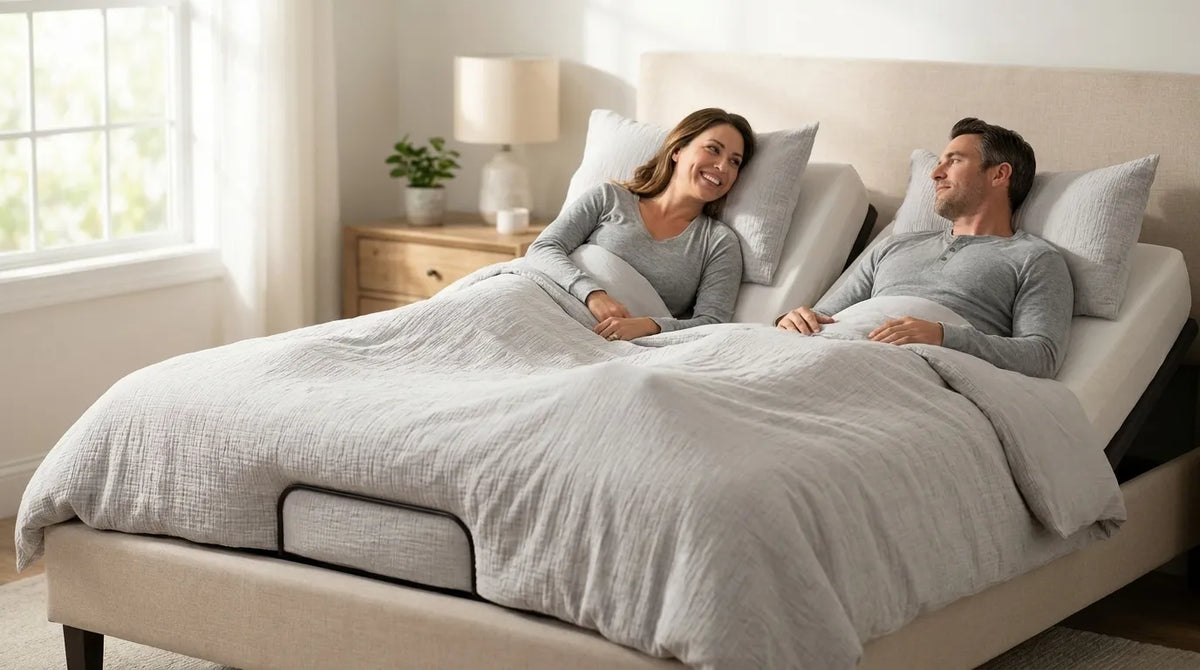
- Independent split-side adjustable beds let one partner use elevation while the other sleeps flat, preserving shared sleep without compromise.
- Complete adjustable bed packages pair a base, a compatible mattress, and bedding designed to hold the elevated position all night.
How Flat Sleeping Worsens Sleep Apnea
In supine sleep, gravity promotes posterior displacement of the tongue and soft palate, altering airway geometry and pressure inside the velopharynx, the narrowest region of the upper airway, which increases collapsibility and drives positional obstructive sleep apnea. Supine posture also reduces lung volumes such as functional residual capacity, which decreases caudal tracheal traction on the upper airway and makes collapse more likely.
Upper airway collapsibility, measured as pharyngeal critical closing pressure, decreases by approximately 1.8–2.5 cmH₂O in the lateral position compared with the supine position, a direct measure of how much more collapsible the airway becomes when sleeping flat on the back. Elevating the head and torso uses gravity in the opposite direction. The tongue and soft palate shift slightly forward rather than falling straight back, the cross-sectional area of the upper airway increases, and the diaphragm moves more freely.
A 2026 study of 12,036 patients found that 66.3% had positional OSA, with supine AHI averaging 48.7 events per hour versus 20.9 events per hour non-supine, showing how strongly body position shapes breathing during sleep.
“Elevating the head gently opens the airway, which is why anti-snore positioning reduces snoring for many sleepers. The geometry of the position is doing the work, not the foam underneath.” — Marcus Webb, Head of Sleep Systems, Leva Sleep
Why An Inclined Position Beats Sleeping Flat
Inclined sleeping supports better breathing for most people with obstructive sleep apnea. A 2024 study of 45 OSA patients found that 30 degrees of head-of-bed elevation reduced mean apnea-hypopnea index from 23 to 14 events per hour, with significant reductions in velar and oropharyngeal airway collapses. Elevating the head and torso keeps the airway open by preventing the tongue and soft palate from collapsing backward under gravity.
The most effective position uses a gentle, full-length incline from the hips upward. A wedge should be long enough to support from the hips up to avoid a sharp bend at the midsection that strains the lower back. An adjustable base achieves this naturally. The head section rises as a continuous slope from the hips, keeping the spine in alignment. A sharp waist bend compresses the abdomen, can worsen reflux, and does not provide the airway benefit of a true torso incline.
Recommended Head-Of-Bed Height For Sleep Apnea
Sleep specialists generally recommend head-of-bed elevation between 7.5 and 30 degrees, with 10–15 degrees (4–6 inches) as a practical starting point and 30 degrees producing greater reductions in AHI. This range provides a useful guide, and individual comfort and clinician advice still matter. Evidence does not show a simple rule where a steeper angle always works better, and very steep positions can increase sliding, discomfort, or pressure.
A gradual incline from the hips works better than a sharp bend at the waist. Stacking pillows under the head alone does not create this shape. Stacking pillows lifts the head while the shoulders stay flat, bending the neck forward and compressing the throat, which can worsen snoring. An adjustable base raises the entire head section as a single plane, keeping the neck in a neutral position relative to the torso.
Choosing Pillow Height With Sleep Apnea
A very high pillow pushes the head forward, flexes the neck, and narrows the airway at the throat. On an inclined surface, a thin soft pillow or no extra pillow usually works better than stacking a thick pillow, which pushes the chin toward the chest and strains muscles at the base of the skull; the head should feel like a natural extension of the spine.
A modest pillow combined with an elevated head section works better for most sleepers. For back sleepers, the elevated base handles the positional change and the pillow simply supports the natural cervical curve. For side sleepers, a pillow that keeps the head and neck in neutral alignment with the spine is generally best for sleep apnea. It should fill the gap between the shoulder and the ear without pushing the chin toward the chest. A small polysomnography study found that flexing the head more than 15 degrees while supine was associated with a higher AHI, which reinforces how much neck position matters alongside torso angle.
Best Mattress Types For Adjustable Bases And Sleep Apnea
Pillow choice is only half the equation. The base and the mattress underneath it determine whether that neutral neck position holds all night. Most mattresses are not built to bend. A mattress that resists articulation will fight the base, wear unevenly at the flex points, and reduce the effective elevation the base can achieve. The table below compares the three main mattress types on how well each bends on an adjustable base, along with pressure relief and durability under repeated articulation.
| Mattress Type | Bending With An Adjustable Base | Pressure Relief | Durability Under Articulation |
|---|---|---|---|
| Hybrid (Pocket Coil + Foam) | Bends well when individually wrapped coils are used; coils flex independently rather than as a connected unit | Good; foam comfort layers cushion pressure points while coils support spinal alignment | Strong when coils are individually wrapped. Bonnell (connected) coil hybrids resist bending on adjustable bases and can develop a permanent crease, sagging, or damage to the wire framework at flex points over repeated flexing. |
| Memory Foam (All-Foam) | All-foam memory foam mattresses generally bend readily on an adjustable base because there is no rigid internal structure like coils to resist articulation. Very thick models (over 14 inches) or low-density foams may flex less easily or degrade at bend points. | Excellent; conforms closely to body contours and distributes weight evenly | Good; no coil connections to fatigue, though lower-density foams may compress unevenly over time |
| Latex (Natural Or Synthetic) | Latex mattresses bend adequately in thinner profiles. Thicker or denser latex layers can resist articulation and may crack at repeated flex points. A single molded latex core 12 or more inches thick can resist bending at the hinge point with enough force to stress the motor. Mattresses above 14 inches total height risk exceeding the base's weight rating. | Good; resilient and responsive, with less contouring than memory foam | Moderate; natural latex is durable but thick slabs are less suited to frequent articulation than foam or individually wrapped coil hybrids |
Leva Sleep manufactures its own mattresses, the Heavenly Hybrid (pocket coil) and Heavenly Response (all-foam), in the sizes its bases require, including the 30″ × 80″ dimensions a true Split Queen demands. Both are built to flex with the base night after night and to maintain the elevation the base sets.
How Elevation Fits With Or Without CPAP
For mild positional OSA, elevating the head and avoiding back-sleeping can reduce snoring and apneas for some people. A 2026 MedComm review reports that positional therapy improves AHI versus no treatment and is often better tolerated than CPAP, but that CPAP remains superior for overall physiologic control. For diagnosed moderate-to-severe OSA, PAP therapy remains the clinical standard, with CPAP or auto-PAP as first-line therapy. An adjustable bed works as a complement to prescribed treatment.
Positioning can reduce snoring, but it cannot replace prescribed therapy for moderate to severe obstructive sleep apnea. Elevation alone is not sufficient; CPAP therapy remains the standard treatment, and elevation works better as a supplement. Anyone with suspected or diagnosed sleep apnea should consult a clinician before changing or discontinuing prescribed therapy.
Explore Leva Sleep's snoring relief collection for adjustable sleep systems designed to support an elevated sleep position alongside any prescribed treatment plan.
How The 3% Rule Affects Sleep Apnea Diagnosis
The 3% rule is a clinical scoring criterion used in sleep studies, not a treatment. The American Academy of Sleep Medicine updated its scoring manual in February 2023 to make the 3% rule the recommended standard for hypopnea scoring: a hypopnea is counted when airflow drops by at least 30% for at least 10 seconds and is accompanied by either a ≥3% blood-oxygen desaturation or an EEG arousal. This threshold determines whether a breathing event counts toward the Apnea–Hypopnea Index (AHI) used to diagnose and classify OSA severity.
The AASM released Version 3 of its Scoring Manual in 2023 and required accredited sleep facilities to implement the new rules by December 31, 2023, while retaining hypopnea scoring based on ≥3% desaturation and/or arousal as the recommended definition and ≥4% desaturation as an optional alternative. The practical consequence is that the 3% rule captures more events, particularly in women and in milder disease, than the older 4% threshold. This shift can move a patient from “no OSA” to “mild or moderate OSA” and affect treatment eligibility. A clinician should interpret any sleep study result.
How The “Japanese Trick” Relates To Positional Therapy
The term “Japanese trick for sleep apnea” circulates widely online and usually refers to home remedies such as side-sleeping aids and inclined sleeping that claim to reduce snoring or apnea events without a CPAP device. No single clinical protocol carries this name, and no peer-reviewed evidence establishes it as a proven treatment for OSA.
The underlying idea, keeping the airway open by changing body position, matches the principle behind positional therapy and adjustable bed elevation. Positional therapy is best suited to clearly positional, mild-to-moderate OSA and should be viewed as an adjunctive strategy rather than a universal replacement for PAP. An adjustable base applies that same principle in a stable, repeatable way: the head section rises to a consistent angle every night and holds it until morning. For anyone whose clinician has recommended positional changes, an adjustable base provides a reliable way to follow that advice at home.
Split Adjustable Beds For Couples Managing Sleep Apnea
One partner's snoring often becomes the other partner's sleep loss, and a standard adjustable bed forces both people into the same position. A 2025 survey of 2,007 US adults conducted by Atomik Research for the American Academy of Sleep Medicine found that 31% of American adults have opted for a “sleep divorce,” regularly sleeping in a separate room from their partner, with the figure rising to 39% among adults aged 35–44, a group that often manages sleep apnea.
A split configuration addresses this directly. In a Split Queen or Split King adjustable bed, each side has its own independent base with separate head and foot articulation. The partner who needs elevation can use it while the other sleeps flat. Each side can also carry a different mattress firmness so neither person accepts a compromise.

Bedroom size often decides which split configuration works. A Split King occupies roughly 76 inches of width, while a Split Queen occupies 60 inches. That 16-inch difference determines whether the configuration fits the room and whether a couple can keep a shared bed.
Leva Sleep offers one of the largest selections of Split Queen adjustable beds in North America, with five distinct packages from $1,399, 30″ × 80″ mattresses manufactured in-house, and a full line of Split Queen bedding engineered to stay in place at full elevation. Browse the full Split Queen collection to find the right configuration for both partners.
Key Adjustable Bed Features For Sleep Apnea Relief
Leva Sleep is a specialist adjustable bed company offering complete, personalized sleep systems for couples. Nine years in, with more than 25,000 customers served, Leva has built and delivered enough adjustable sleep systems to identify common failure points and design around them.
Four base features do most of the work for sleep apnea relief. The table below shows what each one does and why it matters, so you can see which features are essential and which are nice-to-have when comparing models.
| Feature | What It Does | Why It Matters For Sleep Apnea |
|---|---|---|
| Head Elevation | Raises the head section to a set angle, creating a full-length torso incline from the hips | A 30-degree elevation reduced mean AHI from 23 to 14 events per hour in a 2024 study of 45 OSA patients. The same 30-degree elevation that reduced AHI in that study is what this feature delivers consistently, night after night. |
| Gradual Incline (Full-Length) | Raises the entire upper body as a single slope rather than hinging sharply at the waist | A sharp bend at the midsection strains the lower back and does not produce the airway benefit of a true torso incline. A gradual slope preserves spinal alignment. |
| Independent Split Sides | Each side of the bed articulates separately, with its own motor and controls | The partner who needs elevation gets it without forcing the other into the same position. That 31% sleep divorce figure is exactly what independent split sides are designed to prevent. |
| Anti-Snore Preset | A saved position that gently elevates the head section to a clinically informed angle at the touch of a button | Removes the need to manually adjust the base at 2 a.m. Whisper-quiet German motors mean the adjustment does not wake the partner on the other side. |
Beyond the base itself, a complete Leva sleep system includes:
- Mattresses engineered to bend with the base, so they articulate smoothly and wear evenly at flex points
- Bedding designed for movement, including extra-elastic fitted sheets, duvet clips, and remote pockets that keep the system working at full elevation
- In-house white-glove delivery and setup, including old-bed removal and a walkthrough for both partners
- A 180-night comfort guarantee, giving you time to adapt before deciding whether the elevated position is working
- Complete adjustable bed packages from $1,299, with financing including 0% APR options
- Fifteen to twenty adjustable base models, compared with three to five at a typical mattress retailer
For couples managing pain alongside sleep apnea, the pain relief collection covers adjustable sleep systems designed to reduce pressure on the hips, shoulders, and lower back while maintaining the elevated position the airway needs.
Conclusion: Putting An Elevated Sleep System Together
The decision framework stays simple. Start by identifying whether the problem is positional, meaning snoring or apnea events worsen when sleeping flat on the back. If the problem is positional, an adjustable base becomes the key intervention because it is the only way to achieve a consistent, stable, full-length torso incline night after night.
The base only works well when the mattress on top can bend. A mattress engineered to flex with the base maintains the angle and avoids fighting the motor or wearing out at the hinge points. Once base and mattress are matched, confirm the configuration fits the bedroom and both partners. A Split Queen at 60 inches wide fits where a Split King at 76 inches does not, and independent sides mean neither partner has to share the other's position.
Anyone with diagnosed or suspected sleep apnea should consult a clinician for evaluation and treatment decisions. PAP therapy remains first-line for moderate-to-severe OSA, and an adjustable bed functions as a complement to prescribed treatment. For mild positional OSA, or as an adjunct to CPAP, a well-configured elevated sleep position offers a practical nightly intervention that a specialist adjustable bed makes realistic at home.
Leva Sleep is a specialist adjustable bed company serving the United States, with a luxury showroom in La Jolla, California, where both partners can lie down, experience the elevated position, and work with a specialist to find the right configuration.
Frequently Asked Questions
Does An Adjustable Bed Actually Help With Sleep Apnea?
An adjustable base helps by creating a stable, consistent head-of-bed elevation that keeps the airway more open during sleep. When the head and torso are elevated, gravity holds the tongue and soft palate slightly forward rather than letting them collapse into the back of the throat, which is the mechanical cause of most obstructive snoring and apnea events. Clinical studies have tested elevations from 7.5 to 30 degrees and found meaningful reductions in apnea-hypopnea index at multiple angles.
The advantage of an adjustable base over a wedge pillow or bed risers is consistency. The angle stays the same every night, the entire torso rises as a single slope rather than hinging at the waist, and the knee section can rise slightly to prevent sliding. For diagnosed moderate-to-severe OSA, an adjustable base works as a complement to PAP therapy. For mild positional OSA, it may serve as a primary positional strategy when discussed with a clinician.
What Is The Difference Between A Split Queen And A Split King Adjustable Bed?
A Split King uses two Twin XL mattresses (each 38″ × 80″) placed side by side on two independent bases, forming a 76-inch-wide footprint. A Split Queen uses two 30″ × 80″ mattresses on two independent bases, forming a 60-inch-wide footprint. Both configurations give each partner fully independent head and foot articulation, separate firmness choices, and individual controls.
The 16-inch width difference creates the practical distinction. A Split Queen fits in bedrooms where a Split King does not, which matters in condos, older homes, and any room where a King-size footprint feels too wide. The challenge is that 30″ × 80″ mattresses are not a standard supply-chain size and must be purpose-built, which is why most retailers cannot offer a true Split Queen. Leva Sleep manufactures its own 30″ × 80″ mattresses in two constructions and two firmness levels and offers five Split Queen packages from $1,399.
Can I Use My Current Mattress On An Adjustable Base?
Some existing mattresses work on adjustable bases, and many do not. A standard innerspring mattress with a connected coil system will resist articulation, create pressure at the flex points, and wear unevenly over time. Memory foam and individually wrapped pocket coil hybrids bend more readily, but even these vary significantly by construction and density.
The safest approach is a mattress specifically engineered to flex with an adjustable base, where the foam layers and any coil system are designed for repeated articulation rather than a flat surface. Using an incompatible mattress on an adjustable base can also void the mattress warranty. If keeping an existing mattress, confirm with the manufacturer that it is rated for adjustable base use before purchasing a base separately.
How Long Does It Take To Adjust To Sleeping Elevated?
Most people need at least two full weeks before the incline stops feeling noticeable, and some take longer, particularly if they have been back-sleeping on a flat surface for years. The body adapts to a new sleep geometry gradually. Muscle tension in the lower back and hips shifts, the neck finds a new neutral position, and the nervous system stops registering the incline as unusual.
This is why Leva Sleep offers a 180-night comfort guarantee, giving you time to adapt before deciding whether the elevated position is working. Deciding in the first week whether an elevated position helps comes too early, both for comfort adaptation and for assessing any effect on snoring or apnea. Anyone using an elevated position as part of a clinician-recommended plan should schedule follow-up sleep testing to assess whether the position controls OSA, rather than relying on symptoms alone.
What Should Couples Look For When Buying A Bed For Sleep Apnea?
Couples evaluating a bed for sleep apnea relief should assess five things. First, independent articulation, so each side has its own head and foot elevation controls and the partner who needs elevation does not force the other into the same position. Second, a gradual full-length incline, where the head section rises from the hips as a single slope rather than hinging sharply at the waist.
Third, quiet motors, because adjusting the bed at 2 a.m. should not wake the other partner and whisper-quiet motors become a practical necessity in a shared bed. Fourth, a mattress engineered to flex, so the mattress bends with the base without resisting articulation or wearing unevenly at the flex points. Fifth, bedding designed for movement, since standard fitted sheets tend to pop off an articulated base and sheets with extra elastic and deep pockets keep the system working at full elevation.
A specialist adjustable bed company that carries 15 or more base models, manufactures its own compatible mattresses, and delivers with trained in-house teams is better positioned to meet all five criteria than a generalist retailer treating the base as an add-on.