
Adjustable Bed for Snoring and Acid Reflux: The Evidence
Written by: Matthew Timmins, Founder and Managing Director, Leva Sleep
How An Adjustable Bed Helps With Acid Reflux And Snoring
An adjustable bed helps with acid reflux by elevating the entire torso from the waist up. Gravity then helps keep stomach acid from traveling into the esophagus during sleep. A doctor-reviewed guide by Yoshinori Abe, MD (reviewed 07/09/2026) recommends 6–8 inches (15–20 cm) of upper-body elevation for nighttime reflux relief. For snoring, a review of clinical studies at CantSleep.org identifies 7.5–30 degrees of head elevation as the range at which airway cross-section increases and snoring is reduced.
The clinically studied elevation targets for each condition differ:
- Acid Reflux: 6–8 inches of head-of-bed elevation, torso from the waist up (Ubie Health, medically reviewed by Yoshinori Abe, MD, 07/09/2026).
- Snoring: 7.5–30 degrees of head elevation to help open the airway (CantSleep.org review of clinical studies).
An adjustable bed lets you reach those positions at home and hold them through the night without stacking pillows.
Key Takeaways For Sleepers With Snoring Or Reflux
- An adjustable bed helps both snoring and acid reflux by elevating the upper body so gravity keeps airways open and stomach acid below the esophagus.
- Clinically studied elevation targets differ: the 6–8 inch torso elevation range for reflux and the 7.5–30 degree head elevation range for snoring.
- A flat bed cannot create those specific angles consistently, and stacked pillows shift during the night.
- Adjustable beds outperform bed risers and wedge pillows by offering precise angle control, night-to-night adjustability, and independent sides for couples.
- Leva Sleep offers adjustable beds with split configurations engineered for snoring and acid reflux relief, with independent positioning and quiet motors.
The Snoring Mechanism
The throat functions as a soft, collapsible tube. During waking hours, the muscles of the tongue, palate, and pharynx hold it open. During sleep, those muscles relax. In a horizontal position, gravity pulls the tongue and soft palate backward toward the posterior pharyngeal wall. The airway narrows and the vibration that causes snoring begins.
In back sleepers, this effect is strongest. Roughly two-thirds of people who snore do so primarily or exclusively while sleeping on their backs, a pattern formally known as positional obstructive sleep apnea. Elevating the head gently opens the airway, which is why anti-snore positioning reduces snoring for many sleepers.
The Acid Reflux Mechanism
Acid reflux during sleep stems from gravity acting on stomach contents rather than from airway collapse. When the torso lies flat, the lower esophageal sphincter (LES) loses gravitational assistance that normally helps keep stomach contents down. During sleep, three protective mechanisms against reflux are simultaneously suppressed: gravity (when lying flat), swallowing frequency (which falls by 80% during NREM sleep), and saliva production. These changes make nocturnal reflux more erosive than daytime reflux.
Clinicians commonly recommend sleeping with the head elevated for conditions including sleep apnea, acid reflux, and post-surgical recovery. An adjustable base provides that position at home in a repeatable way.
The disruption these conditions cause to couples reaches beyond physical symptoms. A June 2025 survey of 2,007 US adults conducted by Atomik Research for the American Academy of Sleep Medicine found that 31% of American adults had opted for a “sleep divorce” by regularly sleeping in a separate room from their partner. Among adults aged 35–44, the figure rises to 39%.
What Angle To Use For Snoring And Acid Reflux
The clinical evidence points to different elevation targets for reflux and snoring. Knowing how and why they differ helps you choose a starting angle that matches your main symptom.
For acid reflux: Doctor-reviewed guidance from Yoshinori Abe, MD (07/09/2026) specifies 6–8 inches (15–20 cm) of elevation, measured at the head end, lifting the torso from the waist up. A 2020 systematic review and meta-analysis by Khan and Singh in Gastroenterology Report (8(3):196–205) confirmed that head-of-bed elevation reduces esophageal acid exposure in GERD patients. Research on sleeping position and head-of-bed elevation has generally found benefit for reflux symptoms. A 2011 Lancet meta-analysis found that sleeping with the head of bed raised 6–8 inches reduces nighttime reflux events by 67%.
For snoring: Sleep specialists recommend elevation between 7.5 and 30 degrees as a first-line lifestyle intervention for positional snoring or mild airway obstruction. A 2022 study tracked 25 snorers over more than 1,000 nights and found that sleeping at a 12-degree incline reduced snoring duration by 7%, reduced nighttime awakenings by 4%, and increased deep sleep by 5%. A 2024 study of 45 patients with obstructive sleep apnea sleeping at 30 degrees found the mean apnea-hypopnea index improved from 23 to 14 events per hour.
Why the angles may differ: Reflux elevation restores gravity’s role in keeping stomach contents below the esophageal junction, so a modest incline often works. Snoring elevation changes airway geometry to prevent soft-tissue collapse, and benefit tends to increase with angle up to about 30 degrees. For someone managing both conditions, the right angle is the one that calms the primary symptom without creating a new problem. Above 10 inches, elevation becomes effective for reflux but causes a sliding sensation and lower back pressure that disrupts sleep for many people. An adjustable bed lets you dial in the angle precisely and change it as symptoms evolve.
Adjustable Bed vs Bed Risers vs Wedge Pillows: Practical Tradeoffs
Each option achieves elevation through a different mechanism and suits a different type of sleeper. The table below shows the trade-off at a glance: risers and wedges can reproduce the right incline for one sleeper, but only an adjustable base lets two people set different angles on the same bed.
| Option | Angle Adjustable? | Supports Full Torso? | Works Independently for Two People? |
|---|---|---|---|
| Bed risers | Limited, typically adding 3–8 inches; some are fixed at purchase height, while many are adjustable or stackable | Yes, tilts entire sleeping surface (straight-incline geometry used in reflux research) | No, both partners share the same incline |
| Wedge pillow | No, fixed foam angle | Only if at least 24 inches long (shorter wedges support only the head and neck, not the torso) | Partially, one partner can use one without affecting the other |
| Adjustable bed base | Yes, precise, night-to-night control | Yes, when used in zero-gravity or head-elevated position (head-only elevation without knee raise can fold the body at the waist and increase abdominal pressure) | Yes, with a split configuration, each side is fully independent |
Who should start with the cheaper option: Bed risers reproduce the straight-incline geometry used in reflux research for under $20 and work as a reasonable first test for a single sleeper with reflux. CantSleep.org recommends testing elevation with a 10–15 degree incline using bed risers or a wedge pillow for at least two weeks before committing to a larger investment. A wedge pillow offers a viable middle option if sized correctly, at least 24 inches long to support the full torso, with a firm foam core that does not compress under body weight.
Where an adjustable bed wins: An adjustable base wins on control. The angle can be changed in real time and adjusted night to night as symptoms change. For couples, each side moves independently. Because the base can raise the knees along with the head, it supports the whole torso without folding the body at the waist, which helps avoid the abdominal-pressure problem that head-only elevation can create.
The Solution: How Leva Sleep Addresses Dual Symptoms
If the comparison above points you toward an adjustable base, the next question is which one. Leva Sleep is a specialist adjustable bed company that focuses on complete adjustable sleep systems. Every feature in a Leva system exists to answer a specific geometry problem, and snoring and acid reflux both come down to geometry.
- Anti-Snore Positioning that gently elevates the head to help open the airway
- Lumbar Control And Pillow Tilt for micro-geometry, with independent support of the lower back curve and the pillow angle beyond simple head-up and foot-up movement
- Whisper-Quiet German Motors so position changes do not wake a partner
- Mattresses Engineered To Flex with the base, plus bedding designed for movement, including extra-elastic fitted sheets, duvet clips, and remote pockets
- Split Queen And Split King Configurations with fully independent sides so each partner sets their own angle
- Per-Side Heating And Cooling to address temperature differences between partners
Leva Sleep offers the largest selection of Split Queen adjustable beds in North America. Five packages start at $1,399. Each uses a 30″ × 80″ mattress Leva manufactures in-house and a full line of Split Queen bedding. Complete adjustable bed packages span $1,299 to $8,999+, backed by a comfort guarantee that Leva’s policy states as 180 nights, while the US store currently displays a 60-night guarantee, and financing options including 0% APR. Over nine years and more than 25,000 customers, Leva has built and delivered adjustable sleep systems long enough to see what fails and to engineer around those failure points.
Browse Leva Sleep’s Split Queen collection and see which package fits your room and budget.
Split Configurations For Couples With Different Needs
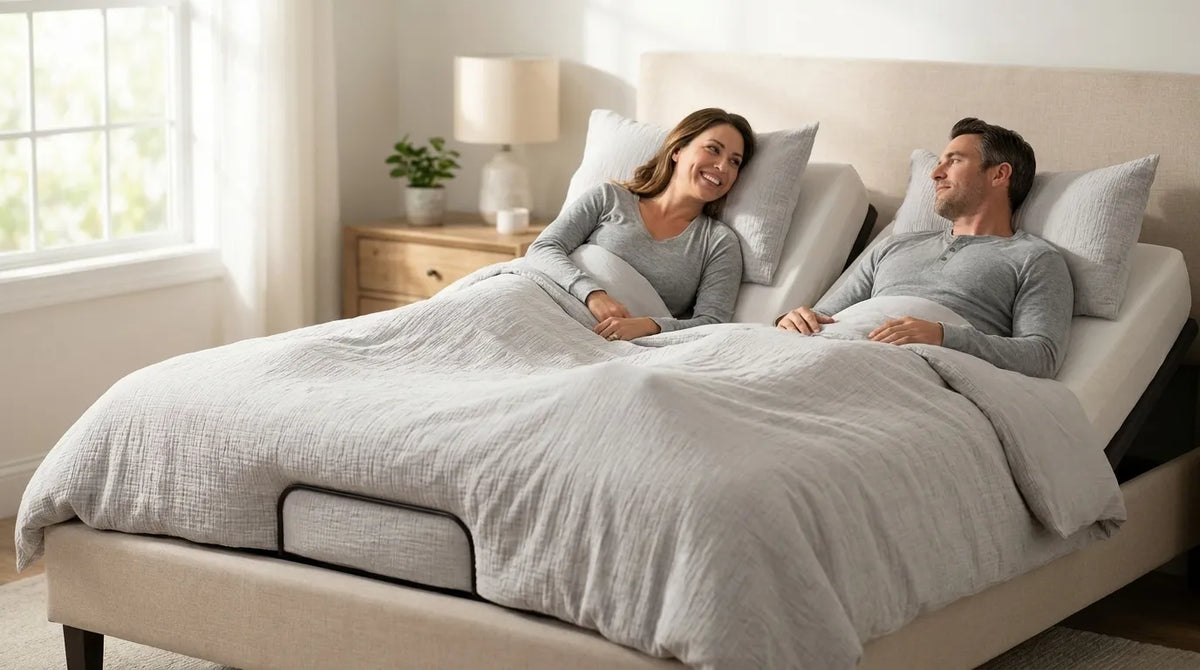
A split adjustable bed for snoring and acid reflux lets each side of the bed set its own angle independently. The partner without symptoms can stay flat. The partner with reflux or snoring can use the clinically studied incline. Both people keep their preferred geometry.
A Leva Sleep Split Queen consists of two fully independent bases, each with head and foot articulation, fitted with two 30″ × 80″ mattresses that Leva manufactures in-house. This configuration differs from a “split-head queen,” which uses a single mattress with only the head section split. That split-head style exists as a minor SKU and does not represent the default Split Queen configuration.

A Split Queen occupies 60 inches of width. A Split King occupies 76 inches. That 16-inch difference often determines whether the configuration fits the room. It is also the reason couples in condos, older homes, and downsized spaces frequently hear “no” from other retailers. Leva designs systems that fit those spaces.
For couples where snoring is the primary concern, the snoring relief collection provides a direct path to the right configuration. For those managing pain alongside reflux or snoring, the pain relief collection addresses both needs in one system.
Model-Selection Framework For Snoring And Reflux
When you evaluate an adjustable bed for snoring and reflux, focus on features that directly affect positioning and comfort. Start with the features that address the conditions, then look at the ones that make the bed livable for a couple.
- Independent Head And Foot Adjustment so you can use zero-gravity, raising head and knees together to avoid folding the body at the waist and increasing abdominal pressure
- A Dedicated Anti-Snore Preset that stores a gentle head elevation and removes the need to fine-tune the angle every night
- Lumbar Control with a dedicated motor supporting the lower back curve, separate from the main head section
- Pillow Tilt with an additional motor angling the head and pillow section independently, useful for stomach sleepers and airway positioning
- Quiet Motors so adjustments do not wake a partner in a shared bed
- Mattress Compatibility because most standard mattresses resist articulation, and a mattress engineered to flex with the base protects both comfort and lifespan
Leva Sleep offers 15–20 adjustable base models compared with the 3–5 typically found at a standard mattress retailer. Complete packages run from $1,299 to $8,999+. Leva carries Aireloom, Tempur-Pedic, Stearns & Foster, Beautyrest, Serta, Kingsdown, and Helix, pairing each mattress with the right base through specialists who understand how each mattress should sit. Many customers arrive after a doctor or physiotherapist recommends an elevated sleeping position. Leva’s stated comfort guarantee is 180 nights, while the US store currently displays a 60-night guarantee, and 0% APR financing options spread the cost over time.
When An Adjustable Bed Is Not Enough
Positional snoring, which worsens on the back and improves on the side, differs clinically from obstructive sleep apnea (OSA). Sleeping elevated works especially well for positional snoring and snoring linked to acid reflux, but it does not replace CPAP therapy in moderate to severe sleep apnea cases.
An adjustable bed does not treat sleep apnea. A clinician should evaluate persistent snoring, witnessed apneas, waking with gasping or choking, or uncontrolled reflux. The American Academy of Sleep Medicine maintains clinical practice guidelines for the diagnosis and treatment of OSA, including diagnostic testing pathways and positive airway pressure therapy as first-line treatment for confirmed moderate-to-severe disease.
Similarly, acid reflux that occurs more than twice per week or appears with difficulty swallowing, unexplained weight loss, persistent vomiting, or chest pain requires medical evaluation. Untreated ongoing nighttime reflux can lead to esophagitis, strictures, Barrett’s esophagus, and in rare cases increased risk of esophageal cancer.
Stomach Sleepers With Reflux: How To Navigate The Tradeoff
Stomach sleeping often works well for snoring. The head turns to one side, gravity pulls soft tissue forward rather than backward, and the airway stays open. One study measured airway obstruction scores of 38 (back), 16 (side), and just 6 (stomach), suggesting prone sleeping virtually eliminates positional airway obstruction regardless of severity. Many people, however, find that stomach sleeping worsens acid reflux because the stomach presses against the mattress while the torso stays flat.
A stomach sleeper who needs reflux elevation faces a real conflict. The options worth evaluating are:
- A flat-tilt configuration using a very gentle whole-bed incline of about 4–6 inches that does not force a specific sleeping position but still offers some gravitational assistance against reflux
- A pillow-tilt or split-head configuration that angles the head section independently while the rest of the base stays flat, useful for testing whether a modest head angle feels tolerable in a prone or semi-prone position
- A position strategy that uses left-side sleeping as a transition, because left-side sleeping reduces esophageal acid exposure compared with the right side, as the stomach sits lower than the esophagus in that position
The right answer depends on whether snoring or reflux feels more urgent and on whether the stomach-sleeping habit reflects preference or anatomy. An adjustable bed with pillow tilt and lumbar control allows micro-adjustments that a flat mattress or a fixed wedge cannot match. For some stomach sleepers, a very gentle incline feels acceptable. For others, position strategy matters more than angle. A generous trial period gives space to test these options honestly.
Frequently Asked Questions
How Long Before Elevation Helps Acid Reflux?
Most people who respond to elevation notice some change within the first few nights. The clinically studied target remains the same elevation range described earlier. An adjustable base holds that position reliably and lets you fine-tune the angle over time. It functions as a comfort product rather than a medical device and does not cure GERD. Reflux that occurs more than twice per week or appears with difficulty swallowing, chest pain, or unexplained weight loss still requires medical evaluation.
Do Adjustable Beds Actually Help With Snoring?
For positional snoring, which worsens on the back, elevating the head between 7.5 and 30 degrees increases the cross-sectional area of the upper airway and reduces the gravitational pull that causes soft tissue to collapse into the throat. Clinical studies have found meaningful reductions in snoring duration and airway obstruction scores at inclines within this range. An adjustable bed offers a reliable way to maintain that position through the night because it elevates the entire upper body rather than just the head. It does not replace CPAP therapy in moderate to severe obstructive sleep apnea, and persistent snoring with witnessed apneas, gasping, or daytime sleepiness should be evaluated by a clinician.
How Are Snoring And Acid Reflux Connected?
The two conditions share a common aggravating factor, a horizontal sleeping position, but their mechanisms differ. Snoring arises from soft-tissue collapse into the airway when throat muscles relax during sleep. Acid reflux arises from the loss of gravitational assistance that normally keeps stomach contents below the esophageal junction. Obstructive sleep apnea and GERD can interact. Repeated apneas generate strong negative pressure in the chest that can pull stomach acid upward, and acid reaching the upper airway inflames tissue around the soft palate, which can worsen airway obstruction. Treating one condition often improves the other, yet each still requires its own evaluation.
Is It Better To Sleep Flat Or Inclined With Sleep Apnea?
For positional obstructive sleep apnea, defined as an apnea-hypopnea index at least twice as high when sleeping on the back versus non-supine positions, an inclined or side-sleeping position can reduce airway obstruction events. Approximately 50–60% of OSA patients have this positional pattern. For non-positional or severe OSA, elevation alone does not provide adequate treatment, and CPAP remains the first-line therapy recommended by the American Academy of Sleep Medicine. An adjustable bed acts as a positioning tool that may complement clinical treatment for patients whose clinician has recommended elevated sleeping. Anyone with suspected sleep apnea should undergo diagnostic testing rather than relying on positional changes alone.
What Angle Should I Sleep At For Acid Reflux?
The most studied and clinically recommended range for nighttime acid reflux uses the same 6–8 inch head-of-bed elevation described earlier, measured at the head end and lifting the torso from the waist up. This range corresponds roughly to a 15–20 degree incline on a standard adjustable base or wedge. Below about 6 inches, the gravitational effect on reflux remains small. Above roughly 10 inches, many people experience a sliding sensation and lower back pressure that disrupts sleep. The elevation must raise the entire torso rather than only the head and neck, because stacking pillows under the head bends the neck forward and increases abdominal pressure, which can worsen reflux.
Are Adjustable Beds Worth It For Snoring?
For someone whose snoring clearly follows a positional pattern, worse on the back and better on the side or at an incline, an adjustable bed provides the most comfortable way to maintain therapeutic elevation through the night. Bed risers and wedge pillows offer lower-cost alternatives worth testing first. If a two-week trial with bed risers or a wedge pillow produces meaningful improvement, an adjustable bed delivers the same benefit with precise angle control, night-to-night adjustability, and, in a split configuration, independent settings for each partner. If snoring shows no improvement with elevation, the cause may not be positional, and clinical evaluation becomes the next step.
Can I Use My Current Mattress On An Adjustable Base?
Some mattresses work with adjustable bases, while many do not. Most standard mattresses, particularly those with innerspring systems or thick foam layers not designed to flex, resist articulation, wear unevenly under repeated bending, and shorten their own lifespan. The incline set on the base may not match the incline the body actually experiences if the mattress sags at the bend. A mattress engineered specifically to flex with an adjustable base offers a more reliable solution. Leva Sleep manufactures its own mattresses in both all-foam and pocket-coil hybrid constructions, in 30″ × 80″ for Split Queen configurations, designed to articulate repeatedly without degrading.
What If My Partner Does Not Want Elevation?
A split adjustable bed removes this conflict. In a Split Queen or Split King configuration, each side of the bed operates on a fully independent base with its own head and foot articulation. The partner who needs elevation for reflux or snoring sets their angle. The partner who prefers a flat surface stays flat. Each person keeps their own geometry. This specific problem drives the need for split configurations and explains why Leva Sleep’s Split Queen selection exists for couples in rooms where a King footprint does not fit.
Conclusion: Bringing Clinical Angles Into A Shared Bedroom
Snoring and acid reflux arise from different mechanisms, airway collapse and gravity-driven reflux, and a flat bed cannot address either one effectively. Clinical evidence points to specific elevation ranges for each condition, the 6–8 inch whole-torso elevation range for reflux and the 7.5–30 degree head elevation range for snoring. An adjustable bed brings those positions into the bedroom in a way a flat bed or stacked pillows cannot match.
For couples where only one partner needs elevation, a split configuration removes the compromise. Leva Sleep offers the same Split Queen packages, comfort guarantees, and financing terms described above, along with experience from more than nine years and over 25,000 customers. These systems exist for couples who refuse to accept poor sleep as a permanent condition.
Shop Leva Sleep adjustable beds online or visit the La Jolla showroom.


