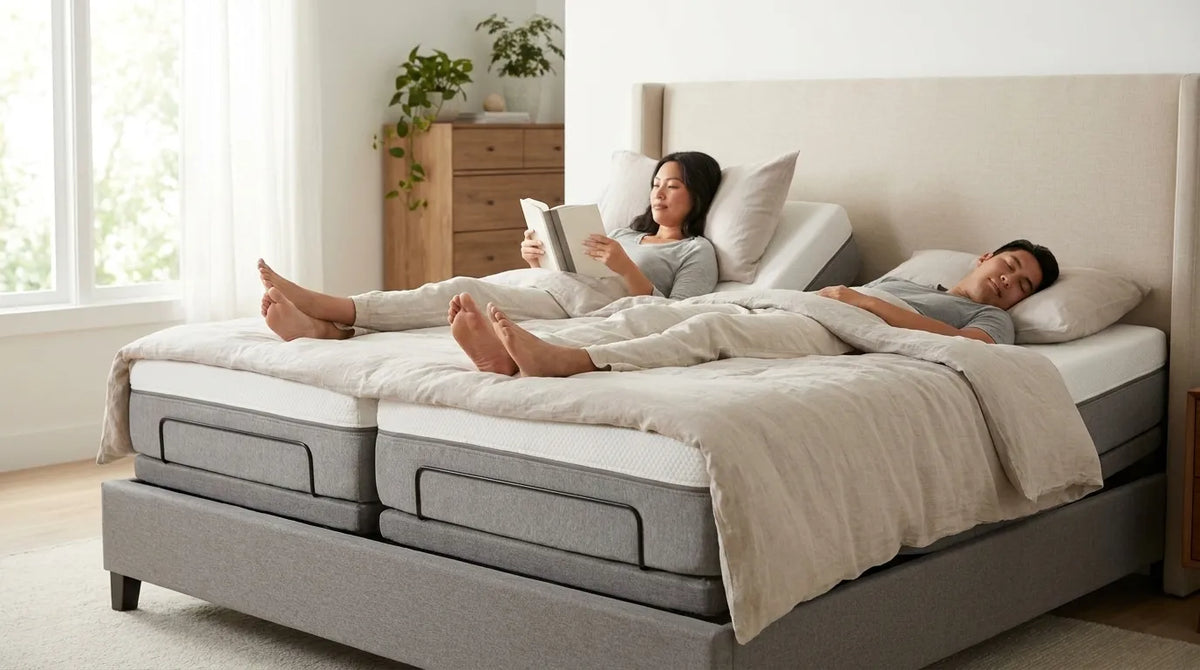
How To Set Up an Adjustable Bed for Acid Reflux
Written by: Matthew Timmins, Founder and Managing Director, Leva Sleep
Key Takeaways
- Elevating the entire torso 6–9 inches on an adjustable bed uses gravity to keep stomach acid below the esophagus, while stacked pillows compress and shift.
- Whole-torso incline from the hips is the configuration supported by clinical guidance and prevents waist folding and lower-back discomfort.
- Adding a slight knee elevation creates a cradle that stops the body from sliding down the incline during the night.
- Adjustable beds outperform wedge pillows, bed risers, and recliners for long-term nightly use because they allow fine-tuning without getting up and support shared sleeping.
- Leva Sleep offers complete adjustable-bed systems with independent head-and-foot control, lumbar support, and bedding engineered for elevation, and you can shop Leva Sleep today for reflux relief that lasts all night.
How Adjustable Beds Help With Acid Reflux
An adjustable bed for acid reflux elevates the head 6 to 9 inches and uses gravity to keep stomach contents down. Stacked pillows compress and bend the neck, while an adjustable base holds a consistent angle all night and lets you adjust it without getting up. Clinicians commonly recommend sleeping with the head elevated for conditions including acid reflux. An adjustable base is the practical way to maintain that position at home every night without building a tower of pillows.
How High To Elevate The Head Of The Bed For Acid Reflux
Two terms define the core choice in elevation setup:
- Head-only tilt: The head section of the bed rises while the rest of the body stays flat. This is the default setting on most adjustable bases and the most commonly misused one for reflux.
- Whole-torso incline: The entire upper body, from the hips upward, rises on a gentle, continuous slope. This is the configuration that clinical studies on reflux elevation actually test.
Mayo Clinic's head-of-bed elevation guidance refers to elevating the entire upper body or torso, for example via bed blocks or a wedge. It does not refer to head-only tilt from stacked pillows, which Mayo Clinic notes is ineffective. The commonly cited elevation range is roughly 4 to 6 inches, sometimes up to 9 inches. Clinical guidance consistently specifies that the torso must be elevated from the waist up. Propping only the head bends the neck forward and can increase abdominal pressure, which may worsen reflux rather than relieve it.
The waist-fold tradeoff is the most common setup error with adjustable beds. A steep head-only tilt creases the body at the waist, compresses the stomach, and creates new lower back discomfort. When the whole bed is angled, the body lies along a single gentle slope instead of bending at the waist. This reduces sliding and keeps spinal alignment more natural. The practical configuration uses a gentle incline that raises the torso from the hips instead of a steep angle that raises only the head.
If 8 inches feels too steep initially, start at 4 to 6 inches and increase gradually over one to two weeks. Some people find adequate relief at 6 inches, while others need the full 8.
Why You Slide Down The Bed At Night And How To Stop It
Even with the incline set correctly, many people wake up flat. Sliding down an inclined bed is the most common reason people abandon elevated sleeping. The mechanism is straightforward: gravity plus a steep incline plus slick bedding equals a slow, inevitable slide toward the foot of the bed. By 2 a.m., the carefully set incline is gone and so is the reflux relief.
Sliding down during the night is the single most common reason people give up on elevated sleeping. Practical fixes that work include:
- Add a slight knee elevation. Raising the foot section of the adjustable base a few degrees creates a gentle cradle. The body rests in a valley rather than on a slope. This configuration is the most effective anti-slide setup and the one most reflux sufferers never try.
- Use bedding engineered to hold at elevation. Standard fitted sheets pop off the moment a bed articulates. Extra-elastic fitted sheets with deep pockets, duvet clips, and high-friction fabrics stay in place at full incline.
- Set the lowest angle that still controls symptoms. A 20-degree incline produces less slip potential than steeper inclines such as a 35-degree incline. Slip risk increases with ramp angle, so the steeper the bed, the more you slide. If sliding persists, the incline may simply be too steep. Try reducing it before adding more friction.
- Wear high-friction sleepwear. Cotton pajamas grip a mattress surface far better than satin or synthetic fabrics.
The knee elevation fix also protects the lumbar spine. When sleeping on an incline without knee support, the legs pull the pelvis forward and flatten the lumbar spine. A slight knee raise lets back muscles relax and the spine settle into natural alignment.
Is Sleeping In A Recliner Good For Acid Reflux?
A recliner elevates the torso and can reduce nighttime reflux. The incline mechanism is the same as an adjustable bed, and a 2012 study found that 65% of people with nighttime acid reflux experienced fewer sleep disturbances after elevating their heads by about 8 inches, a position a recliner naturally provides. For short-term recovery or occasional use, a recliner is a legitimate option.
For long-term nightly use, the documented drawbacks are significant:
- Single-sleeper only. The confined space of a recliner makes sharing with a partner virtually impossible, unlike a bed.
- Hip flexor tightening. Keeping hips in a flexed position for hours night after night causes hip flexors to shorten. This leads to stiffness when standing and lower back discomfort over weeks or months.
- Circulation risk. Sleeping in a recliner can impair blood flow in the legs because the knees remain bent and motionless for hours. Over time this raises the risk of deep vein thrombosis.
- Lighter, more fragmented sleep. Sleep obtained in a recliner is typically lighter and more fragmented than sleep lying down, because the body must maintain muscle tension to keep the head and torso from slumping.
- Not a bedroom solution. A recliner in the living room does not replace a shared bed in a primary bedroom.
The recliner versus adjustable bed comparison for acid reflux comes down to the details. Both use the same gravity mechanism, but only the adjustable bed lets you add knee elevation to stop the slide. Only the adjustable bed lets a partner share the room on their own independent side.
How Bed Risers And Wedge Pillows Compare To Adjustable Beds
Bed risers and wedge pillows are legitimate starting points, and neither matches the flexibility of an adjustable bed. The table below shows why: every alternative either fixes the angle or leaves the torso flat, while only a whole-torso incline on an adjustable base does both.
| Approach | What It Does | What It Doesn't Solve | Who It Suits |
|---|---|---|---|
| Stacked pillows | Bends neck upward | Torso stays flat; pillows compress and shift; can increase abdominal pressure | Not recommended by clinicians for reflux |
| Wedge pillow | At a low incline, elevates the upper torso about 7–8 inches at roughly a 30-degree angle | Shifts during night; fixed angle; must be long enough to reach the hips | Budget trial; mild symptoms |
| Bed risers | Raises whole bed at a fixed angle using risers under the head-end legs | Fixed angle; not adjustable; can make bed unstable on hard floors | Renters; temporary solution |
| Head-only tilt | Raises head section of adjustable base | Folds waist; creates lower back discomfort; not the configuration used in reflux studies | Reading in bed; not overnight reflux |
| Whole-torso incline | Raises entire torso on a gentle slope from the hips up | Requires adjustable base; mattress must flex with the base | Reflux sufferers wanting consistent, adjustable relief |
| Recliner | Typically elevates the torso to a backrest angle of roughly 110°–130° from horizontal, with zero-gravity designs often targeting about 120°–128° | Single-sleeper; pressure on lower back and hips; not a long-term bed solution | Short-term recovery; not couples |
A wedge pillow is an inexpensive way to trial an incline. It should be 7 to 8 inches high with a gradual 30-degree incline, dense enough not to compress under body weight, and long enough to extend to the hips, not just the shoulder blades. Bed risers create a whole-bed incline inexpensively but at a fixed angle that cannot be adjusted during the night. An adjustable bed for acid reflux solves what neither alternative does: a consistent, adjustable angle that you can fine-tune without getting up, combined with knee elevation to stop the slide.
When An Adjustable Bed Is Not The First Step
An adjustable bed does not need to be the first step for everyone. Wedge pillows, bed risers, and lifestyle changes are legitimate starting points, and for some people, they are sufficient.
Lifestyle measures with consistent clinical backing include:
- Finishing the last meal at least 3 to 4 hours before bedtime. A matched case-control study found that individuals with less than 3 hours between dinner and bedtime had a 7.45-fold increased risk of GERD compared to those who waited 4 hours or more.
- Left-side sleeping, which reduces esophageal acid exposure by 2.03% compared with the right lateral position.
- Weight management, where relevant. Losing 5 to 10 lbs reduces nighttime reflux events by 30% in overweight adults.
- Avoiding known trigger foods in the evening.
- Speaking with a clinician before relying on any positioning approach for persistent symptoms.
An adjustable bed for acid reflux is a poor purchase for someone whose symptoms are fully controlled by a wedge and dietary changes, or for someone who has not yet spoken to a clinician about reflux occurring more than twice per week. Warning signs that warrant medical evaluation rather than bedroom rearrangement include nighttime symptoms more than twice per week, difficulty swallowing, unexplained weight loss, persistent vomiting, chest pain, chronic cough or hoarseness, and symptoms that repeatedly wake the sleeper.
What To Look For In An Adjustable Bed For Acid Reflux
The configuration matters more than the price tier. Features worth prioritizing include:
- Head and foot adjustment. Foot elevation is the slide-down fix for reflux sufferers. A base with independent head and foot control lets you create the cradle position that holds the incline all night.
- Whole-torso incline capability. The base should raise the head section gradually enough to incline the full torso. A gentle slope keeps the waist from folding sharply.
- Lumbar support. A dedicated lumbar motor supports the lower back curve independently of the head and foot sections. This feature matters for anyone who develops lower back discomfort from extended inclined sleeping. Explore adjustable beds designed for pain relief if back comfort is a priority alongside reflux management.
- Quiet motors. A base that wakes a partner every time it adjusts solves nothing. Whisper-quiet motors matter in a shared bed.
- Mattress compatibility. Most mattresses are not built to bend. They resist articulation and wear unevenly at the flex point. A mattress engineered to flex with the base is what makes the incline you set the incline you actually sleep on. Without it, the base angle and the sleeping angle are two different numbers.
- Bedding designed for movement. Standard fitted sheets pop off at elevation. Extra-elastic sheets with deep pockets, duvet clips, and remote pockets keep the system working all night.
Why Leva Sleep Is A Strong Adjustable Bed Choice For Acid Reflux
Leva Sleep is a specialist adjustable bed company serving the United States, with a luxury showroom in La Jolla, California. Over nine years and more than 25,000 customers, Leva has built complete adjustable sleep systems, including bases, mattresses engineered to flex, and bedding designed for movement. These systems are built for people who need elevation to work all night, not just at the moment they lie down.
Complete adjustable bed packages start at $1,299 and come with a 180-night comfort guarantee. That guarantee exists because adapting to a new sleep position takes weeks, not days. Leva prefers that a customer take the full six months rather than decide in the first week.
For reflux sufferers specifically, Leva's systems address each of the failure points described above:
- Independent head and foot articulation on each side, so the knee elevation that stops the slide is always available
- Lumbar control and pillow tilt for micro-geometry adjustments beyond basic head-up positioning
- Whisper-quiet German motors that adjust without waking a partner
- Mattresses manufactured to flex with the base, so the angle set is the angle achieved
- Bedding engineered for movement, including extra-elastic fitted sheets, duvet clips, and remote pockets, that holds at full elevation
For couples where only one partner has reflux, Leva offers independent split articulation. Each side controls its own elevation independently, and the partner without reflux keeps their side flat. Leva offers the largest selection of Split Queen adjustable beds in North America, with five packages from $1,399, 30″ × 80″ mattresses Leva manufactures itself, and a full line of Split Queen bedding. For couples in smaller bedrooms, a Split Queen occupies a 60″ footprint versus 76″ for a Split King, a difference that determines whether the room works at all.

Leva also carries Aireloom, Tempur-Pedic, Stearns & Foster, Beautyrest, Serta, Kingsdown, and Helix. Because each of those mattresses flexes differently, Leva pairs each one with the base it was built to sit on, the expertise a generalist retailer does not have.
In a June 2025 survey of 2,007 US adults conducted by Atomik Research for the American Academy of Sleep Medicine, 31% of American adults reported opting for a "sleep divorce". That term refers to regularly sleeping in a separate room from their partner, rising to 39% among adults aged 35 to 44. An adjustable bed for acid reflux, configured correctly, is one of the most direct ways to reduce the pressure that leads to that decision.
See the complete adjustable sleep systems from Leva Sleep.
Frequently Asked Questions
What Way Should You Sleep With Acid Reflux?
Left-side sleeping combined with whole-torso elevation is the best-supported combination. The stomach curves to the left, so lying on the left side keeps the gastroesophageal junction above the gastric acid pool. Right-side sleeping places the junction below the pool, which significantly increases reflux frequency and acid contact time. Elevation adds a gravitational barrier on top of the positional advantage. The two approaches are additive, and using both produces better results than either alone. Most people take one to two weeks to adjust to a new sleeping position, so consistency matters more than immediate comfort.
How Long Does It Take To Notice A Difference With An Adjustable Bed For Acid Reflux?
Some people notice reduced nighttime burning within the first few nights of correct elevation. Adapting to a new sleep position and a new sleep surface typically takes several weeks. Leva Sleep's 180-night comfort guarantee exists because meaningful adaptation takes time. Six months is a realistic window for evaluating whether a configuration is working, not six days. If symptoms persist despite correct elevation and positioning after several weeks, that signals a need to consult a clinician rather than adjust the bed further.
Can I Use My Current Mattress On An Adjustable Base?
Most mattresses are not built to bend. A standard foam or innerspring mattress resists articulation at the flex point and wears unevenly over time. More practically, a mattress that resists bending means the angle set on the base is not the angle the body actually sleeps on, because the mattress pushes back against the incline. Mattresses engineered to flex with an adjustable base, built with flexible foam layers or pocket coils designed to articulate, hold the angle correctly and last longer doing it. This is why Leva sells mattresses and bases as a matched system rather than a base alone.
Is An Adjustable Bed Safe If I Have Sleep Apnea Or Another Condition Alongside Acid Reflux?
Head elevation is commonly recommended for both acid reflux and obstructive sleep apnea, and the two conditions frequently coexist. Elevating the head gently opens the airway and uses gravity to reduce acid backflow, so the mechanisms are complementary. Sleep apnea is a diagnosed medical condition, and elevation is an adjunctive measure, not a replacement for prescribed treatment such as CPAP therapy. Anyone with diagnosed sleep apnea, cardiovascular conditions, or other medical conditions should discuss sleep positioning changes with their clinician before making adjustments. An adjustable bed is a comfort product, not a medical device.
Do I Need A Split King, Or Will A Split Queen Work?
If both partners need independent elevation control and the bedroom can accommodate a 76″ wide footprint, a Split King works well. If the bedroom is smaller, such as a condo, an older home, a guest room, or a downsized primary bedroom, a Split Queen delivers the same independent articulation on each side in a 60″ footprint. That 16-inch difference frequently determines whether split adjustability is possible at all. The Split Queen packages described above deliver the same independent articulation in the smaller footprint.
Compare Split Queen and Split King options or visit the La Jolla showroom.
The Bottom Line: Configure It Right, Then Let It Work
Elevation is the easy part. Making it work all night is the hard part. Many reflux sufferers elevate in ways that fold the waist, bend the neck, create sliding by 2 a.m., or rely on a mattress that resists bending and defeats the angle.
An adjustable bed for acid reflux solves each of those problems when configured correctly. Whole-torso incline from the hips, a slight knee elevation to create the cradle that stops the slide, lumbar support to protect the lower back, and bedding engineered to hold at full elevation all work together. The configuration matters more than the price tier, and the mattress matters as much as the base.
The configuration described above is what Leva builds, with complete packages from $1,299 backed by a 180-night comfort guarantee. The same guarantee that covers the systems already described applies here, with six months to test the configuration in real life.
Book a showroom visit or shop Leva Sleep online to set up an adjustable bed that actually works all night.