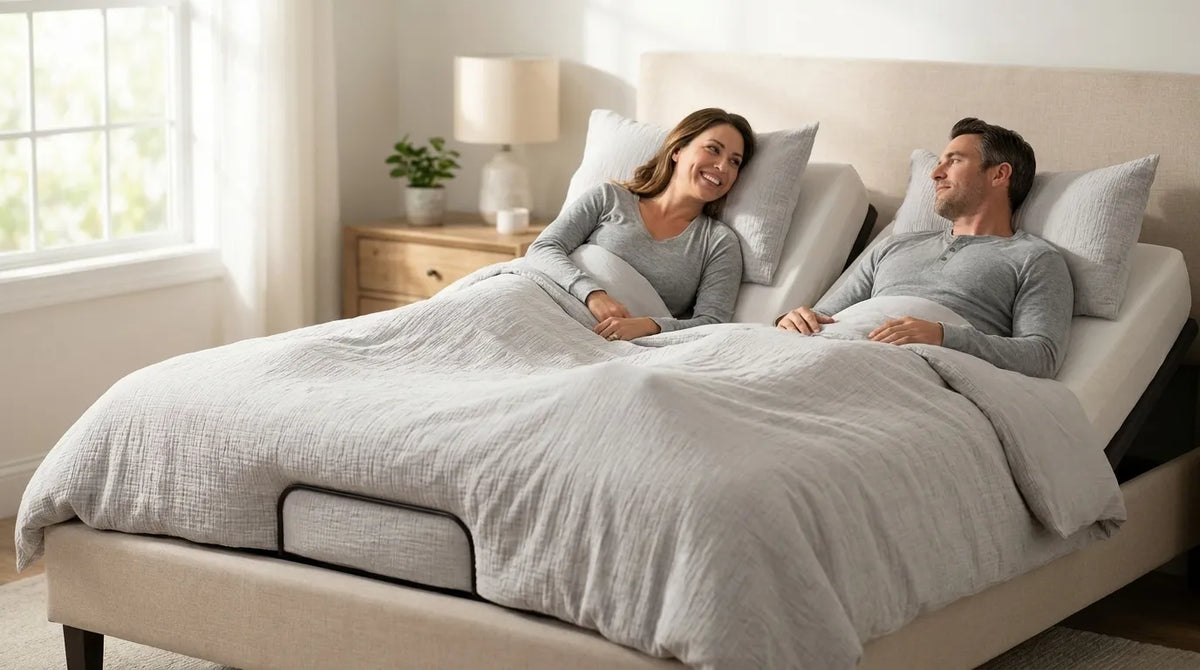
Adjustable Bed for Sleep Apnea and Acid Reflux: What Works
Written by: Matthew Timmins, Founder and Managing Director, Leva Sleep
Key Takeaways
- Raising the head of the bed by about 6–8 inches uses gravity to keep stomach contents below the lower esophageal sphincter and reduces nighttime acid reflux.
- Modest elevation can also reduce snoring and mild positional obstructive sleep apnea by helping keep the airway open. It does not replace CPAP or PAP therapy.
- Obstructive sleep apnea and acid reflux are mechanically linked. Negative intrathoracic pressure during obstructive events can pull gastric contents upward, and each condition worsens the other.
- Left-side sleeping with whole-torso elevation is the evidence-based overlap position that addresses both conditions at the same time without stacked pillows.
- Leva Sleep adjustable beds provide consistent, clinician-aligned elevation and split configurations for couples. Explore Split Queen adjustable beds.
How Sleep Apnea Triggers Nighttime Acid Reflux
The connection between obstructive sleep apnea (OSA) and gastroesophageal reflux disease (GERD) is mechanical, not coincidental. During an obstructive event, the airway collapses and the body responds with forceful inspiratory effort against the blockage. That effort generates exaggerated negative intrathoracic pressure, a suction force on the esophagus that can overcome lower esophageal sphincter (LES) resistance and draw gastric contents upward. At the same time, the struggling breathing effort raises intra-abdominal pressure from below and compresses the stomach. The LES sits between these forces, and acid escapes.
This pattern appears frequently in clinical data. A 2026 systematic review and meta-analysis in the Journal of Clinical Medicine (PubMed ID 41976819), pooling six observational studies, found that adults with OSA have nearly two-fold increased odds of GERD, with a combined odds ratio of 1.96. The authors advised greater clinical awareness of this association rather than universal GERD screening for all OSA patients.
A separate 2026 prospective cohort study by Li et al. in Frontiers in Neurology (PMC13035730) evaluated 580 adults undergoing polysomnography. GERD prevalence reached 29.0% among OSA patients overall. Nocturnal reflux rose from 13.64% in participants with an apnea-hypopnea index (AHI) of 5 or below to 42.41% in those with severe OSA (AHI above 30). As OSA severity increased, reflux burden climbed in parallel.
The cycle also runs in the opposite direction. Acid that reaches the upper airway triggers mucosal inflammation and tissue swelling. That swelling narrows an airway already prone to collapse and makes obstruction more likely. Each new obstructive event creates more pressure swings and promotes more reflux. CPAP therapy reduces nocturnal reflux episodes by smoothing out these pressure swings (Ing AJ et al., Am J Med 2000;108(Suppl 4a):120S–125S). In the Li et al. cohort, 69.6% of CPAP-treated patients with moderate-to-severe OSA and comorbid reflux achieved a clinically meaningful reduction in GERD symptom scores at six months.
Treating OSA and GERD as separate problems with separate therapies on a flat bed leaves this shared nighttime mechanism active. The first practical step toward addressing it is getting elevation right.
How Much to Elevate the Bed for Acid Reflux and Sleep Apnea
Both conditions benefit from a head-up position, but the degree of elevation differs slightly in the research. The table below summarizes current guidance and how an adjustable base fits in.
| Condition | Target Elevation | Best Sleeping Position | What an Adjustable Base Can and Cannot Do |
|---|---|---|---|
| Acid Reflux / GERD | Elevate the head of the bed for nighttime symptoms, per the 2022 ACG Clinical Guideline (no numeric target specified). A separate study found at least 6–8 inches (15–20 cm) is needed to be minimally effective. | Left side with head and torso elevated, per the 2022 ACG guideline. | Can deliver a consistent, whole-torso incline night after night. Cannot replace PPIs when pharmacotherapy is indicated and cannot change acid production or repair a hiatal hernia. |
| Obstructive Sleep Apnea | Mild head-of-bed elevation of about 7.5° (a 15-cm wedge), which reduced median AHI by 31.8% in a study of 52 OSA patients. | Lateral (side) sleeping reduced AHI further to 11.7 events/hour in the same study, outperforming elevation alone. | Can support the elevated and lateral positions clinicians commonly recommend. Cannot replace CPAP or PAP therapy, which remains the most effective intervention for reducing AHI across the literature. |
The practical overlap position is left-side sleeping with modest head elevation. The reflux target of roughly 6–8 inches sits within the range that also produces meaningful positional benefit for OSA. A clinician can help you confirm a specific target based on your reflux severity, OSA severity, and other health factors.
How to Elevate for Acid Reflux Without Making It Worse
- Follow the 2022 American College of Gastroenterology guideline and elevate the head of the bed for nighttime reflux. A separate study suggests that elevation of at least 6–8 inches (15–20 cm) is needed to have a meaningful effect.
- Raise the whole torso, not just the head. Stacking pillows bends the body at the waist, increases pressure on the LES, and can worsen reflux.
- Sleep on your left side with the head elevated. On the left, the acid pocket sits low in the fundus away from the gastroesophageal junction. On the right, it rests directly against that junction and makes reflux more likely (Beaumont et al., 2010, Gut).
- Confirm your elevation plan with a clinician, since reflux severity, OSA severity, and comorbidities vary. Many people still need prescribed therapy alongside positional changes.
The Best Sleeping Position for Both Acid Reflux and Sleep Apnea
Left-side sleeping with modest head elevation is the position most strongly supported by evidence for both GERD and OSA. The left-side advantage comes from anatomy. On the left, the post-meal acid pocket settles low in the gastric fundus, away from the gastroesophageal junction. On the right, it sits directly against that junction and increases reflux risk (Beaumont et al., 2010, Gut).
For OSA, lateral sleeping is the more reliable positional intervention. In the Maniaci et al. Laryngoscope study, lateral sleeping reduced average AHI to 11.7 events/hour, compared with 16.4 events/hour for 30-degree head-of-bed elevation alone. A 2017 systematic review and meta-analysis by Ravesloot and colleagues found that body position influences apnea frequency in roughly 56–75% of OSA patients.
Both conditions respond to the same position rather than competing ones. Left-side sleeping with the head and torso elevated addresses the acid pocket location and airway geometry at the same time. An adjustable base makes that position repeatable at home without a stack of shifting pillows.
Adjustable Bed vs Wedge Pillow vs Recliner for Nighttime Relief
Each elevation option tackles part of the problem, but they differ sharply in consistency, partner independence, and support for OSA. The comparison below shows where each one falls short and where an adjustable base fills the gaps.
A wedge pillow is the lowest-cost entry point and can reduce nocturnal acid exposure when it supports the full torso from the lower back to the shoulders. A wedge that is too short lets the sleeper slide off the incline during the night. Most wedges also shift position over several hours. They provide only modest head elevation for OSA and offer no independent articulation for a partner.
A recliner can reduce reflux symptoms by keeping the torso elevated, but it works poorly for full-night sleep. Sleeping in a recliner flexes the spine and stresses the lumbar curve. The seated geometry also makes the lateral position that benefits OSA much harder to maintain.
An adjustable base is the only option that delivers a consistent, whole-torso incline at a clinician-recommended angle. It also lets the sleeper lie flat or on their side. In a split configuration, one partner can elevate while the other sleeps flat. When you evaluate an adjustable base for both conditions, look at head incline range, the ability to return to flat for side sleeping, motor noise, mattress compatibility with articulation, and whether a split configuration is available for couples.
Can You Use an Adjustable Bed Instead of a CPAP Machine?
You cannot replace CPAP or PAP therapy with an adjustable bed. Clinicians often recommend sleeping with the head elevated for sleep apnea, acid reflux, and post-surgical recovery. An adjustable base makes that position practical at home every night without stacked pillows. It still does not treat OSA on its own.
A 2026 Bayesian network meta-analysis by Song et al. in BMC Pulmonary Medicine, which analyzed 18 randomized controlled trials with 1,520 participants, found that PAP therapy reduced AHI by a mean of 17.39 events/hour versus control. Positional therapy reduced AHI by 10.05 events/hour. Positional strategies, including head-of-bed elevation, work best as complements to prescribed treatment.
Many Leva Sleep customers add an adjustable base after a clinician recommends an elevated sleeping position alongside their existing therapy. The base delivers the position. The PAP device delivers the airway support.
What to Look For in an Adjustable Bed for OSA and Reflux
Someone managing both OSA and nighttime reflux needs specific features, not a generic base. Each of the elements below connects directly to the dual-condition mechanism.
Start with head incline range. You need enough travel to reach the elevation target that helps reflux and still supports positional benefit for OSA. From there, check flat tilt capability so a side sleeper can return to level when elevation is not required and maintain spinal alignment.
An anti-snore preset helps by offering a gentle head elevation that you can trigger quickly without fully waking. This setting supports the airway geometry that drives snoring and mild positional OSA. Lumbar control adds independent lower-back support separate from head or foot elevation and helps keep the spine aligned through a full night at incline.
A mattress engineered to articulate matters as much as the base. Standard mattresses resist bending, wear unevenly under repeated flexion, and often shorten their own lifespan on an adjustable frame. A split configuration becomes essential for couples when one partner needs elevation and the other does not.
Leva Sleep focuses on adjustable beds and builds features like lumbar control, pillow tilt, anti-snore positioning, and a true Split Queen configuration around these needs. You can browse Split Queen adjustable bed packages or explore the snoring relief collection and the pain relief collection that address common concerns in the 45–65 age range.
The Couple Problem When Only One Partner Needs Elevation
Many couples struggle when one partner needs elevation and the other sleeps best on a flat surface. A June 2025 survey of 2,007 US adults by Atomik Research for the American Academy of Sleep Medicine found that 31% of US adults have chosen a “sleep divorce” and regularly sleep in a separate room. That figure rises to 39% among adults aged 35–44. Another 37% go to sleep at different times to accommodate a partner.
Independent split articulation offers a practical way to stay in the same room. A true Split Queen uses two 30" × 80" mattresses on two fully independent bases, each with its own head and foot articulation. This configuration occupies a 60" footprint. A Split King requires 76". That 16-inch difference often determines whether the bed fits the room, especially in condos, older homes, or downsized spaces.
Leva Sleep’s Split Queen always means two fully independent bases with head and foot articulation on each side. Each partner controls their own elevation, position, and, where applicable, firmness. The partner who needs elevation for reflux or OSA gets it. The partner who sleeps flat keeps their preferred position without compromise.

Frequently Asked Questions
Does an Adjustable Bed Help Sleep Apnea?
An adjustable base can support the elevated and lateral sleeping positions that clinical evidence links to reduced OSA severity in position-dependent patients. A 30-degree head-of-bed elevation reduced average AHI by about 31% in one study, and lateral sleeping reduced it further. PAP therapy still delivers a larger overall AHI reduction, so an adjustable bed serves as a positioning tool alongside prescribed treatment.
Is a Recliner Better Than an Adjustable Bed for Reflux?
A recliner can reduce nighttime reflux by keeping the torso elevated, but it does not work well for full-night sleep. The seated position flexes the spine and stresses the lumbar curve. Most recliners also fail to support the lateral sleeping position that benefits both reflux and OSA. An adjustable base provides similar torso elevation in a flat-bed geometry that supports side sleeping, spinal alignment, and, in split setups, independent positioning for each partner.
Is a Wedge Pillow Enough for Reflux and Sleep Apnea?
A wedge pillow can help with nocturnal acid exposure when it supports the full torso from the lower back to the shoulders. A wedge that lifts only the head and neck tends to flex the abdomen and can worsen reflux. Many wedges also shift during the night, which reduces consistency. For OSA, a wedge offers modest head elevation but does not support lateral positioning or partner independence. For mild, isolated nocturnal reflux without partner needs, a well-fitted wedge is a reasonable starting point. For managing both conditions in a shared bed, an adjustable base with split articulation provides a more complete solution.
Will My Current Mattress Work on an Adjustable Base?
Many standard mattresses are not designed to articulate. They resist bending, wear unevenly under repeated flexion, and can shorten their own lifespan on an adjustable base. A mattress built specifically to flex with the base, using construction that tolerates repeated articulation without degrading support layers, performs better over time. Leva Sleep manufactures its own mattresses in all-foam (Heavenly Response) and pocket-coil hybrid (Heavenly Hybrid) designs, each engineered to articulate as part of a matched system.
When Should I See a Doctor?
Anyone who notices symptoms of OSA such as snoring with gasping or pauses in breathing, excessive daytime sleepiness, or waking unrefreshed should seek a formal sleep evaluation rather than relying on positional changes alone. For reflux, symptoms like difficulty swallowing, unintentional weight loss, blood in vomit or stool, or frequent nighttime awakenings from heartburn warrant medical evaluation. Chronic nocturnal reflux increases the risk of Barrett’s esophagus. Positional strategies work as adjuncts to diagnosis and prescribed treatment, not replacements.
Conclusion and Next Steps for Better Sleep Positioning
Sleep apnea and nighttime acid reflux share a mechanical link through the negative intrathoracic pressure generated during obstructive events. Addressing that link at night means using gravity, body position, and consistent elevation together. The evidence supports a specific overlap position: left-side sleeping with a whole-torso incline that raises the head of the bed by several inches without bending at the waist.
An adjustable base does not treat either condition and does not replace CPAP or PAP therapy. It provides the elevated sleeping position clinicians commonly recommend in a way that you can repeat every night. For couples where only one partner needs elevation, independent split articulation solves both sets of needs in one bed and, in a Split Queen, does so within a 60" footprint that fits many bedrooms better than a Split King.
Confirm your target elevation with a clinician, then compare adjustable bed options against the key criteria: head incline range, flat tilt capability, anti-snore preset, lumbar control, mattress compatibility, and split articulation. Leva Sleep, a specialist adjustable bed company serving the United States with a showroom in La Jolla, California, has helped more than 25,000 customers over nine years find the right configuration and offers a stated 180-night comfort guarantee that shoppers should verify across current customer-facing channels.