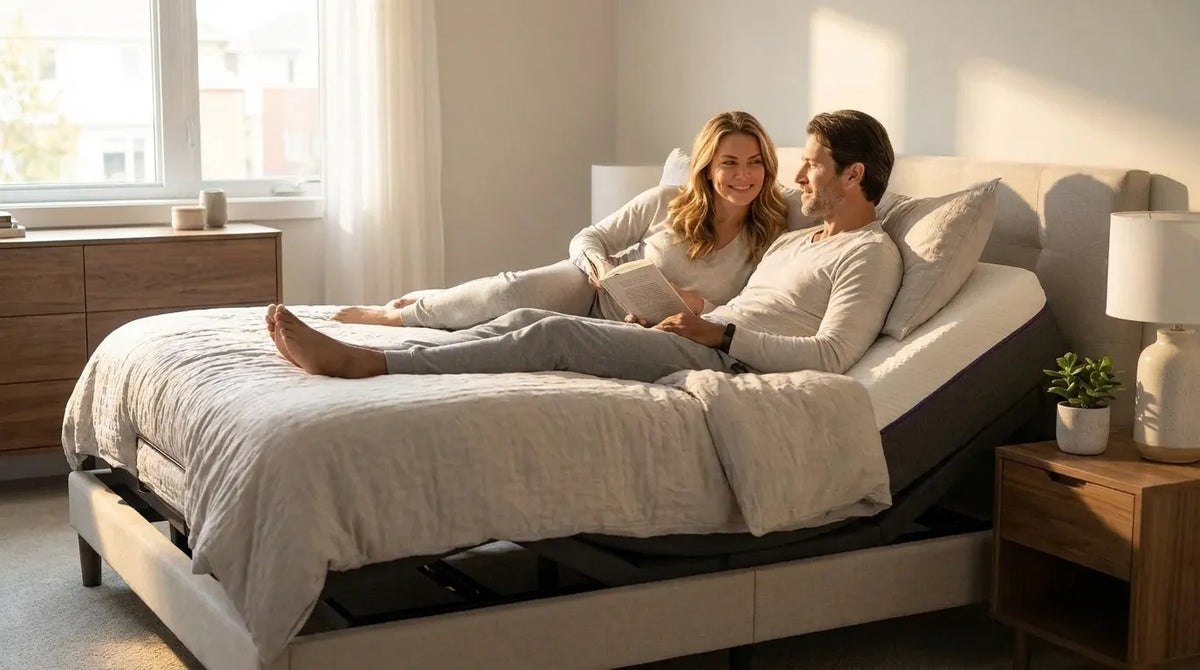
How To Stop Sleeping In Separate Rooms: A Cause-First Plan
Written by: Matthew Timmins, Founder and Managing Director, Leva Sleep
Leva Sleep is a specialist adjustable bed company serving the United States, with a luxury showroom in La Jolla, California.
Last updated: October 8, 2026
Key Takeaways
- Identify the root cause of separate sleeping, such as snoring, temperature differences, movement, or mismatched schedules, before sharing a bed again.
- Follow a staged return plan: start with shared wind-down time, then partial nights, then full nights together with a clear fallback option.
- Pick a bed setup that fits your space and habits, such as two duvets, twin beds pushed together, or a split adjustable base.
- Use independent head and foot adjustment on each side of a split base to address snoring, pain, and position preferences.
- Leva Sleep offers the largest selection of Split Queen adjustable beds in North America, with five packages from $1,399 and a 180-night comfort guarantee.
Shop Leva Sleep adjustable beds today
Why You Are Sleeping In Separate Rooms: A Cause-First Triage
The right fix depends entirely on the cause. Generic advice like earplugs, nasal strips, or a wedge pillow keeps many couples stuck. Each common cause below points to a different first move.
- Snoring or suspected sleep apnea. Screen first, then address position. Clinicians commonly recommend sleeping with the head elevated for conditions including sleep apnea, acid reflux, and post-surgical recovery. Loud snoring with gasping or pauses in breathing warrants a medical evaluation before any bed change. A snoring-relief adjustable base addresses position, and a sleep study addresses the underlying condition.
- Mismatched schedules. Forcing identical bedtimes rarely works. Protect the overlap window, the 30–60 minutes when both partners are awake in bed, instead of demanding synchronized sleep onset.
- One partner sleeps hot, one cold. Separate bedding and per-side temperature control solve this without separate rooms. A flat bed with one shared duvet creates the conflict; tailored bedding and temperature control restore comfort.
- Movement and restlessness. Motion isolation and independent surfaces provide the physical answer. A mattress with strong motion transfer amplifies every shift. A split adjustable base removes the transfer entirely.
- Kids or caregiving. Treat this as temporary. Set a specific date to re-evaluate instead of letting the arrangement become permanent by default.
- Emotional withdrawal or unresolved conflict. The bedroom layout is not the core issue. A new bed configuration will not repair problems that belong in a direct conversation or a therapist’s office.
A Staged Plan To Start Sleeping In The Same Bed Again
A staged return lowers the stakes of any single bad night and gives both partners a clear path. The timeline below is a realistic minimum. Most couples report subjective sleep-quality changes within the first one to two weeks of any arrangement shift, while full physical adaptation to a new configuration takes longer.
- Weeks 1–2. Spend 30–60 minutes of shared wind-down time in the same bed, then separate for sleep. This rebuilds the link between the shared bed and closeness without risking sleep quality.
- Weeks 3–4. Start the night together. Separate only if a night goes badly, using a named fallback instead of an automatic split. Treat the fallback as part of the plan and not as a failure.
- Weeks 5–6. Aim for full nights together, with the fallback still available. If sleep quality collapses, return to the last stage that worked and hold there before advancing again.
The explicit fallback keeps guilt and arguments out of the moment a night goes badly. Both partners already know what happens next.
Visit the La Jolla showroom or shop Leva Sleep online
How To Raise The Conversation Without Guilt Or Blame
Lead with your own experience rather than your partner’s behavior, because “I miss sleeping next to you” lands differently than “your snoring is keeping me up.” Once the conversation feels open, propose a trial period of about four weeks with a defined fallback instead of a permanent change. Before you start, agree on what “better” looks like and how you will know if the arrangement is working, so the trial has a clear endpoint.
Frame the return as a structured experiment instead of a verdict on the relationship. Scheduling relationship-quality check-ins at the two-week and eight-week marks after any arrangement change keeps the discussion from happening only in the heat of a bad night.
The Configuration Answer: Staying Close Without Sacrificing Sleep
A flat bed imposes one geometry on two different bodies for eight hours. The compromise is built into the surface. The table below compares three configurations that reduce that compromise and shows what each one solves and what it leaves unaddressed.
| Configuration | Footprint | What It Solves | What It Does Not Solve |
|---|---|---|---|
| Two Duvets (Scandinavian Method) | Any Bed | Blanket Pulling, Temperature Preference | Snoring, Movement, Schedule Mismatch |
| Twin Beds Pushed Together | 76" (Two 38" × 80" Twin XL Surfaces) | Closeness With Separate Bedding | Articulation, Center Seam |
| Split King Adjustable Base | 76" Wide | Independent Position, Snoring, Pain, Temperature | Room Fit In Smaller Bedrooms |
| Split Queen Adjustable Base | 60" Wide | Independent Position In A Queen Footprint | Requires Purpose-Built 30" × 80" Mattresses |
Two Duvets require no hardware and solve blanket pulling immediately. They do not change snoring, movement, or schedule mismatch. They work well when temperature or blanket conflict is the only issue.
Twin Beds Pushed Together create a 76" footprint from two 38" × 80" Twin XL surfaces. They allow separate bedding and preserve closeness but leave a visible center seam and do not articulate. They serve as a reasonable interim step when room size rules out a King and a Split Queen is not yet in the budget.
Split Adjustable Bases give couples with positional or spatial causes a long-term configuration answer. A Split King occupies roughly 76" of width. A Split Queen occupies 60". That 16-inch difference often decides whether the room works, especially in condos, older homes, and downsized primary bedrooms where a King does not fit.

Leva Sleep is a specialist adjustable bed company focused on split articulation for couples. Independent split articulation removes the built-in compromise. Each side adjusts its own head and foot position. The base also adds lumbar control, pillow tilt, zero-gravity and anti-snore positioning, whisper-quiet German motors, and per-side heating and cooling. The mattresses are engineered to bend with the base, and the bedding, including fitted sheets with extra elastic, duvet clips, and remote pockets, is designed for movement at full elevation.
Leva Sleep offers the largest selection of Split Queen adjustable beds in North America, with five distinct packages from $1,399. Leva manufactures the 30" × 80" mattresses and provides a full line of Split Queen bedding and accessories built to fit them. A true Split Queen means two fully independent bases with head and foot articulation on each side.
For couples whose cause is snoring or airway position, the snoring relief collection focuses on anti-snore positioning. For couples whose cause is pain, the pain relief collection targets lumbar support and pressure relief by position.
Find your split adjustable base at Leva Sleep
Health Evidence On Sleeping In Separate Bedrooms
The sleep-benefit case for sleeping apart is stronger than the relationship-benefit case. When partner disruption is high, sleep quality often improves when sleeping apart, while relationship-quality effects remain mixed across studies. A polysomnography study of co-sleeping couples found that bed-sharing was associated with roughly two percentage points more REM sleep and significantly less fragmented REM. At the same time, objective measurements sometimes show more awakenings and lighter sleep stages when sharing a bed.
Separate sleeping supports health when one partner has untreated obstructive sleep apnea and the other loses an hour of sleep per night to noise disruption. It undermines connection when the real driver is emotional withdrawal or avoidance of intimacy. Some couples find separate bedrooms improve intimacy because physical closeness becomes intentional rather than default. A dedicated wind-down period together before separating for sleep preserves connection while protecting rest. The ongoing conversation about the arrangement often matters more than the arrangement itself.
Does Sleeping In Separate Rooms Count As Separation?
Sleeping in separate rooms is a sleep arrangement, not a relationship status. The AASM 2025 survey shows that 31% of US adults, and 39% of adults aged 35–44, have done it. It is a common, practical response to a physical problem. The stigma attached to it does not match the evidence.
What To Do When One Partner Wants To Keep Sleeping Apart
Propose a trial period with a defined endpoint instead of an open-ended negotiation. Then agree on what “better” means, such as fewer awakenings, more morning energy, or less resentment, and revisit on a schedule instead of only after a rough night. A split adjustable base removes the most common objection, because neither partner has to accept the other’s position, temperature, or elevation setting. The skeptical partner’s side stays exactly as they prefer it.
When To Involve A Professional
Persistent insomnia in either partner should route to cognitive behavioral therapy for insomnia (CBT-I) as first-line treatment. A new mattress or a room change will not resolve it. Loud snoring with gasping or pauses in breathing warrants a medical evaluation, because moving to another room solves the noise for the partner but leaves the person who snores untreated. When the real driver of sleeping apart is relationship-quality decline instead of sleep disruption, couples therapy is the upstream intervention. A bed configuration change cannot replace that work.
Frequently Asked Questions
This section highlights practical details that build on the staged plan and configuration guidance above.
Is It Safe To Sleep In The Same Bed Again If My Partner Snores?
Safety depends on the cause and severity of the snoring. Snoring caused by sleeping on the back, called positional snoring, often responds to head elevation and side-sleeping, which an adjustable base supports directly. Snoring accompanied by gasping, pauses in breathing, or significant daytime sleepiness may indicate obstructive sleep apnea, which warrants a medical evaluation before any bed change. Treating the underlying condition often resolves the disruption. One study found that after treatment for obstructive sleep apnea, 72.4% of couples began sharing a bed again. When snoring drives the separation, a sleep study is the right first step before any configuration change.
How Long Does It Take To Transition Back To One Bed?
As noted in the staged plan, most couples notice subjective sleep-quality changes within the first one to two weeks. A realistic staged transition, with shared wind-down in weeks one and two, partial nights in weeks three and four, and full nights from week five, takes at least five to six weeks. The timeline extends if the physical cause has not been addressed first. Adapting to a new sleep surface and a new sleep position usually takes longer than people expect, so six weeks is a more honest estimate than one.
Does An Adjustable Bed Help Couples Sleep Together?
For couples whose reason for sleeping apart is positional, such as snoring, back pain, acid reflux, temperature difference, or movement, a split adjustable base directly addresses the cause. Each side adjusts independently, so neither partner has to accept the other’s setting. Anti-snore positioning gently elevates the head to help open the airway. Zero-gravity positioning distributes weight to relieve pressure on the lower back and hips. Per-side heating and cooling remove temperature conflict. Configuration becomes a tool for staying close instead of a source of compromise.
What If One Partner Snores And The Other Is A Light Sleeper?
This combination drives many couples to separate rooms. The snoring partner should be screened for positional sleep apnea, a condition where apnea severity is significantly higher when sleeping on the back. Head elevation of 30 to 60 degrees reduces the gravitational pull on the tongue and soft palate that causes airway collapse. A split adjustable base allows the snoring partner to sleep at an elevated head position while the light sleeper maintains a flat or different position on their own independent side. Motion isolation between the two sides means position changes on one side do not transfer to the other.
What If We Try And It Does Not Work?
Return to the last stage that worked and hold there for another week before moving forward again. A single bad night signals the need to use the agreed fallback, not to abandon the plan. If sleep quality consistently collapses across multiple nights despite addressing the physical cause, the cause may not have been fully identified, or a clinical issue such as insomnia, sleep apnea, or restless legs may need professional evaluation. A 180-night comfort guarantee on a Leva Sleep system means the configuration decision does not lock you in after the first week.
Conclusion: Start With The Cause Before Changing Rooms
Sleeping in separate rooms usually reflects a physical problem that shows up as an emotional one. The staged plan above, which fixes the cause, rebuilds nights gradually, and updates the configuration when the cause is positional or spatial, gives couples a clear sequence instead of a list of generic tips. The configuration answer fills a gap most advice skips, with two duvets for blanket conflict, twin beds pushed together as an interim step, and a split adjustable base when snoring, pain, temperature, or movement drive the issue. A Split Queen at 60" fits rooms where a 76" Split King does not.
Leva Sleep focuses on split adjustable systems for couples who want to stop sleeping in separate rooms. The company offers the largest selection of Split Queen adjustable beds in North America, with five packages from $1,399, plus a 180-night comfort guarantee. You can test configurations in the La Jolla showroom or order online with support from specialists who work with couples facing these exact challenges every day.
Explore Split Queen and Split King systems at Leva Sleep