Sleep Quality Trackers: Accuracy, Scores & What They Miss
Written by: Matthew Timmins, Founder and Managing Director, Leva Sleep
Key Takeaways
- A sleep quality tracker estimates sleep duration and stages from movement, heart rate, and other biometrics, not from brain activity.
- Trackers are most accurate for total sleep time and sleep-wake timing, and far less reliable for sleep stages and wake detection.
- Score swings often reflect limited baseline data, sensor fit issues, quiet wakefulness, and firmware changes rather than real sleep changes.
- Orthosomnia describes the anxiety loop that appears when people fixate on nightly scores and sleep worse because of that stress.
- Leva Sleep builds adjustable beds that address movement, wake-event, and snoring patterns that sleep trackers frequently flag.
Shop Leva Sleep Adjustable Beds Today
How A Sleep Quality Tracker Measures Your Night
Consumer sleep trackers rely on multiple sensors working together. A 2026 narrative review published in Sensors (MDPI) describes the core sensor stack found in most wrist- and finger-worn devices:
- Accelerometers detect linear acceleration and classify movement intensity, stillness, and sleep-wake patterns.
- Optical PPG sensors emit LED light into the skin and measure reflected changes in microvascular blood volume to derive heart rate and pulse rate variability, which acts as a proxy for heart rate variability (HRV).
- SpO2 sensors use red and infrared wavelengths to estimate blood oxygen saturation.
- Temperature sensors, present on some devices, track skin temperature changes associated with sleep onset and brief awakenings.
Sleep stages such as light (N1/N2), deep (N3), and REM are estimated, not directly measured. Machine-learning models combine accelerometer movement data with heart rate and HRV changes to infer the likely stage. The same 2026 Sensors review confirms that stage labels are algorithmic inferences rather than direct physiological measurements. The sleep score you see is a composite built from several inputs, not a single-sensor reading. For a deeper look at how these algorithms work, see Sleep Tech: The Sensors And Algorithms Behind Sleep Scores.
Where Sleep Quality Trackers Are Accurate And Where They Struggle
Accuracy depends on the specific metric. Research consistently separates what trackers measure reliably from what they only approximate.
| What Trackers Get Right | What Trackers Miss |
|---|---|
| Total sleep time (within ~17 minutes on average, per a 2025 meta-analysis of 24 studies covering nearly 800 participants) | Sleep stage classification (light, deep, REM), where agreement with polysomnography ranges from fair to moderate at best |
| Sleep-wake timing (bedtime, rise time, sleep onset) | Wake detection, where a 2025 trial of six wearables found correct wakefulness identification only 29–52% of the time |
| Night-to-night trends over weeks and months | Sleep apnea diagnosis, which Johns Hopkins Medicine notes requires tests such as polysomnography or a home sleep apnea test, with in-lab studies recommended when symptoms persist |
| Detecting significant changes in sleep architecture over time | Precise arousal counts and cortical arousals the sleeper does not consciously experience |
The core limitation comes from the signals each device records. Polysomnography captures brain waves (EEG), eye movements (EOG), and muscle activity (EMG), which directly define sleep stages. Consumer trackers measure movement and cardiovascular proxies instead. The 2026 Sensors review by Lepley et al. notes that wrist-worn devices cannot directly measure sleep architecture because they do not capture neural signals. A consumer sleep quality tracker does not replace a clinical sleep study. It can flag patterns worth discussing with a clinician, and it cannot provide a diagnosis.
Why Your Sleep Score Swings When Your Habits Feel The Same
Many people lose trust in their tracker when scores bounce around despite steady routines. Several mechanisms create that volatility without any real change in behavior.
The tracker is still learning your baseline. A 2026 study published in the journal Sleep found that reliable estimates of night-to-night sleep variability require roughly 41–65 consecutive nights of wearable data. With only 7–14 nights, variability estimates correlate just 0.50–0.67 with reference values. Early score swings often reflect limited baseline data rather than a real shift in sleep.
Sensor fit changes the raw signal. The 2026 Sensors review shows that PPG signal quality depends on motion artifact, skin-device contact, sensor placement, skin tone, sweat, temperature, and ambient light. A watch worn slightly higher on the wrist or a ring that has loosened produces a noisier optical signal. That noise degrades heart rate, HRV, and therefore stage estimates.
Quiet wakefulness looks like sleep to the device. A 2026 review in Sleep Advances confirms that consumer trackers systematically over-classify still wakefulness as sleep. When you lie awake and motionless, the tracker often counts that time as sleep. Total sleep time and efficiency scores rise, even when the night felt restless.
Everyday factors register as disturbances. Alcohol, late meals, room temperature shifts, and partner movement all change heart rate and movement patterns. The algorithm interprets those changes as sleep disruption. A single wake event can pull a composite score down sharply, depending on how the proprietary weighting works.
Firmware updates change how the score is calculated. Manufacturers update scoring models in the background. A sudden score drop after an update may reflect a recalibrated algorithm rather than worse sleep. The device is interpreting the same signals differently. For a fuller breakdown of how to use this data constructively, see Sleep Trackers Explained: Read Your Data, Sleep Better.
The most practical approach treats the score as a directional signal over weeks, not a verdict on any single night.
Orthosomnia And A Healthier Way To Use Sleep Scores
Orthosomnia describes an obsessive pursuit of perfect sleep driven by tracker data. Anxiety about the score raises physiological arousal, which blocks sleep, produces a worse score, and increases anxiety again. The pattern is not a formal diagnosis, yet clinicians see it in practice.
Case reports describe patients who trusted tracker data over overnight sleep studies and spent excessive time in bed trying to improve metrics. That behavior often worsened insomnia. A more helpful pattern uses the device as a tool rather than a judge.
Sleep medicine experts suggest one simple change. Check the score once in the morning instead of during the night, and focus on weekly or monthly averages instead of nightly numbers. The Sleep Foundation notes that tracker data can still support a conversation with a clinician when you treat it as context. When tracking creates more stress than insight, a one- to two-week break from the app is a reasonable first step.
How Rings, Wristbands, Watches, Mats, And Apps Compare
No device category escapes the same structural limit. Each measures movement and cardiovascular proxies well enough to flag patterns, and none measures brain activity directly. The table below shows where each category is strongest and where it falls short. No device in this table has been independently tested by Leva Sleep; the characterizations reflect published validation research and manufacturer specifications.
| Device Type | What It Measures Well | What It Misses | Who It Suits |
|---|---|---|---|
| Smart ring (e.g., Oura) | Heart rate, HRV, temperature trends, sleep-wake timing, and sleep/wake sensitivity of 95%+ in validation | Stage precision, variable SpO2 accuracy, and no on-device screen | Users who want discreet, continuous tracking without a wrist device |
| Wristband (e.g., WHOOP, Fitbit) | Movement, heart rate, sleep-wake detection, and deep sleep classification where WHOOP 4.0 led tested devices at 69.63% of PSG N3 epochs | Overall stage classification accuracy and comfort that varies by user | Fitness-focused users who want recovery and strain context alongside sleep |
| Smartwatch (e.g., Apple Watch, Samsung Galaxy Watch) | Heart rate, SpO2, sleep-wake timing, and REM classification where Apple Watch Series 8 led tested devices | Stage precision and battery life that often requires a daytime charging window | Users who want one device for health tracking, notifications, and sleep |
| Under-mattress mat (e.g., Withings Sleep) | Respiratory rate, snoring detection, sleep-wake timing, and a partner-independent signal without a wearable | Stage precision, lack of direct heart rate from body contact, and a strong tendency to over-classify still wake as sleep | Couples, users who dislike wearables, and users tracking snoring patterns |
| Phone app | Convenience, basic movement tracking via phone accelerometer, and low cost | Poor sleep-stage agreement with PSG, especially for REM, and results affected by partner, pets, mattress movement, and phone placement | Casual users or people testing tracking before investing in a wearable |
Whichever category you choose, the device still observes inputs it cannot alter. The next section looks at what those observations usually point to in your sleep environment.
What Your Sleep Quality Tracker Flags About Your Bed
A sleep quality tracker acts as a diagnostic tool. It can see what is happening, and it cannot change any of the inputs. The movement, wake-event, and snoring flags usually point to specific physical causes that the device has no way to fix.
Here is what those flags often detect:
- Movement flag: Body repositioning that often responds to pressure or discomfort on a surface that concentrates body weight on the most prominent points. A flat mattress cannot redistribute that load effectively.
- Wake-event flag: Partner disturbance or airway restriction. A June 2025 survey of 2,007 US adults conducted by Atomik Research for the American Academy of Sleep Medicine found that 31% of US adults have opted for a “sleep divorce,” meaning regular sleep in a separate room from a partner, rising to 39% among adults aged 35–44. Another 37% reported going to sleep at different times to accommodate a partner. The tracker is highlighting a geometry and disturbance problem that the surface and setup create.
- Snore flag: Airway restriction that often improves with positional change. Clinicians commonly recommend sleeping with the head elevated for conditions such as sleep apnea, acid reflux, and post-surgical recovery. An adjustable base creates that position at home, night after night, without stacked pillows.
The key editorial point is simple. A sleep quality tracker can see position and partner disturbance, and it cannot change either one. The inputs it keeps flagging are the inputs the sleeper controls, and the most direct input is the sleep surface itself.
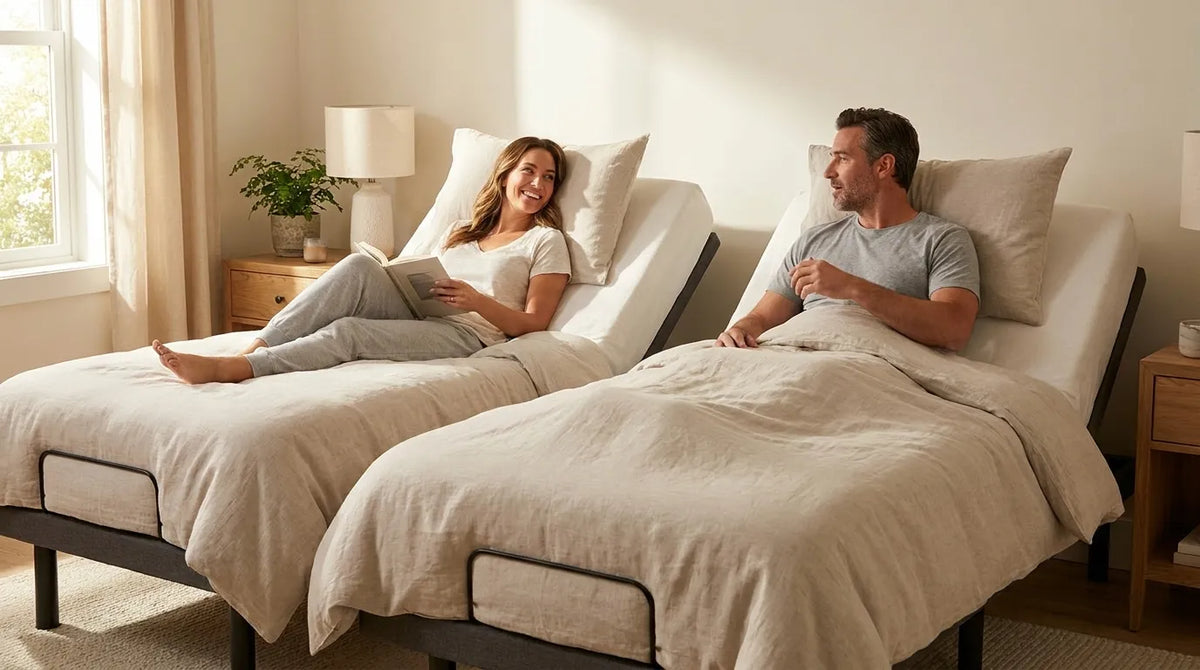
Leva Sleep is a specialist adjustable bed company that focuses on those problems. The first is partner disturbance. Independent per-side articulation means each partner adjusts their own side, so two different bodies stop forcing one geometry on each other. The second is airway restriction. Anti-snore positioning gently elevates the head to help open the airway, which matches the position clinicians commonly recommend for snoring and airway issues.
For couples whose tracker keeps flagging partner movement as a wake event, Split Queen adjustable beds provide two fully independent bases with head and foot articulation in a 60-inch footprint that fits rooms where a Split King will not. For sleepers whose tracker consistently flags snoring or breathing disturbances, the snoring relief collection targets the positional input the tracker can see but cannot change.

As one Leva Sleep specialist puts it: “Every other surface you spend hours on adjusts to you. Your car seat, your desk chair, your couch. The bed is the last one still stuck in one position.” Another Leva team observation captures the same idea: “You cannot solve a geometry problem by changing the foam. That is the mistake almost every mattress purchase makes.”
For a detailed look at how tracker data maps to adjustable bed decisions, see Sleep Quality And Partner Movement: What Research Says.
Frequently Asked Questions About Sleep Trackers And Your Bed
Are Sleep Quality Trackers Accurate?
As noted earlier, trackers are most reliable for total sleep time and sleep-wake timing, while wake detection remains their weakest metric. Stage labels come from algorithms that infer sleep depth from movement and cardiovascular data rather than from brain activity. For most users, the most useful role of a tracker is to show personal trends over weeks instead of acting as a precise ruler for any single night.
Can A Sleep Quality Tracker Detect Sleep Apnea?
No consumer sleep tracker can diagnose sleep apnea. Some devices, including certain Apple Watch and Samsung Galaxy Watch models, can flag breathing-disturbance patterns worth discussing with a clinician. These notifications do not count as a diagnosis, and the absence of a notification does not rule out sleep apnea. The American Academy of Sleep Medicine’s clinical practice guideline designates polysomnography as the standard diagnostic test for obstructive sleep apnea. The guideline states that clinical tools, questionnaires, and prediction algorithms should not be used to diagnose OSA without polysomnography or a technically adequate home sleep apnea test. If a tracker or partner repeatedly notices loud snoring, pauses in breathing, or gasping, that information should go to a clinician.
Why Does My Sleep Score Keep Changing When My Habits Have Not?
Score volatility often reflects device behavior rather than your choices. As covered above, reliable variability estimates require roughly 41–65 consecutive nights, so short windows produce unstable scores. Sensor fit changes the optical signal, quiet wakefulness often appears as sleep, and everyday factors such as alcohol, late meals, room temperature, and partner movement all register as disturbances. Firmware updates can also recalibrate scoring models. Treat the score as a directional signal over time instead of a nightly verdict.
How Many Nights Of Data Before A Trend Is Meaningful?
Research published in the journal Sleep shows that 7–14 nights of wearable data produce variability estimates that correlate only 0.50–0.67 with reference values, which falls in a poor-to-modest reliability range. Reliable variability estimates usually require roughly 41–65 consecutive nights, depending on the metric. For basic trend direction, such as whether total sleep time is generally rising or falling, two to four weeks of consistent data provide a usable signal. Weekly and monthly averages give more insight than nightly scores for most people.
What Is A Good Sleep Score?
Each brand defines “good” differently. Sleep scores are proprietary calculations that vary by brand, algorithm version, and individual baseline, so an 82 on one device does not match an 82 on another. A more helpful question asks whether your personal score trends in a consistent direction over weeks. When a score and your experience conflict, trust how you feel. A tracker that shows high scores while you consistently feel unrefreshed may be missing a problem such as sleep apnea or another sleep disorder that needs clinical evaluation.
Should I Stop Using A Sleep Tracker?
The relationship with the data matters more than the device itself. Many people do well checking a score once in the morning, reviewing weekly trends, and using the information as a starting point for conversations with clinicians. When tracking drives anxiety that disrupts sleep, clinicians describe that pattern as orthosomnia and often suggest a one- to two-week break from the app. The tracker’s most reliable output is the pattern it keeps flagging around movement, wake events, and snoring, which usually points back to the sleep environment.
Explore Adjustable Beds That Address What Your Tracker Flags
Conclusion: Turn Tracker Insights Into Concrete Sleep Changes
A sleep quality tracker tells you when you slept poorly and offers a rough explanation. It measures total sleep time and sleep-wake timing most reliably. Stage classification remains an estimate, and wake detection is its weakest link. Score volatility often reflects sensor physics and algorithm design rather than anything you did differently.
Next steps work best when they stay simple. Look at weekly trends instead of nightly numbers. Bring persistent flags, especially snoring, repeated wake events, and frequent movement, to a clinician if they recur across weeks. Consider whether the surface you sleep on is the variable your tracker keeps pointing toward.
Leva Sleep exists to address that question. The company has served more than 25,000 customers over nine years as a specialist adjustable bed provider. Complete adjustable bed packages start at $1,299. The stated policy is a 180-night comfort guarantee, which should be confirmed against the live US store because terms may change. A luxury showroom in La Jolla, California, is open to visitors, and national delivery is available across the United States.
Transform Your Sleep With Leva Sleep In-Store Or Online