
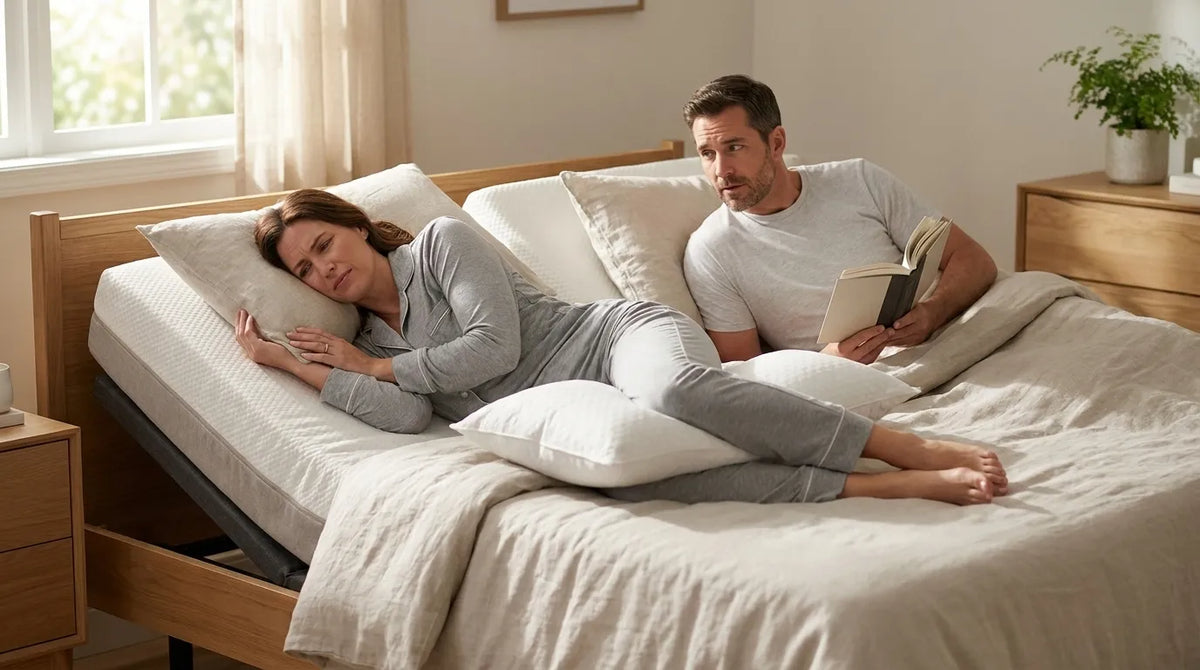
Sleep Quality And Hip Pain: Why Your Hips Hurt At Night
Written by: Matthew Timmins, Founder and Managing Director, Leva Sleep
Key Takeaways For Nighttime Hip Pain
- Hip pain at night usually comes from pressure and joint geometry when movement stops and sensitive structures stay loaded for hours.
- Pain location guides position: outer-hip pain improves with back or opposite-side sleeping and a knee pillow, while groin pain eases with slight knee elevation.
- A flat mattress forces one shape on two bodies, so couples often end up in a compromise that worsens one partner’s pain.
- Adjustable bases with independent split articulation let each sleeper dial in the elevation and support that matches their specific hip pattern.
- Leva Sleep designs adjustable systems that solve this geometry problem so each partner’s hips and back receive the support they need.
Explore adjustable beds built for hip pain relief
Why Hip Pain Often Gets Worse At Night
Daytime movement keeps joints lubricated and spreads pressure across changing contact points. At night, that protective motion stops. Lying on the affected side presses body weight directly onto the tender tendons and bursa over the greater trochanter, while lying on the other side lets the top leg drop across the body, stretching and compressing those same tendons against the bone, so the sore structures stay loaded exactly when the body tries to rest.
An arthritic hip stiffens when held still, and the frequent motion that keeps a joint lubricated stops during sleep. That stiffness is compounded by body chemistry. Cortisol, the body’s natural anti-inflammatory hormone, follows a circadian rhythm and drops to its lowest levels (nadir) between 10 PM and 2 AM, rather than in the early morning hours, so the body’s capacity to suppress inflammation falls just as sustained pressure builds. During the day, movement helps keep the joint more active; at night, stiffness, inflammation, or pressure from the sleep position can become much harder to ignore, as Daria Brooks Terrell, MD, executive director of the Center for Better Aging, has explained. Together, mechanical pressure, reduced movement, and reduced cortisol turn manageable daytime discomfort into sleep-disrupting night pain.
Where Your Hip Hurts And What That Means
Pain location offers the clearest first clue, because different structures create different patterns and respond to different positions. The three patterns below cover most nighttime hip pain.
Outer Hip / Greater Trochanter
Greater trochanteric pain syndrome (GTPS) describes pain and tenderness over the greater trochanter, the bony bump on the outer hip where the gluteal tendons attach. GTPS is the most prevalent lower limb tendinopathy. It affects approximately 1 in 4 women over age 50, with an estimated incidence of about 1.8 patients per 1,000 population per year. The older label “trochanteric bursitis” is still common, though a landmark sonographic study of 877 patients found that gluteal tendinosis was the underlying pathology in 49.9% of cases, while true bursitis occurred in only 20.2%.
Direct compression of the greater trochanter against the mattress applies sustained pressure to the bursa and tendon insertions, making side-lying on the affected hip particularly aggravating. The practical sleep strategy is to avoid direct pressure on the painful side, sleep on the back or opposite side, and use a pillow between the knees to keep the pelvis level. The surface should let the hip sink slightly instead of holding it at full height, so a conforming comfort layer reduces direct pressure on the greater trochanter.
Groin / Front Of Hip
Hip joint pathology is more strongly associated with groin pain and deep anterior hip pain than with isolated outer-hip pain; the hip joint sits deep behind the groin, so problems inside the joint, including osteoarthritis, tend to register there first. Back-sleeping with slight knee elevation reduces hip flexor compression and keeps the joint closer to neutral. An adjustable base with independent leg elevation holds this position through the night without stacks of pillows that slide out of place.
Radiating Down The Leg
Burning or electrical pain that extends below the knee suggests nerve-related pain rather than primary hip-joint disease; hip pain almost never travels below the knee, while back pain with nerve compression frequently does. For nerve-origin pain, stomach-sleeping is contraindicated. Side-sleeping with a firm pillow between the knees or back-sleeping with both head and knees slightly elevated reduces lumbar nerve compression. A surface with adjustable articulation, allowing independent head and foot elevation, gives the positional control that a flat mattress cannot match.
The table below summarizes how each pain location maps to a sleep position and the surface characteristic that supports it.
| Pain Location | Recommended Sleep Position | Surface Characteristic |
|---|---|---|
| Outer hip / greater trochanter | Back or opposite side with knee pillow | Surface that lets hip sink (conforming comfort layer over supportive base) |
| Groin / front of hip | Back with slight knee elevation | Adjustable leg elevation to reduce hip flexor compression |
| Radiating down the leg | Side with knee pillow or back with head and knees elevated | Supportive surface with adjustable head and foot articulation |
Why Side Sleeping Often Triggers Hip Pain
Knowing where the pain sits explains why side-sleeping often aggravates it. In side sleeping, the bottom hip bears the full load against the mattress, compressing the greater trochanteric bursa and gluteal tendons against the bone, while the top leg drops toward the mattress without support, rotating the pelvis and pulling the lumbar spine out of neutral alignment. That combination creates sustained, asymmetric loading on the hip structures for hours.
Use these position adjustments to reduce that loading:
- Start by removing direct pressure: sleep on your back or the less painful side so the affected hip is not pinned against the mattress.
- If you stay on your side, place a firm pillow between the knees and ankles to keep the hips level and prevent the top leg from pulling the pelvis into rotation.
- Finally, choose a surface that lets the hip sink slightly instead of holding it at full height, which reduces direct pressure on the greater trochanter.
Best Sleeping Positions And Surfaces For Hip Pain
No single position works for every hip pattern, yet a few principles help most people.
Side-sleeping: Optimal knee pillow thickness for most adults is 4–6 inches; a pillow that is too thin allows residual hip drop, while one that is too thick creates upward pelvic tilt on the upper side. Aim to keep hips and shoulders at the same horizontal level, with the spine parallel to the surface. The NHS and the Royal College of Obstetricians and Gynaecologists recommend a pillow between the knees for back pain and pelvic girdle pain.
Back-sleeping: A pillow under the knees reduces hip flexor tension and lowers lumbar extension, keeping the hip joint closer to neutral. Sleeping on the back with a pillow under the knees tends to relieve back and hip pain by keeping the spine in neutral alignment. An adjustable base that elevates the foot section independently recreates this position every night without wandering pillows.
Surface firmness also matters. “Medium-firm” works as a starting point, not a complete answer. Side sleepers under 150 lbs often do better on medium-soft; 150–200 lb sleepers usually need medium; 200–250 lb sleepers often need medium-firm; above 250 lbs, a firmer surface helps prevent the hip from sinking past neutral. Match the surface to body weight and pain location instead of relying on a generic label.
The Couples Problem: Two Bodies, One Flat Surface
A flat mattress forces one geometry on two different bodies. One partner’s hip needs to sink into a conforming comfort layer, while the other’s lower back needs firm lumbar support. A flat surface can only answer with compromise, often firm enough to fail one partner and soft enough to fail the other. The core issue is geometry, and a better flat mattress still keeps both partners on the same plane.
Polling from the American Academy of Sleep Medicine, conducted by Atomik Research in June 2025 among 2,007 US adults, found that 31% of American adults reported a “sleep divorce”, meaning they regularly sleep in a separate room from their partner. That figure rose to 39% among adults aged 35–44, the group most likely to juggle hip pain and a partner with different needs. Another 37% reported going to sleep at a different time to work around a partner.
Leva Sleep’s adjustable systems address this directly. Independent split articulation means each side of the bed adjusts separately, so one partner’s hip can rest on a conforming surface with slight leg elevation while the other’s back receives lumbar support at a different angle. The same per-side control applies to lumbar support, pillow tilt, and anti-snore positioning, so neither partner has to accept the other’s settings. For couples in a Queen-sized room, Leva Sleep’s Split Queen adjustable beds, two fully independent bases with head and foot articulation in a 60-inch footprint, provide this control without the 76-inch width of a Split King. Leva offers the largest selection of Split Queen adjustable beds in North America: five packages from $1,399, with 30" × 80" mattresses manufactured in-house and Split Queen bedding designed to stay in place at full elevation.

As Leva Sleep’s product team puts it: “A flat bed asks two different bodies to accept the same shape for eight hours. One of them always loses.”
Find your split adjustable bed and stop compromising on sleep
When To See A Clinician About Hip Pain At Night
Position and surface changes solve most mechanical hip pain, yet some patterns point to issues that need a clinician’s eye. The signs below call for professional evaluation instead of self-management.
Seek a clinician appointment if:
- Hip pain consistently disrupts sleep, or morning stiffness takes more than 30 minutes to ease.
- Pain feels burning or electrical and radiates below the knee, suggesting nerve involvement.
- Symptoms persist for more than a few weeks without improvement from position changes.
- Fever, unexplained weight loss, significant hip pain after a fall, or inability to bear weight accompany the pain.
Clinicians often ask whether changing position changes the pain at all. If no position, time of night, or amount of stillness helps, that constancy matters more than the fact that the pain appears at night and warrants prompt evaluation.
Frequently Asked Questions About Nighttime Hip Pain
Why Does My Hip Hurt At Night But Not During The Day?
Daytime movement keeps joints lubricated and spreads pressure across different contact points. At night, the same structures, such as the greater trochanteric bursa, gluteal tendons, or hip joint, stay loaded for hours without voluntary repositioning. As noted earlier, the body’s natural anti-inflammatory hormone drops to its nightly low during these hours, so inflammation is harder to suppress. Pain then builds through the night and often peaks on waking, even when daytime activity feels manageable.
Why Does My Hip Hurt When I Wake Up?
Morning hip pain that feels worse than evening pain usually reflects sustained positional stress instead of a fresh injury. The hip stays in a loaded position for hours without the small adjustments that happen while awake, so inflammation in the bursa, gluteal tendons, or joint builds overnight and peaks on waking. Morning stiffness that consistently takes more than 30 minutes to ease is a recognized clinical cue that overnight inflammation has been significant and warrants evaluation.
Does A Pillow Between The Knees Actually Work?
A firm pillow between the knees solves a specific side-sleeping problem. Without support, the top leg drops toward the mattress, rotates the pelvis, and pulls the lumbar spine out of neutral. The 4–6 inch thickness range mentioned earlier is what keeps the hips level and prevents femoral internal rotation, which reduces pressure on the greater trochanteric bursa and sacroiliac joint. The pillow needs enough firmness to hold its shape through the night, so a collapsing pillow gives little lasting benefit.
Is A Firm Or Medium-Firm Mattress Better For Hip Pain?
Labels like “firm” and “medium-firm” only start the conversation. The right surface depends on body weight, sleep position, and pain location. Side sleepers need enough give so the greater trochanter does not stay pinned at full pressure, while back sleepers need enough support to keep the hips from sinking and tilting the pelvis. As the body section explains, firmness labels are a starting point rather than a prescription, because the same label behaves differently for a 130 lb side sleeper and a 240 lb back sleeper.
Can An Adjustable Bed Help Hip Pain?
An adjustable base gives you control over angles that a flat mattress fixes in place. Slight leg elevation reduces hip flexor tension for back sleepers with groin or front-of-hip pain, and independent head and foot articulation lets you find a less loaded hip angle without holding that posture yourself. For couples, split designs allow each partner to match their side to their own weight, position, and pain pattern. Many clinicians recommend sleeping in elevated positions for hip pain, reflux, and post-surgical recovery, and an adjustable base is the practical way to repeat those positions at home without unstable pillow stacks.
Conclusion: Match Your Bed To Your Hip Pain
Hip pain at night comes down to geometry. The sleep surface needs to match your pain location, body weight, and preferred position instead of a one-size firmness label. A flat mattress keeps two different bodies in the same shape for eight hours, so couples need a solution that supports one partner’s hip while also supporting the other partner’s back at a different angle.
Leva Sleep’s adjustable systems, with independent split articulation, lumbar control, pillow tilt, and per-side positioning, are built so each partner’s hips and back receive the support they need without compromise. Over nine years and more than 25,000 customers, Leva has refined complete sleep systems for this exact problem. Complete packages start at $1,299, backed by a 180-night comfort guarantee, with in-house white-glove delivery and a luxury showroom in La Jolla, California.
Transform your sleep with Leva Sleep by visiting the La Jolla showroom or shopping online today.


