

Best Mattress for Sciatica: Relieve Nerve Pain at Night
Written by: Matthew Timmins, Founder and Managing Director, Leva Sleep
Key Takeaways for Sleeping With Sciatica
- A medium-firm mattress (5–6/10) with zoned lumbar support and responsive foam helps prevent lumbar sag and reduces sciatic nerve compression.
- Very soft and very firm mattresses both increase sciatica symptoms by changing pelvic position and narrowing the neural foramen.
- Zoned lumbar support matters because a firmer middle third keeps the pelvis level while softer zones at the shoulders and hips allow healthy contouring.
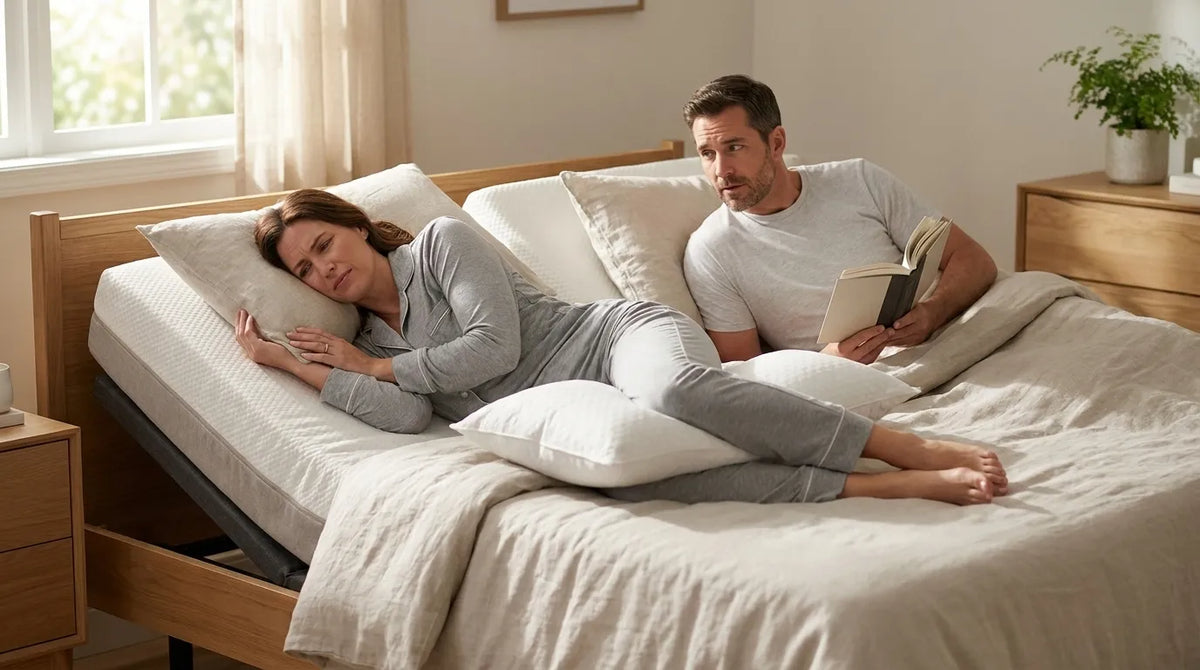
- Side sleeping on the pain-free side with a knee pillow, or back sleeping with a pillow under the knees, further reduces pressure on the sciatic nerve.
- Leva Sleep pairs zoned mattresses with adjustable bases so the surface and spinal angles work together for more complete sciatica relief.
Shop Leva Sleep Adjustable Beds
Best Mattress Type for Sciatica Nerve Pain
A medium-firm mattress rated around 5–6 on a 10-point firmness scale with zoned lumbar support and responsive foam is the standard recommendation for sciatica. Memory foam, latex, or hybrid designs in this range help keep the pelvis from sinking, maintain the lumbar curve, and reduce compressive load on the sciatic nerve root during sleep.
Firmness alone does not determine relief. The Sleep Foundation's 2026 testing guidance notes that zoning and material responsiveness matter as much as the number on the label. A single firmness rating applies the same resistance under the shoulders, waist, and hips, even though those zones carry very different loads.
What Actually Causes Sciatica Pain at Night?
To understand why firmness matters, it helps to see where the compression occurs. The sciatic nerve exits the lumbar spine through the neural foramen, the opening between adjacent vertebrae. When the lumbar spine sags into flexion on a too-soft mattress or is forced into extension on a too-firm one, the diameter of that foramen decreases and nerve compression increases. Because people spend approximately 2,920 hours per year lying down, a mattress that holds the lumbar spine outside neutral alignment for long stretches actively compresses the L4–L5 and L5–S1 nerve roots during the window when the body should be recovering.
The mechanism here is specific to sciatica rather than general back pain. Herniated disc is the most common cause of sciatica, responsible for approximately 90% of cases, with L4–L5 and L5–S1 accounting for most clinically significant herniations. Spinal stenosis, or narrowing of the canal or foramen, is the most common cause in adults over 50 and typically worsens with extension, which makes flat back sleeping without lumbar support particularly problematic.
Lying still overnight reduces spinal fluid movement and increases inflammatory chemicals around the compressed nerve, which often intensifies sciatica at night and in the morning. Spinal discs also absorb fluid overnight, temporarily increasing their volume. If a disc already bulges or herniates, this extra hydration raises pressure on nearby nerves. A 2026 systematic review in the Journal of Orthopaedics and Traumatology (Caggiari Gianfilippo et al.) analyzing 47 studies found that evidence most consistently favored medium-firm mattresses over very firm or very soft surfaces for adults with nonspecific low back pain or morning stiffness. This supports the clinical view that a sleep surface should both distribute pressure and maintain a neutral lumbar curve.
Can a Bad Mattress Trigger Sciatica?
A mattress rarely causes sciatica but can significantly aggravate it. Sciatica is a symptom of an underlying problem, most commonly a herniated disc or spinal stenosis compressing or irritating the sciatic nerve root. The mattress is a modifiable factor in how much load that already-compromised nerve tissue bears each night.
Signs that a current mattress contributes to symptoms include:
- Waking with numbness, tingling, or radiating leg pain that was not present at bedtime
- Hip or shoulder pressure that causes frequent repositioning
- Morning pain that eases within 30–60 minutes of getting up, a specific indicator that the sleep surface is a contributing factor
- A visible dip or sag under the hips
- A mattress older than roughly 7–10 years, after which most mattresses begin losing alignment support, though some sources cite shorter intervals of 5–8 years
Do I Need a Firmer or Softer Mattress for Sciatica?
Medium-firm is the standard recommendation, typically 5–6 on a 10-point firmness scale. Within the AANS-recommended 5–7/10 range, 6/10 is the evidence-based compromise point for most sciatica presentations. This level is firm enough to resist lumbar sag yet soft enough to allow hip and shoulder contouring that prevents spinal torque from the pelvis tilting on a flat surface.
When the mattress is too soft, the pelvis sinks, the spine twists into lateral flexion, and the lumbar zone sags, which narrows the posterior neural foramen. Plush mattresses below 4.5/10 allow the lumbar spine to sag into flexion and narrow the posterior neural foramen. When the mattress is too firm, pressure concentrates at the hip and shoulder, circulation drops, and the lumbar spine is forced into extension, which narrows the anterior foramen. Ultra-firm mattresses above 7.5/10 create pressure-point loading at the thoracic-lumbar junction and force the lumbar spine into extension, narrowing the anterior foramen.
Body weight and sleeping position shift the ideal point:
- Side sleepers under 130 lbs may do better at 4–5, while those over 230 lbs often need 6.5–7.0 to prevent the lumbar zone from sinking past neutral
- Back sleepers generally need medium to medium-firm
- Stomach sleeping is contraindicated for sciatica by both Mayo Clinic and the AANS because it places the lumbar spine in hyper-extension, narrowing the anterior foramen and increasing disc pressure at L4–L5 and L5–S1
Mattress Materials That Work Best for Sciatica
The three main material categories differ most in how quickly they respond to movement, and for sciatica, responsiveness matters more than simple softness. The table below compares them on the attributes that affect nerve compression overnight. All values are qualitative and drawn from cited sources.
What Is Zoned Lumbar Support and Why It Matters for Sciatica
Zoned lumbar support means the mattress has firmer resistance in the middle third, the lumbar zone, and softer, contouring layers at the shoulders and hips. For side sleeping, the correct neutral alignment places the hips slightly deeper than the lower back, and lumbar zoning is the key specification that creates this pattern. The mattress must provide firmer resistance in the lumbar zone while allowing more give at the hip and shoulder zones.
A single firmness rating is a poor proxy for back support. It applies the same resistance under the shoulders, waist, and hips, even though those zones carry very different loads. Zoned support stiffens through the middle third to hold the pelvis level while letting the shoulder sink, creating one surface that works for both back and side sleepers.
When reading a product description, look for language such as “zoned coils,” “reinforced center third,” “lumbar layer,” or “five-zone support.” A mattress described only by a single firmness number gives no clear information about zoning.
How to Sleep With Sciatica to Take Pressure Off the Nerve
Sleep position forms the other half of the sciatica problem. A correctly specified mattress reduces surface load, and position sets the geometry of the spine during the night. The following steps reflect guidance from clinical sources:
- Side sleeping on the pain-free side with a firm pillow between the knees so the hips, knees, and ankles stack vertically. A small folded towel under the waist fills the gap between the ribs and hip and keeps the spine neutral. The pillow must be firm enough to hold its shape.
- Back sleeping with a pillow under the knees so they bend to about 30 degrees. The AANS recommends placing a pillow under the knees for back sleepers with sciatica. This reduces hip flexor tension, flattens the lumbar lordosis toward neutral, and reduces disc pressure at L4–L5 and L5–S1.
- Avoid stomach sleeping entirely. Stomach sleeping forces the lumbar spine into extension and the neck into a held rotation, which reliably worsens night pain.
- Use an adjustable base to elevate the head and knees. A reclined position at about 30–45 degrees can be used with an adjustable bed or recliner to reduce lumbar pressure and lessen nerve irritation while keeping hips and knees slightly flexed.
- Stay in a position for ten minutes before judging it. Many patients give up on a good position within the first thirty seconds before the bones have settled.
- Apply a hot pack or ice pack before bed. Use heat on the buttock and lower back for 10–15 minutes for muscle-tension pain, or an ice pack wrapped in a towel for 10 minutes for sharp inflammatory pain. Ice works best in the first 48 hours, while heat is appropriate after initial inflammation calms.
- Perform gentle hamstring and piriformis stretches before bed, holding each for 20–30 seconds and avoiding aggressive bending or twisting that increases nerve irritation.
Mattresses and Accessories to Avoid With Sciatica
The clearest warning sign is a mattress that dips under the hips because that dip forces the lumbar spine out of neutral for the entire night. Sag often begins as a subtle dip felt only as morning stiffness. Plush or ultra-soft ratings below 4.5/10 and unsupportive innersprings with thin comfort layers tend to create the same effect. Age compounds the problem, so any mattress older than 7–10 years is usually a replacement candidate regardless of its original specification.
A topper rarely fixes sciatica. A topper can provide partial relief only when the mattress is too firm but structurally sound. A 2–3 inch Dunlop latex or medium-density gel memory foam topper adds surface pressure relief while the firm support core below maintains lumbar alignment. A topper simply conforms to a sagging mattress, so it cannot correct a dip. Soft fiber-fill, down, or cotton toppers compress unevenly and do not redistribute pressure at the lumbar zone.
The word “orthopaedic” on a label does not guarantee suitable support. A mattress marketed as orthopaedic but rated above 7.5/10 creates pressure-point loading at the hip and forces the lumbar spine into extension, which conflicts with sciatica relief.
When a Mattress Is Not Enough: Adjustable Bases and Medical Red Flags
Leva Sleep addresses both halves of the sciatica problem, surface and geometry, in a single system. The Leva Sleep beds for pain relief collection pairs mattresses engineered with zoned lumbar support with adjustable bases that hold the spine in a clinician-recommended position all night, without stacks of shifting pillows.
Clinicians commonly recommend sleeping with the head and knees elevated for conditions including sciatica, acid reflux, and post-surgical recovery. An adjustable base is how that position is achieved at home, night after night. Sciatica sufferers often benefit from an adjustable base because the zero-gravity position decompresses the lumbar spine and reduces pressure on the sciatic nerve. A flat mattress, however well specified, can only address the surface. It cannot hold the knees elevated at 30 degrees or recline the torso to 30–45 degrees through the night.
Leva Sleep is a specialist adjustable bed company offering complete, personalized sleep systems for couples, serving the United States with a luxury showroom in La Jolla, California. The company has more than nine years in business and over 25,000 customers served. Complete adjustable bed packages range from $1,299 to $8,999+, with financing options including 0% APR. Leva Sleep's stated policy is a 180-night comfort guarantee, while the US store currently displays a 60-night comfort guarantee with a comfort exchange fee. Leva Sleep systems feature independent split articulation and whisper-quiet German motors. Higher-end bases add lumbar control, pillow tilt, anti-snore mode, and app control. Mattresses are engineered to bend with the base, and bedding is designed for movement with extra-elastic fitted sheets, duvet clips, and remote pockets. In-house white-glove delivery and setup include old-bed removal and a walkthrough for both partners. Leva Sleep mattresses are made in the US, and half of the US lineup is unique to the American market, including premium California-made brands. Leva carries Aireloom, Tempur-Pedic, Stearns & Foster, Beautyrest, Serta, Kingsdown, and Helix.
For couples in a room that cannot accommodate a King footprint, Leva Sleep offers the largest selection of Split Queen adjustable beds in North America. Five packages start from $1,399, with 30" × 80" mattresses Leva manufactures and a full line of Split Queen bedding. Each side articulates fully and independently so one partner's sciatica positioning does not disturb the other's sleep.

A mattress can reduce the load on a painful back, but it cannot diagnose the cause of that pain. Nerve compression from a herniated disc requires medical evaluation. Red flags that warrant prompt medical attention include:
- Pain lasting more than 6–8 weeks despite home treatment
- Severe shooting pain down both legs
- Progressive numbness or weakness in the leg or foot
- Loss of bladder or bowel control
- Saddle anesthesia, or numbness in the inner thighs or perineum
- Fever or unexplained weight loss alongside sciatica symptoms
Frequently Asked Questions
Can a Mattress Topper Help Sciatica?
A topper can help only in specific situations. As noted earlier, a topper offers partial relief when the mattress feels too firm but remains structurally sound. It cannot correct a sagging surface. In that case, replacement is the more effective option.
How Long Does It Take to Feel a Difference After Changing Mattresses?
Most sciatica patients who respond to a mattress change notice improvement within 2–4 weeks, and significant symptom reduction typically requires 3–6 weeks of consistent improved-alignment sleep. The mechanism, reduced nightly nerve compression, is cumulative rather than immediate. Sciatica from a disc herniation often improves naturally within 6–12 weeks regardless of mattress change, so improvement credited to a new mattress in week eight may partly reflect the condition's natural course. A mattress trial of at least 90 nights is recommended before drawing conclusions. Leva Sleep's stated 180-night comfort guarantee provides twice that window, while the US store currently displays a 60-night guarantee with a comfort exchange fee.
Is a Firm Mattress Better for Sciatica?
A 2003 randomized controlled trial in The Lancet assigned 313 patients with chronic low back pain to medium-firm versus firm mattresses and found that the medium-firm group reported significantly less pain in bed, upon rising, and during daily activities at 90 days, with odds ratios of approximately 2.36, 1.93, and 2.10 respectively favoring medium-firm. Ultra-firm mattresses above 7.5 on a 10-point scale create pressure-point loading at the hip and force the lumbar spine into extension, narrowing the anterior neural foramen. The common retail advice to “go as firm as possible” for back pain is not supported by controlled evidence and often worsens sciatica in side sleepers.
When Should I See a Doctor Instead of Buying a New Mattress?
Seek medical evaluation if pain lasts more than 6–8 weeks despite home treatment, radiates below the knee with numbness or weakness, affects both legs simultaneously, or appears with loss of bladder or bowel control, saddle anesthesia, fever, or unexplained weight loss. Progressive leg weakness, meaning weakness that worsens over time, suggests ongoing nerve damage and requires prompt evaluation. A mattress can reduce the load on a painful back, but it cannot reverse nerve compression caused by a herniated disc or spinal stenosis. Bedding is a comfort decision to make alongside proper clinical assessment.
Conclusion: The Two Halves of the Sciatica Problem
Sciatica at night has two main contributors: the sleep surface and the spinal geometry that surface creates. A medium-firm mattress with zoned lumbar support and responsive foam addresses the surface by keeping the pelvis from sinking, supporting the lumbar curve, and keeping the neural foramen as open as the underlying pathology allows. An adjustable base addresses the geometry by holding the head and knees at the clinician-recommended elevation through the night, without relying on pillows that shift or fall.
A flat mattress, however well specified, can only solve one half of the problem. Leva Sleep focuses on both halves with complete adjustable sleep systems, the largest selection of Split Queen adjustable beds in North America, and mattresses engineered to flex with the base rather than resist it. Every system is delivered and set up by Leva's own trained team, with both partners shown how to use it.
Explore Leva Sleep's Pain Relief Collection

%20with%20zoned%20lumbar%20support%20and%20responsive%20foam%20helps...)