Best Luxury Adjustable Bed Bases: Top Picks Compared
Written by: Matthew Timmins, Founder and Managing Director, Leva Sleep
Key Takeaways
- Luxury adjustable bed bases earn that label through motor quality, articulation range, lumbar and pillow-tilt motors, true split configuration, weight capacity, and warranty length. Price alone does not define the category.
- Premium motors run quieter at about 35 dB and last for 10,000 or more cycles. Wider head-incline ranges around 75–80 degrees and dedicated lumbar support create more usable positions and better spinal alignment.
- True split configurations give each partner independent control. Split Queen bases provide that independence in rooms that cannot accommodate a Split King footprint.
- Memory foam, latex, and hybrid mattresses flex safely on articulating bases when engineered for movement. Leva Sleep manufactures matched Split Queen mattresses so each partner can choose a preferred firmness.
- Leva Sleep offers one of the largest selections of Split Queen adjustable beds in North America and backs its systems with long-term warranties. Explore Leva Sleep’s adjustable base and Split Queen collections.
How Luxury Adjustable Bed Bases Are Engineered
The luxury tier rests on specific engineering standards rather than a price band. Each specification below affects how the bed performs every night.
Motor Quality And Noise. Adjustable bed motor noise ranges from roughly 35 dB on premium models to 50 dB on budget bases, which spans quieter than a library whisper to closer to light rainfall. Luxury bases often use German-engineered actuators such as OKIN motors. Premium units are tested for 10,000 cycles or more at full load, compared with an industry standard of 5,000 to 7,000 cycles. A bed that wakes a partner every time it moves has not solved the sleep problem. Leva Sleep uses whisper-quiet German motors with smooth, gradual travel across its base lineup.
Articulation Range. Standard bases reach about 60 degrees of head incline and 45 degrees of foot incline. Premium models extend to 75 or 80 degrees of head incline, which supports reading, reflux management, and anti-snore positioning. A wider range creates more usable positions that match real-world needs.
Independent Lumbar Motor. A dedicated motor raises a plate beneath the lower back independently of the head and foot sections. Active lumbar articulation uses a separate linear actuator and appears on premium models. Passive systems rely on zero-gravity angle positioning instead. Lumbar support targets the curve of the lower spine, which head and foot angles alone cannot correct.
Pillow Tilt. An additional motor angles the head and pillow section independently of the main head incline. Pillow tilt adds roughly 10 to 15 degrees of neck-specific angle beyond the main head incline. This extra control helps reduce forward head posture and pressure on the cervical vertebrae.
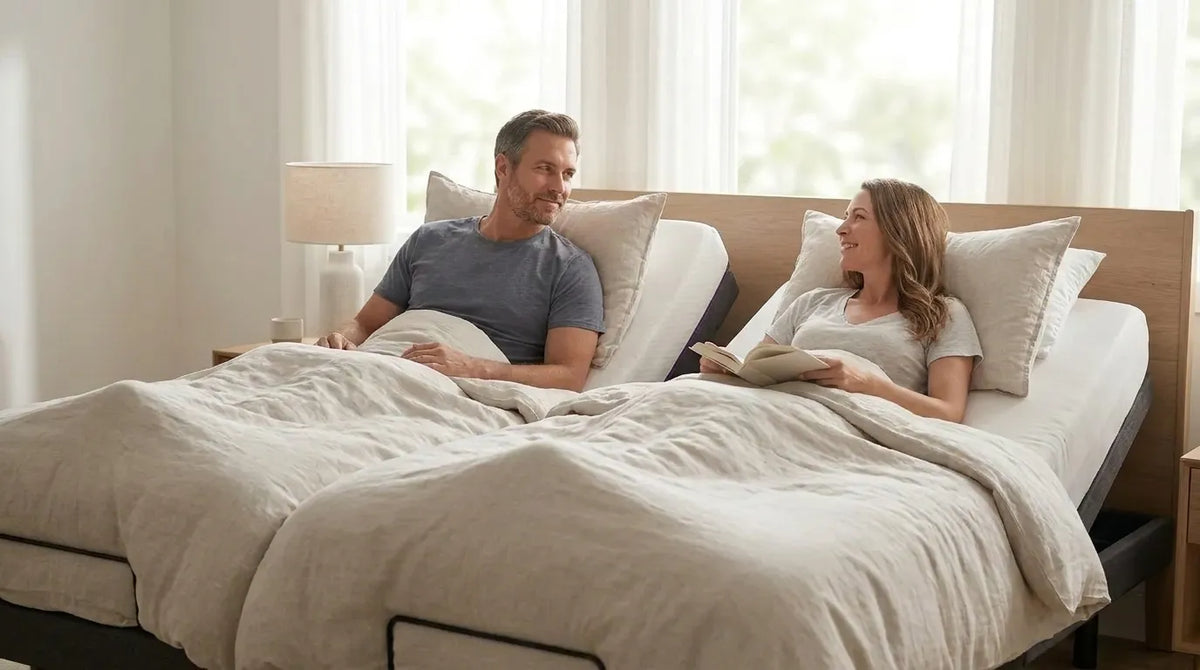
Split Configuration. Two bodies have two different geometries. A true split base gives each partner independent control of head lift, foot lift, lumbar, massage, and position presets, so neither person has to negotiate a shared angle.
Weight Capacity And Frame Construction. Frames rated below 750 lbs use thinner 16–18 gauge steel that may flex during articulation. Frames rated 750 lbs and above use 14-gauge or thicker alloy steel with additional cross-bracing. Capacity matters most in the lumbar zone, where the actuator lifts against body weight at a different leverage angle than the head or foot motors.
Warranty Length And Coverage. Budget motors typically survive 3,000–5,000 cycles, while premium motors can exceed 18,000 cycles. Warranty language should explicitly name the lumbar motor, since some warranties exclude lumbar articulation components and leave owners with out-of-pocket repair costs within the first few years. Leva Sleep backs its mattresses and bases with a long-term limited warranty and designs and assembles its own systems.
Mattress Compatibility. Most mattresses are not built to bend. Traditional innerspring mattresses with connected coils do not flex well, and repeated bending can damage the coils and weaken the frame. Memory foam, latex, and hybrid mattresses with pocket coils are compatible when built with enough flexibility at the articulation points. The ideal mattress thickness for a base with lumbar support is 10 to 12 inches. That range allows the sleeper to feel the lumbar lift without straining the motor.
How Leading Luxury Adjustable Bases Compare
The table below highlights how pricing and warranty coverage vary across frequently cited luxury adjustable bed bases. Price ranges reflect current retailer listings, and warranty terms come from manufacturer and retailer documentation. Always verify current pricing and availability directly with the manufacturer or retailer, since figures change.
| Model | Price (Queen, Approx.) | Warranty (Motors/Frame) |
|---|---|---|
| Tempur-Pedic TEMPUR-Ergo Smart | $1,999 (Discounted From $2,199) | 3 Years Full (Parts + Labor); 25 Years On Frame Only |
| Beautyrest Black Luxury | Contact Retailer For Current Pricing | 20-Year Limited Warranty |
| Saatva Adjustable Base Plus | From $1,024 (Sale Price) | Lifetime Warranty |
Across these models, price, warranty length, and coverage move independently. A higher price does not always guarantee longer or more comprehensive motor protection.
Leva Sleep applies the same engineering standards to its own lineup. Leva offers 15–20 adjustable base models, compared with the 3–5 at a typical mattress retailer. Complete packages run from $1,299 to $8,999+. The lineup includes Aireloom, Tempur-Pedic, Stearns & Foster, Beautyrest, Serta, Kingsdown, and Helix, and each mattress is paired with a suitable base. In-house white-glove delivery and setup is included and covers removal of the old bed, full assembly, height adjustment, and a walkthrough with both partners.
Compare Leva Sleep’s adjustable base lineup.
Choosing Between Split King And Split Queen For Couples
Footprint drives the choice between Split King and Split Queen. A Split King occupies roughly 76 inches of width, using two Twin XL mattresses at 38 inches × 80 inches each. A Split Queen occupies 60 inches, using two 30-inch × 80-inch mattresses side by side. That 16-inch difference often decides whether the room works.
Split King is easy to source because it uses standard Twin XL sizes that most mattress manufacturers already produce. Split Queen presents a manufacturing challenge. A true Split Queen requires purpose-built 30-inch × 80-inch mattresses that fall outside the normal supply chain. Many retailers therefore offer only a standard Queen with no independent sides or a King that will not fit the room.
The scale of the problem is significant. In a June 2025 survey of 2,007 US adults conducted by Atomik Research for the American Academy of Sleep Medicine, 31% of American adults reported regularly sleeping in a separate room from their partner. That figure rises to 39% among adults aged 35 to 44, the center of Leva Sleep’s customer base.
Split-Head uses a single mattress footprint where only the head sections adjust independently. It suits couples who want one shared mattress with individualized upper-body positioning, but it does not provide independent foot articulation or per-side lumbar control.
Leva Sleep offers the largest selection of Split Queen adjustable beds in North America, with five packages from $1,399. Leva manufactures 30-inch × 80-inch mattresses in two constructions, the Heavenly Hybrid pocket coil in Luxury Firm and Medium/Plush, and the Heavenly Response all-foam. A full line of Split Queen bedding and accessories completes the system.

See the five Split Queen packages and choose your firmness level.
Real-World Downsides Of Adjustable Bed Bases
Split Queen solves the footprint problem for many couples, but an adjustable base still does not fit every situation. Before committing, weigh these downsides.
- Cost Relative To A Flat Bed. A quality adjustable base adds meaningful cost over a standard foundation, and that upfront gap is real. The fair comparison looks at one matched system versus the cost of replacing mattresses every few years because the sleep problem never changed.
- Learning Curve. Finding the right positions takes time. Most people do not discover their preferred zero-gravity or reading preset in the first week. Adapting to a new sleep surface and a new sleep position often takes longer than expected.
- Motor Noise On Basic Bases. Budget motors operate at around 50 dB, which is audible enough to wake a partner. This complaint appears most often with bases sold as add-ons at general mattress retailers and reflects under-engineered motors rather than the entire category.
- Bedding Requirements. Standard fitted sheets tend to pop off when the bed articulates. Bedding engineered for movement, with extra elastic, deep pockets, and duvet clips, becomes a necessary part of the system.
- Mattress Condition Matters. An adjustable base cannot restore a mattress that has already broken down. If the mattress has lost its support, the base only changes the angle of a compromised surface.
- Who Should Avoid One. A buyer who shares a bed with a very light sleeper who wakes to any motor movement may find the adjustment cycle disruptive. A buyer whose bedroom cannot accommodate the footprint of the configuration they need should solve the room layout before moving ahead with a purchase.
Expected Lifespan Of A Luxury Adjustable Bed Base
Lifespan depends on motor duty-cycle rating, frame construction, weight capacity, and whether the mattress is built to flex with the base. Budget motors are rated for 3,000–5,000 cycles. Premium motors from OKIN or Leggett & Platt can exceed 18,000 cycles, which translates into many additional years of reliable operation under daily use.
Mattresses not designed for articulation wear unevenly. Repeated bending of a traditional innerspring mattress can damage the coils and weaken the structure, which shortens the mattress’s life and can increase stress on the base motor. Leva Sleep builds the Heavenly Hybrid and Heavenly Response mattresses to flex with the base and sells them as a matched system. Leva backs its mattresses and bases with a long-term limited warranty and supports customers directly rather than passing them to a third-party manufacturer.
How Adjustable Bases Behave During Power Outages
Most consumer adjustable bed bases stop wherever they are when utility power disappears. Head, foot, lumbar, and height controls no longer move, and massage, under-bed lighting, USB charging, and app connectivity usually stop as well.
Many adjustable bases include an emergency power-down box or strap that accepts disposable 9-volt batteries. This backup system moves the base to a flat or safe position during an outage rather than running every feature repeatedly. Vaya Sleep recommends replacing the 9V backup batteries in the power brick every two years, since old backup batteries can leak and damage the power supply.
Confirm the power-outage behavior and backup mechanism with any manufacturer before buying. If loss of bed movement could create a health or transfer risk, treat the bed as part of a care plan and involve both the bed supplier and a healthcare provider.
Using Memory Foam Mattresses On Adjustable Bases
Memory foam mattresses usually work well on adjustable bases when they are built with enough flexibility at the articulation points. The real question concerns the specific mattress construction and whether it can bend repeatedly at the hinge points without cracking, delaminating, or losing support.
Memory foam, latex, and most hybrid mattresses bend easily and pair well with adjustable bases. Traditional innerspring mattresses with connected coils do not flex well, and repeated bending can damage the coils. The safest approach uses a mattress the manufacturer has explicitly designed and warranted for use on an articulating base.
Leva Sleep builds the Heavenly Hybrid pocket-coil mattress and the Heavenly Response all-foam mattress specifically to flex with the base and sells them as a matched system. Both are available in 30-inch × 80-inch Split Queen dimensions, so each partner in a split configuration can choose a preferred firmness level.
Explore Leva Sleep’s beds for pain relief, which are engineered as complete systems from the base up.
Side Sleeping Comfort On Adjustable Beds
Side sleeping on an articulated base often improves comfort. A slight elevation at the head reduces airway restriction. A slight elevation at the knees reduces pressure on the hips and lower back by taking the pelvis out of a rotated position.
In the zero-gravity position, the head and knees sit slightly elevated. This geometry distributes body weight evenly, reduces pressure on the lower back, and supports circulation. Side sleepers benefit from this position as much as back sleepers.
The key variable for side sleepers is mattress firmness at the shoulder and hip zones. An adjustable base changes the angle of the surface, while the mattress still needs to allow the shoulder and hip to sink appropriately. This requirement is one reason Leva Sleep sells bases and mattresses as a matched system rather than a base alone.
For couples where one partner’s snoring disrupts the other’s sleep, Leva Sleep’s snoring relief collection includes systems with anti-snore positioning that gently elevates the head to help open the airway. Clinicians commonly recommend this geometry for conditions including sleep apnea and airway restriction.
Where To Experience A Luxury Adjustable Bed In Person
Leva Sleep’s luxury showroom in La Jolla, California gives shoppers a way to experience articulation and motor noise firsthand. A ten-minute conversation with a specialist and five minutes horizontal often clarify more than pages of specifications. Hearing the motor at about 35 dB in a quiet room, feeling the lumbar plate rise independently of the head section, and noticing the difference between a 60-degree and a 75-degree head incline all require in-person testing.
Leva Sleep serves the United States nationally with in-house white-glove delivery and setup. The team removes the old bed, completes full assembly, adjusts the height, and walks both partners through the system. Leva uses its own trained staff rather than third-party freight contractors.
Book a showroom visit or start building your adjustable bed system online.
Frequently Asked Questions About Luxury Adjustable Bases
What Are The Downsides Of Using An Adjustable Bed?
The main downsides include higher cost than a flat foundation, a learning curve in finding preferred positions, and motor noise on lower-quality bases. Bedding specifically engineered for articulation becomes necessary, and an adjustable base cannot restore a mattress that has already broken down. Buyers who need a King footprint but have a bedroom sized for a Queen face a configuration problem that a standard adjustable base cannot solve, although a true Split Queen can address it. An adjustable base does not make sense when the primary sleep problem is mattress condition rather than sleep position.
What Is The Lifespan Of A Luxury Adjustable Bed Base?
A luxury adjustable bed base with premium motors rated for 10,000 or more duty cycles can often perform reliably for 10 to 20 years under daily use. Budget adjustable bed bases with lighter-duty actuators commonly start showing motor fatigue around 4 to 6 years of nightly use, especially when operated near the base’s maximum weight rating. Warranty coverage provides a useful proxy for manufacturer confidence in motor and frame durability. Look for explicit coverage of the lumbar motor as well as the frame, and confirm that the manufacturer backs the warranty directly.
What Happens To An Adjustable Bed When The Power Goes Out?
Most quality adjustable bases retain their last position when power is lost, so the bed stays where it is rather than dropping flat. Many include a battery backup box, typically holding two 9-volt batteries, that allows the base to be lowered to a flat position during an outage. This backup exists for emergency repositioning rather than continued normal operation. Confirm the specific power-outage behavior and backup mechanism with the manufacturer before purchasing, particularly when elevated positioning carries medical importance.
Can You Put A Memory Foam Mattress On An Adjustable Base?
Memory foam mattresses are generally compatible with adjustable bases when they are built with enough flexibility at the hinge points. The critical factor is whether the specific mattress construction, including foam density, layer arrangement, and any internal support structures, can bend repeatedly without cracking or losing support. Traditional innerspring mattresses with connected coil systems usually do not suit adjustable bases. The safest approach uses a mattress the manufacturer has explicitly designed and warranted for articulating bases, ideally purchased as a matched system with the base.
What Is The Best Luxury Adjustable Base For A Queen Bedroom That Cannot Fit A King?
For couples who want independent per-side adjustability in a Queen footprint, a true Split Queen adjustable bed provides the right configuration. A Split Queen uses two 30-inch × 80-inch mattresses on two independent bases, occupying 60 inches of width, which is 16 inches narrower than a Split King. The configuration remains rare because the 30-inch × 80-inch mattress size does not exist in the standard supply chain and must be purpose-built. Leva Sleep manufactures this size in-house and offers five Split Queen packages from $1,399, with two mattress constructions and two firmness levels, so each partner can choose a preferred feel.