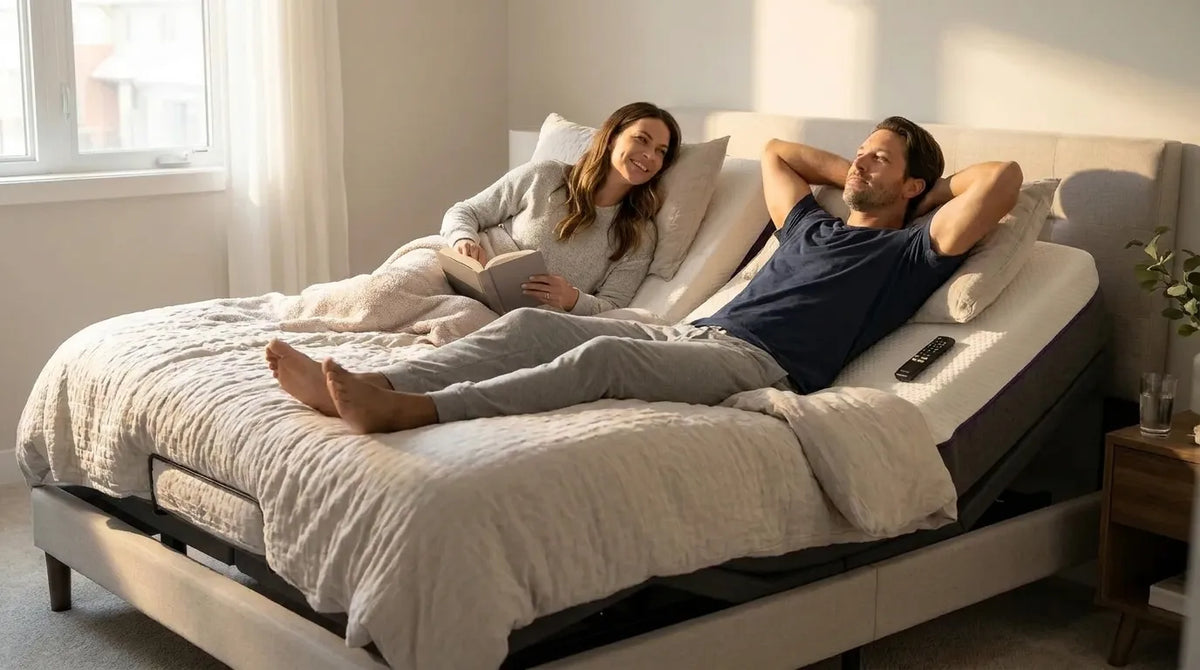
Adjustable Bed for Snoring: Setup, Tips, and What To Know
Written by: Matthew Timmins, Founder and Managing Director, Leva Sleep | Last updated: October 14, 2026
Last updated: October 14, 2026
Key Takeaways
- Head-of-bed elevation at 20–30 degrees often opens the airway and reduces positional snoring.
- Start at 20 degrees, then increase in 5-degree steps while tracking snoring over 1–2 weeks.
- Adjustable beds ease positional snoring but do not treat obstructive sleep apnea, which needs medical care.
- Prioritize bases with at least 30-degree head elevation, split options for couples, and motors under 45 dB.
- Leva Sleep offers anti-snore positioning, Split King and Split Queen options, and complete packages starting at $1,299.
Find your anti-snore angle with Leva Sleep
What Angle Should I Set My Adjustable Bed To For Snoring?
Dr. Phyllis Zee, Chief of Sleep Medicine at Northwestern Medicine, states that an incline of 10 to 30 degrees is typical, with 20 to 25 degrees a good starting point. That range is broad, so here is a step-by-step protocol for finding your own angle.
- Set the head of the bed to 20 degrees on the first night.
- Stay at that setting for 3–4 nights and note whether snoring improves. A recording app or bed partner feedback works well.
- If snoring continues, increase the angle by 5 degrees.
- Cap adjustments at 30 degrees. Above this, comfort often declines and neck strain risk rises.
- Give each new setting 1–2 weeks before deciding whether it helps.
If 20 degrees does not help enough, the next lever is pillow tilt. A dedicated pillow-tilt motor angles the head section independently of the base. If that still does not help, check whether your mattress can articulate fully. A rigid innerspring mattress can limit effective elevation even when the base is set correctly.
The table below maps each angle range to what it targets and when to try it, so you can match your setting to your symptoms.
| Angle | What It Targets | When To Try It |
|---|---|---|
| 7–12° | Mild positional snoring; tongue displacement | First night; also the range most anti-snore presets default to, per a three-month comparison of 15 adjustable bed models |
| 20–25° | Moderate positional snoring; acid reflux; nasal congestion | Recommended starting range, per Dr. Phyllis Zee of Northwestern Medicine |
| 30° | Moderate OSA events; epiglottic and tongue base collapse | After trialing lower angles; a multicenter observational study found 30-degree elevation reduced average AHI from 22.6 to 16.4 events per hour (p < 0.001), a 31% reduction |
Two studies illustrate how much angle and position matter. A 2017 study of 52 adults with mostly mild to moderate OSA found that a 7.5-degree head-of-bed tilt reduced median AHI from 15.7 to 10.7 events per hour and improved minimum oxygen saturation. A 2025 multicenter observational study of 30 adults with OSA found that average AHI fell from 25.7 while flat on the back to 17.8 while elevated at 30 degrees and 14.8 while side sleeping, suggesting position and angle work together.
Shop Leva Sleep's snoring relief collection and find your angle
Positional Snoring Vs. Obstructive Sleep Apnea: How To Tell The Difference
Positional snoring worsens when lying on the back and often improves with head elevation or side sleeping. Obstructive sleep apnea (OSA) involves repeated partial or complete airway collapse during sleep, which causes brief arousals, drops in blood oxygen, and daytime consequences regardless of position.
An adjustable bed addresses positional symptoms; it does not treat obstructive sleep apnea itself. Positional improvement does not reliably distinguish benign positional snoring from OSA, because some OSA is position-dependent, so reduced snoring after head elevation may lessen a symptom without eliminating airway obstruction.
Medical evaluation is warranted when any of the following are present:
- A bed partner witnesses pauses in breathing
- Gasping or choking sounds during sleep
- Morning headaches on waking
- Excessive daytime sleepiness or difficulty concentrating
- Unrefreshing sleep despite adequate hours
If any of those signs appear, do not rely on a questionnaire or prediction tool to rule OSA in or out. The American Academy of Sleep Medicine diagnostic testing guideline (Kapur et al., Journal of Clinical Sleep Medicine, 2017) strongly recommends against using questionnaires or prediction tools alone to diagnose OSA because they miss too many cases.
What To Look For In An Adjustable Base For Snoring
Some adjustable bases support snoring relief better than others. Focus on the features below when you compare options.
Head Elevation Range: The base should reach at least 30 degrees. A multicenter observational study found that 30-degree head-of-bed elevation reduced average AHI from 22.6 to 16.4 events per hour (p < 0.001), a 31% reduction. Bases that cap at 20 degrees cannot reach the clinically studied range.
Split Configuration: For couples where only one partner snores, independent per-side control matters. A Split King uses two Twin XL (38" × 80") mattresses on two independent bases, forming a 76"-wide footprint. A Split Queen uses two 30" × 80" mattresses on two independent bases, forming a 60"-wide footprint. It is rare because the mattress size must be purpose-built.

Mattress Flexibility: Many standard mattresses resist articulation and shorten their own lifespan when forced to bend. A mattress engineered to flex with the base supports long-term performance at elevation.
Motor Quietness: Look for a base rated under 45 decibels at full elevation. A bed that wakes the non-snoring partner during adjustment has solved nothing.
Auto-Snore Detection: When snoring is detected, smart beds typically respond by raising the adjustable base to tilt the head up to a slight angle, changing airway geometry to reduce positional obstruction while minimizing sleep disruption. These systems add convenience but do not treat the underlying condition. Dr. Rafael Pelayo of Stanford Sleep Medicine Center said there is "not a ton of research" on whether smart beds being sold to consumers help improve sleep, and that many studies of smart-bed features have been small, preliminary, or led by manufacturers.
The table below summarizes the four criteria that matter most when comparing bases for snoring relief.
| Feature | Why It Matters For Snoring | What To Look For | Notes |
|---|---|---|---|
| Head elevation range | Must reach the 20–30° clinical range | Minimum 30° head lift | 31% AHI reduction at 30° in multicenter study |
| Split vs. solid | Lets non-snoring partner stay flat | Split King (76") or Split Queen (60") | Split Queen requires purpose-built 30" × 80" mattresses |
| Auto-snore detection | Adjusts head angle without waking user | Microphone or vibration sensor with auto-response | Limited independent research; convenience feature, not a treatment |
| Motor noise | Adjustment must not wake the other partner | Under 45 dB at full elevation | Above 50 dB can wake a sleeping partner |
Leva Sleep As The Specialist Solution: Leva Sleep's anti-snore mode detects snoring and makes micro-adjustments to the head of the bed to gently elevate the head and help open the airway. For couples, Split King and Split Queen configurations provide independent per-side control so the non-snoring partner can stay flat. Complete adjustable bed packages start at $1,299 with a 180-night comfort guarantee, and the Split Queen selection, five packages from $1,399 with 30" × 80" mattresses Leva manufactures and a full line of Split Queen bedding, is the largest in North America.
Explore Leva Sleep's Split Queen adjustable beds for snoring
Can Side Sleepers Use An Adjustable Bed For Snoring?
The criteria above assume back-sleeping elevation. Side sleepers need a different approach. The goal for a side sleeper is a modest head incline, around 10 to 20 degrees, that keeps the spine neutral rather than a steep angle that creates shoulder or hip pressure.
A split configuration is particularly useful here. One partner can side-sleep at a modest incline while the other uses a steeper elevation or stays flat entirely. Neither partner must accept the other’s setting.
See Leva Sleep's complete buying guide for snoring couples for more on side-sleeper configurations.
Adjustable Bed Vs. Wedge Pillow Vs. Anti-Snore Pillow
Each solution elevates the head and upper torso, yet they differ in how reliably they hold that position through the night and how they affect spinal alignment.
A wedge pillow or bed risers used for head-of-bed elevation should elevate the torso, not just the head, because a pillow that flexes the neck without elevating the torso can worsen airway obstruction. Dr. Sam A. Kashani, a board-certified sleep medicine physician, said the biggest issue with propping up the head is doing it with pillows instead of a true incline: "Elevation done correctly helps; the harm comes from elevating the wrong way."
The table below compares how each solution holds an angle through the night and what it does to spinal alignment.
| Solution | How It Works | Angle Achieved | Pros | Limits |
|---|---|---|---|---|
| Adjustable bed | Motorized base elevates head and torso together on a true incline | 0–75° (variable, user-set) | Holds angle all night; adjustable per side; zero gravity preset; can be changed nightly | Higher upfront cost; requires compatible mattress |
| Wedge pillow | Fixed-angle foam wedge elevates upper torso | Typically 30–45° fixed | Low cost; no assembly; portable | Fixed angle cannot be adjusted; can shift during the night; elevates torso only if positioned correctly under the upper back, not just the head |
| Anti-snore pillow | Contoured shape repositions the head and neck | Minimal (head only, typically <10°) | Lowest cost; easy to try | Elevates head without raising torso; can worsen airway obstruction if neck is flexed without torso elevation; no per-side control |
An adjustable bed holds the angle night after night and can be changed per side. A wedge pillow achieves a fixed angle and can shift during the night. An anti-snore pillow repositions the head without raising the torso, which most often flexes the neck without providing the true incline that clinical research has studied.
Compare Leva Sleep's adjustable bases for snoring relief
Who Should Avoid Using An Adjustable Bed For Snoring?
An adjustable bed for snoring suits positional snorers, whose snoring worsens on their back and improves with elevation. It does not suit every situation.
An adjustable bed for snoring is not the right primary intervention for:
- People with untreated obstructive sleep apnea who need medical evaluation and evidence-based treatment such as CPAP or an oral appliance
- People whose snoring is caused by nasal obstruction, deviated septum, allergic rhinitis, or medication side effects, which elevation does not correct
- Anyone whose doctor has recommended a specific intervention that takes precedence
- People who experience neck or back pain, headaches, numbness, or difficulty breathing at elevation, as Dr. Likhita Shaik of University of Iowa Health Care advises against routinely sleeping propped up without a medical reason and recommends reassessing elevation if it causes these symptoms
Anthem's Clinical UM Guideline CG-DME-15 (published 04/15/2026) states that ordinary (non-hospital) beds and power or manual lounge beds, including named consumer adjustable bed products, are classified as not medically necessary because they are sold as furniture and are not primarily medical in nature or primarily used to treat disease or injury. This classification matters for anyone expecting insurance reimbursement. A consumer adjustable base purchased for snoring relief counts as a furniture purchase, not a covered medical device.
For guidance on adjustable beds and sleep apnea specifically, see Leva Sleep's sourced buying guide.
Frequently Asked Questions
Do Adjustable Beds Help With Sleep Apnea?
Adjustable beds can reduce positional symptoms, but they do not treat obstructive sleep apnea. As noted earlier, the 30-degree study showed a meaningful AHI drop that still left participants in the moderate OSA range, so elevation works best as an adjunct to CPAP or an oral appliance rather than a replacement. Anyone with suspected OSA should seek clinical evaluation and objective sleep testing.
How Much Will Medicare Pay For An Adjustable Bed?
Medicare generally does not cover consumer adjustable beds for snoring. Consumer adjustable bases are classified as furniture and have no HCPCS billing code, so no Medicare claim can be filed for them. Medicare Part B may cover a hospital-grade bed, supplied by a Medicare-enrolled DME provider, only when strict criteria are met. CMS Local Coverage Determination L33820 states that a fixed-height hospital bed is covered only if the beneficiary has a medical condition requiring body positioning not feasible with an ordinary bed, requires the head of the bed elevated more than 30 degrees most of the time due to congestive heart failure, chronic pulmonary disease, or problems with aspiration, or requires traction equipment that can only be attached to a hospital bed. Snoring alone does not meet these criteria. Confirm coverage details with your provider and Medicare plan.
How Long Until I Notice A Difference?
Most people need 1–2 weeks of consistent use at a given angle before they can judge effectiveness. Tracking snoring response over two weeks is the recommended approach. If side sleeping or head elevation reduces snoring, positional therapy is likely appropriate. If snoring persists in all positions after two weeks, the obstruction is probably anatomic rather than gravitational, and clinical evaluation becomes the next step.
Will An Adjustable Bed Help If My Partner Snores?
A split configuration lets the non-snoring partner stay completely flat while the snoring partner elevates independently. As described above, the Split King and Split Queen each use two independent bases, and the Split Queen’s 60" footprint fits bedrooms that cannot accommodate a King. Leva Sleep offers both configurations with independent per-side control, whisper-quiet motors, and anti-snore positioning, including a Split Queen selection of five packages from $1,399 with 30" × 80" mattresses Leva manufactures in-house.
Explore Leva Sleep's split configurations for snoring couples
The Right Solution For Positional Snoring
Snoring disrupts sleep for both partners, and 31% of US adults have already opted for a "sleep divorce" (Atomik Research for the American Academy of Sleep Medicine, June 2025, n=2,007). Most people who snore do so positionally, meaning their snoring worsens on their back. For them, head-of-bed elevation in the 20–30 degree range is the most practical intervention available at home.
An adjustable base holds that position reliably, night after night, without stacks of pillows that shift, flex the neck, or fail to elevate the torso. It also lets couples fine-tune angles per side instead of compromising on a single flat setting.
Leva Sleep is a specialist adjustable bed company serving the United States, with a luxury showroom in La Jolla, California. Leva's anti-snore positioning, Split King and Split Queen configurations with independent per-side control, 180-night comfort guarantee, and complete packages starting at $1,299 create a focused solution for positional snoring. The largest selection of Split Queen adjustable beds in North America, five packages from $1,399 with 30" × 80" mattresses Leva manufactures, means couples in smaller bedrooms can still choose independent elevation.
See Leva Sleep's 2026 guide to the best adjustable beds for couples with snoring.
Partner Snores? Your Adjustable Base Solution, Step By Step walks through the full decision process from angle-setting to configuration selection.
Transform your sleep with a Leva Sleep adjustable bed