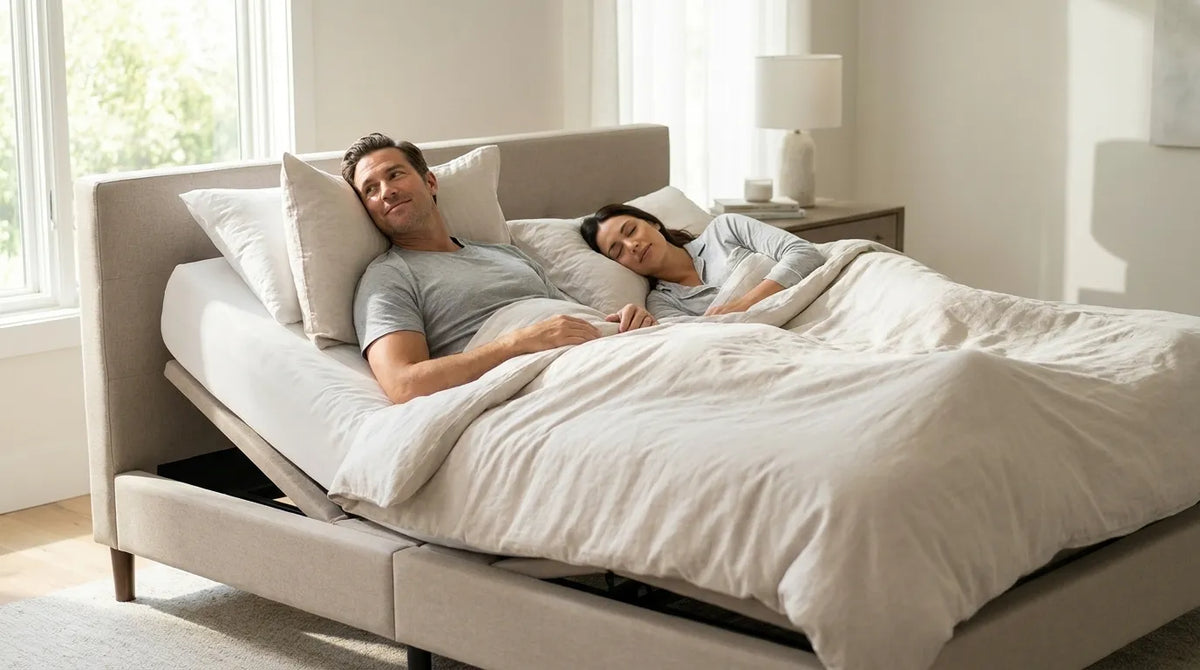
The Best Mattress Setup for Couples With Sleep Apnea
Written by: Matthew Timmins, Founder and Managing Director, Leva Sleep
Key Takeaways
- A flexible mattress on an adjustable base lets one partner elevate 20–45 degrees for sleep apnea while the other stays flat.
- Split-head, Split King, and two Twin XL setups all provide independent head elevation, while a single shared mattress keeps both partners in the same position.
- Split configurations reduce motion transfer, allow independent firmness, and support CPAP use without disturbing the non-apnea partner.
- Trade-offs include split bedding, a center gap, higher cost, and the need for a bedroom that fits the chosen footprint.
- Leva Sleep manufactures purpose-built Split Queen and Split King systems with whisper-quiet motors and bedding designed for adjustable bases.
Browse Leva Sleep Adjustable Bed Systems
How Flexible Mattresses Support Sleep Apnea Couples
A flexible mattress is built to bend smoothly on an adjustable base. Most standard mattresses resist that motion and can wear unevenly at the hinge point. Repeated flexing can also create structural stress in traditional designs.
A mattress built to flex avoids those problems by using materials that move with the base. High-density foam, pocketed coils, and latex all return to a flat profile without delaminating or permanently distorting.
Key terms used throughout this article:
- Split King: Two Twin XL (38″ × 80″) mattresses on two independent bases, forming a 76″-wide King footprint. Each side adjusts separately.
- Split Queen: Two 30″ × 80″ mattresses on two independent bases, forming a 60″-wide Queen footprint. Each side adjusts separately. This size is rare because it must be purpose-built and does not exist in the standard supply chain.
- Split-Head / Flex-Top: A single mattress footprint where only the head sections adjust independently.
- Zero Gravity: Head and knees slightly elevated, which distributes body weight evenly and reduces lumbar pressure.
- Anti-Snore Mode: A preset or automatic micro-adjustment that gently elevates the head to help open the airway.
The scale of the problem these setups address is significant. A June 2025 survey of 2,007 US adults conducted by Atomik Research for the American Academy of Sleep Medicine found that 31% of US adults have opted for a "sleep divorce", regularly sleeping in a separate room from a partner. Among adults aged 35–44, the figure rises to 39%. A further 37% reported going to sleep at different times to accommodate a partner.
How One Partner Elevates While The Other Sleeps Flat
Only specific configurations let one partner elevate while the other stays flat. Couples navigating sleep apnea usually choose from four realistic setups:
- Split-Head / Flex-Top Mattress: One mattress with independently adjustable head sections. Each partner’s head can elevate separately while the foot sections remain shared or synchronized.
- Split King (Two Twin XLs on Two Independent Bases): Fully independent control of every position on each side, including head, foot, and lumbar. This setup suits couples with significantly different needs.
- Two Twin XLs on Separate Bases: Functionally identical to a Split King but sometimes purchased as separate units. Each side remains fully independent.
- One Adjustable Base Under a Shared Mattress: Both partners move together because the mattress is one piece. One partner cannot elevate while the other stays flat, so this setup does not solve the positioning problem for apnea couples.
The first three configurations allow independent head elevation. The fourth keeps both partners in the same position. For a couple where one partner needs 30–45 degrees of head elevation and the other sleeps flat, only configurations one through three work.
Leva Sleep’s Split Queen collection offers true split adjustability with two fully independent bases and purpose-built 30" × 80" mattresses, a configuration most retailers do not offer.

Explore Leva Sleep’s Split Adjustable Configurations
Split-Head Vs. Split King Vs. One Shared Mattress: The Three Setups Compared
The table below compares the three main setups on the questions that matter most for apnea couples. It shows what each configuration does for the apnea partner and for the other partner, and whether each side can move independently.
| Configuration | What It Does For The Apnea Partner | What It Does For The Other Partner | Footprint Width | Where It Fails |
|---|---|---|---|---|
| Split-Head / Flex-Top Mattress | Head section elevates independently; foot section is shared | Head section stays flat if preferred; foot movement is shared | 60″ (Queen) or 76″ (King) | Foot articulation is not independent; firmness is the same on both sides |
| Split King (Two Twin XLs) | Full independent head, foot, and lumbar control; each Twin XL measures 38″ × 80″ | Side stays completely flat or at any preferred position; independent firmness available | 76″ (two 38″ Twin XLs) | Requires a room that fits a King footprint; split bedding required; center gap between halves |
| One Adjustable Base Under A Shared Mattress | Head elevates, but both partners move together | Must match the apnea partner’s elevation with no independent control | 60″ (Queen) or 76″ (King) | Keeps both partners at the same angle, so it does not solve independent positioning |
A true Split Queen requires two 30″ × 80″ mattresses, a size that does not exist in the standard mattress supply chain. A Split Queen’s combined footprint is 60″ × 80″, matching a standard Queen’s overall dimensions. Leva Sleep manufactures the 30″ × 80″ mattresses in-house, which is why five Split Queen packages exist at Leva when most retailers offer none.
How Noticeable Is The Center Gap In A Split King?
On a Split King or Split Queen, a gap sits between the two halves. The center gap between two Twin XL mattresses is typically 0.5 to 2 inches, depending on the frame and bedding used.
A mattress bridge or a snug-fitting mattress protector can minimize that space. A split king bridge pad costs roughly $30–$80.
Most couples stop noticing the gap during everyday sleeping on their own side. It becomes obvious when lying in the middle of the bed or cuddling. Lying on top of one shared flat sheet or lightweight blanket stretched across both mattresses creates a continuous surface and helps keep separate bedding layers from shifting.
Leva Sleep’s Split Queen sheet sets, including the Alpine Pure Cotton and Bamboo Breeze adjustable bed sheet sets, are cut for split configurations with extra elastic that holds at full elevation. That small detail is one many retailers never address.
Real Trade-Offs Of A Split King Adjustable Bed
A split adjustable bed involves real trade-offs that couples should understand before purchasing:
- Split bedding is required. A Split King uses two Twin XL fitted sheets instead of one King fitted sheet, which adds a few extra minutes each time the bed is made. Standard King fitted sheets will not stay on independently moving mattresses.
- Two mattresses mean two surfaces to maintain. Each half develops its own wear pattern. If one side needs replacing before the other, that side can be replaced independently.
- The bed is heavy and not easily moved. Split King adjustable beds do not suit people who frequently rearrange furniture or move homes.
- Some couples prefer one shared surface. The center gap and the visual separation of two mattresses feel wrong to some couples, especially those who sleep in the center of the bed or move across it frequently.
- Cost is higher than a standard setup. Adding two adjustable bases under a Split King instead of one under a standard King can widen the total cost gap to $2,000–$3,000 compared with a non-split configuration.
Content that admits limits earns more trust. A split adjustable bed is the right answer for many couples navigating sleep apnea, though not for every couple.
What The Non-Apnea Partner Actually Experiences
The skeptical partner usually wants to know how their own sleep will change before agreeing to a significant purchase. Here is what changes on the other side of the bed and what stays familiar:
- Their side stays flat if they want it flat. Independent bases keep each partner’s position separate, so the non-apnea partner can sleep exactly as they always have.
- Each partner chooses their own firmness. On a Split King or Split Queen with two separate mattresses, firmness does not need to match. Leva’s Heavenly Hybrid is available in both Luxury Firm and Medium/Plush in the 30″ × 80″ Split Queen size.
- Quiet motors reduce sleep disruption. Basic adjustable bases sold as add-ons at mattress chains created the “noisy adjustable bed” reputation. Leva’s systems use whisper-quiet German motors with smooth, gradual travel.
- CPAP use fits comfortably with a split setup. Each side has its own head angle and its own space. The apnea partner’s CPAP machine sits on their nightstand and interacts only with their side of the bed, so the non-apnea partner’s sleep environment stays familiar.
- Motion isolation improves noticeably. Separate mattresses reduce motion transfer. Many couples only realize how much less motion they feel after they sleep in a standard King on vacation and suddenly notice each other moving again.
See How Leva Sleep Systems Support Both Partners
The Clinical Case For Head Elevation In Sleep Apnea
The partner-experience case is practical, and the clinical case explains why head elevation is more than a comfort preference. Clinicians commonly recommend sleeping with the head elevated for conditions including sleep apnea, acid reflux, and post-surgical recovery.
An adjustable base provides that position at home, night after night, without stacking pillows. Elevating the head gently opens the airway, which is why anti-snore positioning reduces snoring for many sleepers.
The mechanism: in obstructive sleep apnea, the soft palate, tongue base, and epiglottis relax during sleep. Gravity pulls these structures backward when lying flat. Tilting the body forward shifts that gravitational load and can keep the airway open for some anatomies.
A 2026 study published in Laryngoscope found that 30-degree head-of-bed elevation reduced average apnea-hypopnea index (AHI) from 22.6 to 16.4 events per hour, a 31% reduction, in patients with obstructive sleep apnea. The same study reported that combining 30-degree elevation with side sleeping reduced average AHI further to 11.7 events per hour.
The Semi-Fowler position, a head-of-bed elevation of 30 to 45 degrees, is described as the most commonly used positioning angle in home care and clinical settings for patients with respiratory conditions including sleep apnea. The practical range for home use on an adjustable base is 20–45 degrees, adjusted based on comfort and anatomy. Clinical guidance suggests starting around 30 degrees and adjusting upward in small increments over several nights, because results depend on anatomy, apnea severity, and whether the apnea is positional.
What A Couple’s Adjustable Setup Actually Costs
Couples’ adjustable setups fall into four price tiers, from entry-level packages under $2,000 to luxury systems above $5,000. The table below shows the range and representative packages in each tier; all pricing reflects the Leva Sleep US catalog as of August 2026.
| Tier | Price Range (USD) | Representative Packages |
|---|---|---|
| Entry | $1,299 – $1,899 | Cala, Vela, Heavenly Response |
| Core | $2,499 – $2,999 | Passions Adore, Sereno Signature |
| Premium | $3,799 – $4,499 | Tempur-Pedic ProAdapt, Stearns & Foster Estate Winslet |
| Luxury | $5,999 – $8,999+ | Natural Fusion Reserve Collection, Aireloom |
Split Queen packages start at $1,399 (Cala). Additional options are available at $1,899 (Vela, Heavenly Response), $2,699 (Passions Adore), and $2,799 (Sereno Signature). Components purchased separately include adjustable bases from $1,299 (Elite 250) to $2,199 (Quest Elite); Leva mattresses from $949 (Heavenly Response) and $1,399 (Heavenly Hybrid); the Leva Sleep System heating and cooling layer at $1,299; and sheet sets at $159–$230. Financing is available, including 0% APR options.
Who Probably Should Not Start With A Split Adjustable Bed
A split adjustable bed is not the right first step for every couple navigating sleep apnea. In some situations, other interventions come first:
- When the apnea-hypopnea index is high or oxygen desaturation is dangerous. No bed position replaces CPAP’s positive airway pressure for moderate-to-severe obstructive sleep apnea. Positional therapy is best suited to clearly positional OSA, especially with low non-supine event rates and mild-to-moderate disease; CPAP remains superior for overall physiologic control. Head elevation complements CPAP rather than replacing it.
- When a sleep study has not been done. Loud, frequent snoring with pauses, gasps, or choking sounds is often a sign of obstructive sleep apnea that warrants a medical evaluation. A bed adjustment does not provide a diagnosis.
- When a wedge pillow is sufficient. For pure head elevation, a wedge pillow achieves the same incline as an adjustable bed. An adjustable base adds the convenience of changing angles and comfort positions, which some people find easier to maintain long-term. For mild, positional apnea, a wedge pillow can be a lower-cost starting point.
- When the couple moves frequently. Split adjustable beds are heavy, complex to disassemble, and poorly suited to frequent relocation.
- When budget is the primary constraint. A complete split adjustable system starts at $1,299. If that is not feasible, a CPAP adjustment or positional therapy device is usually a more appropriate first step.
FAQ
What Is The Difference Between A Split-Head Mattress And A Split King?
A split-head mattress, also called a flex-top, is a single mattress where only the head sections are divided. Each partner’s head can elevate independently while the foot of the bed remains one connected surface.
A Split King uses two entirely separate Twin XL mattresses (each 38″ × 80″) on two fully independent adjustable bases. On a Split King, every position, including head, foot, and lumbar, is controlled independently per side. On a split-head mattress, foot articulation is shared.
Couples who need full independent positioning, including different foot elevation, usually do better with a Split King. Couples who mainly want independent head elevation and prefer one continuous mattress surface often find a split-head configuration sufficient.
Do You Fall In The Crack Of A Split King?
The gap between the two Twin XL mattresses in a Split King is typically 0.5 to 2 inches. The section above explains how to minimize that gap with bridges, protectors, and split-friendly sheets.
What Are The Downsides Of A Split King Adjustable Bed?
The main practical downsides are split bedding, a center gap, a heavy frame that is hard to move, two surfaces to maintain, and higher total cost than a standard King setup. Some couples also prefer one shared sleeping surface and dislike the visual and physical separation of two mattresses.
Can One Partner Elevate While The Other Sleeps Flat?
Yes, when the couple uses a split-head mattress, a Split King, or two Twin XLs on separate bases. A single adjustable base under a shared mattress moves both partners together. The configuration comparison above shows how each option handles independent elevation.
What Mattress Works On An Adjustable Base Without Breaking Down?
Mattresses engineered for adjustable bases use materials that flex without relying on a connected spring grid. Memory foam, latex, and pocketed-coil hybrids are the most dependable pairings.
Traditional Bonnell and continuous-coil innerspring mattresses are poor matches because their interconnected structures can experience structural stress when repeatedly bent. Among foam types, higher-density foam resists compression set significantly better than budget foam, while lower-density foam may sag within two to three years under regular articulation.
Leva Sleep manufactures its own mattresses, the Heavenly Hybrid (pocketed coil) and Heavenly Response (all-foam), specifically to flex with the base night after night. They are sold as part of a matched system rather than as a base sold separately.
What Is The Best Mattress Setup For Couples Who Sleep Differently?
The most flexible setup for couples with different sleep needs is a split configuration that allows independent firmness and independent positioning on each side. A Split King or Split Queen with two separate mattresses lets each partner choose their own firmness level, such as one side Luxury Firm and the other Medium/Plush, while also controlling their own head and foot elevation.
A single shared mattress, no matter how well engineered, forces a firmness compromise. For couples in a Queen-sized bedroom, Leva Sleep’s Split Queen system with the Heavenly Hybrid in two different firmness levels solves both the firmness and positioning challenges in a 60″ footprint.
Conclusion: Choosing The Right Setup For Sleep Apnea Couples
A flat bed forces one geometry on two different bodies. For couples where one partner has sleep apnea, that geometry often fails the person who needs airway support every night.
The solution is a split configuration on an adjustable base, where one side elevates 20–45 degrees and the other stays exactly as the non-apnea partner prefers. This approach supports clinical guidance on head elevation while preserving comfort for both people.
Leva Sleep is a specialist adjustable bed company serving the United States, with a luxury showroom in La Jolla, California. Across nine years and more than 25,000 customers, Leva has built complete adjustable sleep systems: bases with independent per-side control, mattresses engineered to flex, per-side heating and cooling, and bedding designed for movement.
Leva offers one of the largest selections of Split Queen adjustable beds in North America, with 30″ × 80″ mattresses manufactured in-house and a full line of Split Queen bedding and accessories. The Split King is available for couples with larger bedrooms. Every system is delivered by Leva’s own trained white-glove team and backed by a comfort guarantee.
Schedule A Showroom Visit Or Start Building Your Leva System Online