Anti Snore Adjustable Bed: Angles, Features & When to Skip
Written by: Matthew Timmins, Founder and Managing Director, Leva Sleep
Key Takeaways
- An adjustable bed can ease positional snoring by raising the head 10 to 15 degrees, up to 30 degrees for some people. It does not treat obstructive sleep apnea.
- Anti-snore mode uses either a manual preset or sensor-driven automatic adjustment to elevate the head. The angle affects snoring relief, while the feature affects convenience.
- Independent split bases matter for couples when only one partner snores, because one side can elevate without tilting the other.
- Begin at 10 to 15 degrees, track results with a snoring app, and adjust gradually. An adjustable base holds the exact angle night after night, unlike pillows or wedges.
- Leva Sleep focuses on Split Queen adjustable beds for couples, with complete systems designed for shared bedrooms and different sleep needs.
Shop Leva Sleep Adjustable Beds For Snoring Relief
Do Adjustable Beds Help With Snoring?
An adjustable bed can reduce positional snoring by elevating the head between roughly 10 and 30 degrees. This elevation counteracts gravity-driven collapse of the tongue and soft palate into the airway, which is the primary mechanical cause of snoring in many back sleepers. This approach supports lifestyle-level snoring relief rather than medical treatment of sleep apnea.
When the body lies flat, soft tissue in the throat relaxes and gravity pulls it toward the back of the airway. The resulting partial obstruction causes the vibration heard as snoring. Sleep specialists recommend elevating between 7.5 and 30 degrees to increase the upper airway's cross-sectional area and reduce tissue collapse, with 10 to 15 degrees cited as the most practical starting point.
The effective angle varies by person. Neck circumference, body weight, sleep position, nasal congestion, and alcohol use all influence how much elevation helps. A 2022 study tracking 25 snorers over more than 1,000 nights found that a 12-degree incline reduced snoring duration by 7%, nighttime awakenings by 4%, and increased deep sleep by 5%. Higher angles can create larger reductions. A 2026 study in Laryngoscope reported that 30-degree head-of-bed elevation reduced the average apnea-hypopnea index from 22.6 to 16.4 events per hour, a 31% reduction. Angles above 30 degrees often cause neck strain and sliding, which can worsen comfort and sleep quality.
A practical way to find a personal angle starts at 10 to 15 degrees. Hold that position for several nights, track results using a snoring app such as SnoreLab or Sleep Cycle, then adjust in small steps. An adjustable base holds the same geometry night after night. A foam wedge softens over time, a stack of pillows shifts, and bed risers stay fixed and crude for fine-tuning.
Find Your Snoring-Relief Angle With A Leva Sleep Adjustable Base
What Is Anti-Snore Mode On An Adjustable Bed And Does It Actually Work?
Anti-snore mode uses a preset or automatic micro-adjustment that gently elevates the head section of an adjustable base to help open the airway. Depending on the base, it works as a button the sleeper presses before bed or a sensor-driven system that responds automatically during the night.
A manual preset raises the head to a saved position when activated. The sleeper or their partner presses a button on the remote or app. This approach can work well, but it depends on someone being awake enough to trigger it. Active snore detection uses sensors embedded in the base to listen for snoring patterns and then gradually raises the head without any manual trigger. The anti-snore preset on adjustable beds typically raises the head of the bed by around 7 degrees, though this varies by manufacturer.
Both approaches use the same airway mechanism. The difference lies in whether the adjustment happens only when someone presses a button or continues automatically while both partners stay asleep.
Automatic Snore Detection Vs. Manual Anti-Snore Preset: What Is The Difference?
The angle does the therapeutic work. The feature only changes how easy it feels to apply that angle consistently. A manual preset at a lower price point can work as well as a smart base for a consistent back-sleeper who presses a button before sleep. A premium smart base adds consistency and autonomy for people who want the bed to respond on its own.
The table below breaks down the main feature types, what each one does, and who each suits best.
| Feature Type | What It Does | Who It Suits |
|---|---|---|
| Manual Anti-Snore Preset | Head elevation saved to a remote button, which activates when pressed. Typically raises the head approximately 7 degrees. | Consistent back-sleepers who can activate before sleep, and couples where the non-snoring partner is willing to trigger it. |
| Zero-Gravity Preset | Head and knees elevate together to distribute body weight, reduce spinal compression, and support circulation. All six smart adjustable bases in Smart Home Explorer's May 2026 review include a zero-gravity preset. | Sleepers with lower back pressure or circulation concerns, and anyone who prefers a combined head-and-knee position over head-only elevation. |
| Active Snore Detection (Sensor-Driven) | Embedded acoustic or biometric sensors detect snoring patterns and automatically raise the head during sleep without manual activation. | Couples where the snorer cannot reliably activate a preset, or anyone who wants the bed to respond without waking either partner. |
| Sleep-Tracking Integration | Sensors track heart rate, respiratory rate, movement, and sleep stages. Data feeds an app that logs position history and may suggest adjustments. | Data-oriented sleepers who want long-term sleep records, especially when snoring patterns vary from night to night. |
Compare Leva Sleep's Snoring Relief Collection
Explore Leva Sleep Adjustable Bases And Smart Features
What Angle Should You Raise An Adjustable Bed For Snoring?
For most people, 10 to 15 degrees, roughly 4 to 6 inches of head lift, offers the most practical starting point. Thirty degrees often produces greater reductions in snoring but can create neck strain at sustained angles. Anatomy, body weight, sleep position, and nasal congestion all shift the effective angle for each person.
In practice, 10 degrees feels like a gentle incline that many sleepers barely notice. Thirty degrees feels like a meaningful tilt, noticeable yet often comfortable when the entire upper body is elevated instead of just the head. The Maniaci et al. 2026 Laryngoscope study advises raising the whole torso rather than just the head, because propping up on pillows bends the neck and can worsen obstruction. An adjustable base elevates from the shoulder upward, which creates more favorable geometry. Stacking pillows lifts only the head while the shoulders stay flat. That position bends the neck forward and compresses the throat, which can worsen snoring rather than reduce it.
A wedge pillow can reach a similar angle but often shifts position through the night as the sleeper moves and softens over months of use. An adjustable base holds the angle precisely, night after night, and changes in seconds if the angle needs adjustment. A wedge works as a lower-commitment way to test whether elevation helps at all before investing in a base. Bed risers under the head-end legs at around six inches cost very little and deliver the same basic elevation mechanism for testing. If elevation helps, a motorized base delivers that result more reliably over time.
Do Adjustable Beds Help Sleep Apnea?
Angle and feature only matter when elevation suits the underlying condition. An adjustable bed does not treat obstructive sleep apnea (OSA), even though it can reduce snoring and ease breathing for some people.
According to the American Sleep Apnea Association, obstructive sleep apnea is a sleep disorder in which the upper airway narrows and breathing stops or slows for more than 10 seconds at a time, repeatedly, dozens to hundreds of times per night. A sleep study is the only way to confirm whether snoring relates to sleep apnea. Primary or positional snoring, by contrast, involves vibration of narrowed upper-airway tissues while airflow continues.
A key clinical difference involves whether breathing actually stops. In OSA, bed partners often report silent pauses followed by gasping, snorting, or choking, whereas primary snoring does not include witnessed pauses. Daytime symptoms such as excessive sleepiness, morning headaches, or waking unrefreshed align more closely with OSA than with uncomplicated snoring.
Clinicians often recommend sleeping with the head elevated for conditions including sleep apnea, acid reflux, and post-surgical recovery. An adjustable base provides a practical way to maintain that position at home without stacking pillows. Elevation can reduce apnea severity in some patients, yet medical treatment still needs to address the underlying disorder. The American Academy of Sleep Medicine recommends follow-up sleep testing to assess response to non-PAP interventions for OSA.
Symptoms that call for a clinician rather than a bedding solution include:
- Witnessed pauses in breathing during sleep
- Gasping or choking sounds during sleep
- Excessive daytime sleepiness, including falling asleep while reading or driving
- Morning headaches felt on both sides of the front of the head
- Waking unrefreshed after a full night of sleep
- High blood pressure occurring alongside other symptoms
Why Independent Sides Matter When Only One Partner Snores
Many couples shop for adjustable beds because one partner snores and the other does not want to sleep tilted. A standard queen or king adjustable base moves as a single unit, so elevating one side always elevates both. A split configuration solves that conflict by giving each partner an independent base with its own motor and controls.
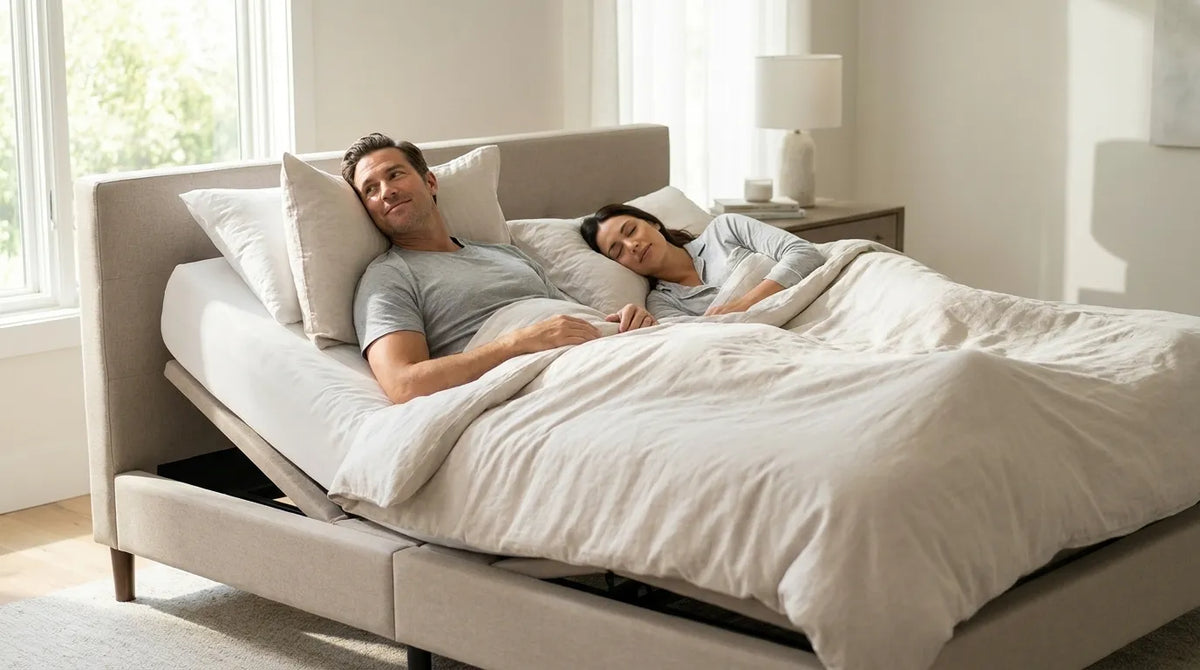
A split adjustable base with independent sides lets the snorer sleep inclined while their partner stays flat. Bed risers and mattress wedges tilt both people at once, which rarely works as a long-term couple solution.
The configuration choice then becomes Split King or Split Queen.
- Split King: Two Twin XL (38" × 80") mattresses on two independent bases. Total footprint: 76 inches wide. Requires roughly 76 inches of wall space.
- Split Queen: Two 30" × 80" mattresses on two fully independent bases. Total footprint: 60 inches wide. Requires roughly 60 inches of wall space.
That 16-inch difference often decides whether the room layout works. Condos, apartments, older homes with smaller primary bedrooms, and couples downsizing frequently need adjustability for snoring, hips, knees, or reflux. These same households often have rooms where a King simply does not fit comfortably.
Leva Sleep focuses on Split Queen adjustable beds for these rooms, with five packages from $1,399, 30" × 80" mattresses manufactured in-house, and a full line of Split Queen bedding and accessories built to fit them. Many retailers skip true Split Queen systems because the mattress size falls outside the standard supply chain.

In a June 2025 survey of 2,007 US adults conducted by Atomik Research for the American Academy of Sleep Medicine, 31% of American adults reported a “sleep divorce,” regularly sleeping in a separate room from their partner. Among adults aged 35 to 44, the figure rises to 39%. A split adjustable bed gives many of these couples a way to share a room again.
For larger rooms, Leva's Split King adjustable bed offers the same independent control with a wider footprint.
See Split Queen And Split King Options From Leva Sleep
Mattress Compatibility: Which Mattresses Flex With An Articulated Base
Mattress construction determines whether it can flex safely on an adjustable base. Traditional innerspring mattresses with a rigid perimeter often do not flex well, and using one on an adjustable base can void the mattress warranty. Memory foam, latex, and hybrid mattresses with individually pocketed coils usually work better.
The most reliable option involves mattresses engineered specifically to articulate with the base. These models are built to flex night after night without wearing unevenly or breaking down at the bend points. Leva Sleep designs its mattresses as part of a matched system so the base and mattress work together rather than as separate purchases.
What To Check Before Buying An Anti Snore Adjustable Bed
A short checklist helps separate marketing claims from features that actually affect nightly sleep. Review each point before you buy.
- Motor Noise: A bed that wakes a partner every time it adjusts has solved very little. Whisper-quiet motors matter in a shared bed.
- Adjustment Range: Confirm the base reaches the angle needed, typically 10 to 30 degrees for snoring relief.
- Anti-Snore Feature Type: Identify whether the anti-snore function uses a manual preset or an active sensor. The airway mechanism stays the same, while convenience differs.
- Split Configuration: When only one partner snores, a split base allows one side to elevate without tilting the other.
- Mattress Compatibility: Confirm that the existing mattress is rated for articulation, or plan to replace it with a compatible model.
- Bedding: Standard fitted sheets often pop off when the bed articulates. Look for deep pockets and extra elastic designed for adjustable bases.
- Remote Or App Control: Check whether the anti-snore preset can be activated without fully waking either partner.
- Delivery And Setup: White-glove delivery and in-room setup simplify installation for a system of this size. A box on the doorstep leaves the heavy lifting to you.
Why Leva Sleep Focuses On Couples And Split Configurations
Leva Sleep specializes in complete, personalized adjustable bed systems for couples. Over nine years and more than 25,000 customers, the company has focused on problems that often send one partner to the guest room, including snoring, different comfort preferences, different temperature needs, and the geometry of two bodies that do not match.
Leva offers roughly 15 to 20 adjustable base models, compared with 3 to 5 at many mattress retailers. Complete adjustable bed packages range from about $1,299 to $8,999+, with financing options that include 0% APR offers. Leva states a 180-night comfort guarantee, while the US store currently displays a 60-night guarantee and a comfort exchange fee, which buyers should clarify before purchase.
On Split Queen systems, Leva provides five packages from $1,399, with 30" × 80" mattresses manufactured in-house in both all-foam and hybrid pocket-coil constructions, plus a full line of Split Queen bedding and accessories. This configuration fits the room size most couples actually have and remains rare at traditional retailers.
Leva systems include anti-snore positioning that gently elevates the head, independent split articulation, lumbar control, pillow tilt, zero-gravity positioning, and whisper-quiet German motors. Leva Sleep mattresses are made in the United States, and about half of the US lineup is unique to the American market, including premium California-made brands. The assortment also includes Aireloom, Tempur-Pedic, Stearns & Foster, Beautyrest, Serta, Kingsdown, and Helix, paired with the right base by specialists who understand how each mattress should perform on an adjustable frame.
Leva serves customers across the United States, with a luxury showroom in La Jolla, California, and in-house white-glove delivery and setup. For couples whose primary concern is pain relief alongside snoring, Leva's pain relief collection addresses both needs in a single system.
Build A Couple-Focused Adjustable Bed System With Leva Sleep
Frequently Asked Questions
How Does Anti-Snore Mode Work On An Adjustable Bed?
Anti-snore mode uses a preset or automatic micro-adjustment that gently elevates the head section of an adjustable base to help open the airway. On most bases, it functions as a manual preset that the sleeper or partner activates by pressing a button on the remote or in an app. On bases with active snore detection, embedded sensors listen for snoring patterns and raise the head automatically during sleep. Both approaches use the same airway mechanism, while automation changes how often the feature works without waking anyone.
Which Angle Range Usually Helps With Snoring?
Sleep specialists commonly cite a range of roughly 10 to 30 degrees. Ten to 15 degrees offers the most practical starting point for most people, noticeable yet comfortable. Thirty degrees can reduce snoring events more strongly but may cause neck strain if only the head elevates instead of the full upper body. The right angle varies by anatomy, body weight, sleep position, and nasal congestion. Start at 10 to 15 degrees, hold that position for several nights, track results, and adjust gradually. An adjustable base makes this process straightforward because the angle changes in seconds and holds precisely.
Can An Adjustable Bed Replace Sleep Apnea Treatment?
An adjustable bed cannot replace medical treatment for obstructive sleep apnea. Elevation can reduce snoring and may ease apnea severity for some people, yet it does not cure the underlying disorder. Only a clinician-ordered sleep study or home sleep apnea test can confirm whether snoring relates to sleep apnea. Symptoms that warrant a clinician include witnessed pauses in breathing, gasping or choking during sleep, excessive daytime sleepiness, and morning headaches. A sleep specialist evaluation provides the correct next step when these signs appear.
Should I Choose Automatic Snore Detection Or A Manual Preset?
A consistent back-sleeper who can activate a preset before sleep often does well with a manual preset at a lower price point. The airway mechanism matches that of a sensor-equipped base. Active snore detection adds autonomy. The base responds during sleep without either partner needing to wake up and press a button. That autonomy often justifies the premium for couples where the snorer cannot reliably activate a preset or where waking the non-snoring partner defeats the purpose.
Will A Split Adjustable Bed Help If Only My Partner Snores?
A standard queen or king adjustable base moves as a single unit, so elevating one side always elevates both. When only one partner snores and the other prefers to stay flat, a split configuration solves the problem. Two independent bases, each with its own motor and controls, let the snoring side elevate while the other side stays level. A Split Queen, at 60 inches wide, fits most bedrooms that already hold a standard queen. A Split King requires roughly 76 inches of wall space and suits larger rooms.
How Do I Choose Between A Split King And A Split Queen?
Room size usually decides the choice. A Split King uses two Twin XL (38" × 80") mattresses side by side, for a total width of 76 inches. A Split Queen uses two 30" × 80" mattresses, for a total width of 60 inches. That 16-inch difference often determines whether the room still feels comfortable. If the bedroom already fits a standard King, a Split King works. If the bedroom fits a standard Queen, a Split Queen delivers full independent adjustability without requiring a larger room.
Will My Current Mattress Work On An Adjustable Base?
Many mattresses are not built to bend repeatedly. Memory foam, latex, and hybrid mattresses with individually pocketed coils usually work with adjustable bases. Traditional innerspring mattresses with a rigid perimeter or continuous coil design often do not flex adequately and can wear unevenly or void their warranty on an articulating base. The safest approach involves confirming compatibility with the mattress manufacturer before purchasing a base or selecting a mattress engineered specifically to flex as part of a matched system.
When Should I See A Clinician Instead Of Buying An Adjustable Bed?
An adjustable bed addresses positional snoring related to gravity and soft tissue collapse when the body lies flat. Medical evaluation still matters when symptoms suggest a deeper issue. See a clinician if snoring occurs alongside witnessed pauses in breathing, gasping or choking sounds during sleep, excessive daytime sleepiness, morning headaches, difficulty concentrating, or high blood pressure with other symptoms. Loud snoring that has worsened recently also justifies medical evaluation. A sleep study remains the only definitive way to distinguish primary snoring from obstructive sleep apnea.
Conclusion
Elevating the head of the bed between 10 and 30 degrees gently opens the airway by counteracting gravitational collapse of soft tissue that drives positional snoring. Manual presets and active sensors both deliver that elevation, while automation mainly changes how easily the angle stays consistent through the night. Adjustable beds can reduce snoring for many positional snorers, yet anyone with witnessed breathing pauses, gasping, or excessive daytime sleepiness should consult a clinician before relying on bedding changes.
For couples where one partner snores and the other does not, a split configuration lets one side elevate without changing the other. A Split Queen delivers that flexibility in a 60-inch footprint, the same width as a standard queen, which suits most primary bedrooms. As noted above, Leva Sleep offers a broad Split Queen lineup and a wide price range of complete systems, with financing options and a published comfort guarantee that buyers should review in detail.
Start Building Your Anti-Snore Adjustable Bed With Leva Sleep