

How Elevating the Head of Your Bed Reduces Snoring
Written by: Matthew Timmins, Founder and Managing Director, Leva Sleep
Key Takeaways
- Elevating the head of the bed by 4–6 inches (7–15°) can reduce positional snoring by 30–60% by keeping the airway more open.
- Adjustable bases provide a consistent, full-torso incline that stacked pillows or wedge pillows cannot reliably maintain all night.
- An adjustable base addresses only positional snoring and does not replace CPAP or treat moderate-to-severe sleep apnea.
- Clinicians recommend seeing a sleep specialist if gasping, choking, witnessed breathing pauses, morning headaches, or daytime sleepiness occur.
- Leva Sleep offers split adjustable bases with anti-snore positioning, independent per-side control, and whisper-quiet motors designed for snoring relief.
Explore adjustable bases built for snoring relief
The Problem: Why Snoring Happens and Flat Sleeping Makes It Worse
What Causes Snoring When You Lie Flat?
Snoring is the sound produced when air squeezes past soft tissue that has relaxed and narrowed the airway during sleep. When lying flat in the supine position, gravity pulls the tongue and soft tissue posteriorly toward the back of the throat, narrowing the airway and increasing airflow turbulence. The primary vibrating structures are the soft palate, uvula, sides of the throat, and base of the tongue. Four specific anatomical changes occur during supine sleep: the tongue displaces backward reducing space in the oropharynx, the soft palate and uvula slump against the back wall of the throat, narrowed air passages cause tissues to flap against each other producing the snore sound, and throat muscles relax during deep sleep magnifying airway collapse.
Why a Flat Bed Forces the Problem
A flat bed locks you into a single spinal geometry for eight hours. For a snorer, that geometry is the problem because a horizontal head position lets soft tissue collapse into the airway. The MSD Manuals (reviewed July 2026) notes that sleep-induced muscular relaxation is at least part of the etiology of snoring because muscle tone is the only component of airway flutter that can change during sleep. A flat mattress forces a compromise between partners: firm enough for one often feels wrong for the other. The snoring continues.
The Scale of the Problem
Snoring is a relationship stressor with measurable consequences. In a June 2025 survey of 2,007 US adults conducted for the American Academy of Sleep Medicine, 31% said they had opted for a “sleep divorce” by regularly sleeping in a separate room from a partner. Among adults aged 35–44, that figure rises to 39%. A further 37% reported going to sleep at different times to accommodate a partner. The good news is that the most common form, positional snoring, often responds to a change in sleeping geometry.
The Solution: How Elevating the Head of the Bed Reduces Snoring
The Positional Mechanism
When the head and upper torso are raised, the tongue base may sit more forward and the throat walls may remain more open, reducing soft-tissue collapse and vibration. This is the core positional mechanism by which head-of-bed elevation can reduce snoring. The key is raising the entire upper torso so the spine stays close to neutral and the airway geometry improves without the neck kinking forward.
What the Clinical Guidance Says
Mayo Clinic’s snoring guidance lists raising the head of the bed as a standard first-line lifestyle measure. It recommends raising the whole bed frame or using a gentle wedge to reduce airway collapse and help sinus drainage. It also warns against a tall pillow, which pushes the chin toward the chest and kinks the neck.
Ubie Health’s Doctor’s Note (reviewed by Yoshinori Abe, MD, on 07/09/2026) recommends raising the head of the bed by 4–6 inches using blocks or a wedge pillow, noting that a slight incline lessens tongue and soft palate collapse and thereby reduces snoring. The MSD Manuals (reviewed July 2026) recommends putting blocks under two of the bed’s legs to raise the head of the bed, or using a wedge pillow that slants the whole upper body, and explicitly warns that people should not use pillows to raise only the head.
All three sources converge on the same instruction: raise the whole upper body on a gentle incline. The research below explains how that geometry affects snoring and apnea.
What the Peer-Reviewed Research Shows
Clinical sleep-medicine studies consistently show snoring reduction of 30–60% at a torso elevation of 7°–15°, with the mechanism being gravity loading the soft palate away from the back of the throat. A 2017 systematic review and meta-analysis by Ravesloot and colleagues in the Journal of Clinical Sleep Medicine found that body position influences apnea frequency in roughly 56% to 75% of obstructive sleep apnea patients. Pooled short-term data showed about an 11-event-per-hour AHI drop (approximately 54%) and an 84% reduction in supine sleep time.
What Angle or Height to Use for Snoring
A practical starting point is gentle elevation in the 4–6 inch range noted above. Dr. Andrew Lederman, Chief of the Division of Physiatry at New England Baptist Hospital, recommends choosing an incline that is comfortable enough to sleep on throughout the night rather than assuming a steeper wedge is always better, and warns that elevating only the head can bend the neck and lead to stiffness. Sleeping sitting upright is unnecessary; the goal is a gentle incline that keeps the airway open without straining the neck. Because the right angle varies by person, give any new setting several nights before adjusting it.
Shop adjustable bases for snoring relief
Find your anti-snore position with a Leva Sleep adjustable base
What an Adjustable Base Will and Will Not Fix
An adjustable base addresses positional snoring only. It does not replace CPAP and does not treat moderate-to-severe sleep apnea. The MSD Manuals (reviewed July 2026) identifies structural factors that make snoring more likely in an already-compromised upper airway, including nasal septal deviation, rhinitis that causes tissue swelling, obesity, macroglossia, enlarged soft palate, and enlarged lateral pharyngeal walls. A deviated septum typically amplifies snoring instead of causing it: a narrowed nasal airway raises inspiratory resistance, increases suction downstream, and promotes mouth breathing that lets the tongue fall back into the pharynx, which worsens vibration of throat tissue that is the actual sound source.
If snoring originates from nasal blockage, anatomical structure, or significant airway obstruction, an adjustable base may soften the sound but often will not stop it. Snoring has many causes beyond body position, including congestion, alcohol, weight, and nasal structure, that a position change will not address.
When to See a Doctor About Snoring
See a clinician or sleep specialist if any of the following are present:
- Gasping or choking during sleep
- Witnessed breathing pauses
- Morning headaches
- Daytime sleepiness despite adequate hours in bed
- High blood pressure or irregular heartbeat
The MSD Manuals (reviewed July 2026) lists red flag findings of particular concern in snoring evaluation, including witnessed apnea or choking during sleep, morning headaches, an Epworth score of 10 or higher, BMI of 35 kg/m² or higher, very loud constant snoring, and hypertension, and separately notes that obstructive sleep apnea may have consequences including hypertension, stroke, heart disorders, and atrial fibrillation. OSA severity is categorized as mild (5 to 15 episodes per hour), moderate (16 to 30 episodes per hour), and severe (more than 30 episodes per hour). An adjustable base can support a clinician-recommended elevated sleeping position, and medical evaluation remains essential when these signs appear.
For readers whose snoring is positional rather than a sign of apnea, the next step is choosing a positional approach that holds up night after night. The comparison below shows how the three common options differ.
Comparison: Adjustable Base vs. Wedge Pillow vs. Side-Sleeping
The three most common positional approaches differ mainly in how consistently they hold an incline through the night and how well they work for couples. The table below compares them on those dimensions.
| Option | What It Does Well | Where It Falls Short | Adjustability | Suitability for Couples |
|---|---|---|---|---|
| Adjustable Base | Holds a consistent incline all night, with independent head and foot articulation and no sliding | Requires investment and does not treat sleep apnea | Preset positions with remote or app control; split configuration available | Split King and Split Queen allow each partner independent control |
| Wedge Pillow | Low-cost entry point, portable, and requires no installation | Can slide during the night and may strain the neck if too steep; polyfoam wedges flatten within 6 to 12 months | Fixed angle with limited adjustability | Occupies shared bed space and can encroach on a partner’s side |
| Side-Sleeping | Clinically supported for reducing supine snoring; Johns Hopkins Medicine and Harvard Health both note it helps keep the airway open | Hard to maintain all night; roughly 56% of habitual snorers snore only or predominantly in the supine position, so sustained lateral positioning is the challenge | No mechanical adjustability and relies on behavioral cues or positional aids | Partner may still be disrupted by movement or rolling |
The Best Solution for Couples Who Want to Act on the Evidence
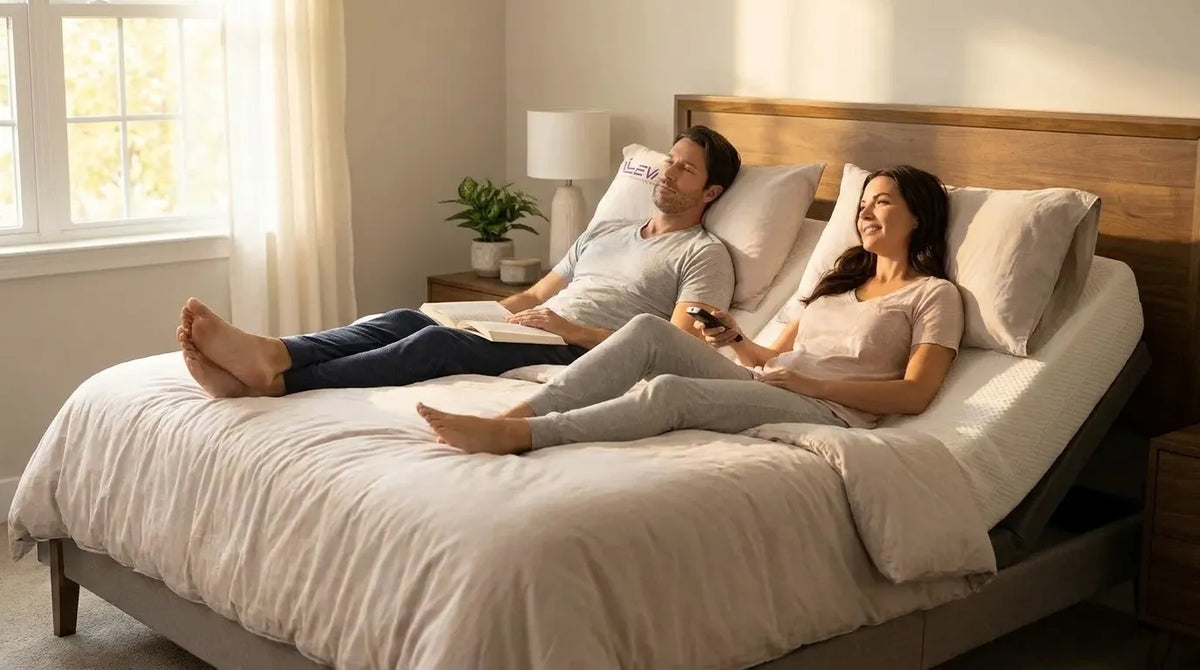
Leva Sleep is a specialist adjustable bed company offering complete, personalized sleep systems for couples. For readers who want to act on the evidence and hold a gentle incline all night without stacking pillows, Leva Sleep builds a system designed for that goal.
The system is built around the anti-snore position. Anti-snore positioning gently elevates the head to help open the airway, and lumbar control and pillow tilt refine the geometry so the incline stays comfortable. On Split Queen and Split King bases, independent per-side control lets each partner set a preferred position, while whisper-quiet German motors adjust without waking the other side. Per-side heating and cooling then address temperature, which is the second-most common source of partner conflict in bed.

Leva Sleep offers the largest selection of Split Queen adjustable beds in North America, with five distinct packages from $1,399, mattresses Leva manufactures in 30" × 80", and a full line of Split Queen bedding built to fit them. The typical retailer offers none. Complete adjustable bed packages run $1,299 to $8,999+, with financing available including 0% APR. Leva Sleep’s stated policy is a 180-night comfort guarantee, though the US store currently displays a 60-night guarantee with a comfort exchange fee, along with in-house white-glove delivery and setup, and a showroom in La Jolla, California.
“You can’t solve a geometry problem by changing the foam. That’s the mistake almost every mattress purchase makes.” — [Name], [Title], Leva Sleep
Build a personalized anti-snore sleep system with Leva Sleep
What to Look For in an Adjustable Bed for Snoring
Shoppers who want an adjustable base for snoring relief can focus on a few key features.
- Anti-Snore Presets: A dedicated mode that gently elevates the head section to help open the airway.
- Head Elevation Range: Enough articulation to reach a comfortable incline in the 4–6 inch range without straining the neck.
- Quiet Motors: A bed that wakes your partner every time it moves has solved little; whisper-quiet motors matter in a shared bed.
- Split Configuration: For couples, independent sides mean neither partner has to accept the other’s setting. A Split Queen fits a standard Queen footprint (60 inches wide). A Split King occupies a King footprint (76 inches wide).
- Mattress Compatibility: A mattress that sags where the base bends loses the incline you set. A sleep surface that stays supportive through the bend matters for maintaining the anti-snore position.
For a curated selection, see Leva Sleep’s best beds for snoring relief collection. For couples in rooms where a King will not fit, explore Split Queen adjustable beds. For pain relief alongside snoring, see best for pain relief.
Frequently Asked Questions
Is It Better to Lay Flat or Elevated for Snoring?
Elevated is better for positional snoring. When lying flat on the back, gravity pulls the tongue and soft palate backward, narrowing the airway and increasing the vibration that produces snoring. Elevating the head and upper torso shifts that geometry so the airway stays more open. Clinical guidance recommends raising the head of the bed by approximately 4–6 inches as a first-line lifestyle measure for snoring. The elevation should lift the entire upper body to avoid kinking the neck and worsening the airway pinch.
Do Adjustable Beds Help With Snoring?
Adjustable bases can help with positional snoring. An adjustable base holds a consistent incline all night, which helps keep the airway open in a way that stacked pillows rarely do because pillows shift, compress, and allow the sleeper to slide back to a flat position. The 30–60% reduction cited earlier comes from clinical sleep-medicine studies using a torso elevation of 7–15 degrees. An adjustable base is not a cure for sleep apnea and does not address snoring caused by nasal congestion, a deviated septum, or other anatomical factors.
Can an Adjustable Bed Help Sleep Apnea?
An adjustable bed can support a clinician-recommended elevated sleeping position, which may help with mild positional sleep apnea. It does not replace CPAP and does not treat moderate-to-severe obstructive sleep apnea. CPAP is the medical gold standard for obstructive sleep apnea. If you experience witnessed breathing pauses, gasping, morning headaches, or daytime sleepiness, see a sleep specialist before relying on positional therapy alone.
What Is the Best Bed for Someone Who Snores?
The best bed for a snorer is one that holds a gentle incline all night without sliding or straining the neck. An adjustable base with anti-snore positioning does this reliably at the recommended incline. A wedge pillow can work as a lower-cost trial but may slide during the night and typically flattens within 6–12 months. Side-sleeping is also clinically supported but hard to maintain without positional aids. For couples, a split adjustable base lets the snoring partner elevate without forcing the same position on the other side.
Does Snoring Mean Poor Sleep Quality?
Snoring does not always mean poor sleep quality for the snorer, yet it frequently harms the partner’s sleep. Primary snoring without apnea may not disrupt the snorer’s own sleep architecture, but it commonly disrupts the partner’s. The AASM survey cited earlier found that 31% of adults had opted for a sleep divorce, with higher rates in midlife. Snoring is one of the most common drivers of that outcome.
Adjustable Base vs. Wedge Pillow for Snoring
An adjustable base holds a consistent incline all night and offers independent control for each partner in a split configuration. A wedge pillow is a lower-cost entry point but can slide, may strain the neck if too steep, and typically wears out within 6–12 months. For a long-term solution, an adjustable base is more stable, more adjustable, and better suited to couples with different positioning needs. A wedge pillow is a reasonable way to test whether elevation helps before committing to a base.
Can an Adjustable Bed Replace CPAP for Mild Sleep Apnea?
CPAP is the medical gold standard for obstructive sleep apnea and remains the primary therapy. As noted above, it is not interchangeable with an adjustable bed. For mild positional sleep apnea, a clinician may recommend positional therapy, including head-of-bed elevation, alongside or instead of other measures, depending on severity. An adjustable base can support an elevated sleeping position that a clinician recommends, and it does not replace prescribed therapy. Always follow your doctor’s guidance. If you have not been evaluated for sleep apnea and have warning signs, that evaluation comes first.
Conclusion: Elevation as a First-Line Step for Positional Snoring
For positional snoring, elevating the head of the bed helps keep the airway open and can meaningfully reduce noise. Clinical guidance recommends the 4–6 inch range as a first-line lifestyle measure, and the evidence supports elevation as a practical first step for many snorers. An adjustable base is how that position is achieved at home, night after night, without stacking pillows or sliding off a wedge.
An adjustable base still addresses positional snoring only. It does not replace CPAP and does not treat moderate-to-severe sleep apnea. If warning signs are present, such as gasping, choking, witnessed breathing pauses, morning headaches, or daytime sleepiness, see a clinician.
For couples who want to act on the evidence, Leva Sleep builds complete, personalized sleep systems with anti-snore positioning, independent per-side control on Split King and Split Queen bases, whisper-quiet German motors, and a stated 180-night comfort guarantee (the US store currently displays a 60-night guarantee with a comfort exchange fee). Complete packages run $1,299 to $8,999+, with financing available including 0% APR.
Transform your sleep with Leva Sleep by visiting the La Jolla showroom or shopping online today

%20can%20reduce%20positional%20snoring%20by%2030%E2%80%9360%25%20by%20keeping%20the%20air...)