
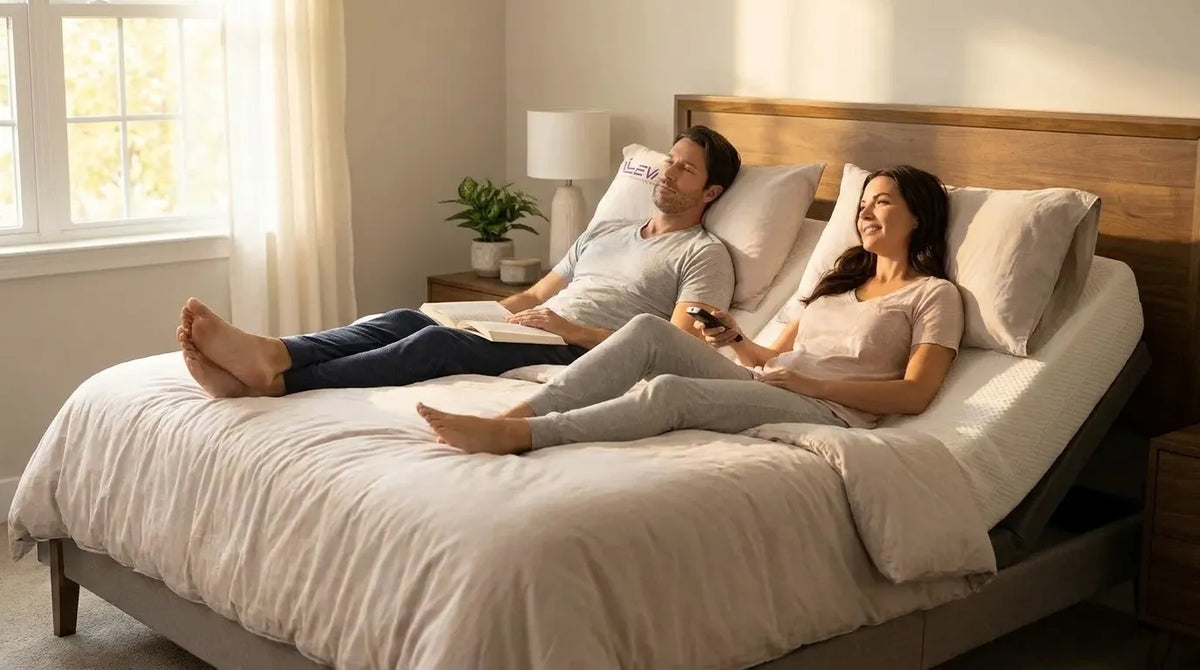
Adjustable Base Zero Gravity Position: Set It and Tune It
Written by: Matthew Timmins, Founder and Managing Director, Leva Sleep
Key Takeaways
- The zero gravity position gently elevates your head and knees to create a V-shape that eases pressure on the lower back and hips.
- Start flat, raise the head section first, then the foot section, and fine-tune in small steps until your lower back feels fully supported.
- Use a deeper decompression angle for short pre-sleep sessions, and a milder version for all-night sleep to avoid hip-flexor tightness.
- Side sleepers need a shallower setup with modest head elevation and minimal knee lift because classic zero gravity angles suit back sleepers.
- Leva Sleep offers a wide range of split adjustable bases, app presets, and a 180-night guarantee so you can experiment with confidence.
Explore Leva Sleep Adjustable Bases
What You Need Before You Start
The zero gravity position requires an adjustable base with independent head and foot articulation. For couples with different positioning needs, a split configuration, where each side articulates independently, lets both partners choose their own setup. Most bases can approximate the position even without a dedicated preset button.
Clinicians commonly recommend sleeping with the head elevated for conditions including sleep apnea, acid reflux, and post-surgical recovery. An adjustable base makes that elevation repeatable at home without stacking pillows. The zero gravity position functions as a comfort and positioning tool. Adjustable bases can improve comfort and may help reduce symptoms associated with certain conditions. They do not diagnose or treat sleep apnea, GERD, cardiovascular disease, or circulatory disorders. Persistent symptoms require evaluation by a healthcare professional.
Anyone with spinal fusion, osteoporosis, certain hip or knee conditions, heart or respiratory issues, or specific post-surgical positioning instructions needs clinician guidance before using the zero gravity position. Individuals with spinal fusion and osteoporosis should avoid adjustable beds because articulation can worsen or cause other issues, according to orthopedic physical therapist Karena Wu, P.T., D.P.T.
Even after you receive clearance, expect a gradual adjustment. Setup takes a few minutes, but your body often needs weeks, not days, to adapt to the new posture.
What Angles Should You Aim For?
Once you know it is safe to use the position, the next step is choosing angles that match your goal. The table below shows typical head and knee elevation ranges for four common use cases so you can align your setup with how you plan to use the bed.
| Use Case | Head Elevation | Knee Elevation | Recommended Session Length |
|---|---|---|---|
| Decompression or post-workout wind-down | 20–30° | 25–35° | 20–30 minutes |
| Reading or watching | 30° or higher | 15–25° | Up to 1–2 hours |
| Anti-snore positioning | 10–20° | Minimal to moderate | All night if comfortable |
| All-night sleep | About 20–30° | About 25–35° | All night if comfortable |
Short decompression sessions work well at deeper angles, so keep them to 20–30 minutes. For reading or watching, a higher head angle and moderate knee lift maintain upright posture and reduce neck strain. Pillow tilt further helps prevent “tech neck” and supports the lumbar area.
For snoring, prioritize head elevation over knee elevation and track changes in snore time and next-day alertness. For all-night sleep, use the gentle V-shape described above. Tune until your lower back feels flat against the mattress, and reduce the angle if your hip flexors feel tight when you wake.
Every figure in this table reflects ranges drawn from the clinical and manufacturer guidance cited throughout this article. Fine-tune in 2–3 degree increments instead of jumping between presets.
How To Get Zero Gravity Position On An Adjustable Bed
The steps below apply to bases with a Zero-G preset and to models without one.
- Start flat. Confirm the base is fully flat before adjusting so you begin from a clear baseline.
- Raise the head section to a comfortable reading angle, roughly 20–30 degrees. Stop before your chin tucks toward your chest.
- Raise the foot section until your knees sit slightly above your hips, roughly 25–35 degrees. This shift takes pressure off the lower back. Raising the knees closes the gap that normally forms under the lumbar spine when you lie flat, so the supporting muscles can relax.
- Micro-adjust. Lower the head a few degrees at a time until your lower back feels flat against the mattress and your neck feels relaxed. Use individualized fine-tuning in 2–3 degree increments instead of chasing a single universal angle.
- Use the Zero-G button as a starting point. If your base includes a Zero-G preset, press it, then adjust from there. Zero-gravity angles vary across brands, so treat the preset as a shortcut, not a final answer.
- Create a manual preset when needed. If your base has no Zero-G button, build the position using steps 2–4. Save it as a custom preset if your base or app supports saved positions. Leva Sleep’s app supports custom sleep positions, vibrating alarms, and subtle adjustments to reduce snoring.
- Check the bedding. Standard fitted sheets often pop off when the bed articulates. Look for bedding with extra elastic and deep pockets so the corners stay anchored as the head and foot sections move.
For couples, a Split Queen adjustable bed or a Split King adjustable bed gives each partner fully independent head and foot articulation. One side can hold a decompression angle while the other stays flatter for sleep. Leva Sleep offers 15–20 adjustable base models versus the 3–5 found at a standard mattress retailer, with independent split articulation, lumbar control, pillow tilt, and whisper-quiet German motors that keep the position practical for nightly use.

See Adjustable Bases With Custom Presets
Should You Sleep In Zero Gravity Position All Night?
Short decompression sessions and all-night sleep place different demands on your body. In a 20–45 minute decompression window, the position distributes body weight, eases lower back pressure, and supports circulation. Many people notice less lower back tension after a single 20-minute session, with the biggest change in chronic discomfort appearing after one to two weeks of daily use.
Across a full night, deeper angles can create new issues. Sleeping with flexed hips for eight hours can tighten the hip flexors over time, similar to long days at a desk. Neck strain becomes more likely when the head angle sits too high or the pillow angle feels off. Extended use of a steep angle can also reduce circulation in the legs and stiffen the lower back.
A practical approach uses deeper angles for pre-sleep decompression and a gentler version for all-night sleep. Lower the head from your decompression setting, keep the knees supported at a milder elevation, and adjust until your lower back feels flat against the mattress. Most people notice early signals within 1–2 weeks and clearer trends by 30–60 days.
Adaptation usually takes weeks. Leva Sleep’s 180-night comfort guarantee gives you six months to decide whether the bed and your preferred position truly work for you.
Can You Sleep On Your Side In Zero Gravity Mode?
The classic zero gravity position primarily suits back sleepers. Side sleepers can still use a modified version, but the setup needs to stay gentler, around 10–15 degrees of head elevation with minimal knee lift, so the neck stays aligned and the hips avoid extra strain. If your shoulder feels jammed or your hip feels compressed, the angle needs to come down.
Most side sleepers sleep more comfortably in a flatter all-night setup. A slightly elevated head, a pillow that keeps the spine neutral, and a mattress with enough shoulder and hip give help prevent pressure buildup. Lumbar control and pillow tilt on an adjustable base still help side sleepers find a more supportive geometry, even though the classic zero gravity angle does not serve as the main target.
What Are The Downsides Of The Zero Gravity Position?
The zero gravity position improves comfort for many people, yet it also carries specific drawbacks.
- It does not replace CPAP or other prescribed therapies for sleep apnea.
- Sustained hip flexion overnight can tighten the hip flexors over time.
- Neck strain can develop when the head angle sits too high or the pillow loft pushes the neck into a poor angle. Pillow loft changes the effective angle, so the same base setting can feel right with one pillow and wrong with another.
- Standard back-sleeper angles do not suit side sleeping.
- Extended use can reduce circulation in the legs.
The position does not fit every body or every condition. People with hip or knee issues that make flexion uncomfortable, anyone with prescribed sleep positioning, and anyone managing significant heart or respiratory concerns should involve a clinician. Certain angles may affect breathing or circulation, so medical input matters.
Zero Gravity, Anti-Snore, And Flat: How They Differ
Flat, anti-snore, and zero gravity positions each serve a distinct purpose on an adjustable base.
- Flat: One geometry for both partners. This setup concentrates pressure on the hips, shoulders, and lower back and leaves the lumbar curve unsupported.
- Anti-snore: A gentle head elevation that helps open the airway. A 2017 study found that tilting the bed by 7.5 degrees reduced obstructive sleep apnea severity by about 31.8% and improved minimum oxygen levels during sleep. Elevating the head gently opens the airway, which often reduces snoring. Leva Sleep’s anti-snore mode detects snoring and makes micro-adjustments to the head of the bed automatically.
- Zero gravity: Head and knees rise together to distribute weight and reduce pressure on the lower back. This position differs from anti-snore because it raises both ends for full-body pressure relief rather than focusing solely on airway positioning.
The best beds for snoring relief and the best beds for pain relief combine these positions with independent per-side articulation. Each partner can choose their own geometry without compromise.
The 2022 American College of Gastroenterology clinical guideline recommends elevating the head of the bed by 15–20 cm (6–8 inches) to reduce overnight acid reflux and specifies that the whole upper body should be raised. An adjustable base achieves this consistently, while stacked pillows shift during the night.
Why Leva Sleep Fits Zero Gravity Users
Leva Sleep focuses on adjustable beds and complete, personalized sleep systems for couples. The usefulness of the zero gravity position depends heavily on the base and mattress beneath you, which makes specialization valuable.
Leva Sleep offers 15–20 adjustable base models compared with the 3–5 typically found at a standard mattress retailer. Leva’s bases include independent split articulation, lumbar control, pillow tilt, anti-snore mode, and whisper-quiet German motors. Full app control lets you save and adjust custom sleep positions. Mattress type affects how well an adjustable base achieves the position. Memory foam and latex flex more easily and follow the frame, while traditional innerspring mattresses can resist articulation. Leva’s mattresses are built to flex with the base night after night.
Leva Sleep also offers the largest selection of Split Queen adjustable beds in North America, with five packages from $1,399. Leva manufactures the 30″ × 80″ mattresses and provides a full line of Split Queen bedding. A Split Queen occupies 60 inches of width versus 76 inches for a Split King, a 16-inch difference that often determines whether a room layout works. A Split King remains the better choice when room dimensions allow.
According to a June 2025 survey of 2,007 US adults conducted by Atomik Research for the American Academy of Sleep Medicine, 31% of US adults regularly sleep in a separate room from a partner. Among adults aged 35–44, the figure rises to 39%. Another 37% go to sleep at different times to accommodate a partner. Independent articulation on each side of a split bed directly addresses the geometry conflicts that drive many of these decisions.
Complete adjustable bed packages range from $1,299 to $8,999+. Financing is available, including 0% APR. Every purchase includes a 180-night comfort guarantee and in-house white-glove delivery with old bed removal. Leva Sleep has operated for nine years and served more than 25,000 customers. Leva Sleep mattresses are made in the US, and half of the US lineup is unique to the American market, including premium California-made brands. Leva carries Aireloom, Tempur-Pedic, Stearns & Foster, Beautyrest, Serta, Kingsdown, and Helix, and pairs each mattress with the right base through specialists who understand how each model performs on an adjustable frame.
Frequently Asked Questions
Should I Sleep With My Bed In Zero Gravity Position?
The zero gravity position works especially well as a decompression or pre-sleep posture at deeper angles. For all-night use, a gentler version usually feels better. Lower the head, keep the knees softly supported, and adjust until your lower back feels flat against the mattress. Sustained hip flexion at steep angles can tighten the hip flexors over time, and neck strain becomes more likely when the head angle sits too high. Most back sleepers adapt to a milder all-night version within a few weeks, while side sleepers typically need a flatter setup.
Can You Sleep On Your Side In Zero Gravity Mode?
The zero gravity position is designed around back sleeping. Side sleepers who try deeper angles often feel a jammed shoulder and extra hip strain. Side sleepers still benefit from an adjustable base, especially from lumbar control and slight head elevation, but they usually feel better with a shallower setup. A head angle around 10–15 degrees with minimal knee lift works better when a side sleeper wants some elevation.
What Are The Downsides Of The Zero Gravity Position?
Common downsides include hip flexor tightening from sustained overnight flexion, neck strain from high head angles or mismatched pillow loft, reduced leg circulation during long sessions, and poor comfort for side sleeping at standard angles. The position does not treat sleep apnea, GERD, or other medical conditions. People with hip or knee conditions, spinal fusion, osteoporosis, or heart and respiratory issues should work with a clinician before using it.
How Long Should You Stay In Zero Gravity Position?
For decompression, 20–30 minutes works as a practical starting point, followed by a brief period of standing and walking. For all-night use, reduce the angles from your decompression setup, then adjust until your lower back feels supported and your neck feels neutral. Many people notice meaningful changes in back comfort within one to two weeks of consistent use, with clearer trends by 30–60 days.
Is It Healthy To Sleep In A Zero Gravity Position?
For most healthy adults, a gentle all-night version of the position creates a low-stress posture that eases spinal load and spreads body weight more evenly. It functions as a comfort and positioning tool rather than a medical treatment. People with spinal, hip, knee, cardiovascular, or respiratory conditions should consult a clinician first.
What If My Adjustable Base Has No Zero Gravity Preset?
You can still create the position manually. Start flat, raise the head section to a comfortable angle, then raise the foot section until your knees sit slightly above your hips. Micro-adjust in 2–3 degree increments until your lower back feels flat against the mattress and your neck feels relaxed. If your base or app supports saved positions, store this setup as a custom preset. Leva Sleep’s app supports custom sleep positions for this exact use case.
Find A Base With Custom Presets
Conclusion: Set It, Tune It, Track It
The adjustable base zero gravity position uses a gentle V-shape that distributes body weight and reduces pressure on the lower back. You can reach it manually or with a preset, but every preset works best as a starting point. Tune in small increments until your lower back feels flat against the mattress and your neck feels relaxed.
Use deeper angles for short decompression sessions before bed. For all-night sleep, lower the head, keep the knees softly supported, and pay attention to how your back and hips feel over the first few weeks. Side sleepers usually need a shallower, different setup, and anyone with a relevant medical condition should involve a clinician.
Incremental changes and consistent tracking reveal what truly works for your body. Adaptation often takes weeks, which makes the right base, the right mattress, and a 180-night guarantee as important as the position itself.
Start Your 180-Night Trial With Leva Sleep


