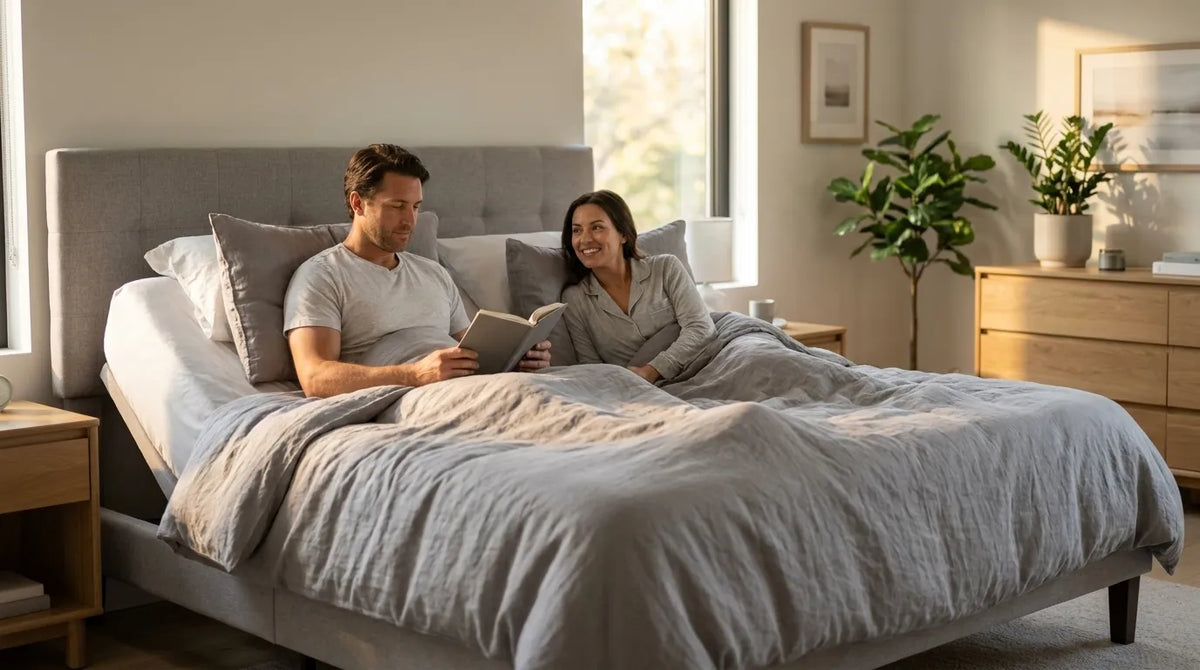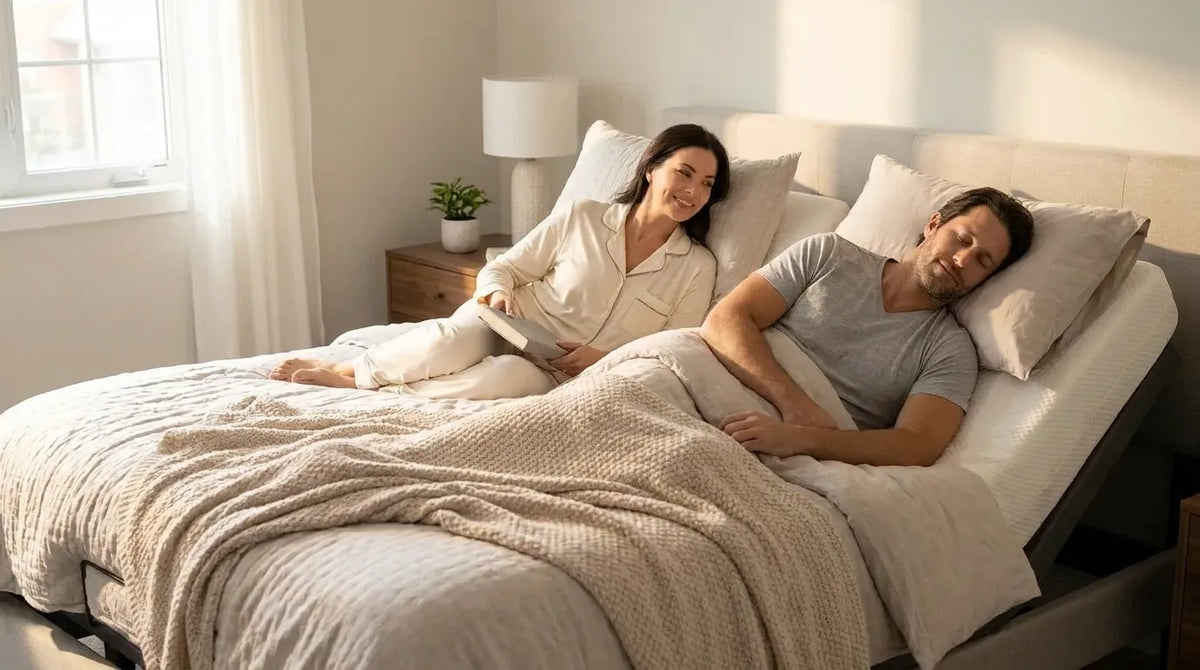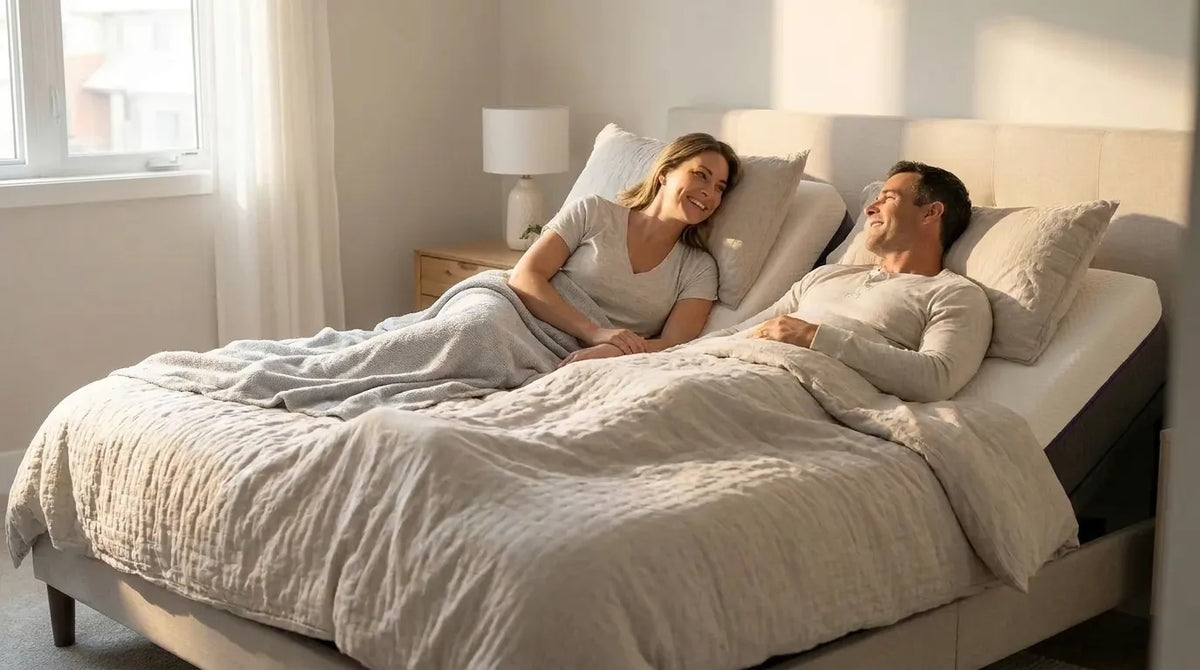
Sleep Temperature Control for Couples: Complete 2026 Guide
Written by: Matthew Timmins, Founder and Managing Director, Leva Sleep
Updated September 2026
Key Takeaways
- Dual-zone temperature control systems resolve thermostat conflicts by letting each partner set an independent sleep temperature on their side of the bed.
- Three technology types, air-based, water-based, and integrated, offer different trade-offs in noise level, maintenance, and installation complexity.
- Active cooling systems can add up to 52 minutes of sleep per night and provide targeted relief for night sweats and hot flashes that passive bedding cannot match.
- Choosing the right system depends on budget, noise tolerance, maintenance preferences, and whether a standalone topper or integrated adjustable-base solution fits the couple’s needs.
- Integrated systems like the Leva Sleep System bundle per-side temperature control with adjustable positioning and elevation-friendly bedding in a single solution.
The Problem: Why Temperature Conflict Disrupts Couples' Sleep
A June 2025 survey of 2,007 US adults conducted by Atomik Research for the American Academy of Sleep Medicine found that 31% of American adults have opted for a “sleep divorce,” regularly sleeping in a separate room from their partner. Among adults aged 35–44, the figure rises to 39%. Another 37% reported going to sleep at different times to accommodate a partner.
A Sleep Number poll found that 80% of couples report one or both partners sleeping at an unpleasant temperature, making thermal incompatibility one of the most common and solvable sources of shared-bed conflict. Temperature conflict has an engineering solution: giving each side of the bed its own independent microclimate. Dual-zone systems deliver that solution by separating temperature control for each partner.
Why Couples Often Prefer Different Sleep Temperatures
Individual thermoregulation varies significantly based on metabolic rate, body composition, age, hormonal status, and medication. Research published in the Journal of Physiology found that women experience a smaller drop in core body temperature during the night than men, and also reach their lowest body temperature earlier in the night. Estrogen and progesterone both affect the body’s internal thermostat. During the luteal phase of the menstrual cycle, core body temperature rises. Perimenopausal women may experience vasodilation episodes that make a 65°F room feel comfortable one moment and unbearably warm the next.
Core body temperature naturally drops approximately 1–2°C as sleep initiates, reaching its lowest point during deep sleep. This thermodynamic shift is mechanistically necessary for sleep onset and slow-wave sleep maintenance. When partners have different baseline temperatures, a single thermostat setting rarely satisfies both.
How Dual-Zone Temperature Control Works: Three Technology Types
Dual-zone temperature control lets each side of a shared bed heat or cool independently, so one partner’s setting does not affect the other’s. Three distinct technology types deliver this capability.
Air-based systems (e.g., BedJet): A bedside unit blows temperature-controlled air through a hose routed under the sheets. The BedJet 3 installs in under 15 minutes with no tools and is air-based, requiring no water. The trade-off is audible fan noise, particularly at higher cooling speeds.
Water-based systems (e.g., Chilipad, Eight Sleep): A control unit circulates temperature-regulated water through microchannels in a pad or cover placed over the mattress. Water conducts heat approximately 25 times more efficiently than air, which is why water-based systems can reach and hold lower temperatures more precisely. The trade-off is periodic distilled water refills and descaling every three to six months.
Integrated systems (e.g., Leva Sleep System): Heating and cooling are built directly into an adjustable base rather than added as a standalone topper. The Leva Sleep System provides per-side temperature control as part of a complete sleep system that also includes independent head and foot articulation, lumbar control, anti-snore positioning, and bedding engineered to hold at full elevation.
| Attribute | Air-Based (BedJet) | Water-Based (Chilipad, Eight Sleep) | Integrated (Leva Sleep System) |
|---|---|---|---|
| Temperature range | 67–109°F | 55–115°F (Chilipad), 55–109°F (Eight Sleep Pod 5) | Per-side heating and cooling |
| Installation time | Under 15 minutes | 30–60 minutes plus priming | Included with adjustable base setup |
| Noise level | 49–61 dB (low to high) | 41–46 dB (Chilipad) | Whisper-quiet German motors |
| Maintenance | None | Distilled water refills; descaling every 3–6 months | Minimal; part of complete system |
| Adjustable base integration | Works alongside, not integrated | Works alongside, not integrated | Built into the base |
With these three technology types in mind, couples can compare specific products more easily. The next section shows how leading systems stack up on technology, price, and key features.
Comparison of Top Systems for Couples
The table below compares the leading dual-zone systems across technology type, price, and standout features. Use it to see how the main options differ before you look at the detailed descriptions.
| Product | Technology | Price Range | Key Features |
|---|---|---|---|
| BedJet 3 Dual Zone | Air-based | $1,329–$1,389 (dual-zone bundle) | Two independent units; Cloud Sheet air partition; heats in 60 seconds; free app control |
| Chilipad Dock Pro / 2.0 | Water-based | $1,199–$1,999 (Dock Pro dual zone), $2,798–$3,198 (Chilipad 2.0 dual zone) | 55–115°F range; no subscription required; machine-washable pad; nightstand remote (2.0) |
| Eight Sleep Pod 5 | Water-based | From $2,399 (US pricing varies by configuration) | Autopilot AI; sleep tracking (HRV, heart rate, sleep stages); Hot Flash Mode; requires subscription for advanced features |
| Leva Sleep System | Integrated | From $1,299 for the heating and cooling layer as part of a complete system (Leva US catalog, August 2026) | Built into adjustable base; per-side control; compatible with Split Queen and Split King configurations; bedding engineered for elevation |
The BedJet 3 Dual Zone is the fastest to install and the most accessible entry point for couples who want independent temperature zones without modifying their mattress or base. Two independent units route air under a partitioned Cloud Sheet, so each side runs its own temperature without crossover.
The Chilipad Dock Pro and its successor the Chilipad 2.0 offer the widest temperature range among water-based options (55–115°F) with no subscription fee. That combination makes them a strong value for couples who want active hydronic cooling without ongoing costs. The 2.0 adds an offline nightstand remote and a built-in mattress protector layer.
The Eight Sleep Pod 5 adds Autopilot AI, biometric sleep tracking, and a Hot Flash Mode that delivers rapid one-tap cooling relief. The mandatory subscription for advanced Autopilot features adds cost over time. Over three years, the subscription alone adds $600–$1,200 compared to a no-subscription alternative.
The Leva Sleep System takes a different approach. Instead of a standalone topper placed on an existing mattress, it integrates heating and cooling directly into the adjustable base. This means per-side temperature control is part of a complete sleep system. That system also delivers independent head and foot positioning, lumbar support, anti-snore modes, and bedding designed to hold at full elevation, features standalone toppers do not address.
Key Benefits of Dual-Zone Temperature Control for Couples
- No compromise: Each partner sets their own temperature independently. One side can run warm while the other cools, simultaneously, in the same bed.
- More sleep per night: Sleep Number research presented at SLEEP 2026, based on nearly 82,000 people across more than one million sleep sessions, found that dynamic bed temperature control can add up to 52 minutes of sleep per night.
- Targeted relief for night sweats and hot flashes: Active systems cool the sleep surface below ambient room temperature, which passive bedding cannot replicate.
- Reduced partner disturbance: Eliminating the midnight blanket adjustment and tossing caused by overheating reduces motion that wakes the other partner.
- Relationship continuity: By removing the thermal incompatibility that drives many couples to sleep apart, dual-zone systems help partners stay in the same bed.
See the Leva Sleep System in person at the La Jolla showroom, or shop the full collection online.
How to Choose the Right System: A Decision Framework for Couples
This step-by-step framework helps couples match a technology type and product tier to their specific situation.
- Identify the temperature gap. A difference of 2–4°F between partners may be addressed with separate duvets and breathable bedding. A gap of 5°F or more, or active night sweats on one side, calls for an active dual-zone system. Active cooling systems are the only true solution for couples with a temperature preference difference greater than 5°F.
- Set a realistic budget. The BedJet 3 Dual Zone bundle starts at $1,329. The Chilipad Dock Pro dual-zone configuration ranges from $1,199 to $1,999. The Chilipad 2.0 dual zone runs $2,798–$3,198. Eight Sleep Pod 5 pricing varies by configuration and market. The Leva Sleep System heating and cooling layer is $1,299 as part of a complete system (Leva US catalog, August 2026).
- Choose between a standalone topper and an integrated system. Standalone toppers (BedJet, Chilipad, Eight Sleep) work with an existing mattress and base. The Leva Sleep System integrates temperature control with an adjustable base, adding independent positioning, lumbar control, and anti-snore capability in a single system. Couples who also want to address snoring or back and joint pain may find an integrated system delivers more value than a temperature topper alone.
- Evaluate noise tolerance. BedJet 3 produces 49–61 dB depending on fan speed, which is audible and comparable to a bedside fan. The Chilipad Dock Pro runs 41–46 dB, closer to a quiet library. Leva’s adjustable base uses whisper-quiet German motors. For light sleepers, noise level often becomes a deciding factor.
- Consider maintenance commitment. Air-based systems require no maintenance. Water-based systems require distilled water refills and descaling every three to six months. Integrated systems are maintained as part of the complete bed system.
- Factor in long-term integration. Finally, consider whether you will want adjustable positioning for snoring, acid reflux, or back pain in the future. If so, an integrated system that combines temperature control with a full adjustable base may deliver more value than a standalone topper added to a flat bed.
How These Systems Work with Adjustable Bases and Bedding
Temperature control systems interact differently with adjustable bases depending on whether they are standalone or integrated. Standalone toppers like the Chilipad and Eight Sleep can be used on adjustable bases, though Sleep Foundation recommends using two single-zone units on split adjustable beds to allow full range of motion on each side. The BedJet sits beside the bed and routes a hose under the sheets, so it works alongside an adjustable base without interfering with articulation.
The Leva Sleep System is built into the adjustable base itself, which eliminates the compatibility question. Leva also designs its bedding, including fitted sheets with extra elastic, duvet clips, and remote pockets, specifically to hold at full elevation. Standard fitted sheets often pop off when a base articulates. This detail is one that generalist retailers do not solve and that matters every night the bed is used at an angle.
For couples who want both per-side temperature control and per-side positioning, such as independent head and foot elevation, lumbar support, and anti-snore mode, the Leva Split Queen and Split King configurations deliver both in a single system. The Split Queen is particularly relevant for couples in bedrooms where a King footprint (76 inches wide) does not fit. Leva’s Split Queen uses two 30" × 80" mattresses on two independent bases in a 60-inch footprint, a configuration most retailers do not offer because the mattress size must be purpose-built.

Conclusion: Match the System to Your Shared Sleep
Temperature conflict in a shared bed is common and solvable. Air-based systems like the BedJet 3 Dual Zone offer the fastest installation and lowest maintenance. Water-based systems like the Chilipad and Eight Sleep Pod 5 deliver more precise active cooling, with the trade-off of water maintenance and, for Eight Sleep, an ongoing subscription. Integrated systems like the Leva Sleep System combine per-side temperature control with a complete adjustable base, addressing temperature, positioning, snoring, and bedding compatibility in a single engineered solution.
The right choice depends on the size of the temperature gap between partners, budget, noise tolerance, and whether a standalone topper or a system-level solution better fits the bedroom and the couple’s broader sleep needs. Given how common sleep divorce is (see above), investing in the right temperature control system can help many couples stay comfortable in the same bed.
Frequently Asked Questions
Which bed cooling system is best for couples?
The best system depends on each couple’s priorities. For the fastest installation and lowest maintenance, the BedJet 3 Dual Zone (air-based, dual-zone bundle starting around $1,329) is the most accessible entry point. For the widest temperature range with no subscription fee, the Chilipad Dock Pro or Chilipad 2.0 (water-based, dual-zone configurations from $1,199 to $3,198 depending on model and size) are strong choices. For AI-driven automation and biometric sleep tracking, the Eight Sleep Pod 5 leads the category but requires a subscription for its most advanced features. For a complete system that integrates per-side temperature control with an adjustable base, independent positioning, and bedding designed for elevation, the Leva Sleep System offers that combination in a single engineered solution starting at $1,299 for the heating and cooling layer as part of a complete system.
Is Eight Sleep worth it for couples?
Eight Sleep offers one of the most advanced feature sets among standalone temperature systems, including Autopilot AI, biometric tracking (heart rate, HRV, sleep stages), Hot Flash Mode, and per-side water temperature control. The mandatory subscription for Autopilot and advanced features adds ongoing cost. Over three years, that subscription adds several hundred dollars to the total investment. Couples who prioritize AI-driven automation and detailed sleep data may find that value compelling. Couples who want active dual-zone cooling without a subscription may find the Chilipad 2.0 delivers equivalent core temperature control at a lower total cost over time.
Can each partner control their own side of the bed temperature independently?
Each partner can control their own side independently with a true dual-zone system. True dual-zone control means each side operates completely independently, so one partner can cool their side while the other warms theirs at the same time. The BedJet 3 Dual Zone achieves this with two separate air units and a partitioned Cloud Sheet. The Chilipad Dock Pro “We” configuration uses two separate Dock units, one per side. The Eight Sleep Pod 5 provides per-side water temperature control through a single cover. The Leva Sleep System provides per-side heating and cooling built into the adjustable base, with each side controlled independently. When evaluating any system, confirm it uses true dual-zone hardware rather than a single unit attempting to serve both sides, because single-unit designs can produce temperature bleed at the center of the bed.
What is the best sleep temperature for couples?
Sleep scientists generally recommend a bedroom temperature between 65–68°F (18–20°C) for most adults, a range cited by the National Sleep Foundation and the American Academy of Sleep Medicine as supporting the core body temperature drop needed for sleep onset and deep sleep maintenance. Individual preferences vary significantly based on age, sex, hormonal status, body composition, and medication, which explains why a single thermostat setting rarely satisfies both partners. As noted in the decision framework, a gap of 5°F or more calls for active dual-zone cooling. Dual-zone systems address this by letting each partner set their own microclimate independent of the room temperature and independent of the other side of the bed.
Do temperature control systems work with adjustable beds?
Most standalone systems can be used alongside an adjustable base, though compatibility varies. The BedJet routes a hose under the sheets from a bedside unit, so it works alongside any adjustable base without interfering with articulation. Water-based toppers like the Chilipad and Eight Sleep can be placed on adjustable bases. For split adjustable beds, using two single-zone units rather than one dual-zone pad is recommended to allow each side full range of motion. The Leva Sleep System is built into the adjustable base itself, so compatibility is not a variable because the temperature control, positioning, and bedding are all designed as a single system. Standard bedding is a separate consideration. Fitted sheets on most adjustable bases pop off at elevation, which is why Leva designs its sheet sets with extra elastic and duvet clips specifically for articulating bases.