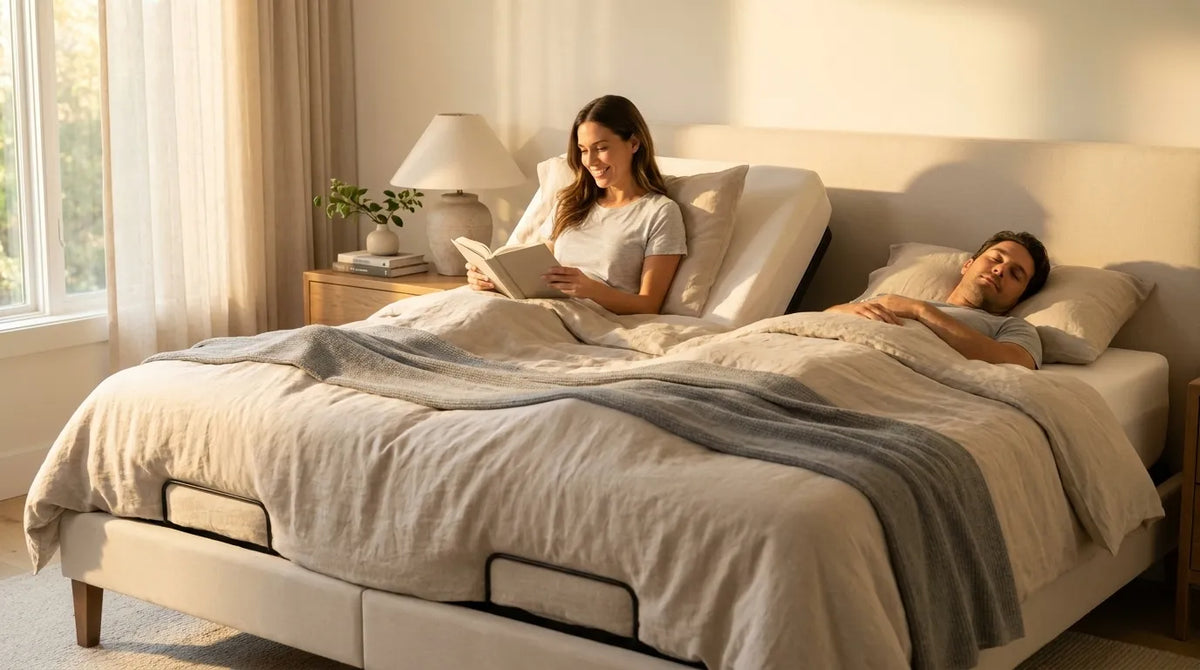
Adjustable Beds for Snoring Couples: The Complete Guide
Written by: Matthew Timmins, Founder and Managing Director, Leva Sleep
Updated September 2026
Key Takeaways
- Adjustable beds reduce snoring by elevating the head 10–30 degrees, using gravity to keep the airway open and limit soft tissue collapse.
- Split configurations (Split King or Split Queen) let one partner elevate while the other sleeps flat, so couples can share a bed comfortably.
- Key features for snoring couples include independent split articulation, quiet motors, anti-snore presets, lumbar control, and motion isolation.
- Prices for complete adjustable bed packages range from $1,299 for entry-level systems to $8,999+ for luxury setups with advanced features.
- Leva Sleep offers the largest selection of Split Queen adjustable beds in North America, with packages starting at $1,399.
How Adjustable Beds Help Reduce Snoring
Adjustable beds reduce snoring for many people by elevating the head 10–30 degrees and using gravity to keep the airway more open. A split design lets one partner elevate while the other sleeps flat, so each person can choose their own position.
When you lie flat, gravity allows the soft tissues in your throat, including the tongue, soft palate, and uvula, to fall backward into the airway. This narrowing creates the vibration we recognize as snoring. Raising the head gently opens the airway and limits that collapse.
A 2017 study at a Brazilian sleep clinic involving 52 patients found that raising the head of the bed 7.5 degrees reduced the apnea-hypopnea index from 15.7 to 10.7 events per hour, a 31% reduction, while minimum oxygen levels rose and sleep quality was maintained. A 2025 multicenter study using a steeper 30-degree elevation confirmed this benefit at a higher angle.
Clinicians commonly recommend sleeping with the head elevated for conditions such as sleep apnea, acid reflux, and post-surgical recovery. An adjustable base makes that position repeatable at home every night without stacking pillows. Pillows shift and compress and rarely hold a consistent angle, while an adjustable base maintains a precise position all night.
Most adjustable bases include an anti-snore preset, a single button that raises the head to a recommended angle. Higher-end models add automatic snore detection, where a sensor listens for snoring and makes small head-position changes until it stops. GhostBed's Smart Adjustable Base, for example, uses a patented audio sensor that detects consistent snoring patterns and automatically elevates the head up to 15 degrees, with customizable sensitivity levels.
Some users find automatic adjustment features disruptive, especially light sleepers who wake easily. A manual preset that you activate before falling asleep often suits those sleepers better. For people who want the bed to respond on its own, automatic detection can justify the added cost.
An adjustable bed does not treat obstructive sleep apnea and does not replace CPAP therapy, which remains the medical gold standard. Head elevation can reduce symptoms for some people, especially mild to moderate and positional cases, and does not affect central sleep apnea, which stems from neurological causes rather than obstruction. If snoring is accompanied by gasping, choking, or excessive daytime sleepiness, consult a healthcare professional before making any purchasing decision.
Split King vs. Split Queen: Choosing the Right Setup for Your Room
Couples shopping for an adjustable bed face one major decision first: whether to choose a split configuration and, if so, which size. The table below outlines how the three main options compare.
| Configuration | Dimensions | Footprint Width | Best For |
|---|---|---|---|
| Split King | Two Twin XL (38″ × 80″) | 76 inches | Larger bedrooms (12′ × 12′ minimum) |
| Split Queen | Two 30″ × 80″ | 60 inches | Smaller bedrooms, condos, guest rooms |
| Split-Head Queen | One mattress, head sections adjust independently | 60 inches | Couples where only one partner needs head elevation |
A Split King uses two Twin XL mattresses, each 38 inches by 80 inches, placed side by side to create the same 76-inch by 80-inch footprint as a standard king. Any retailer can assemble this from standard sizes. The tradeoff is space, because a Split King occupies roughly 76 inches of wall. A Split King typically requires a minimum room size of 12′ × 12′. Bedrooms that fall below that threshold often push couples toward a standard Queen, which removes the option of split adjustability.
A Split Queen occupies 60 inches of wall, the same footprint as a standard Queen. That 16-inch difference often decides whether the room layout works. It also decides whether a couple can solve their sleep problem together or feel forced into separate solutions.
Very few companies offer a true Split Queen because it requires two 30″ × 80″ mattresses, a size that standard mattress supply chains do not carry. No existing shelf stock covers that dimension. A company must commit to building the mattress, the base, and every accessory that fits it.
Leva Sleep offers the largest selection of Split Queen adjustable beds in North America, with five distinct packages from $1,399 and mattresses manufactured in-house in 30″ × 80″. Because Leva builds both halves, a Split Queen customer can choose two different firmness levels in one bed, with two fully independent bases providing head and foot articulation on each side.

Leva also offers a Split-Head Queen, a single mattress where only the head sections adjust independently. This configuration suits couples where only one partner needs elevation. It differs from a true Split Queen and does not serve as Leva's default configuration.
Features That Matter Most for Snoring Couples
Adjustable beds vary widely, and certain features matter more for couples dealing with snoring. The table below highlights the essentials.
| Feature | Why It Matters |
|---|---|
| Independent split articulation | Each partner controls their own side, so one elevates while the other sleeps flat. |
| Quiet motors | Low-noise movement prevents waking your partner every time you adjust. |
| Anti-snore mode | Preset or automatic head elevation supports airway opening. |
| Lumbar control | Supports the lower back curve independently of head and foot position. |
| Pillow tilt | Fine-tunes head angle for reading, watching, or airway positioning. |
| Per-side heating and cooling | Addresses temperature differences, a common source of partner conflict in bed. |
| Motion isolation | Separate mattresses reduce the feeling of a partner tossing and turning. |
Beyond the base features, bedding details matter more than most couples expect. Standard sheets often pop off the moment the bed articulates. Sheets designed for adjustable beds use extra elastic and deep pockets to stay in place. Leva designs every sheet set, protector, and duvet for split and adjustable beds, solving a detail that generalist retailers usually overlook.
Explore Leva's snoring relief collection to see how adjustable positioning can help.
Adjustable Bed Pricing for Snoring Couples
Adjustable bed packages that include both base and mattress cover a wide price range. The tiers below reflect the Leva US catalog as of August 2026.
| Tier | Price Range (USD) | What You Get |
|---|---|---|
| Entry | $1,299 – $1,899 | Basic adjustability, anti-snore preset, single-zone massage |
| Core | $2,499 – $2,999 | Split configurations, lumbar control, pillow tilt, app control |
| Premium | $3,799 – $4,499 | Advanced bases, premium mattress brands, per-side heating and cooling |
| Luxury | $5,999 – $8,999+ | Top-tier systems with extensive customization |
Leva packages start at $1,299 and include a 180-night comfort guarantee. Leva's pricing advantage comes from designing in-house, overseeing manufacturing directly, assembling regionally, and delivering with its own teams. A comparable system sold through a traditional retail chain typically includes a manufacturer margin, a distributor margin, a retailer margin, and a third-party delivery contract. Leva removed three of those four layers.
Tips for Adjusting to an Adjustable Bed as a Couple
Most couples need weeks, not days, to adapt to a new sleep surface and a new sleeping position. Leva's 180-night guarantee reflects that a six-month window gives a more realistic adjustment period than a single week.
Use these practical starting points while you settle in:
- Use the split settings from the first night. A split configuration lets each partner keep their preferred position from day one. The skeptical partner can leave their side exactly how they like it.
- Start with a gentle elevation. Begin with a 10–15 degree head elevation and increase the angle gradually as your body adjusts.
- Check your bedding. Standard sheets usually pop off at elevation. Choose sheets designed for adjustable beds with extra elastic and deep pockets.
- Give it time. Many people notice a change in snoring frequency within the first few weeks. Improvements in overall sleep quality often become clearer over a longer period.
When to See a Doctor About Snoring
Approximately 94% of people with obstructive sleep apnea snore, but only about one-third of habitual snorers have a diagnosable OSA condition. An adjustable bed can help with positional snoring, yet it does not replace medical care for sleep apnea. If snoring occurs alongside gasping, choking, or excessive daytime sleepiness, a proper medical evaluation becomes essential. While head elevation can reduce positional snoring, it does not address the underlying physiology of moderate to severe apnea.
Sleep Together Again: The Bottom Line
An adjustable bed can reduce snoring by elevating the head and helping keep the airway open. A split configuration, whether Split King or the rarer Split Queen, lets each partner customize their side without compromise. The most important features include quiet motors, independent articulation, anti-snore modes, and solid construction. Bedding engineered for movement completes the system.
Leva Sleep is a specialist adjustable bed company serving the United States, with a luxury showroom in La Jolla, California. After nine years in business, Leva designs complete sleep systems, including adjustable bases, mattresses built to flex, and bedding engineered for movement, for couples who want to sleep well together.
Frequently Asked Questions
Does head elevation on an adjustable bed actually reduce snoring?
Head elevation reduces snoring for many people through a clear mechanical effect. When you lie flat, gravity pulls the tongue, soft palate, and uvula backward into the airway, which narrows the passage and creates vibration. Elevating the head, typically between 10 and 30 degrees, counteracts that gravitational pull and keeps the airway more open. Clinical studies have found meaningful reductions in apnea-hypopnea index scores at elevations as low as 7.5 degrees, with additional benefit at steeper angles. The effect is strongest for positional snorers, whose snoring worsens on their back, and for mild to moderate cases. Head elevation does not cure obstructive sleep apnea and does not address central sleep apnea. Anyone with suspected apnea should seek a medical evaluation before making a purchasing decision.
What is the difference between a Split Queen and a Split King, and which one suits a smaller bedroom?
A Split King uses two Twin XL mattresses, each 38″ × 80″, on two independent bases to create a 76-inch-wide footprint, the same width as a standard king. A Split Queen uses two 30″ × 80″ mattresses on two independent bases to create a 60-inch-wide footprint, the same width as a standard queen. Both configurations give each partner fully independent head and foot articulation. The 16-inch difference in width usually decides what fits in smaller bedrooms, condos, and older homes where a king frame feels too large. Split Queen remains rare because the 30″ × 80″ mattress size falls outside standard manufacturing. Leva Sleep produces that size in-house, which allows it to offer five Split Queen packages from $1,399 and maintain the largest selection in North America while many retailers offer no Split Queen option at all.
Can both partners use different firmness levels in a split adjustable bed?
Yes. In a true split configuration, whether Split King or Split Queen, each side uses a separate mattress. Each partner can choose a different firmness level, such as Luxury Firm on one side and Medium or Plush on the other. This flexibility removes the usual compromise that comes with a single-mattress adjustable bed. Leva manufactures its Heavenly Hybrid and Heavenly Response mattresses in 30″ × 80″ so Split Queen customers receive the same firmness choice that Split King buyers enjoy.
Will standard sheets fit an adjustable bed?
Standard fitted sheets rarely work well on an articulating base. When the head or foot section elevates, the sheet pulls tight and often pops off the corners, which frustrates many first-time adjustable bed owners. Sheets engineered for adjustable beds solve this with deeper pockets, extra elastic around the full perimeter, and fabric that stretches enough to move with the base. Leva designs its sheet sets, mattress protectors, and duvets for split and adjustable configurations. This includes the Alpine Pure Cotton and Bamboo Breeze sheet sets, both cut for split configurations and built to stay in place at full elevation.
What is a realistic budget for an adjustable bed system that helps two people with snoring?
A complete adjustable bed package that includes split adjustability and an anti-snore preset typically starts around $1,399 for a Split Queen at Leva Sleep. That entry tier covers true independent articulation on both sides, a matched mattress, and the core features needed to address positional snoring. Core-tier packages with lumbar control, pillow tilt, and app control usually range from $2,499 to $2,999. Premium and luxury tiers, which add per-side heating and cooling and premium mattress brands, range from $3,799 to $8,999 and above. Financing options, including 0% APR plans, allow couples to spread the system cost monthly. All Leva packages include a 180-night comfort guarantee.