
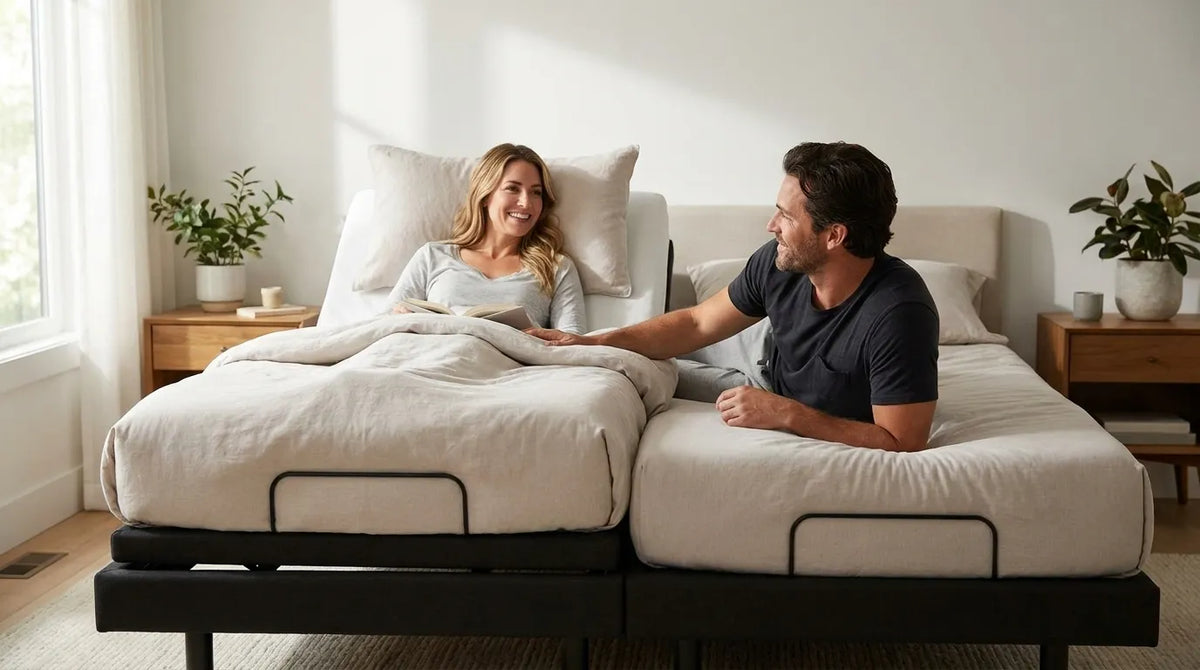
Couples Sleep Technology: The Complete Adjustable Bed Guide
Written by: Matthew Timmins, Founder and Managing Director, Leva Sleep
Key Takeaways
- A flat mattress forces one geometry on two different bodies and creates conflicts over temperature, firmness, snoring, and motion that a better traditional mattress cannot resolve.
- Couples sleep technology solutions match specific problems: dual-zone temperature control for hot and cold conflicts, anti-snore positioning for airway issues, independent firmness for surface preferences, and independent articulation for position needs.
- Split Queen configurations with two 30" × 80" mattresses deliver true independent adjustability in a standard Queen footprint and remove the usual tradeoff between a cramped Queen and an oversized King.
- Complete adjustable bed systems address temperature, position, firmness, and motion isolation together instead of solving a single variable and leaving the rest untouched.
- Leva Sleep manufactures complete split adjustable bed systems with per-side heating and cooling, anti-snore positioning, and bedding engineered for movement, and offers one of the broadest Split Queen selections in North America.
Shop Leva Sleep Adjustable Beds
Why Couples Conflict In Bed: The Mechanism Nobody Explains
A flat surface imposes a single spinal geometry on two people who are not built the same and do not sleep the same. One partner is 5'4" and side-sleeps with a hip that needs to sink. The other is 6'2" and sleeps on his back. His lower back needs support, and his airway closes when it is horizontal. A flat mattress can only answer that with a compromise: firm enough to fail one of them, soft enough to fail the other.
The downstream problems trace back to this original constraint:
- Pressure in the hip, shoulder, and knee, because a flat plane concentrates body weight on the points that stick out furthest
- Lower back ache on waking, because a flat plane leaves the lumbar curve unsupported and the pelvis rotated
- Snoring and airway restriction, because a horizontal head position lets soft tissue collapse into the airway
- Acid reflux at night, because a horizontal torso removes the only thing keeping stomach contents down
- The 2 a.m. reposition, the restless partner, and the drift to the guest room all follow from the same original constraint
The scale of the problem is significant. In a 2025 survey of 2,007 US adults conducted for the American Academy of Sleep Medicine, 31% of American adults said they had opted for a “sleep divorce” and regularly slept in a separate room from their partner. Among adults aged 35 to 44, the figure rises to 39%. A further 37% reported going to sleep at different times to accommodate a partner.
Roughly one in three American couples has already given up on sharing a bed comfortably. The mechanism behind that statistic is geometry. Changing the foam on a flat mattress does not change the underlying geometry problem. Buying a better flat mattress buys a better version of the thing that is already failing.
Geometry also explains why motion transfers so easily between partners. Research tracking 46 couples over 8 nights found that 5–6% of all 30-second sleep epochs contained body movements, with approximately one-third occurring simultaneously in both partners. This demonstrates how one partner's motion fragments the other's sleep even when neither is aware of it.
An actigraphy study of 55 couples found that roughly 19% of all awakenings were “wake transmissions” caused by a partner's movement, according to Sleep Foundation motion isolation research.
A 2012 study in the Journal of Physiological Anthropology found that the thermal environment is one of the most important factors affecting sleep quality, with elevated skin temperature delaying sleep onset and reducing slow-wave sleep. This creates a direct mechanism behind the hot-sleeper and cold-sleeper conflict that affects many couples.
How Couples Sleep Technology Solutions Work
Couples sleep technology solutions let two people share a bed while removing conflicts over temperature, firmness, position, motion, and schedule. These systems include dual-zone temperature control, anti-snore positioning, independent firmness and support, and independent articulation. Each category targets a specific source of partner sleep disruption.
The framework below maps each conflict to the technology category that addresses it:
- One partner sleeps hot, one sleeps cold → Dual-zone temperature control with per-side heating and cooling
- One partner snores, the other is disturbed → Anti-snore positioning using head elevation and snore-detection technology
- One partner needs a firmer surface → Independent firmness and support through split mattresses or air-chamber systems
- One partner needs the head elevated for reflux or breathing → Independent articulation using split adjustable bases
- One partner moves a lot, the other is a light sleeper → Motion isolation through split configurations and pocketed coils
- Different schedules and different bedtimes → Independent articulation with whisper-quiet motors
Dual-Zone Temperature Control For Couples
Hot and cold sleepers share one bed but rarely share one ideal temperature. One partner sleeps hot and kicks off the covers. The other sleeps cold and reaches for another layer. On a shared mattress, the same surface temperature cannot satisfy both. Research published in the Journal of Physiological Anthropology found the optimal sleep temperature is 15.6 to 19.4 degrees Celsius, but partners often have different preferences, so the “right” temperature for one feels wrong to the other.
Three real approaches exist, and each has trade-offs:
- Airflow systems use forced airflow or internal fans to alter the microclimate under the sheets. They offer a low-maintenance, hose-free setup, at the expense of potential wind noise. Testing of dual BedJet 3 configurations found that running different temperatures on each side can create a clash of “cold and warm fronts colliding”, which some couples find off-putting.
- Water circulation systems use a pad with a per-side temperature range. The Chilipad 2.0 offers a temperature range of 55°F to 115°F per side. These systems provide precise, conductive thermal control but require regular distilled water refills and reservoir sanitation, and both docks emit a faint operational hum.
- Integrated per-side heating and cooling layers are built into the sleep system itself. Leva Sleep's integrated per-side heating and cooling, The Leva Sleep System, is available in Split Queen as well as Split King, while many standalone pads are not designed around Split Queen footprints.
The table below summarizes how these three approaches compare on temperature range, maintenance, and whether they work in a Split Queen footprint.
| Approach | Temperature Range | Maintenance | Split Queen Compatible |
|---|---|---|---|
| Airflow (BedJet 3) | 66°F–109°F | Low | No |
| Water circulation (Chilipad 2.0) | 55°F–115°F | Regular refills required | No |
| Integrated (Leva Sleep System) | Per-side heating and cooling | None | Yes |
The American Academy of Sleep Medicine recommends that the ideal sleep environment temperature is in a range of 68 to 72°F, with some extension to 65–75°F. Couples with different thermal preferences can use dual-zone systems to stay within that range while still tailoring each side.
Snoring And Airway Technology
Snoring often keeps the non-snoring partner awake while the snorer sleeps through it. The partner who is not sleeping is usually the one who ends up in the guest room. Bed partners of heavy snorers are up to three times more likely to struggle with sleep, according to a 2017 literature review.
Three approaches address snoring and airway restriction:
- Positional elevation raises the head of the bed to open the airway. Clinicians commonly recommend sleeping with the head elevated for conditions including sleep apnea, acid reflux, and post-surgical recovery. An adjustable base achieves that position at home, night after night, without stacking pillows.
- Snore-detection devices use silent sensors, such as vibration sensors spanning the bed cover at chest level rather than microphones, to detect snoring. They then gently elevate the adjustable bed base in real time to open the airway and reduce snoring without waking either partner. Some pillow-based designs instead gently inflate an air bladder to nudge the sleeper's head to a different angle.
- AI-monitored adjustable bases use built-in sensors, such as vibration sensors in the cover or acoustic sensors, to detect snoring and then automatically and gently elevate the head of the bed, typically by a small angle up to about 15 degrees, to help reduce snoring.
All three approaches work because elevating the head gently opens the airway. A 2026 study led by Dr. Antonio Maniaci and colleagues, published in Laryngoscope, found that 30-degree head-of-bed elevation reduced the average apnea-hypopnea index in obstructive sleep apnea patients from 22.6 to 16.4 events per hour, a 31% reduction. The same study found that adding lateral sleeping to 30-degree elevation dropped the average AHI further to 11.7 events per hour. The authors caution that patients should raise the whole torso rather than only the head with pillows, because propping up on pillows bends the neck and can worsen airway obstruction. A stable, full-length elevation achieved by an adjustable base creates the correct geometry.
Leva Sleep's anti-snore mode detects snoring and makes micro-adjustments to the head of the bed.
Shop Anti-Snore Adjustable Beds
Independent Firmness And Support
Partners rarely agree on how firm a mattress should feel. One prefers a firmer surface, while the other needs more pressure relief. On a traditional mattress, one partner always compromises. RTI International research confirms that optimal mattress firmness varies individually based on body weight, sleep position, and personal comfort needs, which creates conflicts for couples forced to share a single traditional mattress.
The mechanism is structural. A side sleeper at 170 lbs and a back sleeper at 170 lbs often need different mattresses, because side sleepers typically require softer firmness ratings than back sleepers of the same body weight to achieve enough shoulder and hip sinkage for spinal alignment. A heavier sleeper compresses a mattress's comfort layers more deeply, while a lighter partner can experience that same surface as too firm.
Three approaches address firmness conflict:
- Air-chamber systems allow each partner to adjust firmness independently through an app or remote control. They solve per-side firmness well but address only that single variable.
- Split mattresses place two separate mattresses side by side, allowing each partner to choose their own firmness. This is the most direct solution for firmness conflict.
- Split articulation combines independent firmness with independent position, so each partner controls both the surface feel and the angle of their side.
Firmness is one variable. Position often matters more. A mattress that solves firmness but not position still leaves one partner compromising on how they sleep.
Leva Sleep manufactures mattresses in 30" × 80" in two constructions, Heavenly Hybrid (pocket coil hybrid in Luxury Firm and Medium/Plush) and Heavenly Response (all-foam), so each partner chooses their own feel in a true Split Queen.
Explore Mattresses For Pain Relief
The Configuration Decision: Split King Vs. Split Queen Vs. Split-Head
Room size often decides whether couples can use split adjustability. Many couples in smaller bedrooms are told split adjustability only comes in King. They then hear that their only options are to compromise on a standard Queen or buy a King they do not have room for. Clear footprint comparisons and configuration details resolve that choice.
A Split King occupies roughly 76" of width, using two Twin XL mattresses at 38" × 80" each. A Split Queen occupies 60" with two 30" × 80" mattresses. That 16-inch difference often decides whether the room works and whether a couple can solve their sleep problem without changing homes or furniture layouts.
The table below lays out the three configurations side by side so you can see exactly what each one offers.
| Configuration | Footprint | Independent Articulation | Mattress Size |
|---|---|---|---|
| Split King | 76" | Yes, both sides | Two Twin XL (38" × 80") |
| Split Queen | 60" | Yes, both sides | Two 30" × 80" |
| Split-Head Queen | 60" | Head only | One Queen mattress |
A true Split Queen with two fully independent bases and head and foot articulation on each side is rare in the market because it requires purpose-built 30" × 80" mattresses, a size that does not exist in the normal mattress supply chain. To offer it, a company has to commit to building the mattress, the base, and every accessory that has to fit it. Most retailers therefore answer “no” when asked about Split Queen.
Leva Sleep offers the largest selection of Split Queen adjustable beds in North America, with five distinct packages starting at $1,399, mattresses manufactured in-house in 30" × 80", and a full line of bedding and accessories built to fit them. The typical retailer offers none. For couples who need a Split King, Leva Sleep's Split King configurations are available across the same complete system.

Browse Split Queen Adjustable Bed Packages
Accessories That Keep Up With Adjustable Beds
Accessories often fail before the bed does. Standard fitted sheets pop off the moment the bed articulates. On a split adjustable base, a single shared King duvet bunches, slides, or creates cold spots when the two sides are raised to different elevations. Duvets with clips or a centre separation allow each side to move independently while maintaining coverage. The base can work perfectly while the bedding fails at 30 degrees.
Leva Sleep engineers every sheet set, protector, and duvet for split and adjustable beds. Extra elastic, deep pockets, duvet clips, and remote pockets keep bedding in place at full elevation. The Alpine Pure Cotton and Bamboo Breeze adjustable bed sheet sets are cut for split configurations with extra elastic that holds at full elevation. The Remy and Remy Sub Zero mattress protectors, the Adjustable Bed Essentials Bundle, and the Gold Bedding Bundle are all available in Split Queen. In this category, the details are the product.
The Cost Ladder: What Couples Actually Spend
Couples evaluating sleep technology see a wide range of prices and often lack a clear framework for what each option solves. The table below maps each category to what it addresses and its typical cost range.
| Category | Typical Range | What It Solves |
|---|---|---|
| Cooling pad (e.g., Chilipad 2.0, Queen) | About $2,998 for the Chilipad 2.0 Queen; other water-based pads from a few hundred dollars upward | Temperature conflict only |
| Snore-detection device | $79–$499 | Snoring only |
| Complete Leva Sleep adjustable bed package | $1,299–$8,999+ | Full system: temperature, position, firmness, articulation |
Complete Leva Sleep packages run from $1,299 to $8,999+. Financing including 0% APR is available, and every package includes a 180-night comfort guarantee. Leva Sleep states its pricing is 30–50% less than comparable high-end competitors, based on company positioning. The company attributes this to designing in-house, overseeing manufacturing directly, assembling regionally, and delivering with its own trained teams.
See Leva Sleep Package Pricing
Why Leva Sleep Works Well For Couples
Most sleep technology solves exactly one problem: a cooling pad handles temperature, a snore device handles snoring, and a split mattress handles firmness. None of these options addresses the full set of conflicts a couple faces. Leva Sleep is a specialist adjustable bed company offering complete, personalized sleep systems for couples, addressing all four conflict variables in one package.
Leva Sleep systems provide:
- Independent split articulation in Split King and true Split Queen
- Lumbar control and pillow tilt
- Zero-gravity and anti-snore positioning
- Whisper-quiet German motors
- Mattresses engineered to bend
- Bedding designed for movement
- Per-side heating and cooling
- In-house white-glove delivery and setup with old-bed removal
Leva Sleep offers the largest Split Queen selection in North America, with five packages starting at $1,399, mattresses manufactured in-house in 30" × 80", and a full line of bedding and accessories built to fit them. The typical retailer offers none. Leva has operated for nine years and served more than 25,000 customers across that time. Complete packages are backed by a 180-night comfort guarantee, which customers should confirm as current on customer-facing materials. The La Jolla, California showroom offers a way to experience the system in person.
Shop Leva Sleep Adjustable Bed Systems
Frequently Asked Questions
How Do You Stop A Partner's Snoring Without Waking Them?
As explained above, elevating the head opens the airway, which is why anti-snore positioning helps many sleepers. Clinicians commonly recommend sleeping with the head elevated for conditions including sleep apnea, acid reflux, and post-surgical recovery. Leva Sleep's anti-snore mode detects snoring and makes micro-adjustments to the head of the bed. For couples where snoring is the primary conflict, an adjustable base with anti-snore positioning offers a direct way to keep both partners in the same bed.
Do You Need A Split King To Get Independent Adjustability?
Independent adjustability is available in more than one footprint. Leva Sleep offers true Split Queen configurations with two fully independent bases, each with head and foot articulation on each side. A Split Queen occupies 60" of width versus 76" for a Split King. Couples in condos, apartments, older homes, or downsized bedrooms who have been told split adjustability only comes in King have a direct alternative. As noted earlier, Leva Sleep offers five Split Queen packages starting at $1,399, with 30" × 80" mattresses manufactured in-house and a full line of Split Queen bedding and accessories.
Will My Sheets Fit An Adjustable Bed?
Most standard fitted sheets struggle to stay on when the bed articulates. This is the frustration many couples discover only after they buy an adjustable base. Leva Sleep engineers every sheet set, protector, and duvet for split and adjustable beds. Extra elastic, deep pockets, duvet clips, and remote pockets keep bedding in place. The Alpine Pure Cotton and Bamboo Breeze sheet sets are cut specifically for split configurations and hold at full elevation. A split bed that the sheets will not stay on solves only half the problem.
What If We Do Not Have Room For A King?
Room constraints do not have to rule out independent adjustability. A Split Queen occupies 60" of width, the same footprint as a standard Queen. Couples who have been told their only options are a standard Queen or a King they do not have room for have a third path. True split adjustability in a Queen footprint provides two independent sides and two firmness choices. As noted earlier, Leva Sleep offers the largest Split Queen selection in North America, with five packages starting at $1,399 and a full line of Split Queen bedding.
What If We Do Not Like It?
Leva Sleep's stated policy is a 180-night comfort guarantee with a comfort exchange available within that period. Adjusting to a new surface and a new sleeping position takes weeks rather than days, which is why the window is generous. The 180-night window exists because the first week on a new sleep system rarely predicts long-term fit. Couples who have spent years on a flat mattress often need several weeks before the new positions feel natural.
Conclusion: The Compromise Is The Problem
Shared beds fail when both partners must compromise on one fixed geometry. A flat bed forces one shape on two different bodies for eight hours. Couples sleep technology solutions remove that compromise instead of asking partners to negotiate around it. The four main solution pathways map directly to the four most common conflicts:
- Dual-zone temperature control for temperature conflict
- Anti-snore positioning for snoring and airway restriction
- Independent firmness and support for firmness conflict
- Independent articulation for position conflict
The most effective path is a complete system that addresses all four variables, rather than a single gadget that solves only one. Leva Sleep is a specialist adjustable bed company serving the United States, with a luxury showroom in La Jolla, California. After nine years, Leva designs complete sleep systems, including adjustable bases, mattresses built to flex, and bedding engineered for movement, for couples who want to sleep well together.
Explore Leva Sleep Systems For Couples


