

Anti Snoring Mouth Guard: Decision-First Buying Guide 2026
Written by: Matthew Timmins, Founder and Managing Director, Leva Sleep
Key Takeaways
- An anti-snoring mouth guard, or mandibular advancement device (MAD), holds the lower jaw forward to open the airway and reduce snoring vibration.
- Four main device types exist: boil-and-bite trays, adjustable MADs, tongue-retaining devices, and custom dentist-fabricated appliances. Each works differently and suits different budgets and needs.
- Custom, titratable MADs have the strongest clinical evidence and can reduce snoring frequency by 50–70 percent. Over-the-counter boil-and-bite options usually have lower response rates and shorter lifespans.
- Common side effects include jaw stiffness, tooth soreness, excess saliva, dry mouth, and gradual bite changes. Ongoing pain or bite changes need professional evaluation.
- Leva Sleep adjustable beds elevate the head to address positional snoring that a mouth guard cannot fully resolve, so they can complement or replace a tray for many couples.
Shop adjustable beds that support quieter sleep
Comparing The Main Types Of Anti-Snoring Mouth Guards
Anti-snoring mouth guards available to US buyers include:
- Boil-and-bite tray
- Adjustable mandibular advancement device with a jaw-advancement range
- Tongue-retaining device (TRD)
- Custom dentist-fabricated appliance
Each device type works differently, costs differently, and fails differently. The table below maps the key differences.
| Device Type | Mechanism | Typical US Price Band | Who It Suits |
|---|---|---|---|
| Boil-and-bite tray (e.g., ZQuiet, SmartGuard RX at $50, SnoreRx at $59.99) | Thermoplastic tray molded to the teeth by the user, holds the lower jaw forward at a fixed or limited-range position | About $50 up to roughly $200 | Occasional snorers with healthy teeth, no crowns or bridges, no TMJ history, and no suspected sleep apnea who want a low-cost first trial |
| Adjustable MAD with jaw-advancement range (e.g., SnoreRx Plus at $100, Somnofit-S at $150) | Boil-and-bite or semi-custom tray with a built-in screw, strap, or bar system that allows incremental jaw advancement after fitting | $100–$200 | Regular snorers who want more precise titration than a fixed boil-and-bite allows, without the cost of a custom appliance |
| Tongue-retaining device (e.g., SmartGuard RX hybrid, Zyppah at $100) | Suction bulb holds the tongue forward without advancing the jaw, does not require dental retention | $100 or less | People who cannot tolerate jaw advancement, have insufficient dentition for a MAD, or whose snoring is driven mainly by tongue position |
| Custom dentist-fabricated appliance | Laboratory-made from dental impressions or digital scans, titratable in precise increments by a trained dentist, highest retention and comfort | $1,000–$3,000+ | People with diagnosed mild-to-moderate OSA, those who have failed OTC devices, or anyone whose dental anatomy requires a precision fit |
Last updated: September 28, 2026. Price ranges reflect current US market listings from Sleep Foundation, SleepApnea.org, and Integrative Dental of Denver. No testing scores or proprietary rankings are used; prices are drawn from verifiable retail and clinical sources cited inline.
Boil-and-bite trays often fail on retention. Thermoplastic devices cannot be accurately titrated, offer limited control over advancement, and typically have shorter lifespans and lower adherence rates than custom devices, according to the British Academy of Dental Sleep Medicine. Adjustable MADs solve some of that, but if the initial jaw position is wrong, there is no correction path for fixed designs. Tongue-retaining devices sidestep the jaw entirely, at the cost of comfort, and TRDs are less comfortable than MADs and are considered a second-line option. Custom appliances mainly fail on cost and access rather than on clinical performance.
See adjustable options that help positional snoring
Do Anti-Snoring Mouthpieces Really Work?
Anti-snoring mouthpieces reduce snoring for many people, but they do not cure every case. Their success depends on fit quality, how far the jaw can advance, and whether the snoring has a dental or positional cause. They also do not replace full sleep apnea treatment.
The clinical evidence is strongest for custom, titratable devices. A 2025 umbrella review found mandibular advancement devices reduce snoring frequency by 50 to 70 percent across multiple study designs. A 2023 network meta-analysis of 51 randomized controlled trials found custom titratable MADs reduce the apnea-hypopnea index by a mean of 52 percent. CPAP achieved 68 percent. The 2015 AASM/AADSM guideline recommends oral appliance therapy over no treatment for primary snoring and recommends a custom, titratable oral appliance for adults with OSA who are intolerant of CPAP or prefer an alternative.
The evidence for over-the-counter boil-and-bite devices is weaker. A 2017 randomized controlled trial found complete treatment response was 64 percent with custom-made mandibular repositioning devices versus 24 percent with ready-made devices. A 2025 meta-analysis comparing mandibular advancement device designs found adjustable devices outperform fixed designs by 22 percent on objective sleep study measures, with lower side effect rates.
Data from roughly 160,000 Sleep Foundation profiles show that more than two-thirds of people snore at least occasionally and 21 percent snore regularly. The ORCADES study 5-year follow-up found that up to 63 percent of participants using mandibular advancement devices reported they stopped snoring due to a more open airway.
The practical takeaway: a well-fitted, titratable device helps most people with primary snoring or mild-to-moderate sleep apnea. An over-the-counter boil-and-bite works as a first trial for a healthy-toothed occasional snorer. Anyone with possible apnea still needs a sleep study.
What Are the Side Effects of Wearing a Mouth Guard for Snoring?
Most people notice side effects during the first one to two weeks, and many of these fade with time. The most common include:
- Jaw stiffness and muscle soreness: Transient morning TMJ soreness occurs in 10–20 percent of MAD patients during the initial adaptation period and typically resolves within two weeks.
- Tooth soreness: Tooth discomfort affects 15 to 20 percent of users and usually signals poor fit or over-advancement.
- Excess saliva: Excessive salivation affects 30 to 40 percent of users in the first two weeks and diminishes over time.
- Dry mouth: Dry mouth affects 10 to 15 percent of users and may persist beyond the adaptation period.
- Bite changes over time: Approximately 14 to 20 percent of patients develop measurable occlusal changes after two or more years of MAD use, usually a reduction in overjet and overbite.
Jaw pain that worsens, a bite that feels different later in the day, or jaw locking that continues beyond two weeks all need professional evaluation instead of continued self-treatment, according to Westchester TMJ & Sleep.
Who Should Avoid Over-the-Counter Anti Snoring Mouth Guards
Some people should not use an OTC mandibular advancement device without a dentist or physician’s guidance:
- People with extensive crowns, bridges, or dental implants, because device pressure can stress restorations; SleepApnea.org lists crowns, bridges, and implants as contraindications for OTC mouthpieces
- People with braces or active orthodontic treatment, because a MAD can interfere with tooth movement and appliance integrity
- People with existing TMJ disorder, since MADs are contraindicated in patients with active, severe temporomandibular disorders
- People with loose teeth or advanced periodontal disease, because the AASM lists active periodontal disease or loose teeth as an anatomical contraindication, as device pressure accelerates tooth loss
- People with full or partial dentures, since a MAD requires adequate natural dentition for retention; edentulous patients are an absolute contraindication for MAD therapy
- People with fewer than eight natural teeth per arch, which is insufficient for device retention, per the AASM
These groups may still have options. A tongue-retaining device can work because it does not rely on the teeth, and a custom dentist-fabricated appliance may still be possible. Having crowns, bridges, or missing teeth does not automatically disqualify a patient from oral appliance therapy, but patients with very few teeth or poor oral health may need alternative options, according to South Bay TMJ.
Explore snoring relief options beyond trays
When a Mouth Guard Is Not Enough: Snoring vs. Sleep Apnea
A mouth guard does not treat obstructive sleep apnea. It can soften the sound of snoring while the underlying breathing disorder continues. The following symptoms signal that a sleep study, rather than an OTC device, should come next:
- Witnessed breathing pauses: A bed partner sees the sleeper stop breathing, then resume with a gasp or snort. Witnessed breathing pauses, gasping, choking, or snorting during sleep are strong warning signs of possible obstructive sleep apnea.
- Gasping or choking on waking: The sleeper wakes with a gasp or choking sensation.
- Morning headaches: Morning headaches are identified as a common clinical symptom of OSA in a 2026 overview of systematic reviews published in Sleep and Breathing.
- Persistent daytime sleepiness: Falling asleep during conversations, at a desk, or while driving. Persistent daytime fatigue, sleepiness, or irritability, especially waking unrefreshed despite adequate hours of sleep, points toward possible sleep apnea.
Research suggests that approximately 60 to 95 percent of people with obstructive sleep apnea snore, yet snoring loudness alone cannot confirm or rule out apnea. Using anti-snoring gadgets to silence a snore that might be apnea removes the warning sign while leaving the underlying health risk untreated.
Primary snoring, without breathing pauses, gasping, or significant daytime sleepiness, behaves differently. Primary snoring is typically a steady, rhythmic sound and does not involve witnessed breathing pauses, gasping, or choking. For primary snoring, an OTC mandibular advancement device is a reasonable starting point. For suspected sleep apnea, a sleep study comes first.
The apnea-hypopnea index (AHI) grades severity by counting breathing events per hour of sleep. Mild OSA is AHI 5 to 15, moderate is AHI 15 to 30, and severe is AHI above 30. CPAP remains the standard of care for moderate-to-severe OSA. The 2019 AASM clinical practice guideline establishes CPAP as the first-line treatment for adults with obstructive sleep apnea because it reliably opens the airway across every severity level.
How An Anti Snoring Mouth Guard Fits Into Positional Snoring Care
People with positional snoring often benefit from head elevation. Clinicians frequently recommend sleeping with the head and upper torso raised for airway and reflux issues. Most reflux guidelines, including those from the American College of Gastroenterology and Mayo Clinic, recommend raising the head and upper torso by 6 to 8 inches rather than elevating the legs. When a person lies on their back, gravity pulls the tongue and soft tissue at the back of the throat downward and backward, narrowing the airway more than when lying on the side.
A mouth guard and an elevated sleeping position work well together. Positional therapy is commonly combined with oral appliance therapy for patients with both a positional pattern and broader obstruction. For many snorers, improving airway geometry through head elevation reduces the amount of jaw advancement needed from a MAD.
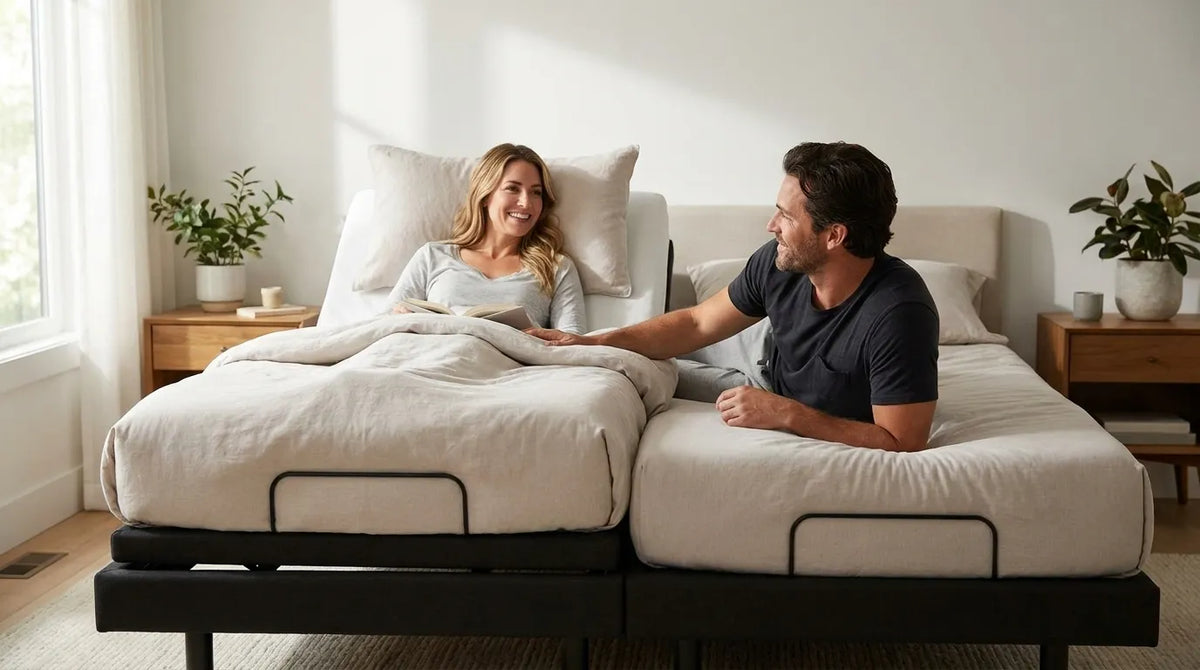
If your snoring worsens on your back, head elevation becomes the lever a mouth guard cannot fully pull. That gap is where an adjustable bed fits. Leva Sleep focuses on adjustable beds with anti-snore positioning that gently elevates the head to help open the airway. The Leva system articulates each side independently, so one partner’s elevated position never forces the other’s. It also offers per-side heating and cooling and comes with a 180-night comfort guarantee.
For couples where one partner snores and the other does not, Leva’s Split Queen adjustable beds and Split King adjustable beds let each side move independently. The snoring partner can sleep with the head elevated while the other side stays flat. For people managing both snoring and back or joint pain, Leva’s beds for pain relief support both comfort and airway position. The full snoring relief collection shows the range of configurations.

See how per-side elevation feels in person or online
How To Choose And Care For An Anti Snoring Mouth Guard
Fitting
The fitting process depends on the device type.
- Boil-and-bite: Submerge the device in fully boiled water for the manufacturer’s specified time, usually about 60 seconds. Cool it briefly in tap water, then bite down firmly for 30 seconds to form the impression, and set it in cool water. SnoreRx’s instructions, for example, allow a maximum of two fitting attempts. After molding, start at the lowest advancement setting. Increase in 1 mm steps, and wear each setting for at least three to five nights before advancing.
- Adjustable MAD: After the boil-and-bite impression, use the built-in screw, strap, or bar to advance the jaw gradually. The validated titration protocol starts at 50 percent of maximum comfortable advancement, increases by 1 mm every three to five nights until snoring stops or side effects appear, then reduces by 1 mm to find the minimal effective position.
- Custom dentist-fabricated: A sleep physician diagnoses the condition and writes a prescription. A dentist trained in dental sleep medicine takes digital scans or physical impressions. A dental laboratory fabricates the device, and the dentist fits and titrates it over several weeks. A follow-up sleep study confirms how well it works.
Cleaning
Users who cleaned their oral appliance with denture tablets or mild soap daily experienced 30 percent longer device life than users who rinsed with water only, and abrasive toothpaste degrades thermoplastic faster, reducing average lifespan by four to six months. Use cool water, since hot water can warp thermoplastic. Clean with a soft toothbrush and non-abrasive soap or denture cleaner.
Replacement Cadence
Boil-and-bite devices last 12 to 18 months with nightly use. Custom-made MADs typically last three to five years, depending on the device type and the patient’s level of parafunctional activity such as bruxism. Signs that a device needs replacement include visible cracks or deformation, a change in fit, or a return of snoring after a period of good control.
What to Ask a Dentist
When you pursue a custom appliance, ask whether the dentist has training in dental sleep medicine, what titration protocol they use, whether a follow-up home sleep test is included, and how they will monitor bite changes over time. The joint AASM/AADSM guideline calls for evaluation by both a sleep physician and a qualified dentist before fitting begins, because the candidate criteria span both medical and dental territory.
Frequently Asked Questions
What Is The Best Anti-Snoring Mouthguard?
The best device depends on dental health, snoring cause, and budget. A healthy-toothed occasional snorer often does well with an adjustable boil-and-bite MAD like SnoreRx Plus ($100) or Somnofit-S ($150), which offer more precision than a fixed tray. Anyone with diagnosed sleep apnea should look at a custom dentist-fabricated appliance, which is the clinical standard. For people who cannot tolerate jaw advancement because of TMJ issues, limited teeth, or discomfort, a tongue-retaining device offers an alternative. When snoring is mainly positional, head-of-bed elevation through an adjustable sleep system addresses airway geometry that a tray cannot change alone.
Is A Snoring Mouth Guard The Same As A Night Guard For Teeth Grinding?
A snoring mouth guard and a grinding guard serve different purposes. A standard bruxism night guard places a barrier between the teeth to limit damage from grinding and does not reposition the jaw. A mandibular advancement device holds the lower jaw forward to influence the airway. These devices are not interchangeable. Using a grinding guard for snoring will not open the airway, and using a MAD as a grinding guard may separate the teeth but does not follow bruxism design standards.
Can I Wear A Mouth Guard If I Have Crowns Or Braces?
Braces conflict with OTC mandibular advancement devices because the device can interfere with orthodontic movement. Crowns and bridges do not always rule out oral appliances, but extensive restorative work needs a dentist’s assessment before you use any device. People with very few remaining teeth, full dentures, or advanced periodontal disease usually are not candidates for MAD therapy and should discuss tongue-retaining devices or other options with a clinician.
Do I Need A Doctor Before Buying An Anti-Snoring Mouth Guard?
People with simple primary snoring and no red-flag symptoms can trial an OTC device without a prior medical visit. Anyone with witnessed breathing pauses, gasping or choking on waking, morning headaches, or persistent daytime sleepiness should schedule a sleep study before buying a device. These symptoms suggest obstructive sleep apnea, and treating only the sound of snoring leaves the health risk in place. A prescription from a sleep physician is legally required before a dentist can fit a custom MAD for diagnosed OSA in the United States.
What Permanently Stops Snoring?
No single intervention permanently eliminates snoring for everyone. Weight loss helps when excess weight narrows the airway. Positional therapy reduces snoring in positional snorers. Custom mandibular advancement devices provide long-term relief for many users. Surgical options, including uvulopalatopharyngoplasty and hypoglossal nerve stimulation, suit selected patients. Most people manage snoring over time with a plan that targets their specific anatomical or positional cause.
Can Losing Weight Cure Sleep Apnea?
Weight loss can significantly reduce OSA severity, and mild cases sometimes resolve after substantial weight reduction. Extra tissue around the neck and upper airway narrows the airway during sleep, so losing that tissue helps. Moderate-to-severe OSA often persists even after major weight loss, so treatment usually continues. A follow-up sleep study after significant weight change is the only way to confirm whether apnea has resolved or improved enough to adjust therapy.
Browse adjustable setups for quieter nights
The Bottom Line
The decision about an anti snoring mouth guard rests on three points: your dental situation, the main cause of your snoring, and whether your symptoms suggest apnea.
Match the device type to those answers. A healthy-toothed occasional snorer can start with an adjustable boil-and-bite MAD in the $100–$150 range. Someone with crowns, bridges, TMJ history, or braces needs a dentist’s assessment before buying any device. Anyone with witnessed breathing pauses, gasping, morning headaches, or persistent daytime sleepiness needs a sleep study before trying a mouth guard.
Positional snoring, especially snoring that worsens on the back as the tongue and soft tissue fall into a horizontal airway, responds well to head elevation. An adjustable sleep system from Leva Sleep changes airway geometry in a way a mouth guard alone cannot. Leva Sleep serves customers across the United States and offers a luxury showroom in La Jolla, California, where you can experience the full system in person. Complete adjustable bed packages start at $1,299 and include a 180-night comfort guarantee.
Start sleeping elevated with Leva Sleep

,%20holds%20the%20lower%20jaw%20forward%20to%20open%20the%20a...)