Best Adjustable Bed for Sleep Apnea: A Sourced Buying Guide
Written by: Matthew Timmins, Founder and Managing Director, Leva Sleep
Updated September 2026
Key Takeaways
- Adjustable beds for sleep apnea work best with at least 60 degrees of head incline, quiet motors, split articulation, and a mattress that flexes easily.
- Head-of-bed elevation shifts soft tissue forward and improves lung volume, which helps keep the airway open alongside CPAP or other prescribed therapy.
- Clinical studies show meaningful AHI reductions at inclines from 7.5 to 30 degrees, with higher angles often helping more severe cases.
- Adjustable beds do not replace CPAP for moderate-to-severe or non-positional OSA, and most insurance plans require a Letter of Medical Necessity before considering coverage.
- Leva Sleep builds adjustable beds with anti-snore mode, split configurations, and flex-ready mattresses that suit couples managing sleep apnea.
Shop Adjustable Beds Designed For Sleep Apnea
How Adjustable Beds Help People With Sleep Apnea
Head elevation gently shifts soft tissue forward and reduces the gravitational load on the upper airway. Clinicians often recommend sleeping with the head raised for sleep apnea, acid reflux, and post-surgical recovery.
An adjustable base lets you hold that position every night without stacking pillows, which IncitefulMed’s 2026 evidence summary warns can bend the neck forward and worsen apnea.
The 2026 MedComm narrative review by Thuy et al. (doi:10.1002/mco2.70877) recommends positional therapy as a phenotype-guided adjunctive strategy. It works best for clearly positional obstructive sleep apnea with low nonsupine event rates and mild-to-moderate disease.
Thuy et al. describe three main ways head-of-bed elevation stabilizes the airway: improved lung volume, reduced rostral fluid shift, and altered gravitational loading of the throat structures.
An adjustable bed supports prescribed therapy such as CPAP; it does not replace it.
Recommended Head Elevation For Sleep Apnea
Clinical sources and retailers recommend head-of-bed elevation for sleep apnea across a wide range, from about 7.5 degrees up to 60 degrees. Most people tolerate a gentle incline of 10–30 degrees for nightly use. Higher angles may suit severe reflux or post-surgical recovery and should be set with a clinician’s guidance.
Two peer-reviewed studies highlight the range of benefit:
- A 2017 study by Souza et al. in Sleep & Breathing found that a 7.5-degree elevation reduced AHI from 15.7 to 10.7 events per hour and improved minimum oxygen saturation.
- A 2022 randomized crossover trial by Sakaguchi et al. in Anesthesiology found that a 30-degree elevation reduced AHI by 15 events per hour in postoperative patients with moderate-to-severe OSA.
These findings show clinically meaningful benefit across a range of incline angles. Greater elevation often produces larger AHI reductions in more severe disease. The right angle still depends on diagnosis, severity, and comorbidities and should be set with a treating clinician.
Can An Adjustable Bed Replace A CPAP Machine?
An adjustable bed cannot replace a CPAP machine. It can make CPAP more comfortable and may help some people with mild positional OSA, but prescribed treatment remains central.
The 2026 BMC Pulmonary Medicine network meta-analysis by Song et al. (18 RCTs, 1,520 participants) found that PAP therapy produced the largest AHI reduction and ranked first with 100 percent probability. Positional therapy still reduced AHI by a clinically meaningful amount but remained less effective than PAP.
A 2025 meta-analysis by Gao et al. of 19 randomized controlled trials (1,231 individuals) also concluded that CPAP is superior for reducing overall AHI and improving oxygenation. The authors describe positional therapy as a safe, viable alternative for people with positional OSA or CPAP intolerance.
The Song et al. analysis reported that roughly 30–50 percent of patients discontinue PAP therapy within the first year. Clinicians often consider positional therapy in that context as an adjunct or alternative for carefully selected patients.
An adjustable bed does not correct central sleep apnea, which involves neurological control of breathing. For mixed sleep apnea, head elevation may help the obstructive component, while CPAP or another device still treats central events.
With those limits in mind, the next step is choosing an adjustable bed that delivers the positioning and articulation the evidence supports.
Best Adjustable Bed For Sleep Apnea: Leva Sleep
Leva Sleep is a specialist adjustable bed company serving the United States, with a luxury showroom in La Jolla, California. For couples managing sleep apnea, Leva Sleep systems focus on precise positioning and long-term durability.

Key features relevant to sleep apnea management include:
- Anti-Snore Mode: Detects snoring and makes small head adjustments to help open the airway.
- Whisper-Quiet German Motors: Smooth, gradual movement that lets one partner adjust without waking the other.
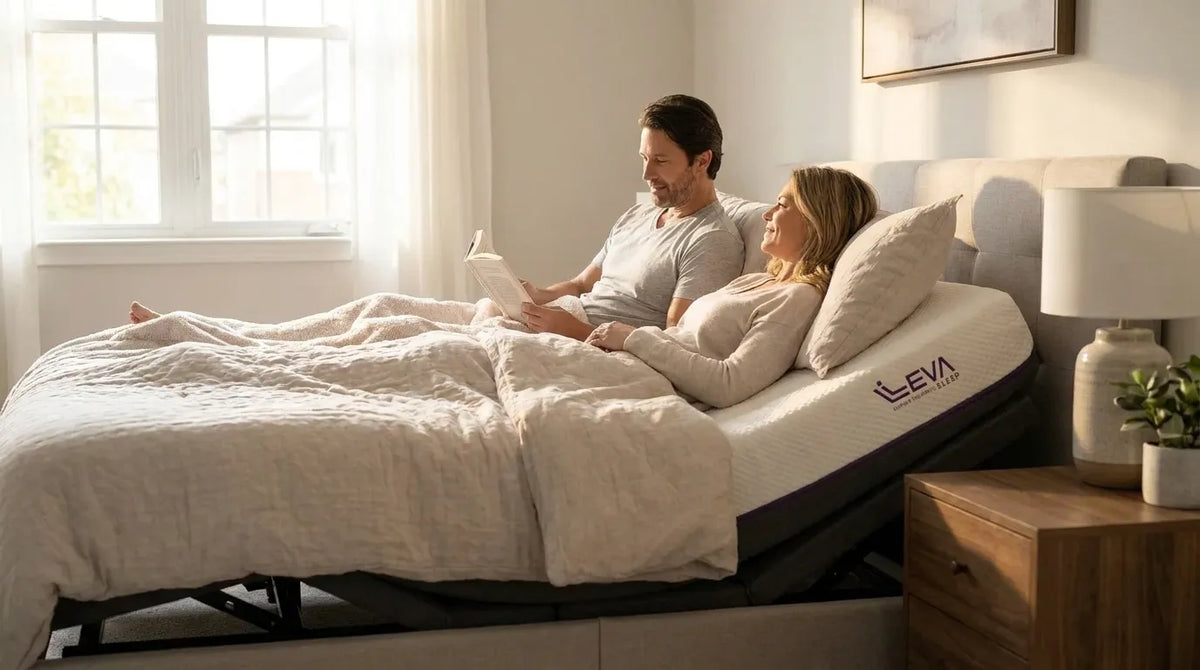
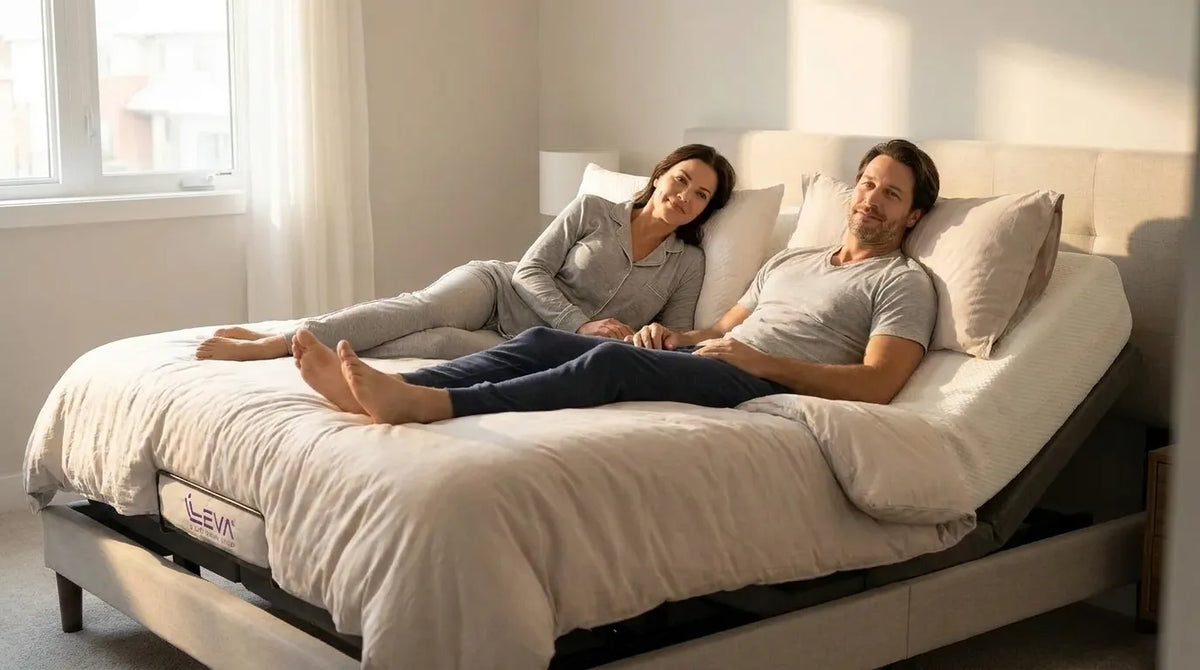
- Independent Split Articulation: Each side adjusts separately, so one partner can sleep elevated while the other stays flat.
- Lumbar Control And Pillow Tilt: Fine-tunes lower-back support and head angle to maintain spinal alignment at elevation.
- Mattresses Engineered To Bend: Leva designs mattresses to flex with the base night after night, which protects comfort and wear.
- Bedding Designed For Movement: Extra-elastic fitted sheets, duvet clips, and remote pockets keep the bed functional at full elevation.
Leva Sleep offers the largest selection of Split Queen adjustable beds in North America, with five packages starting at $1,399. The company manufactures mattresses in the 30" × 80" size that a true Split Queen requires and pairs them with a full line of fitted bedding and accessories.
Leva Sleep systems include a comfort guarantee per company policy and delivery by an in-house white-glove team that handles setup, height adjustment, old-bed removal, and a walkthrough with both partners.
Explore Leva Sleep Adjustable Bed Systems
Split King Vs. Split Queen Vs. Split-Head For Couples With Sleep Apnea
Room size often decides configuration before personal preference does. The table below compares the three main options for couples when one or both partners need head elevation.
| Configuration | Footprint Width | Independent Articulation | Typical Room Fit |
|---|---|---|---|
| Split King | 76" (two Twin XL bases, each 38" × 80") | Head and foot adjust independently on each side | Requires about 76" of wall space, suited to larger primary bedrooms |
| Split Queen | 60" (two independent bases, each 30" × 80") | Head and foot adjust independently on each side | Requires about 60" of wall space, often fits condos and older homes |
| Split-Head Queen | 60" (single mattress footprint, split head only) | Head sections adjust independently; foot section moves together | Uses a standard Queen footprint, suited to couples who only differ on head elevation |
Leva Sleep manufactures true Split Queen bases with fully independent head and foot articulation on each side, across five packages from $1,399. The 30" × 80" mattress size required for a true Split Queen does not exist in the standard supply chain, so Leva builds it in two constructions (Heavenly Hybrid pocket coil and Heavenly Response all-foam) and two firmness levels.
Split-Head Queen remains a separate, more specialized option for couples who only need different head positions.
Will Insurance Pay For An Adjustable Bed For Sleep Apnea?
Most insurance plans do not cover consumer adjustable beds. Anthem’s Clinical UM Guideline CG-DME-15 (published 04/15/2026) classifies consumer adjustable beds, including named furniture brands, as not medically necessary and labels them “lounge beds.” Ordinary beds do not meet the durable medical equipment definition because they are not primarily medical.
HSA and FSA funds follow a related but separate set of rules. Under IRS Publication 502, HSA and FSA dollars can only pay for qualified medical expenses that diagnose, treat, or prevent disease. Adjustable bases usually count as comfort products and do not qualify on their own.
However, IRS Publication 502 and Notices 2006-69 and 2007-2 allow a mattress or adjustable base to qualify when a licensed clinician issues a Letter of Medical Necessity. The letter must name the diagnosis, the item, and the medical reason, and it must be dated on or before the purchase date. Plan administrators still make the final decision.
Readers should confirm details with their insurer, plan administrator, and treating clinician before purchasing, since no coverage is guaranteed.
What To Look For In An Adjustable Bed For Sleep Apnea
The table below links common adjustable-bed features to how they affect nightly comfort and airway management.
| Feature | What It Does | Impact On Sleep Apnea Management |
|---|---|---|
| Head Incline Range | Raises the head section from flat to a maximum angle, often 0–60 degrees | Supports clinically studied incline ranges and lets you fine-tune comfort and airway benefit |
| Snore Response / Anti-Snore Mode | Detects snoring and makes automatic micro-adjustments to the head section | Helps reopen the airway during the night without requiring you to wake and reposition |
| Zero Gravity | Preset with head and knees slightly elevated to distribute body weight | Reduces lower-back pressure and supports circulation while keeping the head gently elevated |
| Motor Noise | Controls how loud the base sounds while adjusting | Quiet motors allow mid-night adjustments in a shared bed without disturbing a partner |
| Split Configuration | Provides two independent sides, each with its own controls | Lets one partner sleep elevated for airway support while the other chooses a different position |
| Mattress Compatibility | Indicates whether the mattress is built to flex repeatedly with the base | Purpose-built mattresses maintain support and lifespan at elevation better than standard models |
| Bedding At Elevation | Uses fitted sheets, protectors, and duvets designed for adjustable bases | Prevents sheets from popping off and keeps the sleep surface stable at therapeutic angles |
Who Should Avoid Using An Adjustable Bed As Primary Sleep Apnea Treatment
An adjustable bed does not serve as primary treatment for every OSA presentation. The following groups should not rely on head elevation alone:
- Severe OSA (AHI ≥30): The 2026 MedComm review by Thuy et al. notes that CPAP remains superior for overall physiological control. Severe OSA requires medical treatment.
- Non-Positional OSA: People whose AHI stays elevated in all sleep positions usually need more than head elevation to reach adequate control.
- Central Sleep Apnea: Head elevation addresses gravity-driven collapse in obstructive apnea. Central sleep apnea involves neurological control and needs specialized devices.
- Anyone Skipping Prescribed Therapy: An adjustable bed can support a CPAP machine, oral appliance, or other therapy but does not replace them.
Anyone with diagnosed sleep apnea should review positional therapy with their clinician before treating it as a primary or sole approach.
Frequently Asked Questions
Is There A Way To Treat Sleep Apnea Without A CPAP?
Positional OSA means the apnea-hypopnea index is at least twice as high in the supine position as in non-supine positions. For carefully selected patients with mild-to-moderate disease, positional therapy may be sufficient as a stand-alone approach.
For moderate-to-severe OSA, CPAP remains the standard of care. The 2025 Gao et al. meta-analysis of 19 randomized controlled trials found that positional therapy is a safe, viable alternative for positional OSA or CPAP intolerance, while CPAP still performs better on AHI and oxygenation.
The Song et al. network meta-analysis cited earlier also showed that PAP outperformed positional therapy on AHI reduction, even though both approaches produced meaningful improvements.
Alternatives to CPAP, including oral appliances, positional therapy, and hypoglossal nerve stimulation, work best when chosen with a sleep medicine clinician who can match treatment to OSA phenotype and severity.
What Makes Sleep Apnea Worse?
Supine sleeping is the most common positional driver of OSA severity. In that position, gravity pulls the tongue and soft palate backward and increases airway collapsibility.
Weight gain is a major systemic factor. The Wisconsin Sleep Cohort found that a 10 percent weight gain predicted about a 32 percent increase in AHI.
Alcohol and sedatives relax upper airway muscles and lower the arousal threshold, which increases both the frequency and duration of apnea events. Nasal congestion from allergies, irritants, or infection raises upper airway resistance and can worsen snoring and apnea severity.
Aging and anatomical traits such as tongue volume, hyoid position, and pharyngeal length also influence risk, even when weight stays stable.
What Is The Pillow Trick For Sleep Apnea?
The “pillow trick” means stacking standard pillows to elevate the head during sleep. Stacked pillows often bend the neck forward and push the chin toward the chest, which can collapse the airway further and worsen apnea.
A wedge pillow or adjustable bed keeps the spine and neck in a straighter, more neutral alignment while elevating the upper body. That alignment reduces gravitational airway collapse.
An adjustable base also lets you set a precise angle and return to it every night, which a loose stack of pillows cannot maintain through normal movement.
Can I Use My Existing Mattress On An Adjustable Bed?
Some existing mattresses can work on an adjustable base, but many are not built to bend repeatedly. A standard mattress often resists articulation, wears unevenly, and shortens its own lifespan when used on a moving base.
The feel can change at elevation compared with flat use, and premature sagging becomes more likely. Leva Sleep designs its Heavenly Hybrid (pocket coil) and Heavenly Response (all-foam) mattresses to flex with the base and offers them in the 30" × 80" size needed for a true Split Queen.
Pairing a purpose-built mattress with the base creates a system that maintains comfort and support instead of a compromise that breaks down early.
Choosing The Right Adjustable Bed Setup For Couples
Sleep apnea affects both partners. When one partner’s airway collapses repeatedly through the night, both people lose sleep. When one partner needs elevation and the other does not, a flat bed forces a compromise that works for neither.
The 2026 MedComm review notes that positional therapy is often better tolerated than CPAP when the position is achievable and sustainable. In a shared bed, that usually means independent articulation so each partner can keep their own preferred geometry.
Couples can start by measuring room width, deciding between Split King, Split Queen, or Split-Head, and then choosing a base and mattress combination that supports both airway management and comfort.
Find Your Split Configuration For Sleep Apnea Relief