Adjustable Bed for Sleep Apnea: What the Research Shows
Written by: Matthew Timmins, Founder and Managing Director, Leva Sleep
Key Takeaways
- Head-of-bed elevation between 7.5° and 30° can meaningfully reduce AHI in people with positional or supine-predominant OSA. Elevation supports treatment rather than curing apnea.
- Adjustable bed bases outperform wedge pillows and stacked pillows because they hold a precise, consistent angle all night without slipping or neck flexion.
- CPAP remains the primary evidence-based treatment for moderate-to-severe OSA. An adjustable bed can make therapy more comfortable and easier to stick with.
- Medicare and standard insurance do not cover consumer adjustable bases for sleep apnea, though HSA/FSA eligibility may apply with a Letter of Medical Necessity.
- Leva Sleep offers specialist adjustable bases with quiet motors, split configurations, and precise angle presets engineered for nightly OSA support.
Shop Leva Sleep Adjustable Beds
Key Terms Defined For Sleep Apnea Elevation
Apnea-Hypopnea Index (AHI): The number of breathing pauses or reductions per hour of sleep. The AASM classifies adult OSA severity as mild (AHI 5–14), moderate (AHI 15–29), and severe (AHI 30 or higher).
Positional OSA: A subtype of obstructive sleep apnea in which the AHI is at least twice as high in the supine (back-sleeping) position as in non-supine positions. Prabakar et al. (2026) in J Otorhinolaryngol Hear Balanc Med estimate it affects more than 50% of OSA patients.
Head-of-Bed Elevation: Raising the upper portion of the sleep surface, using an adjustable base, wedge pillow, or bed risers, so that the head and torso are inclined relative to the legs. Peer-reviewed studies have tested head-of-bed elevation at specific angles including 7.5° and 30° for reducing AHI in OSA.
Explore The Snoring Relief Collection
Find An Adjustable Base That Holds Your Angle All Night
How Adjustable Beds Help With Sleep Apnea
Head-of-bed elevation works through gravity. When the body tilts forward, the soft palate, tongue base, and epiglottis shift away from the back of the throat. This shift lowers the chance of airway collapse during sleep.
A 2026 narrative review in MedComm (Thuy et al.) describes three main effects: improved lung volume, reduced fluid shift from the legs to the neck, and altered gravitational loading that together stabilize the upper airway.
Two named studies define the commonly cited incline range of 7.5° to 30°:
- Souza et al. (2017) in Sleep and Breathing tested a 7.5-degree elevation in 52 OSA patients during full-night polysomnography. Mean AHI fell from 15.7 to 10.7 events per hour and minimum oxygen saturation improved from 83.5% to 87%.
- Maniaci et al. in Laryngoscope found that 30-degree head-of-bed elevation reduced average AHI from 22.6 to 16.4 events per hour (p < 0.001), while control patients improved by only 14%.
Some AI summaries mention a broad “7 to 45 degrees” range, but that phrase blends separate studies rather than describing one protocol. Neither study reports a normal AHI after elevation, so clinicians treat elevation as a supportive measure within a broader plan.
“A flat bed asks two different bodies to accept the same shape for eight hours. One of them always loses,” says a Leva Sleep sleep specialist. “An adjustable base is how a clinician-recommended angle gets held all night, long after loose pillows would have shifted.”
Positional Sleep Apnea And How Elevation Fits In
Positional obstructive sleep apnea (POSA) follows the Cartwright criterion: the supine AHI is at least twice the non-supine AHI. Research estimates that positional OSA accounts for approximately half or more of all OSA cases, so it represents the majority pattern.
When a person lies on their back, gravity pulls the tongue and soft tissue at the back of the throat downward and backward. This posture narrows the airway more than side sleeping. In patients whose throat muscles already relax too much during sleep, that extra narrowing can trigger repeated airway collapse. Side sleeping keeps the airway more open, so breathing events occur less often.
A sleep study report is the reliable way to identify positional OSA. Standard polysomnography reports break AHI down by body position, listing supine AHI, non-supine AHI, and time spent in each. A patient with an overall AHI of 20 might have a supine AHI of 45 and a side-sleeping AHI of 4. That pattern calls for a different strategy than non-positional disease.
A 2020 multicenter analysis found that more than half of OSA patients demonstrated positional OSA, with higher prevalence in mild OSA and lower prevalence in severe OSA. For this group, head-of-bed elevation targets the main driver of airway collapse, which is supine posture, without adding a wearable device or mask.
Head-of-bed elevation differs from positional therapy that enforces side sleeping. It adds a second mechanism. Even when a sleeper remains on their back, a 7.5° to 30° incline reduces gravitational load on the soft tissues of the throat. The Maniaci et al. study found that lateral sleeping reduced AHI further to 11.7 events per hour, which suggests that side sleeping and elevation work best together.
Adjustable Bed vs Wedge Pillow vs Stacked Pillows For Sleep Apnea
The three common approaches to head-of-bed elevation differ most on one thing: whether the angle survives the night. The table below compares them on angle consistency, neck alignment, stability, and partner disruption, which are the factors that decide whether elevation still works at 3 a.m.
| Approach | Angle Held Through the Night | Neck Alignment | Slipping / Stability | Partner Disruption |
|---|---|---|---|---|
| Adjustable Bed Base | Precise and consistent, motorized incline locks at a set angle and does not compress or shift | Torso and head elevate as one unit, neck remains in neutral alignment | No slipping, the sleeper’s body rests on the mattress surface, not on a wedge transition point | Split configurations allow independent elevation per side, partner’s position stays unchanged |
| Wedge Pillow | Moderate, foam compresses over time and may need replacing every one to two years to maintain the correct angle | Better than stacked pillows, lifts torso as one unit, but stacking a normal pillow on top often flexes the neck forward | Sliding is the most common complaint, steeper angles increase the problem, and the transition point where wedge meets flat mattress can cause lower-back discomfort | Occupies one side of the bed, partner usually unaffected unless a full-bed wedge is used |
| Stacked Pillows | Poor, pillows compress unevenly, shift during sleep, and lift only the head and neck | Poor, elevating only the head can bend the neck forward and compress the throat | Shifts freely during sleep, angle is inconsistent and hard to repeat | Minimal, stays on one side of the bed |
A wedge pillow offers a low-cost starting point for mild positional OSA or for testing whether elevation helps. Bed risers ($15–$30) or a wedge pillow ($40–$100) support a one-to-two-week trial to see whether elevation reduces snoring or improves sleep quality. The main drawback is drift. A wedge rarely holds a precise angle all night under a moving sleeper, and a 30 cm wedge at roughly 26–30 degrees often causes sliding once muscles relax.
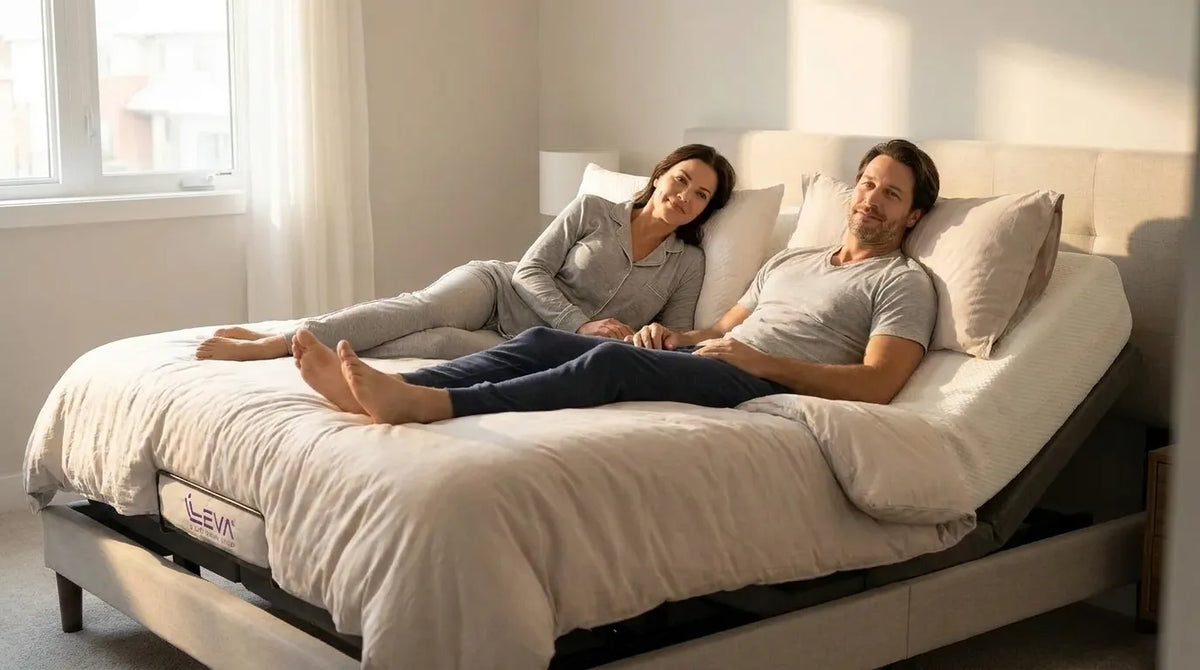
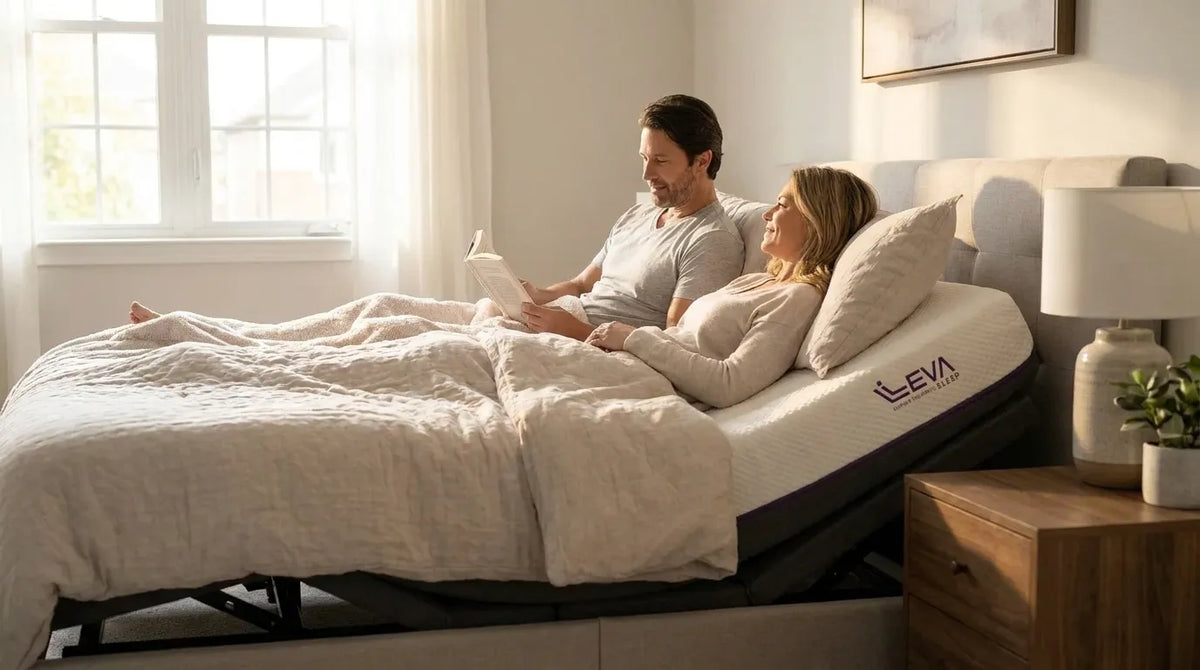
An adjustable bed base removes the slipping problem. The entire upper body tilts as a unit on the mattress surface, the angle is set by a motor and stays fixed, and memory presets let you return to a clinician-recommended angle with one button. For anyone using elevation long term, that consistency usually matters more than the initial cost difference.
Compare Leva Sleep Adjustable Bases
How Adjustable Beds Relate To CPAP
Given that an adjustable base holds elevation more reliably than a wedge, many people wonder whether it can stand in for CPAP. It cannot. An adjustable bed for sleep apnea supports treatment and works alongside CPAP and medical care.
The American Academy of Sleep Medicine’s 2019 Clinical Practice Guideline identifies CPAP as the primary evidence-based treatment for moderate-to-severe OSA. Stopping CPAP without a clinician’s guidance carries documented cardiovascular and cognitive risks.
For CPAP users, head-of-bed elevation can still help. Some CPAP users notice higher leak rates or mask displacement when they sleep on their back. A modest incline can reduce mouth leak and mask movement for some users, which may improve comfort and adherence, even though it does not change the prescribed pressure.
For CPAP-intolerant patients with mild-to-moderate positional OSA, a clinician may recommend positional therapy, including elevation, as part of a multimodal plan. A 2021 meta-analysis of 82 studies found that only 34–69% of CPAP patients met the minimum adherence threshold of 4 hours per night on at least 70% of nights. Any decision to change CPAP use should stay coordinated with the prescribing physician.
Insurance, Medicare, And Paying For An Adjustable Bed
Even when elevation makes clinical sense, cost usually becomes the next question. Consumer adjustable bed bases, the type sold by mattress retailers and specialist sleep companies, are not covered by Medicare or standard health insurance as a sleep apnea treatment.
Medicare’s Local Coverage Determination L33820 covers “adjustable hospital beds” as durable medical equipment only when a physician documents a qualifying condition such as congestive heart failure, COPD, or aspiration risk that requires head elevation above 30 degrees most of the time. The policy also requires documentation that pillows and wedges were considered and ruled out. A retail adjustable base does not meet Medicare’s definition of a hospital bed.
Medicare and most insurers typically cover these OSA-related services:
- CPAP machines and supplies (masks, tubing, filters, humidifier chambers) as durable medical equipment, subject to a compliance trial
- Sleep studies, including in-lab polysomnography and qualifying home sleep apnea tests
- Custom mandibular advancement devices when prescribed by a physician and meeting AHI thresholds
- Certain vibrotactile positional therapy devices when a positional pattern is documented, though some plans still classify these devices as not medically necessary
HSA and FSA eligibility for an adjustable bed depends on plan rules and documentation. IRS Publication 502 allows expenses related to diagnosis, cure, mitigation, treatment, or prevention of disease. A Letter of Medical Necessity from a licensed clinician can support using pre-tax funds for a dual-purpose purchase. Plan administrators make the final call, so patients should confirm eligibility and secure documentation before buying.
Leva Sleep offers 0% APR financing options, which spread the cost of a complete adjustable sleep system into monthly payments. Complete packages start at $1,299.
What To Look For In An Adjustable Bed For Sleep Apnea
Several features determine whether an adjustable base will actually support nightly apnea management. Use these criteria as a checklist when you compare models.
- Independent head elevation that holds a specific angle. Angle control comes first. The base should raise the head section to a precise incline within the studied range and hold it there without drift. Memory presets let you save and recall a clinician-recommended angle.
- Quiet motors. Noise control matters next. A base that wakes a partner every time it moves creates a new problem. Whisper-quiet motors allow position changes without disturbing the person beside you.
- Split configuration for couples with different needs. Split bases protect partner comfort. If one partner needs elevation and the other does not, independent sides prevent nightly arguments over position.
- Lumbar control and pillow tilt. Fine-tuning improves comfort. Lumbar support maintains the natural spinal curve at the elevated angle, and pillow tilt lets you adjust head and neck position more precisely.
- Mattress compatibility. Long-term durability depends on this. Many standard mattresses resist articulation and wear unevenly under repeated flexing. Mattresses engineered to bend with the base keep their support longer.
If you want a base that meets all these criteria, the Leva Sleep snoring relief collection is built specifically for this use case. Leva Sleep is a specialist adjustable bed company offering 15–20 adjustable base models, compared to 3–5 at a typical mattress retailer. Its bases include whisper-quiet German motors, anti-snore positioning, lumbar control, pillow tilt, and memory presets.
Couples often need flexible sizing. For bedrooms where a split king will not fit, Leva’s split queen adjustable beds provide two fully independent bases with head and foot articulation in a 60-inch footprint. Leva also manufactures the 30 × 80 inch mattresses this configuration requires, which is why most retailers do not offer it. For larger rooms, the split king delivers the same independent-side capability in a wider layout.

Leva’s mattresses are made in the US and are engineered to flex with the base. The company designs the mattress and base as a single system, rather than selling a base that must work around an existing mattress.
Who Probably Should Not Buy An Adjustable Bed For Sleep Apnea
An adjustable bed for sleep apnea does not fit every situation. These scenarios often call for different priorities.
- Mild apnea well controlled on CPAP. If CPAP already controls events and adherence is strong, an adjustable base may not change clinical outcomes. In that case, other health investments may matter more.
- Side-sleepers with no positional component. Head-of-bed elevation mainly helps people whose apnea worsens on their back. A dedicated side-sleeper whose sleep study shows similar AHI in all positions may see little benefit from elevation alone.
- Severe OSA without clinician guidance. For severe OSA, elevation alone rarely brings AHI into a normal range. Anyone with severe OSA should coordinate changes in therapy with a clinician and confirm control with follow-up testing.
- Anyone expecting a cure. Elevation can reduce event frequency at studied angles, but it does not erase OSA. An adjustable bed works best as one part of a broader treatment plan.
Frequently Asked Questions
What Angle Should You Elevate A Bed For Sleep Apnea?
The peer-reviewed literature specifically tests 7.5 degrees and 30 degrees. Souza et al. reported meaningful AHI reduction at 7.5 degrees, and Maniaci et al. reported similar percentage improvement at 30 degrees, although their patients started with higher baseline AHI. Many sleep specialists suggest starting around 7.5 to 15 degrees, then adjusting based on comfort and any follow-up sleep study data.
The angle that matters is the one you can hold consistently through the night. Chasing the steepest possible incline with stacked pillows usually backfires, because it bends the neck forward and can compress the airway. The entire upper torso should rise as a single inclined plane.
What Is The 4% Rule For Sleep Apnea?
The “4% rule” describes one way to score hypopneas, not a treatment rule. The AASM recommends scoring a hypopnea when peak signal excursions drop by 30% or more for at least 10 seconds, with either a 3% or greater oxygen desaturation or an associated arousal. An alternative definition requires a 4% or greater desaturation.
The chosen threshold affects the reported AHI. The 3% definition captures more events and produces higher AHI scores, while the 4% definition yields lower scores. When you review a sleep study, check which definition the lab used so you can interpret the severity correctly.
Is There A Way To Treat Sleep Apnea Without CPAP?
CPAP remains the most extensively studied and effective treatment across the full range of OSA severity. For patients who cannot tolerate CPAP, clinicians consider several evidence-based alternatives based on severity and anatomy.
Custom mandibular advancement devices are recommended by the AASM as first-line therapy for mild-to-moderate OSA when patients prefer them over CPAP, and as second-line therapy for CPAP-intolerant patients. Positional therapy, including head-of-bed elevation and vibrotactile devices, fits confirmed positional OSA, especially mild-to-moderate disease. Weight loss can meaningfully reduce AHI in patients with obesity. Hypoglossal nerve stimulation is an FDA-approved surgical option for selected patients with moderate-to-severe OSA who have failed CPAP.
No single alternative works for every OSA pattern. Any plan to manage OSA without CPAP should involve a sleep physician and follow-up testing.
What Is The Pillow Trick Against Sleep Apnea?
The “pillow trick” usually means stacking pillows to elevate the head. This approach offers the least reliable form of head-of-bed elevation for OSA. Stacked pillows lift the head while the shoulders stay flat, which bends the neck forward instead of tilting the whole upper body.
This chin-to-chest posture can compress the throat and worsen obstruction. A wedge pillow, which lifts the torso as a single inclined unit, works better than stacked pillows. An adjustable base is the most effective option. It holds a precise angle all night, with no compression, no shifting, and no neck flexion.
Conclusion And Practical Next Steps
Research on adjustable beds and sleep apnea points to one core idea. A sustained, correct head-of-bed elevation held through the night can meaningfully reduce AHI in people with positional or supine-predominant OSA. An adjustable bed offers the most reliable way to hold that angle, which is why it outperforms wedges and stacked pillows on consistency.
Elevation supports treatment rather than replacing it. Anyone managing OSA should align purchases with clinician guidance, confirm whether their OSA has a positional component through sleep study data, and use follow-up testing, not symptoms alone, to judge whether elevation provides adequate control.
For couples with different sleep needs, a split adjustable base lets one partner sleep elevated while the other stays flat, so neither person has to compromise. Leva Sleep’s specialist team and La Jolla showroom can help match the right system to your clinical and personal situation. The US store currently displays a 60-night comfort guarantee with a comfort exchange fee.
Talk To A Leva Sleep Specialist About Your Sleep Study