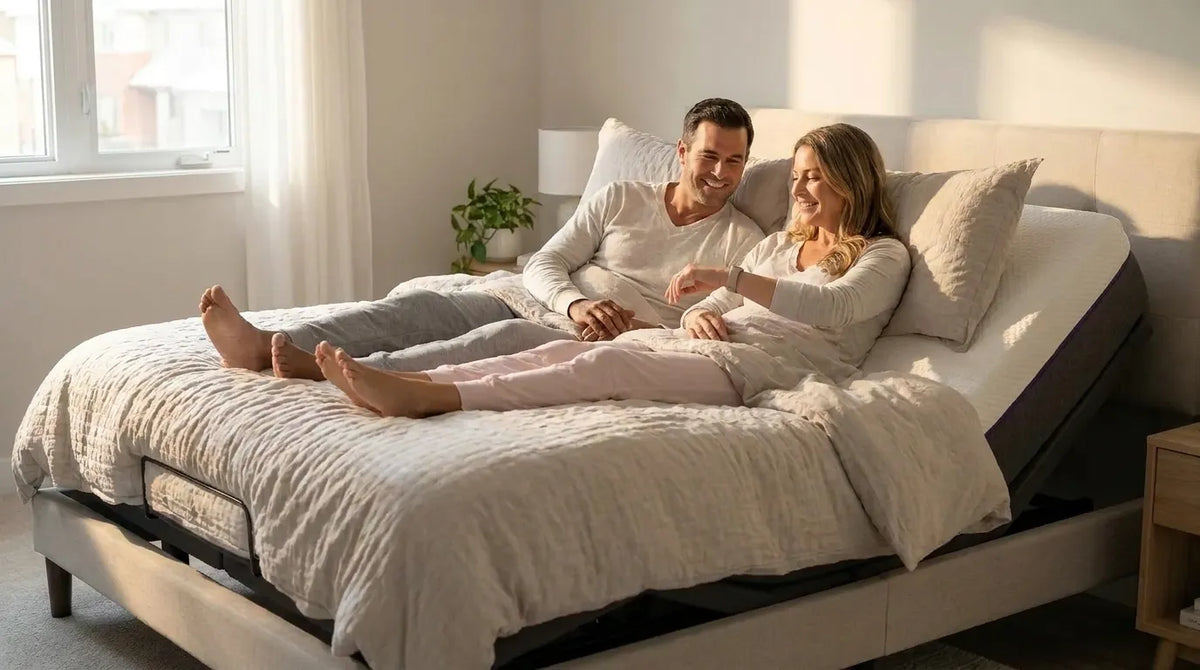
Adjustable Beds for Post-Surgical Recovery at Home
Written by: Matthew Timmins, Founder and Managing Director, Leva Sleep
Key Takeaways
- Many discharge instructions call for specific head and foot elevation angles. A premium split adjustable sleep system holds those angles without unstable pillow stacks.
- A split adjustable system supports positioning needs for knee, hip, spinal, and abdominal procedures when instructions specify elevation angles, not powered vertical height adjustment or side rails.
- Medicare Part B treats hospital beds as durable medical equipment when medical necessity is documented, but treats consumer adjustable bases as furniture with no coverage.
- Transfer height and caregiver access create the main clinical differences. Hospital beds offer powered hi-low adjustment, while premium adjustable systems focus on home-friendly style and independent per-side control.
- Patients who want a bedroom that looks like a home, not a facility, can explore Leva Sleep’s complete adjustable sleep systems starting at $1,299 with a 180-night guarantee.
Matching Your Bed to Your Surgeon’s Discharge Instructions
Positioning requirements vary significantly by procedure. Most common surgeries rely on specific head and leg elevation angles that a premium adjustable base can deliver, rather than powered vertical height adjustment or side rails that require a hospital bed.
| Surgery Type | Head Position | Leg/Foot Position | Key Constraint |
|---|---|---|---|
| Knee Replacement | Flat to slight elevation | Leg elevated straight, above heart level, 12 inches or more | Support must run hip to ankle; no pillow under heel only |
| Hip Replacement | Flat to slight elevation | Leg slightly abducted; pillow between legs; hip angle at or above 90° at all times for first 6 weeks | No leg crossing at knee or ankle; sleep on back for first 6 weeks |
| Spinal Procedures | 30–45° elevation common; side sleeping with pillow between knees permitted after first days using log-roll technique | Neutral; pillow between knees when side-lying | Medium-firm, non-sagging surface critical; no twisting |
| Abdominal Surgery | 30–45° elevation reduces pressure on abdominal muscles and eases breathing | Knees slightly bent; slight back elevation; no stomach sleeping | Brace incision with pillow when coughing or sneezing |
Every positioning decision should follow the exact instructions on the surgeon’s discharge summary. Clinical guidance from GuideChirurgie.fr states, “The position indicated by the team is the first rule.” Any positioning aid must match the prescribed form, dimensions, firmness, and placement. Patients should avoid comfort-based setups that differ from written instructions unless the care team approves them.
For patients whose discharge instructions focus on elevation angles rather than powered height adjustment, a premium adjustable sleep system can provide the required positioning in a bedroom-friendly design. Speak with a Leva Sleep specialist about the adjustable system that matches your discharge instructions in the La Jolla showroom or online.
When an Adjustable Bed Can Replace a Hospital Bed
A premium split adjustable sleep system can satisfy discharge instructions when the clinical requirement involves head-of-bed elevation between 30° and 45°, foot elevation for swelling control, and a stable fixed-height transfer surface. It cannot replace a hospital bed when the physician documents medical necessity for powered vertical hi-low height adjustment, full-length side rails, Trendelenburg positioning, or traction equipment. Those features define a Medicare-covered hospital bed and do not exist on consumer adjustable bases.
Comparing Transfer Heights and Caregiver Access
The table below compares premium split adjustable sleep systems with medical hi-low hospital beds on four key metrics for home recovery. The comparison shows that powered vertical height adjustment is the main clinical difference, while positioning angles are similar.
| Feature | Premium Split Adjustable System | Medical Hi-Low Hospital Bed |
|---|---|---|
| Transfer Height Range | Adjustable frame heights ranging from about 9–15 inches from floor to mattress platform, with no powered vertical adjustment | Ultra-low medical hi-low hospital beds reach minima as low as 2.7 inches (Prius Descend) or 3.6 inches (Med-Mizer AllCare), with other models at 7 inches, and can rise to waist height for caregiver access |
| Bedroom Aesthetics | Upholstered frame that looks like standard bedroom furniture | Standard models appear institutional; luxury hi-low models add wood headboards and designer fabrics at higher cost |
| Medicare Eligibility (2026) | Classified as furniture, with no Medicare coverage even when physician-prescribed | Covered under Part B as DME with documented medical necessity; Medicare pays 80% after a $283 deductible, patient pays 20% |
| Motor Noise | Whisper-quiet German motors with smooth, gradual travel suitable for shared beds | Noise level varies; some full-electric beds use quiet German LIMOSS motors, while standard models are louder |
Vertical height adjustment is the defining difference. Hi-low beds raise the sleep surface to waist height for caregivers, which reduces bending during dressing, wound care, and repositioning. That function does not exist on standard consumer adjustable bases. When caregiver limitations or transfer safety require powered height change, a hospital bed is the appropriate choice. When the need centers on elevation angles alone, a premium split adjustable system can provide equivalent positioning in a more residential look.
Medicare and Insurance Coverage in 2026
Medicare Part B covers a hospital bed as durable medical equipment when a physician documents that the patient’s condition requires body positioning or attachments that an ordinary bed cannot provide. Coverage follows CMS National Coverage Determination 280.7, which requires the physician’s prescription to accompany the initial claim and establish medical necessity.
The 2026 cost structure for a covered hospital bed follows a capped-rental model. Medicare Part B pays 80% of the approved amount after the annual Part B deductible of $283, and the beneficiary pays the remaining 20% coinsurance. For semi-electric hospital beds, this typically equals about $10–$20 per month out-of-pocket based on current Medicare-approved rental amounts for E0260. Rental usually continues for 13 months, then ownership transfers to the beneficiary, so the patient ultimately owns the equipment. The supplier must be enrolled in Medicare and accept assignment, or coverage rules and costs can differ. Medicare covers manual, variable-height, and semi-electric beds when medically necessary, but usually does not cover fully electric beds because powered height adjustment is treated as a convenience feature. Medicare Advantage plans must cover hospital beds at least as extensively as Original Medicare Part B, although they may require prior authorization.
A retail adjustable bed base is classified as furniture and receives no Medicare coverage, even when prescribed for reflux, breathing, or swelling. Patients who do not qualify for a hospital bed, or who prefer a more residential bedroom, typically purchase a premium adjustable sleep system privately. Leva Sleep offers financing options, including 0% APR, to spread the cost of a complete adjustable bed package.
What Patients Report After Surgery at Home
Patients recovering at home from orthopedic and abdominal procedures often describe the same practical challenges in online communities. Many struggle to match discharge instructions with a flat bed, saying they must keep the head at 30 degrees and a leg elevated while juggling sliding pillows. Others dislike the institutional look of a hospital bed in a primary bedroom and feel it changes the mood of the space. Couples frequently report tension when one partner needs elevation and a specific transfer height while the other wants to sleep flat in the same bed. Premium split adjustable systems address the positioning and shared-bed issues directly. Patients who qualify for a hospital bed but dislike the look often research luxury hi-low alternatives.
Why Many Couples Choose a Premium Split Adjustable System
Leva Sleep is a specialist adjustable bed company serving customers across the United States, with a luxury showroom in La Jolla, California. Over nine years and more than 25,000 customers, Leva has focused on complete adjustable sleep systems that include bases with independent per-side control, mattresses engineered to flex, per-side heating and cooling, and bedding designed for movement. The company offers one of the largest selections of Split Queen adjustable beds in North America and manufactures the 30" × 80" mattresses that configuration requires. Because Leva designs, assembles, and delivers its own systems, complete packages start at $1,299 and carry the same 180-night comfort guarantee noted earlier.
For post-surgical patients whose discharge instructions call for head and foot elevation rather than powered vertical height adjustment, a Leva split adjustable system can provide every required positioning function in a home-friendly frame. Independent per-side control lets a recovering partner maintain 30–45° head elevation and foot elevation for swelling control while the other partner sleeps flat. Whisper-quiet German motors allow overnight adjustments without waking a sleeping partner. Mattresses engineered to flex with the base maintain consistent support at elevation angles that can cause a standard mattress to buckle or gap.

Clinicians often recommend sleeping with the head elevated for sleep apnea, acid reflux, and post-surgical recovery. An adjustable base provides that position consistently, night after night, without relying on shifting pillow stacks.
Explore Leva Sleep’s Split Queen adjustable bed collection, which includes five packages from $1,399 with 30" × 80" mattresses made in-house and a full line of Split Queen bedding. For patients managing joint pain or post-operative discomfort, the best adjustable beds for pain relief collection pairs each base with mattresses chosen for pressure redistribution and spinal alignment.
A 2025 survey of 2,007 US adults conducted by Atomik Research for the American Academy of Sleep Medicine found that 31% of American adults had chosen a “sleep divorce,” regularly sleeping in a separate room from their partner. Among adults aged 35–44, the figure rises to 39%. Post-surgical recovery often triggers that separation. Leva Sleep focuses on couples who want to stay in the same bed through recovery and beyond.
Find an adjustable sleep system that supports your recovery positioning needs without an institutional look. Visit the La Jolla showroom or shop online with a 180-night trial.
Frequently Asked Questions
What do doctors say about adjustable beds for post-surgical recovery?
Clinicians commonly recommend head-of-bed elevation between 30° and 45° after abdominal, spinal, and facial surgeries to reduce swelling, ease breathing, and lower pressure on incisions. After knee and hip replacement, foot elevation above heart level is frequently prescribed to manage edema and support circulation. An adjustable base holds these positions reliably without the instability of stacked pillows. Patients should follow the exact positioning instructions on their discharge summary and confirm with their surgical team before choosing any elevation angle or sleep position.
Can an adjustable bed be used as a hospital bed after surgery?
A premium adjustable sleep system can fulfill many positioning requirements in discharge instructions, including head elevation, foot elevation, and a stable transfer surface at a fixed height. It cannot replace a medical hi-low hospital bed when the physician documents medical necessity for powered vertical height adjustment, full-length side rails, Trendelenburg positioning, or traction equipment. Patients whose discharge instructions require only elevation angles, and who do not need a caregiver to raise or lower the entire bed frame, are often well served by a premium adjustable system. Those with complex transfer or caregiver needs should discuss a medical hi-low bed with their care team.
Will Medicare pay for an adjustable bed in 2026?
Medicare Part B does not cover retail adjustable bed bases; they are classified as furniture even when a physician recommends them. Medicare Part B does cover a hospital bed as durable medical equipment when a physician documents that the patient’s condition requires body positioning or attachments that an ordinary bed cannot provide. In 2026, after the annual Part B deductible of $283, Medicare pays 80% of the approved amount and the beneficiary pays 20% coinsurance. Coverage follows a capped-rental model of about 13 months, after which ownership transfers to the patient. The supplier must be enrolled in Medicare and accept assignment. Medigap Plan G can cover the 20% coinsurance in full, and Medicare Advantage plans must cover hospital beds at least as extensively as Original Medicare but may require prior authorization.
What is a safe transfer height for a bed after surgery?
Safe transfer height depends on the patient’s height, mobility level, and whether a wheelchair or walking aid is involved. As noted in the comparison above, ultra-low hospital beds can reach minima below 3 inches, which reduces fall distance during nighttime transfers. Standard consumer adjustable bases typically offer frame heights from about 9–15 inches from floor to mattress platform. That range suits many ambulatory patients but does not match wheelchair seat height or provide the low-position safety margin of a hi-low bed. Patients with significant transfer difficulty, fall risk, or caregiver limitations should review hi-low bed options with their care team before discharge.
What makes a split adjustable bed better than a standard adjustable bed for couples during recovery?
A split adjustable system gives each partner independent control of head elevation, foot elevation, and positioning. The recovering partner can maintain the angles prescribed by the surgeon while the other partner sleeps flat or in a preferred position. On a single-zone adjustable base, both partners share the same elevation, which often leads the non-recovering partner to sleep poorly or move to another room. Leva Sleep’s split configurations, available in both Split King and Split Queen, use whisper-quiet German motors so adjustments during the night do not disturb a sleeping partner. The Split Queen configuration, at 60 inches wide versus 76 inches for a Split King, fits bedrooms where a King footprint is not practical.
Updated recently. Product pricing and availability reflect the Leva Sleep US catalog as of August 2026. Medicare coverage information reflects 2026 Part B rules. Sleep divorce statistics are from a June 2025 survey of 2,007 US adults conducted by Atomik Research for the American Academy of Sleep Medicine. Consult your surgical team for personalized positioning guidance.