Adjustable Beds for Hip Pain: Positions, Mattresses & Bases
Written by: Matthew Timmins, Founder and Managing Director, Leva Sleep | Last updated: October 13, 2026
Key Takeaways
- An adjustable bed for hip pain changes body angles using leg elevation, zero gravity, and lumbar support to reduce tension and support neutral spinal alignment.
- Hip pain location guides the best position: outer hip pain needs side-sleeping pressure relief, groin pain needs reduced hip flexion, and deep joint pain responds to zero gravity plus lumbar support.
- Independent head and foot articulation, zero gravity presets, whole-body tilt, and lumbar control are the core base features for different hip pain patterns.
- Pairing a medium-firm mattress (5.5–6.5 rating) with an adjustable base redistributes pressure on the hip and supports spinal alignment more effectively than a flat bed alone.
- Leva Sleep offers adjustable bases with these features, split configurations for couples, and a 180-night comfort guarantee so users can dial in a position that eases hip pain.
How an Adjustable Bed Helps Hip Pain
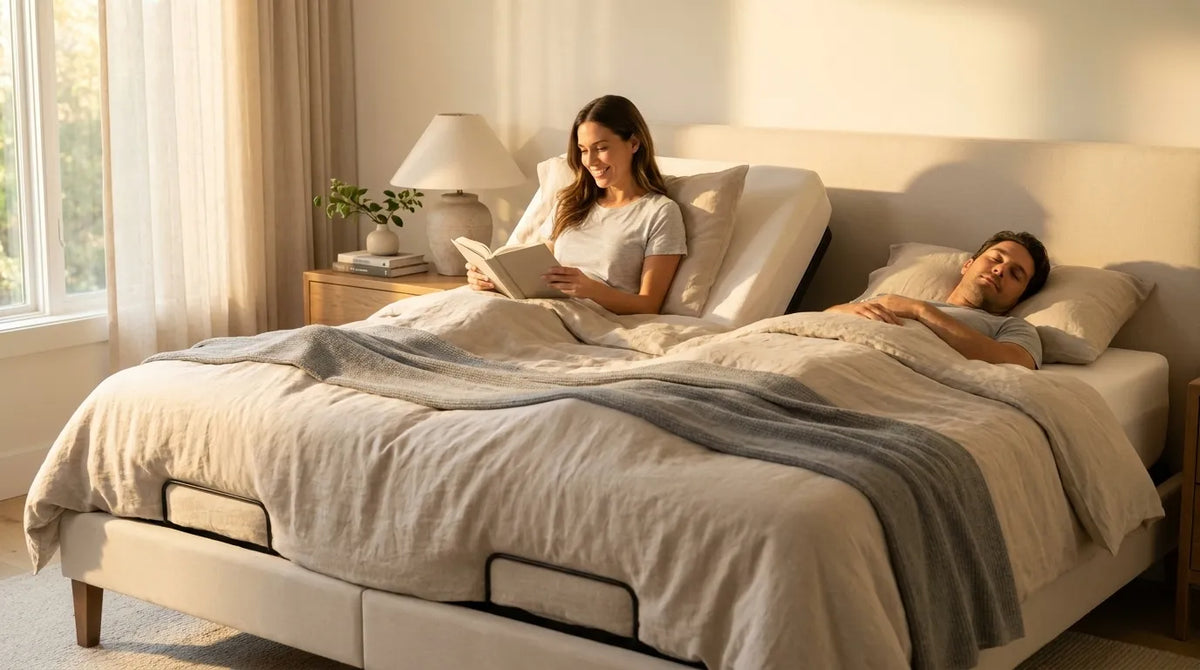
An adjustable base is a powered foundation that articulates the head and foot sections independently, so you can change sleeping position without stacking pillows. That distinction matters for hip pain because the problem is geometric, not just material. Elevating the feet by about 4–6 inches may reduce lumbar disc pressure, relax tight lower back muscles, and improve spinal alignment for some people (Ubie Health, reviewed by Yoshinori Abe, MD, last reviewed 09/12/2026). The zero gravity position takes this further. It is a reclined back-sleeping posture in which the upper body and legs are elevated simultaneously, forming a gentle V-shape with the hips resting lower than the chest and knees, so the pelvis and lower back settle into a less strained position (Medicalic, published June 24, 2026, medically reviewed by Dr. Jubair Islam).
Whole-body tilt, a flat incline rather than a fold at the waist, avoids sharp hip flexion entirely, which matters for groin and front-hip pain. Lumbar control adds a dedicated motor that supports the natural curve of the lower back independently of head or foot position. Together, these features let you dial in the exact geometry your hip needs. A flat bed offers only one geometry.
“You can’t solve a geometry problem by changing the foam. That’s the mistake almost every mattress purchase makes.” — Leva Sleep
Your Hip Pain Has a Location, and the Location Determines the Position
Hip pain behaves differently depending on where you feel it. The location of your pain, whether outer hip, groin, deep joint, or hip combined with lower back, points to a different structure, a different sleeping mechanism, and a different adjustable base feature that helps.
Outside Hip Pain (Bursitis / IT Band, Needs Side-Sleeping Pressure Relief)
Research on body-surface pressures during sleep has shown that the 90-degree side-lying position generates the highest interface pressures of any common sleeping posture, and that even shifting to a 30-degree lateral tilt significantly reduces those readings (Applied Nursing Research, cited by Biologyinsights.com). Lateral hip pain, including greater trochanteric pain syndrome, trochanteric bursitis, and IT band irritation, is driven by direct compression of sensitized structures against the greater trochanter when you lie on the affected side.
For lateral hip pain such as GTPS or trochanteric bursitis, sleep on the unaffected side with a firm pillow between the knees to maintain hip and pelvic alignment and prevent the top hip from adducting into a compressive position (Orthocareguide.com). If both hips are painful, back sleeping with a pillow under the knees is recommended.
The base feature that delivers this is independent head and foot articulation to slightly elevate the legs and reduce hip flexor tension, paired with a mattress that lets the hip sink without bottoming out. Side sleepers with hip pain should place a firm pillow between the knees and ankles that maintains 4 to 6 inches of compressed thickness to prevent the top leg from dropping forward and pulling on the hip and pelvis (Evolve Physical Therapy).
Groin or Front-Hip Pain (Hip Flexor / Labral, Needs Less Hip Flexion)
For groin pain or hip arthritis, sleep on the back with a pillow under the knees to reduce hip flexion pressure and distribute weight evenly, and avoid a fully flexed fetal position because it compresses the hip joint and tightens the posterior capsule (Orthocareguide.com). Labral tears in particular are aggravated by deep hip flexion, which pinches the damaged anterior-superior labrum between the femoral neck and acetabular rim.
The base feature that delivers this is whole-body tilt. A flat incline rather than folding at the waist avoids the sharp hip flexion that a standard head-up position can create. Zero gravity is a useful starting point, but the goal here is a gentle, even incline rather than a pronounced V-shape.
Deep Joint Pain with Lower-Back Involvement (Often Osteoarthritis, Needs Zero Gravity Plus Lumbar Support)
Hip osteoarthritis frequently causes deep groin pain that peaks during rest, as inflammatory mediators accumulate in the synovial fluid overnight. Surveys found that 17% of Americans over age 50 have osteoarthritis in the hip (WashU Medicine, Arthritis Care & Research, 2026). Mayo Clinic guidance recommends placing a pillow under the knees when sleeping on the back because it helps relax the back muscles and maintain the natural curve of the lower back (cited by Medicalic, June 2026).
The base feature that delivers this is a zero gravity preset combined with a dedicated lumbar control motor. The zero gravity position distributes body weight evenly. The lumbar motor maintains the natural spinal curve that a flat surface leaves unsupported.
Hip Plus Lower Back Pain (Linked Hip and Lumbar Symptoms)
When hip pain and lower back pain occur together, a pattern common in osteoarthritis, lumbar disc involvement, and referred pain, no single static position works all night. A knee pillow for side sleeping keeps hips aligned and reduces lumbar twist; an adjustable bed base can fine-tune upper and lower body angles (Ubie Health, reviewed by Yoshinori Abe, MD, 09/12/2026).
The base features that deliver this are independent head and foot control, lumbar control, and pillow tilt. These features let you alternate between back sleeping in zero gravity and supported side sleeping without rebuilding a pillow stack at 2 a.m. For a deeper look at adjustable bed positioning for lower back pain specifically, see Leva Sleep’s complete guide to adjustable beds for back pain.
Best Sleeping Position for Hip Pain on Your Side
Side sleeping is the most common sleep position, and it also generates the highest interface pressures on the hip. Most advice skips the mechanics and what an adjustable base actually changes.
On a flat bed, a side sleeper lies at a full 90-degree lateral angle. The greater trochanter bears concentrated load, the top leg adducts across the midline, and the pelvis rotates. An adjustable base changes this geometry. Slight foot elevation reduces hip flexor tension, and a mattress that lets the hip sink without bottoming out redistributes contact pressure across the thigh and flank rather than concentrating it on the hip bone.
Zero gravity is primarily a back-sleeping position. True zero gravity sleeping is designed mainly for back sleeping, and while some people can rest partly on their side with a mild incline, it often feels awkward when both the head and knees are elevated (Medicalic, June 2026). Side sleepers usually do better with a supportive neck pillow, a pillow between the knees, slight foot elevation on an adjustable base, and a mattress that keeps the spine aligned.
The pillow between the knees is essential. When side sleepers lie on the opposite side without support, the painful leg drops forward and downward into adduction, creating a severe traction force that pulls the IT band taut across the inflamed trochanter (Evolve Physical Therapy). The same 4-to-6-inch pillow support described above prevents this. The adjustable base handles the angles; the pillow handles the alignment.
What Type of Mattress Is Good for Hip Pain?
A mattress with a medium-firm rating of 5.5 to 6.5 out of 10 offers the ideal balance for hip pain sufferers (Evolve Physical Therapy). It cushions bony landmarks like the greater trochanter while providing enough pushback to keep the pelvis neutral and the spine aligned. Too soft, and the heavy pelvic bowl sinks and throws the lumbar spine into lateral bending. Too firm, and the mattress acts like a plank against the greater trochanter, compressing the trochanteric bursa and gluteal attachments.
A systematic review found that medium-firm mattresses improved sleep quality by about 55% and decreased back pain by roughly 48% in people with chronic pain (Sleep Health, cited by Biologyinsights.com). Memory foam and hybrid mattresses, pocket coils with a foam comfort layer, are generally better tolerated than rigid innerspring designs because they contour to the lateral curves of the body and redistribute contact loads.
Material flexibility matters as much as firmness when pairing a mattress with an adjustable base, because most mattresses are not built to bend. When an inflexible mattress is forced to articulate, it resists the base, wears unevenly, and shortens its own life. Leva Sleep builds mattresses, the Heavenly Hybrid (pocket coil) and Heavenly Response (all-foam), specifically to flex with the base, in both standard and 30" × 80" Split Queen dimensions. For more on how joint pain and mattress pairing interact, see Leva Sleep’s guide to adjustable beds for joint pain.
Base Features That Matter For Hip Pain
Four base features map directly onto the hip pain locations described above. The table below shows what each feature does mechanically and when it matters most.
| Feature | What It Does For The Hip | When It Matters |
|---|---|---|
| Independent Head And Foot Control | Allows slight leg elevation to reduce hip flexor tension without forcing hip flexion | Any hip pain location; essential for side sleepers who need foot elevation without a head-up position |
| Zero Gravity Preset | Elevates head and knees simultaneously to distribute body weight and support neutral spinal alignment | Deep joint pain, hip plus lower back pain, osteoarthritis |
| Whole-Body Tilt | Creates a flat incline rather than folding at the waist, avoiding sharp hip flexion | Groin or front-hip pain, labral tears, hip flexor tightness |
| Lumbar Control | Dedicated motor supporting the lower back curve independently of head or foot position | Hip pain with lower-back involvement, osteoarthritis |
Leva Sleep is a specialist adjustable bed company offering 15–20 adjustable base models versus 3–5 at a typical mattress retailer. For hip pain specifically, Leva’s bases feature:
- Independent head and foot articulation
- Zero gravity preset
- Lumbar control
- Pillow tilt
Leva offers the largest selection of Split Queen Adjustable Beds in North America, with five packages from $1,399, 30" × 80" mattresses Leva manufactures itself, and a full line of Split Queen bedding. Complete adjustable bed packages run $1,299 to $8,999+, backed by a 180-night comfort guarantee and in-house white-glove delivery and setup.
Shop Beds For Hip Pain Relief
For couples, these features raise a practical question about how to share a bed when only one partner needs therapeutic positioning.
Split Configuration For Couples Where Only One Partner Has Hip Pain
Couples often face different comfort needs when only one partner has hip pain. A split configuration lets each person choose their own position and firmness without compromise. If the pain partner needs a meaningfully different position or firmness than the non-pain partner, a split base removes the need to negotiate. The non-pain partner’s side stays exactly as they prefer it.
A Split Queen Adjustable Bed fits a 60" footprint, the same width as a standard Queen, compared to 76" for a Split King. That 16-inch difference often decides whether the configuration works in a bedroom. Leva Sleep’s Split Queen packages start at $1,399. They include two fully independent bases with head and foot articulation on each side, plus 30" × 80" mattresses available in different firmness levels so each partner chooses their own feel.

The scale of the problem is significant. Thirty-one percent of US adults have opted for a “sleep divorce,” with that figure rising to 39% among adults aged 35–44 (Atomik Research for the American Academy of Sleep Medicine, June 2025, n=2,007). A split configuration lets couples stay in the same bed while meeting one partner’s positioning needs. If a Split King fits the room, Leva Sleep’s Split King is also available. For couples navigating pain together, see Leva Sleep’s guide to adjustable beds for couples with back pain.
Who Should Not Buy an Adjustable Bed for Hip Pain
An adjustable base is a positioning tool that can reduce pressure and support better alignment. For many people that change is enough to meaningfully improve sleep. Some presentations, however, require medical evaluation before any positioning strategy is appropriate.
“Progressive night pain that no position change relieves is the pattern that warrants urgent medical review, not physiotherapy first” — Kurt Johnson, M.Ost, Co-Founder and Director of One Body LDN. Constant, unrelenting, positionally independent night pain requires prompt evaluation (Orthocareguide.com). Pain that occurs regardless of how you lie and does not improve with any position change is a clinical warning sign a clinician must assess.
Other presentations that warrant professional assessment before purchasing include hip pain accompanied by fever or unexplained weight loss, pain following a fall in an adult over sixty, and bilateral hip pain with prolonged morning stiffness that may indicate inflammatory arthritis. If a clinician has already recommended an elevated sleeping position, an adjustable base is how that recommendation is implemented at home, night after night.
Frequently Asked Questions
Is It Okay to Sleep on Your Side in Zero Gravity Position?
Zero gravity is primarily a back-sleeping position. It places the head and knees in simultaneous elevation, forming a gentle V-shape that distributes body weight evenly. That geometry works well on your back but often feels awkward when you roll onto your side, because the elevated knee section pushes against the top leg and the head section can angle the neck uncomfortably. Side sleepers with hip pain generally do better with a slight foot elevation on an adjustable base, a firm pillow between the knees and ankles maintaining 4 to 6 inches of compressed thickness, and a mattress that lets the hip sink without bottoming out. That combination addresses the pressure mechanics of side sleeping without the awkwardness of full zero gravity on your side.
How to Sleep When Your Lower Back and Hips Hurt?
Back sleeping with a pillow under the knees is the most commonly recommended starting position for combined hip and lower back pain. It distributes body weight evenly, relaxes the iliopsoas muscles, eliminates direct pressure on both trochanters, and relieves strain on the lumbar spine. An adjustable base with a zero gravity preset and lumbar control achieves this position precisely and repeatably, without rebuilding a pillow arrangement every night. For people who cannot tolerate back sleeping, supported side sleeping on the unaffected side with a firm pillow between the knees is the next best option. Alternating between the two positions during the night, which an adjustable base makes easy, can reduce the joint stiffness that builds when any single position is held for hours.
Why Does My Bed Hurt My Lower Back and Hips?
A flat bed imposes a single spinal geometry for eight hours. If the mattress is too soft, the hips sink and the spine twists into lateral bending. If it is too firm, pressure concentrates at the hip and shoulder without relief. These outcomes reflect geometry rather than mattress quality. The mattress determines the surface, and the base determines the angle. An adjustable base lets you change the angle of your body to reduce pressure and support neutral alignment, which is the variable a flat bed cannot change regardless of what it is made of. Pairing that medium-firm mattress with an adjustable base that offers independent head and foot control addresses both the surface and the geometry at the same time.
Do Adjustable Beds Help With Hip Pain?
An adjustable bed for hip pain works by changing the angle of your body, not just the surface you lie on. Because the problem is geometric, the fix is too. Elevating the legs slightly reduces tension on the hip flexors and lower back, while a zero gravity position distributes body weight evenly and supports a neutral spinal position. Which position helps depends on where the pain is. Lateral hip pain from bursitis responds to side-sleeping pressure relief and slight foot elevation. Groin or front-hip pain responds to whole-body tilt that avoids sharp hip flexion. Deep joint pain from osteoarthritis responds to zero gravity with lumbar support. Many customers come to Leva Sleep after a doctor or physiotherapist recommended an elevated sleeping position. The 180-night comfort guarantee gives you time to find the position that works instead of deciding in the first week.
Find Your Hip Pain Relief Setup