How Adjustable Beds Help With Sleep Apnea: Elevation Guide
Written by: Matthew Timmins, Founder and Managing Director, Leva Sleep
Key Takeaways
- Elevating the head of the bed 7.5°–30° can reduce apnea events by increasing lung volume, limiting fluid shift, and changing how gravity loads the airway.
- Adjustable beds hold a stable elevation all night, while wedge or stacked pillows often shift, compress, or push the neck into a poor position.
- Most people do well starting at 7–10 degrees and slowly increasing over two weeks while tracking symptoms and comfort.
- Adjustable beds work alongside CPAP therapy. Positional therapy helps most when apnea worsens on the back, which affects about 50–60% of patients.
- Leva Sleep designs split adjustable bases, lumbar support, and anti-snore presets specifically for sleep apnea positioning.
Find Your Split Adjustable Base
How Elevating Your Head Keeps Your Airway Open
Head-of-bed elevation reduces apnea events through three main physical mechanisms.
First, elevation increases lung volume. When the upper body is raised, the diaphragm moves more freely and functional residual capacity rises. A 2026 study of 12,036 OSA patients published in Sleep and Breathing (Rosa et al.) found that moving from upright to supine posture reduces functional residual capacity. That reduction comes mainly from decreased expiratory reserve volume, which lowers caudal tracheal traction and increases pharyngeal collapsibility. Elevation partially reverses this effect.
Second, elevation reduces rostral fluid shift. When you lie flat, fluid that pooled in the legs during the day moves toward the neck and upper airway, increasing tissue volume around the pharynx. Raising the head and torso limits this shift.
Third, elevation changes how gravity loads the soft tissues of the throat. A 2026 narrative review in MedComm (Thuy et al., University of Sassari) attributes the apnea-hypopnea index (AHI) benefit of head-of-bed elevation to these combined mechanisms, which together improve upper airway stability.
The same MedComm review concludes that positional therapy can improve AHI and is often better tolerated than CPAP, while CPAP remains superior for overall physiologic control of obstructive sleep apnea. The American Academy of Sleep Medicine (AASM) states that PAP therapy is the primary treatment for moderate-to-severe OSA. Positional therapy, including head-of-bed elevation, serves as an adjunct.
A 2026 network meta-analysis in BMC Pulmonary Medicine (Song et al.) pooled 18 randomized controlled trials with 1,520 participants. Positional therapy reduced AHI by a mean of 10.05 events per hour versus control, exceeding the clinically significant threshold of 5 events per hour or 50% reduction from baseline. PAP therapy produced the largest reduction at 17.39 events per hour and ranked first with 100% probability.
The Song et al. network meta-analysis also found that position-dependent OSA, where OSA is significantly more severe in the supine position than in non-supine positions, affects approximately 50–60% of OSA patients. Positional therapy is especially relevant for this group.
A 2025 survey of 2,007 US adults conducted by Atomik Research for the American Academy of Sleep Medicine found that 31% of US adults have opted for a sleep divorce, regularly sleeping in a separate room from their partner. Among adults aged 35–44, the figure rises to 39%. Sleep apnea and snoring are among the most commonly cited reasons for that separation. The table below summarizes what clinical studies have measured at different elevation angles, which is the range you will be adjusting within.
| Elevation Angle | Reported Benefit | Source |
|---|---|---|
| ~7.5 degrees | In a study of 52 OSA patients, median AHI fell from 15.7 to 10.7 events/h (p < 0.001) overall, but among the 13 positional OSA patients the reduction was not statistically significant (11.9 to 9.0 events/h, p = 0.174) | The influence of head-of-bed elevation in patients with obstructive sleep apnea - PMC |
| ~30 degrees | In adults with moderate-to-severe obstructive sleep apnea who are intolerant to CPAP, head-of-bed elevation to 30° during drug-induced sleep endoscopy with positive airway pressure significantly reduces upper-airway collapsibility at all four anatomic sites compared with the level position (P < .01) | The effect of head of bed elevation on upper airway collapsibility during drug-induced sleep endoscopy. - Abstract - Europe PMC |
| 20° to almost 90° | Clinical literature on head-elevated positioning for airway benefit has studied head-up ramping angles across this range, with individual trials using angles such as 20°, 25°, 30°, and 45° | Effectiveness of preoxygenation during endotracheal intubation in a head-elevated position: a systematic review and meta-analysis of randomized controlled trials |
How High To Elevate The Head Of The Bed For Sleep Apnea
The table above shows that the studied range is wide, and the optimal angle varies by anatomy, body weight, and OSA pattern. No single degree setting works for every person. A practical approach is to start low and adjust upward over about two weeks.
How To Titrate Your Angle Over Two Weeks
- Start at 7–10 degrees, a gentle incline that most people tolerate immediately.
- Increase by 2–3 degrees every 2–3 nights.
- Stop increasing when symptoms improve or comfort declines.
- Track awakenings, morning symptoms, and any new discomfort in a simple sleep log.
Very high angles do not always help more. Head-of-bed elevation at or above 30 degrees can cause sliding down the bed, which reduces torso elevation and leaves the lumbar spine unsupported. That posture increases pressure at the sacrum, coccyx, and ischial tuberosities and often causes lower back discomfort, especially in people with low back pain or disc herniation. An adjustable base with lumbar support and a slightly raised foot section helps counteract this sliding.
How Correct Elevation Typically Feels
- Fewer nighttime awakenings
- Less morning dry mouth or sore throat
- Partner reports less snoring
- No new hip, knee, or lower back discomfort
If new discomfort appears before symptoms improve, reduce the angle by 2–3 degrees and hold that level for several nights before trying another increase.
Adjustable Bed, Wedge Pillow, Or Stacked Pillows For Sleep Apnea
Many people find that a wedge pillow starts at the right angle and ends up on the floor by 2 a.m. Stacked pillows start at an imprecise angle, compress unevenly through the night, and often push the neck into flexion instead of a neutral position, which can worsen airway geometry.
A wedge pillow maintains its shape but tends to migrate. Because it sits on top of the mattress instead of integrating with the sleep surface, body movement during the night shifts it away from its starting position. By the time the airway benefit would matter most, during the deepest sleep stages, the wedge often no longer sits where it was placed.
An adjustable base holds the angle that you set. The incline is built into the surface itself. There is no separate object to migrate, no loft to compress, and no need to reposition anything at 3 a.m. The angle set before sleep is the angle present at 6 a.m. For positional therapy, that consistency is the mechanism.
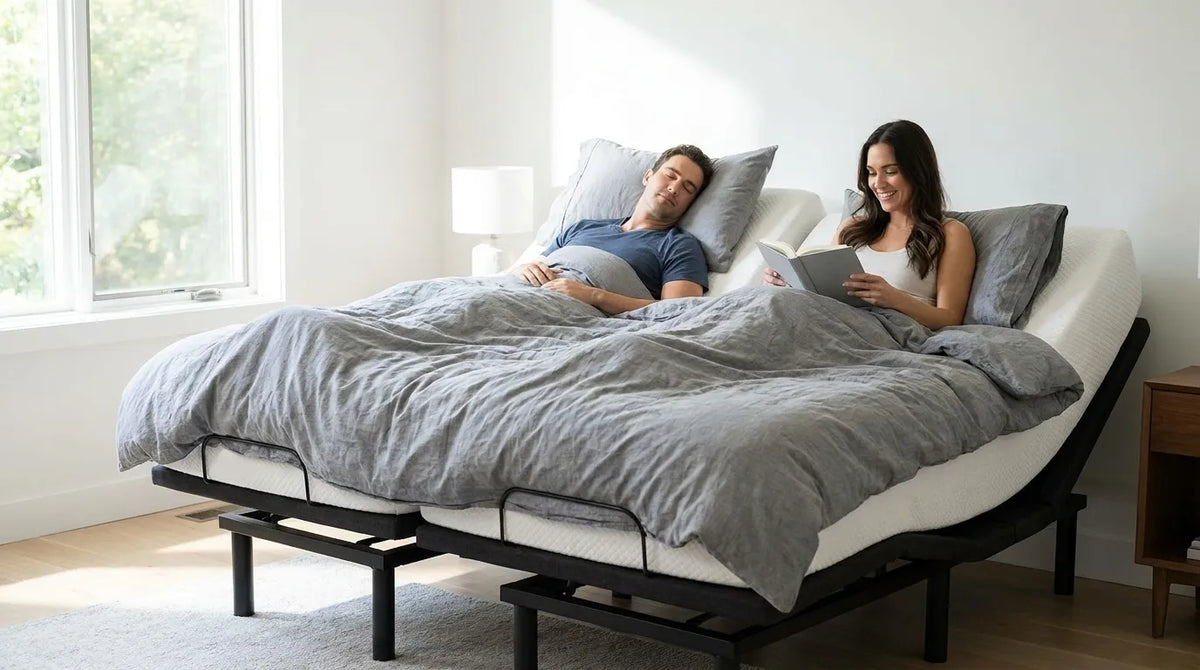
For couples, a Split Queen adjustable bed allows each partner to set an independent elevation. One partner can sleep elevated for airway support while the other remains flat. A wedge pillow placed on a shared mattress affects both partners regardless of individual need.

Using An Adjustable Bed With CPAP
An adjustable bed and CPAP work together. Elevation can improve CPAP tolerance by reducing nasal congestion and making the supine position, which has the highest AHI across sleeping positions per Jereisat et al. (2026), more manageable for the airway even before the machine delivers pressure.
Philips patient guidance on CPAP mask fitting instructs patients to fit the mask while in a sleeping position and with air blowing at the prescribed pressure. That approach tests the seal under real-world therapy conditions. Because posture changes can alter a mask seal, mask fit should be reassessed after any significant position change, including a new head-of-bed elevation. Philips also suggests looping CPAP tubing over the headboard to reduce pull on the mask, which matters when an adjustable frame changes tubing routing and tension.
For moderate-to-severe OSA, PAP therapy remains the primary clinician-directed treatment. Elevation functions as positional therapy that may improve comfort, reduce the number of events that occur before the machine compensates, and make the overall sleep environment easier to maintain.
Insurance, Medicare, And Adjustable Beds For Sleep Apnea
Most people do not receive insurance or Medicare coverage for a retail adjustable bed.
Medicare determines hospital bed coverage using Local Coverage Determination L33820, which requires a physician to document at least one of four qualifying situations, including head-of-bed elevation greater than 30 degrees most of the time, to manage conditions such as congestive heart failure, chronic pulmonary disease, or aspiration risk. Medicare also requires documentation that pillows and wedges were considered and ruled out.
Medicare does not cover standard consumer adjustable beds such as those purchased at a mattress store. These products are classified as comfort items rather than durable medical equipment. Coverage is limited to hospital-grade DME beds prescribed for a documented medical condition and supplied by a Medicare-enrolled DME supplier. The same physical adjustment, raising the head of the bed, can qualify when a doctor documents a covered condition and orders a hospital bed with the necessary medical features through a Medicare-enrolled supplier.
For CPAP therapy, Medicare coverage is separate. Medicare Part B covers CPAP machines as durable medical equipment when a qualifying sleep study documents AHI of 15 or more events per hour, or AHI of 5–14 with documented symptoms. Continued coverage requires adherence of at least 4 hours per night on 70% of nights during the first 90 days of therapy.
Leva Sleep products are retail consumer adjustable beds, which Medicare classifies as comfort items rather than durable medical equipment. They are not reimbursable under Medicare Part B or standard private insurance for OSA. Medicare’s DME benefit only covers qualifying hospital beds when specific medical criteria are met.
Who Should Avoid Buying An Adjustable Bed For Sleep Apnea
Positional therapy works best for position-dependent OSA, which affects approximately 50–60% of OSA patients per the Song et al. 2026 network meta-analysis. The Rosa et al. 2026 study of 12,036 OSA patients found that positional OSA was more common in milder disease: 75.3% of mild OSA patients and 76.7% of moderate OSA patients had positional OSA, compared with 50.4% of severe OSA patients.
Patients with severe OSA need PAP therapy or other clinician-directed treatment as their primary approach. An adjustable bed does not serve as an appropriate primary intervention for severe disease. People with certain spinal instability conditions should consult their physician before changing their sleeping angle. Patients who require specialty air-fluidized mattresses for pressure ulcer management may not be able to use those mattresses on an articulating base.
The American Academy of Sleep Medicine recognizes positional therapy as an effective secondary therapy or complement to primary therapies for OSA in patients with a lower AHI in the non-supine position compared to the supine position. Anyone considering an adjustable bed for sleep apnea should discuss the decision with the clinician who ordered their sleep study. If your clinician confirms that positional therapy is appropriate, the next step is choosing a base that can reliably hold the angle you need.
Features That Matter In An Adjustable Bed For Sleep Apnea
Leva Sleep is a specialist adjustable bed company that builds complete, personalized sleep systems for couples. The features that matter most for apnea positioning come from specific engineering decisions that differ from generalist adjustable bases.
Independent split articulation allows each partner to set a different elevation. For couples where one partner has positional OSA and the other does not, this removes the compromise that makes positional therapy hard to maintain on a shared flat mattress. Leva Sleep’s Split Queen design always uses two fully independent bases with head and foot articulation on each side, rather than a single mattress with only a split head section.
Lumbar control and pillow tilt allow fine-tuning beyond simple head elevation. Supporting the lumbar curve at elevation helps prevent lower back strain, which often causes people to abandon elevated sleeping positions within the first week. Pillow tilt angles the head section independently and can improve airway geometry without raising the entire upper body further.
An anti-snore preset, which gently elevates the head, provides a one-touch option for partners who need quick adjustment without navigating a full settings menu in the middle of the night. Whisper-quiet German motors support the same goal. A base that moves quietly helps both partners stay asleep while one person adjusts position.
Bedding engineered for movement completes the system. Standard fitted sheets often pop off at elevation. Leva Sleep’s sheet sets use extra-elastic construction that holds at full articulation. Duvet clips keep the cover in place when the two sides of a split bed sit at different angles.
Leva Sleep offers the largest selection of Split Queen adjustable beds in North America. There are five packages starting around $1,399, with mattresses manufactured in-house in 30" × 80" and a full line of bedding and accessories built to fit them. Complete packages range from $1,299 to $8,999+, with 0% APR financing available. Leva Sleep’s policy states a 180-night comfort guarantee, while the US store currently displays a 60-night comfort guarantee with a comfort exchange fee. For people with back or joint pain alongside sleep apnea, the pain relief collection addresses both positioning and pressure-relief needs.
What Happens To Your Bed Position When The Power Goes Out
Most adjustable bases hold their last position when power is lost. Many also include emergency power-down or battery backup features that allow the bed to be lowered to a flat position during an outage. The motors stop where they are, and the base remains at whatever elevation was set before the outage unless a power-down feature is activated.
Some adjustable bases with an emergency power-down feature, powered by 9V backup batteries, are designed to return to a flat position during a power failure when the user presses the FLAT button on the remote control. That safety default can feel disorienting and counterproductive for anyone relying on elevation for airway support.
Before purchasing an adjustable base for sleep apnea management, confirm the power-failure behavior with the manufacturer or retailer. Ask whether the base holds its last position during a power outage or returns to flat when power is restored.
Frequently Asked Questions
Do Adjustable Beds Actually Help With Sleep Apnea?
Yes, for some people. Elevating the head and upper body by mild to moderate amounts, such as 7.5° or 30°, keeps the airway more open and reduces apnea and hypopnea events. The 7.5° elevation studied reduced OSA severity by about 31.8% on average among patients with predominantly mild to moderate OSA, through increased lung volume, reduced rostral fluid shift, and altered gravitational loading on the pharynx. Positional therapy is most effective for position-dependent OSA, which affects approximately 50–60% of OSA patients. Patients with severe OSA require clinician-directed primary treatment.
How High Should You Elevate The Head Of The Bed?
Most people do well starting at 7–10 degrees and increasing by 2–3 degrees every 2–3 nights until symptoms improve or comfort declines. Many find their optimal angle between 7 and 30 degrees. Higher angles can cause sliding and lower back strain, which disrupts sleep on their own. A slightly raised foot section and engaged lumbar support can reduce sliding. Track outcomes in a sleep log and adjust based on what you observe over about two weeks.
Can An Adjustable Bed Replace A CPAP Machine?
No. An adjustable bed provides positional therapy. CPAP remains the primary therapy for moderate-to-severe OSA, as established by the American Academy of Sleep Medicine and supported by multiple clinical meta-analyses. Positional therapy, including head-of-bed elevation, can complement PAP therapy by improving comfort and reducing the number of events that occur before the machine compensates. Anyone currently using CPAP should continue and discuss any changes with their prescribing clinician.
Will Insurance Or Medicare Pay For An Adjustable Bed For Sleep Apnea?
Generally no. Medicare’s DME benefit covers qualifying hospital beds, not retail adjustable bases. See the insurance section above for the documentation requirements. CPAP therapy is covered separately under Medicare Part B when a qualifying sleep study and adherence requirements are met.
What Is The Worst Sleeping Position For Sleep Apnea?
Supine, or sleeping flat on the back, is typically worst. A 2026 retrospective study of 338 OSA patients (Jereisat et al.) found that supine sleep was associated with the highest AHI compared with all other sleeping positions, with supine producing a significantly higher AHI than both right-lateral and left-lateral positions (p<0.001 for each comparison). The supine position allows gravity to pull soft tissue into the airway and reduces functional residual capacity, both of which increase pharyngeal collapsibility. Head-of-bed elevation partially counteracts these effects even when the sleeper remains on their back.
What Happens To The Position During A Power Outage?
Most adjustable bases hold their last position when power is lost, and many include emergency power-down or battery backup features that allow the bed to be lowered to flat during an outage. Some bases with an emergency power-down feature, powered by 9V backup batteries, return to a flat position during a power failure when the user presses the FLAT button on the remote control. Confirm the power-failure behavior of any base before purchasing, especially if you rely on elevation for airway support.
Will My Sheets Stay On At Elevation?
Standard fitted sheets typically do not stay on at significant elevation because the corners pull free as the mattress articulates. Leva Sleep bedding is engineered for movement. Extra-elastic fitted sheets and duvet clips hold at full elevation, which matters every night the bed is used at an elevated angle.
Conclusion: Elevation Treats The Airway, The Bed Holds The Angle
Head-of-bed elevation reduces apnea events in many patients through the three mechanisms described above. Clinical evidence, including a 2026 network meta-analysis of 18 randomized controlled trials, shows that positional therapy produces a clinically meaningful AHI reduction, while PAP therapy remains the most effective intervention and the primary treatment for moderate-to-severe OSA.
In practice, you can start at 7–10 degrees, increase by 2–3 degrees every few nights, track outcomes in a sleep log, and stop when symptoms improve or comfort declines. Confirm that the base holds its position during a power outage and that the bedding stays on at elevation. Use CPAP if it has been prescribed, and treat elevation as a way to support that therapy and your overall sleep quality.
Leva Sleep is a specialist adjustable bed company serving customers across the United States, with a luxury showroom in La Jolla, California. Over nine years and more than 25,000 customers, Leva has built complete adjustable sleep systems with independent per-side control, mattresses engineered to flex, per-side heating and cooling, and bedding designed for movement. Complete packages start at $1,299, with 0% APR financing available. Leva Sleep’s policy states a 180-night comfort guarantee, while the US store currently displays a 60-night comfort guarantee with a comfort exchange fee.