How Does an Adjustable Base Help With Sleep Apnea?
Written by: Matthew Timmins, Founder and Managing Director, Leva Sleep
Last Updated: September 18, 2026
Key Takeaways
- Elevating the head of the bed 7.5°–30° uses gravity to reduce airway collapse and can lower AHI by about 31% in mild-to-moderate sleep apnea.
- Adjustable bases hold a steady angle without the neck bend or slippage that stacked pillows and wedge pillows create.
- Head-of-bed elevation works as an adjunct. PAP therapy remains first-line for moderate-to-severe OSA and produces larger AHI reductions.
- Insurance rarely covers consumer adjustable bases for sleep apnea alone. Coverage usually requires documented medical necessity for other conditions.
- Leva Sleep offers adjustable bases and Split Queen systems that make clinician-recommended elevation practical every night.
Shop Adjustable Bases Built For Elevated Sleep
Why Sleeping Flat Often Worsens Sleep Apnea
The upper airway, or pharynx, lacks the rigid support that the trachea has. It stays open through muscle tone and airway geometry. During sleep, muscle tone drops, so geometry largely determines whether the airway stays open or collapses.
When the head and torso lie flat, gravity pulls the base of the tongue, soft palate, and nearby soft tissue backward. This narrows the airway from the front. The jaw can fall back slightly and shrink the space for airflow. In the supine position, relaxed upper-airway tissues are more likely to fall into the retroglossal airway, which can trigger apneas. Head-of-bed elevation research targets this geometry. Tilting the body forward shifts gravitational load on soft tissue, and for some anatomies that shift keeps the airway open.
Two trials quantify the effect at different angles. The 2017 Souza et al. study in Sleep & Breathing found that a 7.5° head-of-bed elevation reduced median AHI from 15.7 to 10.7 events per hour in 52 patients during full polysomnography, a 31.8% mean reduction, with minimum oxygen saturation improving from 83.5% to 87%. The 2026 Maniaci et al. study in Laryngoscope found that 30° head-of-bed elevation reduced average AHI from 22.6 to 16.4 events per hour, a 31% reduction (p < 0.001). Adding lateral sleeping dropped AHI further to 11.7 events per hour, which suggests additive benefit when combining elevation with side sleeping.
The Maniaci study also found that epiglottic collapse seen during drug-induced sleep endoscopy strongly predicted response to head-of-bed elevation (r = 0.903), and that tongue base collapse correlated at r = 0.714. Patients with epiglottic and tongue-base collapse patterns are therefore the most likely to benefit from positional elevation. The 2026 MedComm narrative review (Thuy et al., DOI 10.1002/mco2.70877) attributes the benefit of elevation to improved lung volume, reduced rostral fluid shift, and altered gravitational loading on upper-airway soft tissues.
Practical Elevation Angles For Sleep Apnea
If elevation helps, the next question is how much. Research shows benefits from a mild 7.5-degree incline up to a 30-degree angle. Higher angles can be harder to tolerate and often introduce sliding and discomfort. The table below maps elevation angle to reported effect from the named studies.
| Elevation Angle | Reported AHI Effect | Key Finding | Source |
|---|---|---|---|
| 7.5° | Median AHI reduced from 15.7 to 10.7 events/hr (31.8% mean reduction) | Minimum O₂ saturation improved from 83.5% to 87%; 38.4% of patients did not respond | Souza et al., Sleep & Breathing, 2017 |
| 30° | Average AHI reduced from 22.6 to 16.4 events/hr (31% reduction, p < 0.001) | Adding lateral sleeping reduced AHI further to 11.7 events/hr; average AHI still indicated moderate OSA | Maniaci et al., Laryngoscope, 2026 |
Both trials produced a roughly 31% AHI reduction despite the different angles. That pattern suggests the benefit does not simply rise in a straight line with steeper elevation. The Maniaci study advises raising the whole torso rather than just the head. Propping up on pillows bends the neck and can worsen obstruction, a point covered again in the setup section below.
Higher angles help airway collapse but introduce tradeoffs. The most common are sliding down the bed, lower back strain, and partner disruption. When the head of the bed is elevated above 60°, patients tend to slide downward, increasing shear forces at the sacrum and heels, whereas Semi-Fowler at 30 to 45° reduces this sliding tendency. For most sleep apnea patients, head-of-bed elevation above roughly 35° is poorly tolerated in clinical practice, which makes the 30–45° range the practical ceiling before sliding and discomfort become significant problems.
How Elevation Performs In Mild, Moderate, And Severe Sleep Apnea
Effectiveness depends on severity. For mild-to-moderate OSA, head-of-bed elevation can produce clinically meaningful AHI reductions, roughly 30% in the Souza et al. study. The Souza trial’s starting AHI of 15.7 sat at the mild-to-moderate boundary, and a reduction to 10.7 moved patients into the mild range.
For moderate OSA (AHI 15–30), elevation reduces event frequency but rarely resolves it. Even with 30° head-of-bed elevation, the average AHI in the Maniaci study remained 16.4 events per hour, still in the moderate range. For severe OSA (AHI above 30), positional therapy alone usually fails to achieve adequate control and works best as an adjunct to other therapies.
PAP therapy remains first-line for many adults with moderate-to-severe OSA per the American Academy of Sleep Medicine’s 2019 clinical practice guideline, “Treatment of Adult Obstructive Sleep Apnea with Positive Airway Pressure” (DOI 10.5664/jcsm.7640, published 2019-02-15). The 2026 Carelon Clinical Appropriateness Guidelines (Doc ID SDM01-0926.1-v2, effective 09/19/2026) state that PAP, which works by pneumatic splinting of the airway, is the mainstay of treatment for obstructive sleep apnea.
The 2026 BMC Pulmonary Medicine network meta-analysis (Song et al., 18 RCTs, 1,520 participants) found that PAP reduced AHI by a mean difference of −17.39 events/hour versus control, ranking first with 100% probability of being most effective. Positional therapy reduced AHI by −10.05 events/hour, a clinically meaningful reduction that exceeds the ≥5 events/hour threshold but remains smaller than PAP. An adjustable base therefore functions as an adjunct, not a replacement for PAP therapy.
Find An Adjustable Base That Works With Your PAP Therapy
Why An Adjustable Base Cannot Replace CPAP
An adjustable base cannot replace a CPAP machine. PAP therapy pneumatically splints the airway open regardless of position or anatomy. Head-of-bed elevation shifts gravitational load but cannot fully compensate for significant airway collapsibility in moderate-to-severe OSA.
An adjustable base can make PAP therapy more tolerable. The adjustable base and CPAP relationship works as coexistence. Approximately 30–50% of patients discontinue PAP therapy within the first year, and long-term adherence data suggest this trend has remained stable over two decades. Sleeping at a gentle incline can reduce mask leak caused by flat-back positioning, make back-sleeping with a mask more comfortable, and reduce the pressure required to keep the airway open. These changes can improve adherence to prescribed therapy.
The 2026 Carelon guidelines are explicit that PAP is the mainstay of treatment for obstructive sleep apnea. An adjustable base is a positioning tool that helps patients maintain that therapy night after night.
Tradeoffs And Limitations Of Adjustable Bases
Elevation is an adjunct, and like any intervention it brings tradeoffs worth naming before you buy.
Sliding down the bed. When the head of the bed is elevated above 60°, patients tend to slide downward, increasing shear forces at the sacrum and heels. Even at lower angles, steeper head-of-bed elevation can cause sliding or lower back strain; placing a regular pillow under the knees can help prevent this. Adjustable bases with independent knee articulation address this directly. Raising the knees slightly creates a natural stop that prevents downward slide.
Slippage with wedge alternatives. Foam wedge pillows often allow slippage, so many people slide down the wedge during the night and end up flat again by morning. An adjustable base eliminates this problem because the articulation is structural rather than surface-dependent.
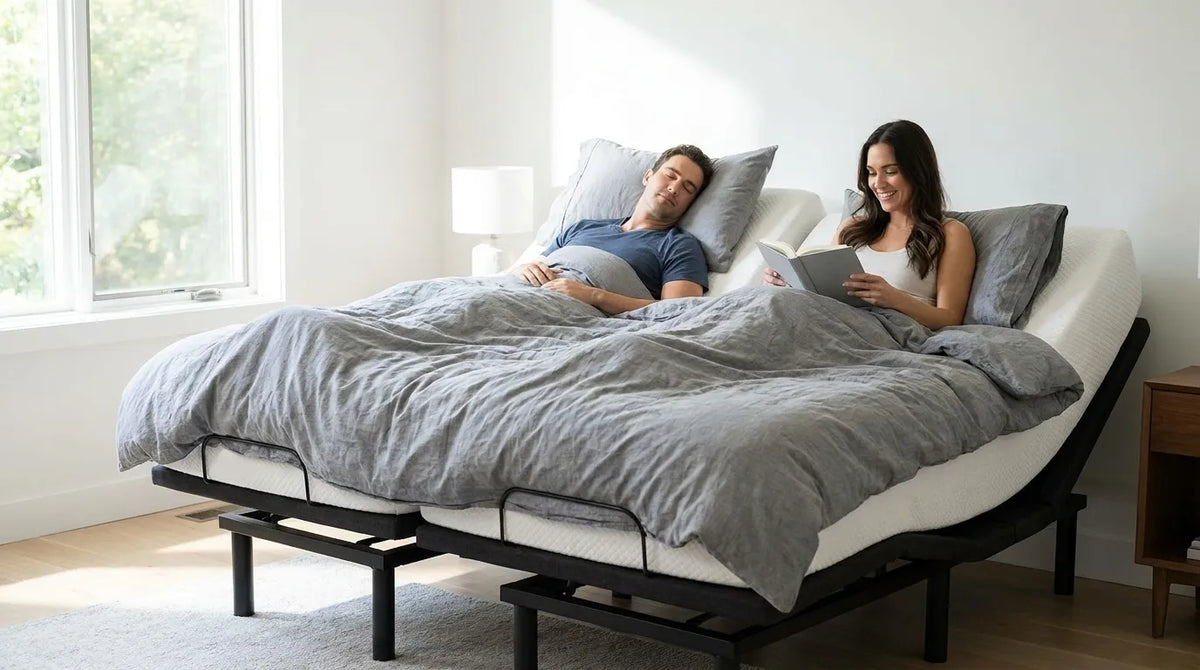
Partner disruption. Slippage and angle changes affect the sleeper and the partner sharing the bed. Adjustable bases with whisper-quiet motors and independent per-side articulation reduce this impact. Each partner adjusts their own side without disturbing the other.
Residual disease. As noted above, the Maniaci trial’s post-elevation AHI still fell in the moderate range. Elevation can meaningfully reduce events for many patients, yet it does not correct the underlying anatomy or remove the need for clinical follow-up.
Insurance Coverage For Adjustable Beds And Sleep Apnea
Most patients do not receive insurance coverage for a consumer adjustable base used only for sleep apnea.
Commercial insurance plans generally cover hospital-style adjustable beds as Durable Medical Equipment when a physician documents that the equipment is medically necessary to treat a diagnosed condition at home. The common qualifying conditions include severe GERD, congestive heart failure, COPD, or significant mobility limitations after surgery or injury. Sleep apnea rarely appears on that list. Coverage ties to broader medical necessity documentation rather than a sleep apnea diagnosis alone.
The most common reason adjustable bed DME claims are denied is incomplete paperwork. The physician’s order must name the diagnosis, explain why the equipment is medically required, and document why standard alternatives will not work. Patients whose clinician recommends an elevated sleeping position should ask the physician to document medical necessity explicitly in the written order and confirm that the supplier is approved by the insurer.
Medicare Part B covers CPAP machines for obstructive sleep apnea under its Durable Medical Equipment benefit, but coverage depends on meeting medical criteria, obtaining a doctor’s prescription, and using a Medicare-enrolled supplier. Medicare does not cover consumer adjustable bases as DME for sleep apnea because they are not hospital beds and are considered comfort or convenience items. Only hospital-grade adjustable beds prescribed for a qualifying medical condition may be covered as DME.
Because coverage hinges on documentation, patients should secure a complete, specific physician order before contacting a supplier and treat coverage as unconfirmed until the insurer and supplier verify it.
How To Set Up An Adjustable Base For Sleep Apnea
Angle. Research shows benefits from a mild 7.5-degree incline up to a 30-degree angle. Patients should discuss with their sleep doctor what degree of elevation is safe and appropriate for their situation. The 2022 MDPI head-of-bed elevation (HOBE) study’s 30° trunk elevation is the highest angle with published AHI data for sleep apnea, with average AHI changing from 23.8 ± 13.3 at 0° to 17.7 ± 12.4 at 30° elevation. Adjustable bed frames let users fine-tune the angle night by night and raise the knees slightly at the same time, which is an effective way to prevent sliding.
Torso, not just head. The Maniaci study advises raising the whole torso rather than just the head. Stacking standard pillows to sleep elevated can be unsafe for sleep apnea patients because it bends the neck forward and pushes the chin toward the chest, which can collapse the airway further and worsen sleep apnea. A wedge pillow, adjustable bed, or bed risers should be used instead to keep the spine and neck straight while elevating the entire upper torso.
Knee articulation. Raising the knees slightly at the same time as the head creates a natural body stop that prevents sliding and reduces lower back strain. Quality adjustable bases build this feature in, and wedge pillows cannot replicate it.
Tracking whether it is working. Patients using a CPAP machine can monitor AHI data through their device’s built-in recording. Those without PAP can track symptoms such as daytime sleepiness, morning headache, partner-reported snoring, and frequency of waking. A follow-up with the prescribing clinician after a period of consistent elevated sleeping provides the most reliable assessment.
Couples in smaller bedrooms. A Split Queen adjustable bed uses two fully independent bases with head and foot articulation on each side, in a 60″ footprint versus the 76″ of a Split King. Each partner sets their own elevation independently. 31% of US adults have opted for a “sleep divorce,” with the figure rising to 39% among adults aged 35–44 (Atomik Research for the American Academy of Sleep Medicine, June 2025, n=2,007). Many in this age group need adjustability for sleep apnea and live in bedrooms where a King will not fit. A true Split Queen means two fully independent bases. It differs from a split-head queen, which uses a single mattress with head-only articulation.

Shop Split Queen And Other Adjustable Systems
Frequently Asked Questions
These quick answers point back to the sections above so you can scan and then dive deeper where needed.
What Documentation Does Insurance Require For An Adjustable Bed?
Insurers usually require a detailed physician order that names the diagnosis, explains why an adjustable bed is medically necessary, and documents why standard alternatives will not work. See the insurance section above for how commercial plans and Medicare handle adjustable beds and CPAP coverage.
How Long Does It Take To Adjust To Sleeping Elevated?
Most patients adapt over several nights to a few weeks. Mild angles in the 7.5°–30° range tend to be easier to tolerate. Sliding, back strain, and partner disruption often improve once the angle and knee articulation are dialed in. The setup and downsides sections above outline ways to shorten this adjustment period.
What Is The 3% Rule For Sleep Apnea?
The “3% rule” refers to the AASM’s recommended hypopnea scoring definition, which requires at least 3% oxygen desaturation and/or an arousal to count a breathing event as a hypopnea. An alternative definition requires at least 4% desaturation. These two thresholds produce materially different AHI values for the same patient. The 3% definition captures more events, particularly in women and in milder disease categories, resulting in higher AHI scores and higher prevalence estimates. The AASM’s 2023 Scoring Manual retains the 3% definition as recommended and the 4% definition as an optional alternative. Patients who have had sleep studies under different scoring rules may see different AHI values even when their breathing has not changed.
Can An Adjustable Base Help If I Cannot Tolerate CPAP?
An adjustable base can reduce event frequency for some patients and may improve comfort enough to retry PAP at lower pressures. As the network meta-analysis cited above shows, PAP still produces a substantially larger AHI reduction than positional therapy. Patients who struggle with CPAP should work with their sleep clinician on mask fit, pressure settings, and adjuncts such as elevation rather than abandoning PAP on their own.
What AHI Level Makes An Adjustable Base Worth Trying?
Evidence is strongest in mild-to-moderate OSA and in position-dependent disease, where supine AHI is at least twice the non-supine AHI. In severe OSA, guidelines still favor PAP as primary therapy, with elevation as a comfort and adherence adjunct. The severity section above explains how elevation performed in key trials and how clinicians think about AHI ranges.
Leva Sleep: Making Clinician-Recommended Elevation Work At Home
Clinicians often recommend sleeping elevated, yet a flat bed cannot hold a consistent angle. Stacked pillows try to compensate and end up bending the neck. For two partners with different needs, a standard bed also cannot adjust each side independently.
Leva Sleep is a specialist adjustable bed company that builds complete, personalized sleep systems for couples. Leva has spent nine years building adjustable sleep systems for more than 25,000 customers. Each system pairs a base with independent per-side control, a mattress engineered to flex, and bedding designed for movement. Anti-snore positioning gently elevates the head to help open the airway.
For couples in smaller bedrooms, Leva offers the largest selection of Split Queen adjustable beds in North America, with five packages from $1,399, 30″ × 80″ mattresses that Leva manufactures, and a full line of Split Queen bedding. A true Split Queen means two fully independent bases with head and foot articulation on each side in a 60″ footprint, 16 inches narrower than a Split King. That difference often separates a room that works from one that does not. Complete Leva adjustable bed packages run from $1,299 to $8,999+, with financing options including 0% APR and a 180-night comfort guarantee. Leva Sleep mattresses are made in the US, and half of the US lineup is unique to the American market, including premium California-made brands.
Patients whose clinician has recommended sleeping elevated for snoring or airway support can start with Leva’s best beds for snoring relief collection to see systems designed for airway-focused elevation.
Explore Leva Sleep Adjustable Systems