Split Queen Adjustable Beds for Couples With Sleep Apnea
Written by: Matthew Timmins, Founder and Managing Director, Leva Sleep
Key Takeaways
- Head elevation at 7.5–30 degrees can reduce airway collapse for many OSA sleepers and works alongside CPAP therapy.
- A true Split Queen uses two independent 30" × 80" bases, so each partner controls their own head and foot position.
- Most existing queen mattresses are 60" × 80" and cannot be divided into two 30" × 80" halves for a true Split Queen.
- Quiet motors and very low motion transfer help the non-apnea partner sleep through nightly position changes.
- Leva Sleep manufactures 30" × 80" mattresses in-house and offers five complete Split Queen packages starting at $1,399.
Shop Leva Sleep Split Queen adjustable beds today
How Adjustable Bed Frames Support Sleep Apnea Treatment
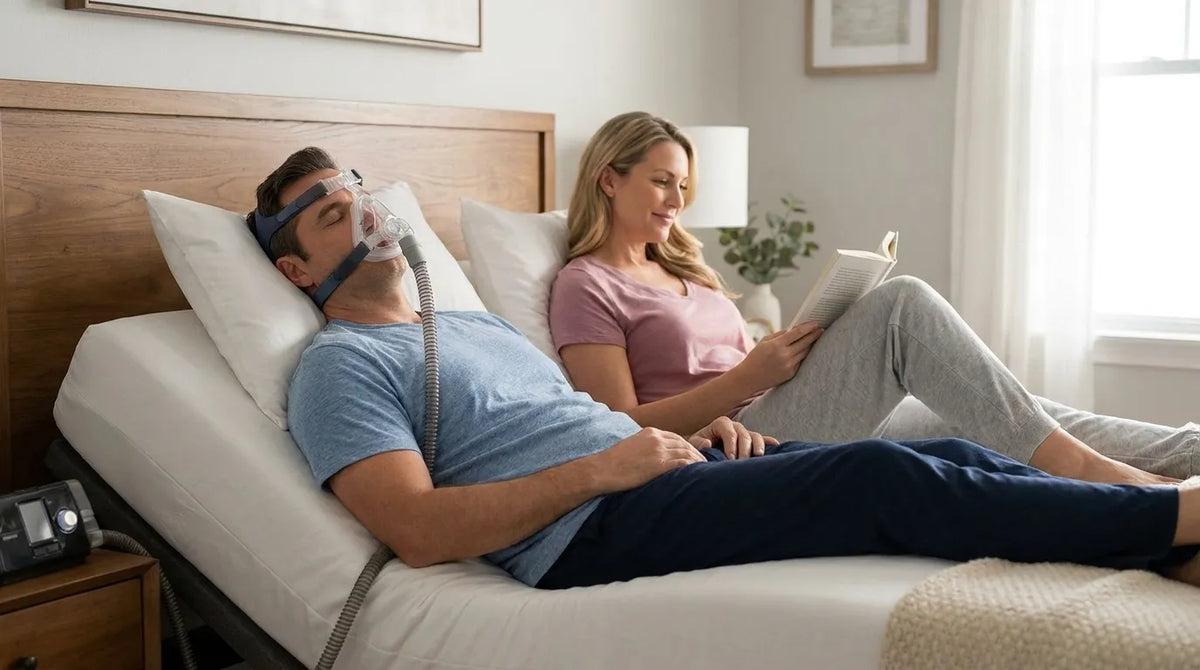
Obstructive sleep apnea (OSA) occurs when soft tissues of the throat collapse into the airway during sleep. Gravity worsens this in the supine position. Elevating the head uses gravity in reverse, keeping soft tissues forward and the airway more open. Clinicians commonly recommend head elevation as an adjunct and still rely on PAP therapy when indicated.
The clinical evidence covers a range of angles. A 2017 study in Sleep and Breathing by Souza et al. tested a 7.5-degree head-of-bed tilt in 52 adults with mostly mild to moderate OSA. Median AHI fell from 15.7 to 10.7 events per hour and minimum oxygen saturation improved, although 20 of the 52 participants did not meet the study's threshold for even a partial response. A 2025 multicenter observational study in Sleep and Breathing by Maniaci et al. compared flat supine sleep, 30-degree elevation, and side sleeping in 30 adults with OSA. Average AHI fell from 25.7 while flat on the back to 17.8 while elevated. Half of the participants met the study's response threshold during elevation and half did not.
Those response rates matter. Elevation reduces the burden for many sleepers but rarely eliminates OSA entirely. Positional therapy can be considered particularly for mild OSA or OSA that is worse while supine, per sleep medicine specialist Dr. Aneesa Das. A 2026 network meta-analysis in BMC Pulmonary Medicine found PAP therapy reduced AHI by a mean difference of 17.39 events per hour versus control, while positional therapy reduced it by 10.05 events per hour, with PAP significantly more effective.
The American Academy of Sleep Medicine recommends follow-up sleep testing to assess response to non-PAP interventions for OSA. Anyone using head elevation as part of an OSA management plan should work with their clinician and confirm the response with appropriate testing.
Explore Leva Sleep snoring and head-elevation solutions online or in the La Jolla showroom
Split-Top Queen Vs. Two Independent Bases For Sleep Apnea
The configuration decision shapes how well a Split Queen works for a couple. Two distinct formats share the "split queen" label, and they function very differently.
A split-head configuration uses a single mattress footprint where only the head sections adjust independently. The head sections move separately and the foot sections move together. This keeps a unified look but limits independence to head-only adjustment.
Two independent 30" × 80" bases give each partner full head and foot articulation. Each side operates on its own. This is what Leva Sleep means by "Split Queen" in its core lineup. The split-top configuration appears as a separate minor SKU and does not represent the default Split Queen offering. The table below shows how the two configurations differ on footprint, mattress size, and independence.
| Configuration | Footprint | Mattress Size | Independence |
|---|---|---|---|
| Split-Top Queen | 60" × 80" | One 60" × 80" mattress, split at head | Head-only |
| Two Independent 30" × 80" Bases | 60" × 80" | Two 30" × 80" mattresses | Full head and foot |
| Split King | 76" × 80" | Two 38" × 80" (Twin XL) mattresses | Full head and foot |
For sleep apnea specifically, full independence matters. The apnea sleeper may need head elevation, zero-gravity positioning, or an anti-snore preset. The non-apnea partner may prefer a flat, unchanged surface. Two independent bases let each person keep their own setting. For a full comparison of Split Queen versus Split King footprints and room requirements, see Adjustable Bed For Couples: Split King Vs. Split Queen.
Using An Existing Queen Mattress On A Split Queen Base
Adjustable bases bend the mattress at the head and foot, so the mattress must flex without resisting, buckling, or damaging internal materials. Memory foam, polyfoam, latex, and individually wrapped coils flex well on adjustable bases. Bonnell coils, offset coils, edge-to-edge wire frames, and rigid foam encasements do not.
Beyond compatibility, a true Split Queen adds a second constraint. It requires two 30" × 80" mattresses. A split queen uses two separate 30" × 80" mattress halves placed side by side on an adjustable base. A standard queen mattress is 60" × 80" and cannot be divided. Most existing queen mattresses are therefore incompatible with a true Split Queen configuration because of their dimensions. Leva Sleep manufactures 30" × 80" mattresses in two constructions (Heavenly Hybrid pocket coil and Heavenly Response all-foam) and two firmness levels so each partner can choose their own feel.
What The Non-Apnea Partner Experiences
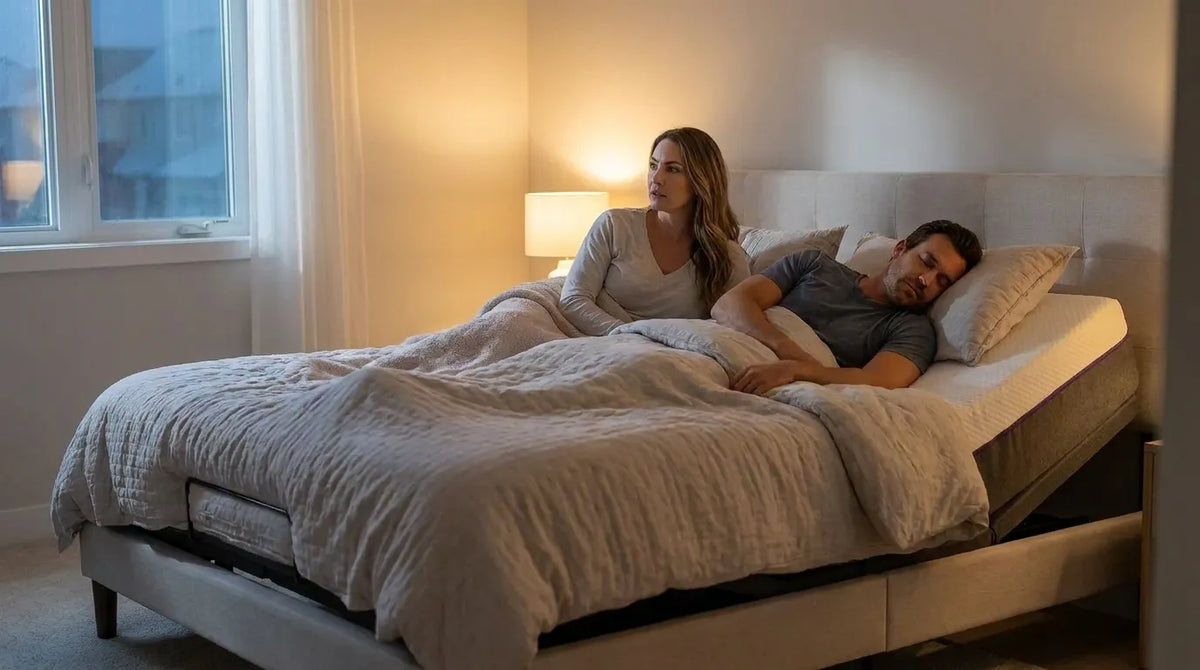
The non-apnea sleeper's comfort often decides whether a couple proceeds with a Split Queen. One partner has been told to sleep elevated. The other has been sleeping in the guest room or enduring a disrupted bed. Many couples want a solution that restores one shared bed and protects both sleepers.
Motor noise is the most common complaint about basic adjustable bases, and it matters most in a shared bed. If the base wakes the non-apnea partner every time it moves, the apnea sleeper's relief simply shifts the problem to the other side of the mattress. Whisper-quiet motors with smooth, gradual travel become a baseline requirement rather than a luxury feature.
Motion transfer is the second concern. A verified customer review noted switching from a previous adjustable base because it "transferred too much movement, so we could feel every time the other person moved," whereas independent bases showed "virtually no motion transfer." Two fully independent 30" × 80" bases remove the structural connection between the two sides and greatly reduce shared movement.
In a split configuration, the skeptical partner's side stays exactly how they like it. Their firmness, their position, and their temperature remain under their control. That stability often answers the concern from partners who are not yet convinced.
Give your partner their side of the bed back with a Split Queen from Leva Sleep
Common Problems With Split Queen Adjustable Beds
A Split Queen configuration introduces practical challenges that a standard queen does not. Each issue has a clear workaround.
Gap Between Halves: Two independent 30" × 80" mattresses placed side by side as a split queen leave a noticeable gap or seam down the center, though a quality foundation with a center support bar or a mattress bridge pad can minimize the gap's visibility and feel. Fitted sheets designed for split configurations use a slit or two-piece construction so each mattress half can move independently, and they do not clamp both halves together at the surface.
Sheet Fit: Standard fitted sheets often pop off when the bed articulates. Sheets with extra-deep pockets and reinforced elastic, designed specifically for adjustable and split beds, stay in place at full elevation.
Motor Noise: Basic adjustable bases use loud motors with jerky movement. Whisper-quiet motors with smooth travel provide a better experience in a shared bed.
Limited Selection: Many retailers offer no true Split Queen because the 30" × 80" mattress size falls outside the standard supply chain. Leva Sleep addresses this gap and offers five distinct Split Queen packages from $1,399.
Insurance, HSA, And FSA For Adjustable Beds
CPAP is covered under durable medical equipment (DME) benefits. CPAP equipment is rented with rental fees applied to the purchase price for a minimum trial period of three months to document compliance, tolerance, and clinical benefits prior to purchase. Consumer adjustable bases (for example, Craftmatic, Simmons Beautyrest, Adjust-A-Sleep) are not classified as durable medical equipment (DME) and are non-covered, while hospital-style adjustable beds and CPAP devices can be covered under the Medicare DME benefit when medically necessary.
HSA and FSA funds may apply with the right documentation. Adjustable bed bases are HSA/FSA eligible when a Letter of Medical Necessity names a condition the elevation supports, such as sleep apnea. Sleep apnea appears among conditions that can support HSA/FSA eligibility, especially with an adjustable base.
The practical steps are straightforward:
- The Letter of Medical Necessity must be dated on or before the purchase it covers. Retroactive letters are rejected.
- The customer's health plan administrator decides each reimbursement claim under its own rules. Eligibility never occurs automatically.
- The LMN does not set a dollar limit. Reimbursement equals the actual receipt amount, capped only by the FSA or HSA balance.
- Retain the LMN, receipt, and reimbursement records for at least seven years.
For sleep apnea specifically, positional therapy is sometimes prescribed alongside CPAP, and some administrators expect documentation of CPAP failure or contraindication before approving elevation-only approaches. Obtain the Letter of Medical Necessity before purchasing and keep all documentation.
Key Features To Prioritize In A Split Queen Adjustable Base
Five specifications determine whether a Split Queen base actually works for an apnea sleeper and their partner.
- Independent Head Adjustment: Each side must elevate independently so one partner can sleep flat while the other elevates.
- Memory Presets: Save the anti-snore or elevated position so it does not need to be found every night.
- Quiet Motors: Whisper-quiet operation keeps adjustments from waking the non-apnea partner.
- Mattress Approval: Confirm the mattress is explicitly rated for adjustable-base use to protect the warranty, and confirm the dimensions are 30" × 80" for a true Split Queen.
- Split-Top Vs. Two-Base Decision: Choose based on how much independence each partner needs. Head-only adjustment suits couples where only one position variable differs. Full independence suits couples with different head and foot preferences.
Why Most Couples Hear “No” On Split Queen
Split King is straightforward. It uses two Twin XL (38" × 80") mattresses side by side, a standard size every mattress manufacturer already produces, on bases every supplier already stocks. Any retailer can assemble one from parts that already exist.
Split Queen presents a manufacturing challenge. A split queen uses two separate 30" × 80" mattress halves. That size does not exist in the normal mattress supply chain. To offer it, a company has to commit to building it, including the mattress, the base, and every accessory that must fit it. Many retailers therefore answer "no" when customers ask for a true Split Queen.
The room-size consequence is significant. A Split King needs roughly 76 inches of wall. A Split Queen needs 60. That 16-inch difference often decides whether the room works and whether a couple can solve their sleep problem in the bedroom they already have.
"Split king is easy, it is two standard mattresses. Split queen is a manufacturing decision. That is why almost nobody offers it, and why couples in smaller bedrooms keep getting told no." — Jane Doe, VP of Product at Leva Sleep
For a deeper look at Split Queen options, trade-offs, and tips, see the full Split Queen guide.
Leva Sleep Split Queen Solutions For Couples With Sleep Apnea
Leva Sleep is a specialist adjustable bed company offering complete, personalized sleep systems for couples. Leva provides one of the broadest selections of Split Queen adjustable beds in North America, with five distinct packages from $1,399, mattresses manufactured in-house in 30" × 80", and a full line of bedding and accessories built to fit them.
"Most people do not come to us for a bed. They come because one of them has been sleeping in the guest room and they want that to stop." — John Smith, Sleep Specialist at Leva Sleep
| Package | From (USD) | Position |
|---|---|---|
| Cala Adjustable Bed Package | $1,399 | Entry point into true split adjustability |
| Vela Adjustable Bed Package | $1,899 | Core package, multiple comfort levels |
| Heavenly Response Adjustable Bed | $1,899 | Leva-built mattress and base, matched as a system |
| Passions Adore Adjustable Bed Package | $2,699 | Also available in Split-Head Queen |
| Sereno Signature Adjustable Bed Package | $2,799 | Premium tier with advanced base features |
Source: Leva US catalog, August 2026
Leva manufactures the Heavenly Hybrid (pocket coil) and Heavenly Response (all-foam) in 30" × 80". Both come in Luxury Firm and Medium/Plush, so each partner chooses their own feel, the same advantage Split King buyers take for granted. Complete packages run $1,299 to $8,999+. Leva offers 15–20 adjustable base models versus 3–5 at a standard mattress retailer. It also includes a 180-night comfort guarantee and in-house white-glove delivery and setup. Leva Sleep mattresses are made in the US, and half of the US lineup is unique to the American market.

Transform your sleep with Leva Sleep and explore Split Queen adjustable bed packages
Conclusion
Head elevation at 7.5–30 degrees can reduce airway collapse for many sleepers with OSA and works alongside CPAP therapy. A split-top queen limits independence to head-only adjustment, while two independent 30" × 80" bases give full independence on both sides. Most existing queen mattresses cannot be used because of their 60" × 80" dimensions and, in some cases, because they are not rated for adjustable-base articulation. The non-apnea partner's comfort often drives the purchase decision, and full independence helps both sleepers stay in the same bed. Complete Split Queen packages start at $1,399, and HSA/FSA funds may apply with a Letter of Medical Necessity obtained before purchase.
Apply this framework to your own situation and consult a clinician before changing any prescribed OSA treatment.
Transform your sleep with Leva Sleep and explore Split Queen adjustable beds today