How to Use Sleep Tracker Data to Choose an Adjustable Bed
Written by: Matthew Timmins, Founder and Managing Director, Leva Sleep
Key Takeaways
- Consumer sleep trackers can flag snoring, low deep-sleep percentages, and breathing disturbances, but they cannot correct positional causes.
- Accuracy limitations mean trackers may miss moderate-to-severe apnea events and misclassify quiet wakefulness as light sleep, which can delay intervention.
- Position-dependent obstructive sleep apnea affects 56–75% of cases, and elevating the head or avoiding back sleeping can reduce airway collapse and improve tracked metrics.
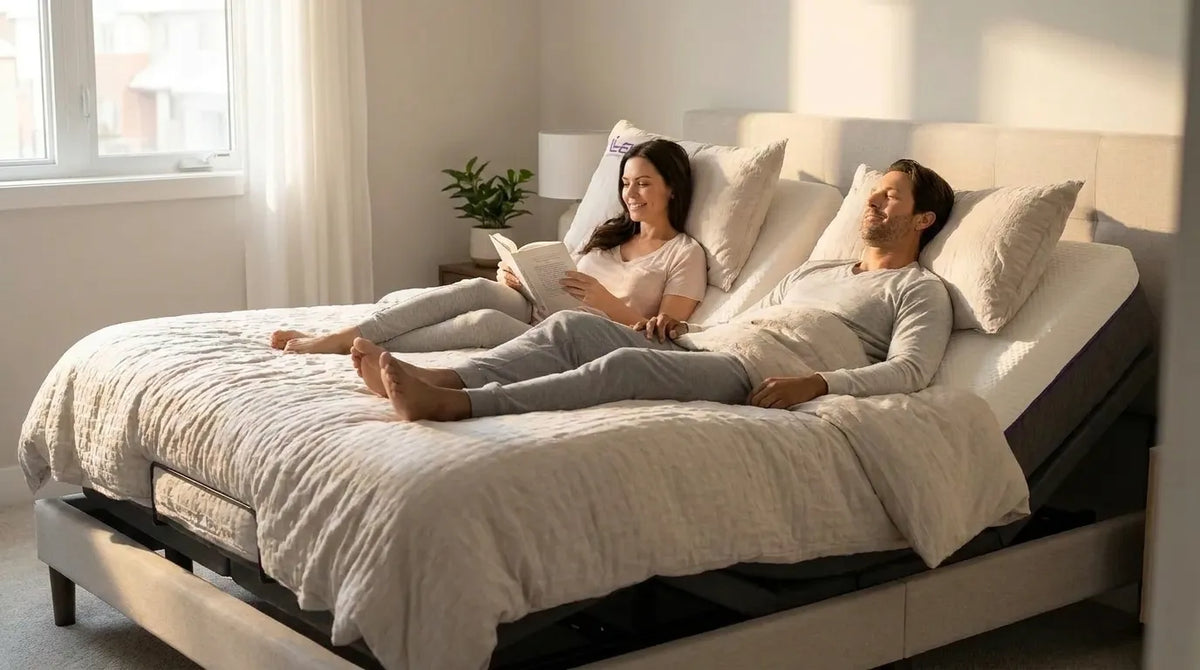
- Split-adjustable beds allow independent per-side positioning so one partner can use anti-snore elevation or zero-gravity settings without disturbing the other.
- Leva Sleep offers split-adjustable bed systems with anti-snore and zero-gravity features, and you can shop Leva Sleep to match your tracker findings with the right positional therapy.
What Sleep Trackers Measure vs. What They Miss
Most consumer sleep trackers estimate total sleep time within a moderate margin of polysomnography (PSG) values, which works for general wellness but not for diagnosing sleep disorders. Sleep staging without EEG remains a core limitation. N1 and N2 discrimination is poor, REM detection through heart rate variability is only moderate, and deep-sleep (N3) estimates vary widely between devices. The American Academy of Sleep Medicine (AASM) states that consumer sleep technology should not be used to diagnose or treat sleep disorders. Tracker data can still support a patient-clinician discussion when used as part of a full clinical evaluation.
Trackers also misclassify quiet wakefulness as light sleep, which inflates reported sleep duration. This misclassification becomes more serious when you consider the roughly 33.4% of U.S. adults aged 35–49 and 34.5% of adults aged 50–64 who already report short sleep duration. For these adults, overestimation can hide a real sleep deficit and delay action.
Accuracy Limits for Sleep Apnea and Snoring
Accuracy drops further once breathing events enter the picture. Wrist-based SpO2 sensors can detect major desaturation events but often miss some hypopneas, and performance for moderate-to-severe obstructive sleep apnea varies by device. Some moderate-to-severe apnea events may go undetected by a consumer wearable on any given night.
Undetected sleep-disordered breathing affects a large share of U.S. adults. A 2024 peer-reviewed estimate from ScienceDirect reported that 83.7 million U.S. adults aged 20 and older have obstructive sleep apnea (OSA), representing approximately 32.4% of the adult population, and experts estimate that 80% of OSA cases in the United States remain undiagnosed. Habitual snoring affects about 40% of adult men and 24% of adult women, and snoring prevalence increases with age, which directly affects adults in the 35–70 range.
These unresolved issues also strain relationships. A June 2025 survey of 2,007 U.S. adults conducted by Atomik Research for the AASM found that 31% of American adults had chosen a “sleep divorce,” meaning they regularly sleep in a separate room from their partner. Among adults aged 35–44, that figure rises to 39%. Another 37% reported going to sleep at different times to accommodate a partner. Trackers reveal the data behind these disruptions, but they do not resolve them.
Compare split-adjustable beds that match your tracked findings at Leva Sleep.
When Tracking Should Lead to Clinical Care
The line between consumer screening and clinical diagnosis is clear. The FDA classifies Samsung's Sleep Apnea Feature (v2.0) under 510(k) number K261011 as an Over-The-Counter Device To Assess Risk Of Sleep Apnea, which limits its use to risk screening rather than formal diagnosis. Apple's Sleep Apnea Notification Feature, cleared by the FDA in September 2024, analyzes breathing-disturbance patterns associated with moderate to severe sleep apnea but is not intended to diagnose, treat, or help manage the condition.
Formal diagnosis of obstructive sleep apnea requires polysomnography, an overnight in-lab study that measures EEG, airflow, respiratory effort, SpO2, and limb movements at the same time. The 2025 VA/DoD Clinical Practice Guideline recommends reserving polysomnography for suspected obstructive sleep apnea, movement disorders, parasomnias, or other sleep diagnoses rather than relying on wearable data alone. Tracker findings that show repeated breathing disturbances, low deep-sleep percentages, or frequent snoring events should prompt a conversation with a clinician, not replace it.
Connecting Tracker Findings to Adjustable-Bed Features
Once a tracker highlights a pattern and a clinician has evaluated it, you can focus on the practical step of choosing a positional intervention. The table below links three common tracker findings to specific adjustable-bed features.

| Tracked Finding | Positional Mechanism | Adjustable-Bed Solution |
|---|---|---|
| Snoring events | Back sleeping pulls the tongue backward and narrows the airway | Anti-snore head elevation, plus independent per-side head articulation so one partner elevates without disturbing the other |
| Low deep-sleep (N3) percentage | Pressure on hips, shoulders, and lumbar spine causes micro-arousals that fragment slow-wave sleep | Zero-gravity positioning, with head and knees slightly elevated to distribute body weight, and lumbar control to support the lower-back curve |
| Breathing disturbances / SpO2 dips | Position-dependent OSA affects approximately 56–75% of all OSA cases, and avoiding back sleeping reduces airway collapse | Independent per-side elevation so the affected partner can maintain a non-supine head angle throughout the night without affecting the other side |
Shop beds for pain relief and positional therapy at Leva Sleep.
How to Choose an Adjustable Bed That Matches Your Data
Choosing an adjustable bed that truly supports your tracked sleep patterns depends on a few practical details.
- Motor noise: A base that wakes a partner during position changes defeats the purpose of independent adjustment. Look for whisper-quiet motors with smooth, gradual movement.
- Mattress articulation compatibility: Most standard mattresses resist bending, wear unevenly with repeated articulation, and shorten their own lifespan. Mattresses engineered to flex with the base, whether all-foam or hybrid pocket-coil, pair better with adjustable systems.
- Split Queen availability: Split King adjustability needs a 76-inch footprint with two standard Twin XL mattresses. A true Split Queen uses a 60-inch footprint and requires purpose-built 30" × 80" mattresses that are not part of the standard supply chain. For couples in smaller rooms, Split Queen is the only way to get independent per-side articulation without upsizing the bed. Learn more about Split Queen adjustable beds at Leva Sleep.
- Trial period: Adjusting to a new sleep position takes several weeks. A 180-night comfort guarantee gives enough time to see whether the positional change delivers the improvement your tracker suggested.
- Complete-package pricing: Leva Sleep adjustable bed packages, which include base and mattress, range from $1,299 to $8,999+, covering entry-level adjustability through luxury configurations.
Clinical Evidence Behind Positional Therapy
A 2026 network meta-analysis found that positional therapy reduced the apnea-hypopnea index (AHI) compared with control, which represents a clinically meaningful reduction for position-dependent cases. The same analysis concluded that positional therapy offers a viable alternative to PAP and oral appliance therapy for patients with position-dependent OSA, which affects the majority of these cases.
A 2026 narrative review in Pathophysiology by Redondo, Ascher, and Abreu confirms that positional therapy reduces supine sleep to limit position-dependent airway collapse and can substantially reduce AHI when people maintain supine avoidance. Results are strongest in patients with positional OSA, lower BMI, and mild disease. The review also notes that positional therapy offers limited benefit in non-positional or severe OSA, which highlights the need for clinical evaluation before choosing an intervention.
Clinicians often recommend sleeping with the head elevated for conditions such as sleep apnea, acid reflux, and post-surgical recovery. An adjustable base makes that position repeatable at home, night after night, without stacked pillows. Joe Li, DO, primary care physician with Hartford HealthCare Medical Group, notes that sleeping on the back can worsen snoring or sleep apnea because gravity pulls the tongue backward and narrows the airway. He also notes that side sleeping helps reduce snoring, lowers acid reflux, and improves circulation.
FAQ
Can a consumer sleep tracker diagnose sleep apnea?
Consumer sleep trackers cannot diagnose sleep apnea. Devices cleared by the FDA are classified as risk-assessment or screening tools, not diagnostic devices. The FDA's 510(k) clearances for wearable sleep apnea features limit their intended use to identifying risk patterns rather than confirming a diagnosis. A formal diagnosis of obstructive sleep apnea requires polysomnography, an in-lab overnight study that measures EEG, airflow, respiratory effort, blood oxygen, and limb movements. Tracker data that shows repeated breathing disturbances or low SpO2 readings should prompt a clinical evaluation. The American Academy of Sleep Medicine states that consumer sleep technology data may support a patient-clinician discussion when used as part of an appropriate clinical evaluation.
What tracked sleep metrics most reliably indicate a positional problem?
Three tracker outputs most often point to position-dependent sleep disruption. Snoring events logged by a wearable or under-mattress sensor often correlate with back-sleeping time, because that position allows gravity to pull soft tissue into the airway. Low deep-sleep (N3) percentages can reflect pressure-related micro-arousals caused by a flat sleep surface that concentrates body weight on the hips, shoulders, and lumbar spine. Repeated SpO2 dips or breathing disturbances, especially when they cluster during certain sleep periods, may indicate position-dependent airway collapse, which affects the majority of OSA cases. None of these findings provide a diagnosis on their own, but each highlights a positional factor that an adjustable bed can address while clinical evaluation moves forward.
How does a split-adjustable bed differ from a standard adjustable base for couples?
A standard adjustable base moves as a single unit, so when one partner raises the head section, both sides of the bed change position. A split-adjustable base divides the bed into two independent sides, each with its own motor, controls, and elevation range. One partner can elevate the head to an anti-snore angle while the other remains flat, or one side can use zero-gravity while the other stays neutral. For couples where only one partner has tracked breathing disturbances or snoring events, split adjustability removes the need for compromise. A Split Queen configuration delivers this independence in a 60-inch footprint, which is 16 inches narrower than a Split King, and works for bedrooms that cannot accommodate a King-size bed.
Compare split-adjustable beds that match your tracked findings at Leva Sleep.
Conclusion: Turning Tracker Insights into Positional Therapy
Sleep trackers provide real value by surfacing patterns such as snoring events, low deep-sleep percentages, and breathing disturbances that might otherwise go unnoticed for years. They cannot change the shape or angle of the surface you sleep on. Evidence from a 2026 network meta-analysis and a 2026 Pathophysiology narrative review supports positional therapy as a meaningful intervention for the roughly 56–75% of OSA cases that are position-dependent. An adjustable bed with independent per-side articulation delivers that intervention at home, every night, for both partners.
Couples whose tracker data shows snoring events, fragmented deep sleep, or repeated breathing disturbances can follow a clear path. First, schedule a clinical evaluation to determine whether the pattern reflects a diagnosable condition. Then choose a positional intervention that matches the specific finding. Leva Sleep's split-adjustable systems, which include anti-snore head elevation, zero-gravity lumbar support, and independent per-side positioning, are designed for that second step. Complete packages start at $1,299, and five Split Queen configurations are available from $1,399 for couples who need a 60-inch footprint instead of a 76-inch one.
Leva Sleep is a specialist adjustable bed company serving the United States, with a luxury showroom in La Jolla, California.
Last updated: August 2026