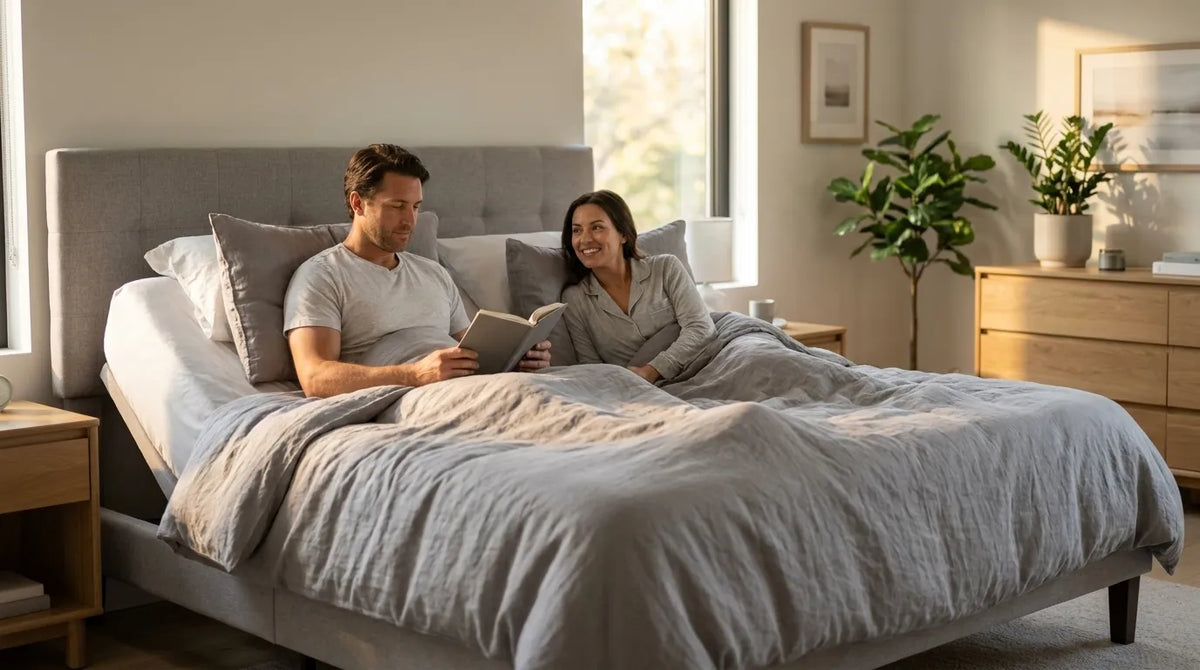
Sleep Quality for Couples: 7 Ways to Sleep Better Together
Written by: Matthew Timmins, Founder and Managing Director, Leva Sleep
Key Takeaways
Here are the key takeaways from this article:
- Over 30% of Americans now choose a sleep divorce, and the real issue often comes from the bed and sleep setup rather than the relationship.
- Sharing a bed can improve REM sleep by 10% and reduce insomnia when couples solve comfort and support differences.
- Snoring, movement, temperature conflicts, and differing schedules are the top disruptors of couple sleep.
- Simple fixes like separate blankets, motion-isolating mattresses, and consistent schedules can help right away.
- For a long-term solution, explore Leva Sleep's Split Queen adjustable bed collection to enjoy independent comfort while staying in the same bed.
The Science of Sleeping Together: Why Sharing a Bed Matters
Sleeping together delivers measurable physical and emotional benefits, not just romantic closeness. A University of Arizona study of 1,007 working-age adults found that people who shared a bed with a partner reported less insomnia, less fatigue, faster sleep onset, and longer total sleep time than solo sleepers.
A study published in Frontiers in Psychiatry found that couples who slept together experienced approximately 10% more REM sleep, the stage linked to emotional processing and memory consolidation, than when they slept alone. Continuous REM stretches averaged 22 minutes, compared to just over 13 minutes when sleeping solo. The researchers also observed sleep-stage synchrony between partners, showing that their bodies align physiologically during shared sleep.
Research presented at the SLEEP 2026 annual meeting found that lower romantic satisfaction strongly predicts higher anxiety, which then predicts lower sleep quality. This pattern shows a direct psychological pathway between relationship health and rest.
The body naturally prefers sleeping next to a partner. The real problem usually comes from the bed and sleep environment, not the togetherness.
Common Challenges That Ruin Couples' Sleep
Sharing a bed often breaks down for five main reasons, which tend to stack on top of each other.
Snoring is the leading cause of couple sleep disruption. Sleep apnea affects roughly 30 million US adults, and about 80% of cases go undiagnosed. Snoring, caused by vibration of pharyngeal tissues that partially block the airway, can reach 80–90 decibels in its loudest range, comparable to a vacuum cleaner. That level of noise easily wakes or lightens a partner’s sleep.
Another major disruptor is movement. On a traditional mattress, motion transfers across the surface. A restless partner can cause dozens of micro-awakenings, brief arousals that fragment sleep architecture even when the sleeper does not remember waking.
Beyond movement, different schedules create constant interruptions. The 2025 AASM survey found that 37% of US adults go to sleep at a different time than they want to so they can accommodate a partner. One person’s bedtime or alarm often cuts into the other’s deep sleep.
Temperature conflicts add another layer of strain. A shared surface cannot fully satisfy a partner who sleeps hot and one who sleeps cold, which leads to the classic blanket tug-of-war and frequent cover adjustments.
Finally, differing comfort preferences create a geometry problem. One partner may need firm support for back pain while the other needs plush pressure relief for hip pain. A flat mattress offers only one shape, so at least one person compromises every night.
As John Smith, Head of Sleep Science at Leva Sleep, explains: “A flat bed asks two different bodies to accept the same shape for eight hours. One of them always loses.”
7 Science-Backed Tips for Better Couple Sleep
These seven strategies move from simple behavioral tweaks to environmental upgrades and, finally, to product-based solutions that tackle root causes.
- Use Separate Blankets (The Scandinavian Method). This Nordic practice gives each partner their own duvet on a shared bed. It removes blanket tug-of-war, allows individual temperature control, and reduces nighttime disturbances while you still share the same mattress. It costs nothing if you already own an extra duvet and works immediately.
- Invest in a Motion-Isolating Mattress. Pocketed coil and all-foam mattresses absorb movement better than traditional innersprings, where interconnected coils send motion across the entire surface. If a partner’s tossing and turning wakes you, a motion-isolating surface sharply reduces those disturbances.
- Try the 7-7-7 Rule to Support the Relationship. This framework, created by licensed marriage and family therapist Dr. Anna Elton, LMFT, encourages a date every seven days, a getaway every seven weeks, and a vacation every seven months. It keeps the “Couple Self” active through shared experiences and novelty, which Dr. Elton identifies as a strong predictor of long-term satisfaction. Because relationship satisfaction reduces anxiety, this kind of intentional connection also supports deeper, more stable sleep.
- Set a Consistent Sleep Schedule. Anchoring wake times within a 30-minute window every day, including weekends, strengthens circadian rhythm and improves sleep continuity. Many couples notice benefits within one to two weeks. Even if bedtimes differ, a shared morning anchor helps both partners regulate their internal clocks.
- Create a Cool, Dark, and Quiet Bedroom. The ideal bedroom temperature sits between 60 and 67°F. Blackout curtains block light that suppresses melatonin. A white noise machine adds a steady sound backdrop that softens the sharp, irregular quality of snoring and movement.
- Use Earplugs or White Noise for Extra Protection. High-quality foam earplugs with a 33 dB noise reduction rating can significantly dampen partner noise. White noise machines create a consistent wash of sound across frequencies so the brain reacts less to sudden noises. These tools are low-cost and available the same day in most areas.
- Upgrade to a Split Adjustable Bed for Independent Comfort. This option addresses the geometry problem instead of only masking symptoms. As John Smith explains: “You cannot solve a geometry problem by changing the foam. That is the mistake almost every mattress purchase makes.” A split adjustable bed gives each partner independent control over head and foot elevation, firmness, and position. Elevating the head opens the airway to reduce snoring. Adjustable lumbar support eases back pain. With split controls, each partner reaches their ideal position without affecting the other.
Shop Leva Sleep online or visit our La Jolla showroom to explore adjustable bed options that fit your space.
When to Consider a Sleep Divorce and Better Alternatives
The sleep divorce trend continues to grow, and for some couples it offers a necessary short-term solution. If one partner has untreated sleep apnea, severe chronic pain, or a medical condition that requires specialized positioning, separate beds may be medically appropriate for a period of time.
For most couples, a sleep divorce simply covers a problem that a better bed and setup can solve. A 2023 study of obstructive sleep apnea patients found that 72% of couples who had been sleeping apart returned to sharing a bed after the patient’s sleep apnea was treated. Their separation reflected an untreated condition, not a true preference for separate rooms.
| Option | Pros | Cons | Best For |
|---|---|---|---|
| Sleeping Together (Flat Bed) | Intimacy, connection, REM sleep benefits | One geometry forced on two bodies, frequent compromise | Couples with minimal sleep differences |
| Sleep Divorce (Separate Rooms) | Uninterrupted sleep, personal space | Less physical intimacy, potential emotional distance, logistical challenges | Couples with severe, untreated medical issues |
| Split Adjustable Bed | Independent comfort per side, shared bed, addresses root causes of most disruptors | Higher upfront investment than a flat mattress | Couples who want both intimacy and high-quality sleep |
As John Smith notes: “Split king is easy, because it uses two standard mattresses. Split queen requires a manufacturing decision. That is why almost nobody offers it, and why couples in smaller bedrooms keep getting told no.”
How Adjustable Beds and Split Configurations Help Couples Sleep
Adjustable beds target the specific mechanisms that disrupt couple sleep and connect directly to the challenges described earlier.
Snoring and airway restriction: Elevating the head gently opens the airway, which directly addresses the most common disruptor. Anti-snore positioning reduces snoring for many sleepers, and clinicians often recommend head elevation for sleep apnea and post-surgical recovery.
Acid reflux: In a similar way, sleeping with the head elevated helps keep stomach acid from flowing back into the esophagus. Clinicians frequently recommend this position for people with reflux.
Back and joint pain: For pain-related awakenings, the zero-gravity position, with the head and knees slightly elevated, distributes body weight more evenly and reduces spinal pressure. Adjustable lumbar support targets the lower back curve specifically, which differs from simply raising the head or foot section.
Differing preferences: With split controls, each partner adjusts their side’s elevation and position independently. One person can sleep flat while the other elevates to read or relieve snoring, without disturbing the other side.
Temperature: Higher-end systems add per-side heating and cooling, so each partner can fine-tune their own thermal environment instead of fighting over a single setting.
Leva Sleep offers one of the largest selections of Split Queen adjustable beds in North America, with five distinct packages from $1,399 and mattresses manufactured in 30" × 80". A full line of Split Queen bedding and accessories supports this format. A Split Queen occupies 60 inches of width, compared with a Split King’s 76 inches. That 16-inch difference often determines whether a couple in a smaller bedroom can solve their sleep problem or must give up on a split configuration. Most retailers offer no true Split Queen, because the 30" × 80" mattress size falls outside the standard supply chain and must be purpose-built.

Explore Leva Sleep's pain relief collection or snoring relief collection to match a system to your primary concern. For couples whose bedroom fits a King footprint, the Duet Split King adjustable bed delivers the same independent per-side control in a wider size.
FAQ
1. What is the 7-7-7 rule for couples?
The 7-7-7 rule, created by licensed marriage and family therapist Dr. Anna Elton, LMFT, encourages couples to schedule a date every seven days, a getaway every seven weeks, and a longer vacation every seven months. The framework keeps what Dr. Elton calls the “Couple Self” active through shared experiences, emotional intimacy, and connection, instead of letting it disappear under household and family duties. The exact numbers can flex; the real goal is to put the relationship on the calendar consistently. Because stronger relationships reduce anxiety, following this rule also supports better sleep for both partners.
2. Does a split king or split queen mattress help couples sleep better?
A split adjustable bed gives each partner fully independent control over head and foot elevation, position, and, on higher-end systems, temperature. This setup addresses the main couple sleep disruptors at their root. Elevating the head helps reduce snoring by opening the airway. Zero-gravity positioning and lumbar support ease back and joint pain. Differing firmness preferences are solved when each partner chooses their own mattress half.
A Split King uses two Twin XL (38" × 80") mattresses on two independent bases, forming a 76-inch-wide footprint. A Split Queen uses two 30" × 80" mattresses on two independent bases, forming a 60-inch-wide footprint, the same width as a standard Queen. The Split Queen format is rare because the 30" × 80" size must be purpose-built. Leva Sleep manufactures this size and offers five Split Queen packages from $1,399.
3. What is the Scandinavian sleep method and does it work?
The Scandinavian sleep method gives each partner a separate duvet on a shared bed instead of one large shared blanket. It is common in Sweden, Denmark, Norway, and much of Europe. The benefits are straightforward: it removes blanket tug-of-war, lets each person choose their preferred warmth level and duvet weight, and reduces disturbances from one partner pulling or shifting a shared cover. It usually requires only a second duvet and cover and keeps both partners in the same bed. Couples can still cuddle or share a duvet at the start of the night, then move to individual covers for uninterrupted sleep. For temperature-related conflict, it ranks among the most effective free interventions.
4. How do I stop my partner's snoring from disrupting my sleep?
The first step involves ruling out obstructive sleep apnea with a doctor, since snoring often signals this condition and earlier in this article you saw how widespread it is. For positional snoring, side sleeping instead of back sleeping reduces airway collapse. Avoiding alcohol before bed and maintaining a healthy weight also lessen snoring severity. White noise machines soften the irregular quality of snoring so the brain reacts less. High-quality foam earplugs with a strong noise reduction rating further dampen partner noise.
The most comprehensive solution uses an adjustable bed with anti-snore positioning. Elevating the head gently opens the airway, which is why clinicians commonly recommend this position for snoring and mild sleep apnea. With a split adjustable bed, the snoring partner’s head can be elevated while the other partner sleeps flat, since each side adjusts independently.
5. What is a sleep divorce and should we try one?
A sleep divorce means regularly sleeping in a separate bed or room from a partner. It appears most often among adults aged 35–44, where 39% report doing it at least some of the time, according to a 2025 AASM survey of 2,007 US adults. For couples with severe, untreated medical conditions, particularly obstructive sleep apnea, it can serve as a reasonable short-term measure.
A 2023 study showed that 72% of couples who had been sleeping apart returned to sharing a bed after the patient’s sleep apnea was treated, which suggests that separation often reflects an underlying medical issue. For many couples, a split adjustable bed offers a more sustainable answer. Each partner controls their own side’s elevation, firmness, and position, so neither has to accept the other’s geometry. The shared bed stays intact, along with the intimacy that comes with it.
Sleep Better Together, Starting Tonight
The science shows that sharing a bed with a partner reduces stress, increases REM sleep, and supports emotional connection. A flat mattress, however, forces one geometry on two different bodies, which usually means one partner compromises.
A better bed and smarter sleep environment provide a more effective solution than a sleep divorce for most couples. Practical steps such as separate blankets, consistent wake times, a cool and dark room, and white noise or earplugs can ease many disruptors right away. For a deeper fix, a split adjustable bed removes the underlying compromise by giving each partner independent control while preserving a shared bed.
Leva Sleep has helped more than 25,000 customers improve how they sleep over nine years, with a luxury showroom in La Jolla, California, and in-house white-glove delivery across the United States. Complete adjustable bed packages start at $1,299 and include a 180-night comfort guarantee.
Visit the La Jolla showroom or shop Leva Sleep online to start sleeping better together tonight.