Best Sleep Position and Bed Setup for Back Pain
Written by: Matthew Timmins, Founder and Managing Director, Leva Sleep
Key Takeaways
- Sleep quality and back pain reinforce each other. Poor sleep heightens pain and inflammation, and pain disrupts sleep and recovery.
- Most people replace their mattress without relief because the real issue is the flat, shared geometry that cannot fit two different bodies.
- Medium-firm support and a pillow under or between the knees are the most consistently supported fixes for nonspecific low back pain.
- Adjustable bases address the geometry problem by allowing independent positioning, lumbar support, and pressure relief for each partner.
- Leva Sleep focuses on adjustable beds that directly target the geometry issue behind back pain during sleep.
Find an adjustable bed that fits your geometry
The Problem: Waking at 3 A.M. and the Partner in the Guest Room
Many couples share the same pattern. One partner wakes at 3 a.m. and cannot find a comfortable position. The other has moved to the guest room. A new mattress went in six months ago, yet nothing changed. A 2025 survey of 2,007 US adults conducted by Atomik Research for the American Academy of Sleep Medicine found that 31% of American adults reported a “sleep divorce,” meaning they regularly sleep in a separate room from their partner. Among adults aged 35 to 44, the figure rises to 39%.
The surface you sleep on is a modifiable variable. Changing the surface, and the geometry it creates, is where durable relief often begins.
How Sleep Quality and Back Pain Affect Each Other
A 2026 narrative review published in Current Sleep Medicine Reports confirms that the sleep–pain relationship is bidirectional. Sleep disruption contributes to central sensitization, and chronic pain disrupts sleep initiation, maintenance, and quality. Historically, clinicians viewed insomnia as secondary to pain and expected it to resolve once pain improved. Current evidence contradicts that view.
The same 2026 review reports that difficulty initiating and maintaining sleep, early awakening, and nonrestorative sleep predicted chronic widespread pain across follow-up periods of 3 to 18 years. These patterns held even after accounting for mental health and in people who were pain-free at baseline. Sleep disturbances more strongly predict future pain than pain predicts later sleep problems, which makes sleep a modifiable driver of pain persistence.
A 2018 systematic review in Sleep Medicine Reviews analyzed 16 longitudinal studies covering more than 61,000 participants. Afolalu, Ramlee and Tang found that worsening sleep quality or duration was associated with a two- to threefold increased risk of pain, poorer physical functioning, and elevated inflammatory markers. Experimental studies show that short-term sleep restriction reduces pain tolerance and increases pain sensitivity in healthy adults. These effects can appear after as little as 24 hours of total sleep deprivation.
A 2026 systematic review published in the Journal of Orthopaedics and Traumatology (Volume 27, article 53) analyzed 47 studies published between 1999 and 2023. It found that medium-firm mattress support was associated with better pressure distribution, improved sleep quality, reduced morning stiffness, and lower low back pain intensity. The traditional recommendation of an “orthopedic” or very firm mattress is not supported by the available evidence as a universal rule. Kovacs et al., in a large randomized controlled multicenter trial published in The Lancet (2003), showed that medium-firm mattresses produced greater improvement in chronic nonspecific low back pain and disability than firm mattresses.
What Is the Best Sleep Position for People with Back Pain?
If sleep is a driver of pain, the next question is how you sleep, because position determines how much load your lower back carries overnight. Position is a health input, not just a comfort preference. Dr. Hailey Andersen, DC, founder of The Spine Studio, explains that sleep is the one time the body cannot self-correct. When awake, a person shifts if a position starts to hurt. Asleep, they can stay in a damaging position for hours without noticing. The three positions ranked by their effect on the lower back are:
- Back sleeping with a pillow under the knees. CoxHealth (August 7, 2026) recommends this position because lying on the back spreads weight evenly across the whole body. The pillow helps maintain the natural lumbar curve while reducing load on the spine. Dr. Andersen of The Spine Studio notes that this tilts the pelvis into a more neutral position and is particularly helpful for pain that worsens with arching backward.
- Side sleeping with a pillow between the knees. CoxHealth identifies this as one of the two best positions for lower back pain because it keeps the hips, pelvis, and spine lined up instead of twisting through the night. This alignment takes pressure off the lower back. Dr. Andersen notes that letting the top leg roll forward and twist the lower back during side sleeping is a common trigger for sciatic nerve irritation, which a pillow between the knees helps prevent. A firmer pillow holds its shape better than a soft one, keeping the hips level rather than flattening after an hour.
- Stomach sleeping. CoxHealth identifies stomach sleeping as one of the toughest positions for the lower back because it flattens the natural spinal curve and forces the neck to twist to one side for hours. The Spine Studio notes stomach sleeping is the position most likely to aggravate both back and neck pain, especially on a soft mattress where the hips sink lower than the chest.
For deeper reading on how position interacts with sleep quality and pain, see Best Sleeping Position for Sleep Quality & Pain Relief.
Why Does My Back Hurt in Bed but Not on the Couch?
Many mattress brands avoid a mechanical explanation for this pattern. The answer comes down to a geometry problem.
A flat bed imposes a single spinal geometry for eight hours on two people who are not built the same and do not sleep the same. One partner may be 5'4" and side-sleeping, with a hip that needs to sink. The other may be 6'2" and on his back, needing lower back support and an airway that stays open when horizontal. A flat mattress can only answer that with a compromise that fails at least one of them.
The flat surface concentrates body weight on the points that protrude furthest, such as the hip, shoulder, and knee. At the same time, it leaves the lumbar curve unsupported and the pelvis rotated. The 2 a.m. reposition, the restless partner, and the drift to the guest room all trace back to this original constraint.
The couch feels better because it reclines, conforms to your body, and lets you change position. The bed does none of those things. As the Leva Sleep team puts it: “You can't solve a geometry problem by changing the foam. That's the mistake almost every mattress purchase makes.” Buying a better flat mattress means buying a better version of the thing that is already failing.
Leva Sleep is a specialist adjustable bed company whose systems are built specifically to address this geometry problem. Each feature connects directly to that mechanism:
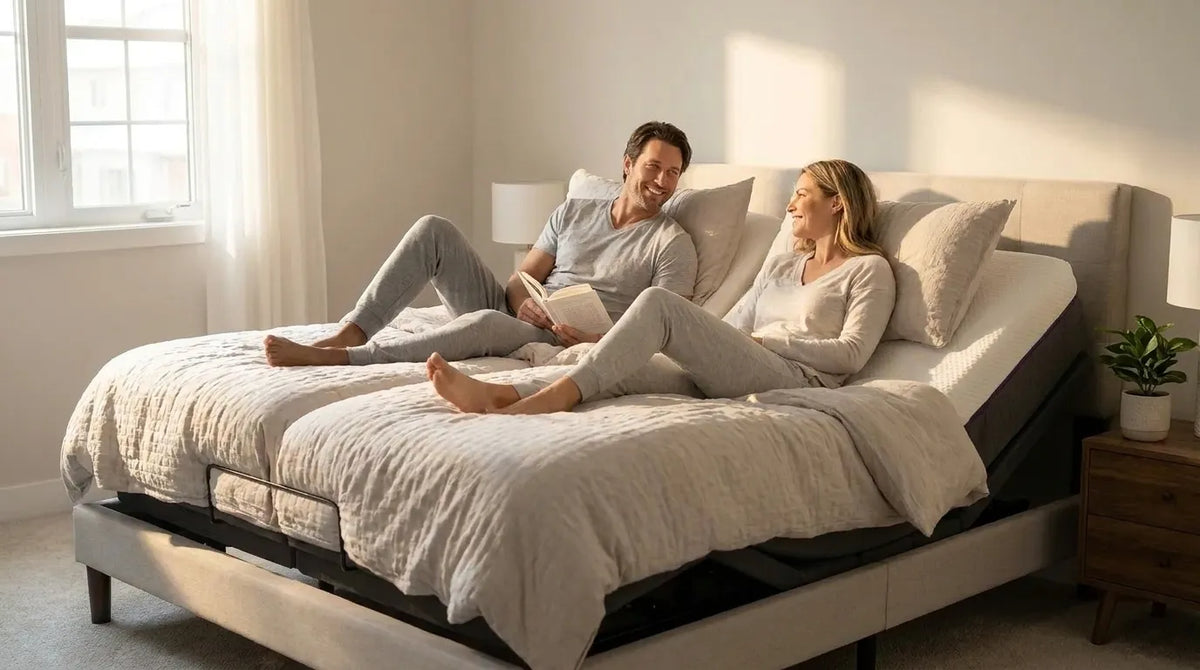
- Independent split articulation allows each side to move on its own, because each partner has a different body and sleep position. This removes the compromise a flat mattress forces.
- Lumbar control and pillow tilt provide micro-geometry that goes beyond simple head-up or foot-up settings. This supports the lumbar curve and angles the pillow separately.
- Zero-gravity and anti-snore positioning treat position as a health input. Elevating the head gently opens the airway, and zero-gravity distributes weight to relieve pressure and support circulation.
- Whisper-quiet German motors let you adjust position without sacrificing the sleep you are trying to protect.
- Mattresses engineered to bend are built to flex with the base, night after night, instead of resisting articulation.
- Bedding designed for movement includes extra-elastic fitted sheets, duvet clips, and remote pockets that work with an adjustable system.
- Per-side heating and cooling extend personalization beyond position into temperature for each partner.
- In-house white-glove delivery ensures the system is installed and working correctly in your bedroom.
Leva Sleep offers the largest selection of Split Queen adjustable beds in North America, with five distinct packages from $1,399, mattresses manufactured in-house in 30" × 80", and a full line of bedding and accessories built to fit them. The typical retailer offers none of these options. For couples whose bedroom cannot accommodate a King, at 76 inches wide versus a Queen's 60 inches, the Split Queen collection makes independent adjustability possible without sacrificing room space.

For a complete guide to selecting the right adjustable base for back pain, see How to Choose an Adjustable Base for Back Pain Relief and Adjustable Bed for Back Pain: The Complete Guide (2026).
When Is Back Pain at Night a Red Flag?
Not all night pain is mechanical. Before assuming your bed is the cause, it helps to know which patterns warrant a doctor's attention. Gale.care's clinical guidance (updated July 2026) defines “true night pain” as pain that is present at rest, unrelated to any specific movement, and does not ease with repositioning. It often wakes a person from sleep rather than simply being noticed while trying to fall asleep. Clinicians focus less on whether pain occurs at night and more on whether changing position changes it at all.
Red-flag patterns that warrant prompt clinical evaluation include:
- Pain that is unrelenting and progressive rather than coming and going
- Unintentional weight loss
- Fever or night sweats
- Personal history of cancer with a new back pain episode
- Pain that does not respond even partially to rest or position change
- Numbness, tingling, or weakness in both legs, or difficulty controlling the bladder or bowel, which can signal cauda equina syndrome, a spinal emergency requiring same-day care
The American Academy of Family Physicians' Choosing Wisely recommendation (2021) advises against imaging for low back pain within the first six weeks unless red flags are present. Night pain without other red flags does not automatically warrant imaging.
Gale.care notes that most nighttime musculoskeletal discomfort is not a red flag. It typically responds at least partially to a position change, a different pillow arrangement, or briefly getting up and moving. Do not self-diagnose; consult a clinician if any red-flag symptoms are present.
Surface and Setup Fixes Compared by What They Change
The table below compares four common fixes by what they change, who they help, and who they leave unresolved. This view shows why a pillow or topper often fails to solve a geometry problem.
| Fix | What It Changes | Who It Helps | Who It Doesn't |
|---|---|---|---|
| Pillow under knees (back sleeping) or between knees (side sleeping) | Sleep position and support for the lumbar curve or pelvic alignment | Side and back sleepers with mild morning stiffness, and those with sciatic-type pain (CoxHealth, 2026) | People whose pain does not respond to position change at all, or whose surface is the structural problem |
| Mattress topper | Pressure distribution and surface feel | People sleeping on a mattress that is too firm for their body type | Does not change underlying geometry or spinal support and does not address partner differences |
| Medium-firm mattress | Pressure distribution and spinal alignment | Adults with nonspecific low back pain or morning stiffness (Journal of Orthopaedics and Traumatology, 2026) | Does not address partner differences in body type, position needs, or temperature, and does not change the flat-surface geometry |
| Adjustable base | Position, spinal geometry, and pressure relief for each side independently | Couples with different needs, people who need elevation for medical reasons, and those who wake with pain that responds to position change | Does not replace a clinician's diagnosis, does not resolve acute unresolved pain, and is not appropriate for those with spinal fusion or osteoporosis without medical clearance |
Explore adjustable systems designed for pain relief
Who Should Not Buy an Adjustable Base
An adjustable base works as a management tool for many people, yet it does not treat every type of problem. Clear guidance on who should avoid one matters as much as explaining who benefits.
- Those with acute, unresolved pain. If a specific joint or muscle is genuinely locked up or inflamed, no pillow arrangement or base position fully resolves it. A clinician's diagnosis comes first. The Spine Studio states that adjusting sleep position helps the average case of morning stiffness but serves as a management tool rather than a treatment for an actual restriction.
- Those with spinal fusion or osteoporosis. Individuals with spinal fusion or osteoporosis face specific mechanical risks. Adjustable beds can worsen or cause other issues for them without medical clearance.
- Those with heart or respiratory conditions. Anyone with heart or respiratory issues should consult a doctor before using an adjustable bed, because certain angles may affect breathing or circulation.
- Those whose budget or room cannot accommodate the system. A Split Queen needs 60 inches of wall width and a Split King needs 76 inches, and complete packages start at $1,299. If your room or budget cannot meet those requirements, a different fix from the table above will be a better fit.
Frequently Asked Questions
What Is the Best Sleeping Position for Lower Back Pain?
Back sleeping with a pillow under the knees and side sleeping with a pillow between the knees are the two positions most consistently supported by clinical guidance for lower back pain. Both maintain a more neutral spinal alignment than stomach sleeping, which flattens the lumbar curve and forces the neck to rotate. A firmer pillow between the knees holds its shape better through the night, keeping the hips level and reducing rotational stress on the lower back. Stomach sleeping is generally not recommended for people with existing back pain.
Why Does My Back Hurt More at Night Than During the Day?
Two mechanisms usually drive this pattern. A flat sleep surface concentrates body weight on the hip, shoulder, and knee while leaving the lumbar curve unsupported, which creates a structural problem that compounds over eight hours in a way that daytime sitting or standing does not. Pain perception also increases with poor sleep and heightened attention at night, when there are fewer distractions. Inflammatory stiffness builds up overnight and often eases with movement in the first 30 to 60 minutes of the day. That pattern differs from true night pain that wakes a person mid-sleep and does not respond to position change at all.
Is a Medium-Firm Mattress Better Than a Firm Mattress for Back Pain?
The evidence consistently favors medium-firm over very firm for adults with nonspecific low back pain. As noted earlier, the 2026 systematic review found medium-firm support outperformed very firm surfaces for pressure distribution, sleep quality, morning stiffness, and pain intensity. Very firm surfaces increase focal pressure over the scapular, pelvic, and sacral regions. As the evidence above shows, very firm mattresses are not universally better. Mattress selection should also account for body type, preferred sleep position, and age.
Can an Adjustable Bed Help with Back Pain?
For people whose back pain responds at least partially to position change, an adjustable base addresses the geometry problem that a flat mattress cannot. Clinicians commonly recommend sleeping with the head or legs elevated for conditions including lower back pain, acid reflux, and sleep apnea. An adjustable base is how that position is achieved at home, night after night, without stacking pillows. Karena Wu, P.T., D.P.T., an orthopedic physical therapist, recommends a 120-degree angle between the thighs and torso, known as the zero-gravity position, for people with lower back pain. As noted above, those with spinal fusion or osteoporosis should consult a doctor first.
What Are the Red Flags for Back Pain at Night?
Red-flag patterns that warrant prompt clinical evaluation include pain that is unrelenting and progressive rather than coming and going, unintentional weight loss, fever or night sweats, a personal history of cancer with a new back pain episode, and pain that does not respond even partially to rest or position change. Numbness or tingling around the groin or saddle area, new difficulty controlling the bladder or bowel, or weakness in both legs are urgent symptoms requiring emergency evaluation. Most nighttime back discomfort is mechanical and responds at least partially to a position change, yet pain that remains constant regardless of position should be evaluated by a clinician.
Shop Leva Sleep adjustable beds
Conclusion: Matching the Solution to Your Body and Your Bed
Sleep quality and back pain share a bidirectional relationship. Sleep loss lowers pain threshold and increases inflammation, and pain fragments sleep and slows recovery. For people sleeping on a flat surface, that cycle often persists because of a geometry problem: one spinal geometry imposed on two different bodies for eight hours, with no ability to adjust. That mechanical mismatch explains why the back often hurts in bed but not on the couch.
The fixes, from simplest to most comprehensive:
- A pillow under or between the knees changes position at no cost and helps most side and back sleepers with mild morning stiffness.
- A mattress topper changes surface feel and may help those on an overly firm mattress, yet it does not change the underlying geometry.
- A medium-firm mattress changes pressure distribution and spinal alignment and remains the most defensible general recommendation for adults with nonspecific low back pain.
- An adjustable base changes position, spinal geometry, and pressure relief independently for each partner and directly addresses the flat-surface geometry problem.
Leva Sleep is a specialist adjustable bed company offering complete, personalized sleep systems for couples. Complete packages run from $1,299 to $8,999+, with financing available, including 0% APR options. The 180-night comfort guarantee provides a full six months to see whether the system is right, because adapting to a new sleep surface and position takes weeks, not days. The La Jolla, California showroom lets you experience the full system in person with specialists who fit the configuration to both partners. For couples in rooms that cannot accommodate a King, the Split Queen collection delivers full independent adjustability in a 60-inch footprint. For those whose primary concern is pain relief, the beds for pain relief collection is the starting point. For couples dealing with snoring that disrupts both partners, the snoring relief collection addresses the airway geometry problem with the same independent articulation.
Discover your Leva Sleep adjustable system