How Sleep Quality and Sleep Apnea Affect Couples
Written by: Matthew Timmins, Founder and Managing Director, Leva Sleep
Key Takeaways for Couples Sharing a Bed
- Untreated obstructive sleep apnea progressively worsens sleep architecture, reducing deep sleep and increasing cardiovascular and cognitive risks over time.
- A flat mattress exacerbates airway collapse by forcing both partners into the same supine position without independent adjustment options.
- Head-of-bed elevation via adjustable bases offers a non-CPAP solution that reduces airway collapsibility for many mild-to-moderate positional OSA cases.
- Independent split configurations allow couples to maintain separate sleep angles, reducing fragmented sleep and lowering the risk of “sleep divorce.”
- Leva Sleep provides Split Queen and Split King adjustable beds with independent head elevation, offering couples a practical, furniture-quality solution for managing sleep apnea together; explore Leva Sleep's snoring-relief collection to find the right setup for your bedroom.
How a Flat Mattress Worsens Airway Collapse
A flat mattress locks two different bodies into one horizontal geometry all night. In the supine position, gravity causes posterior displacement of the tongue and soft palate against the pharyngeal wall, increasing upper airway collapsibility and reducing functional residual capacity. The flat surface offers no structural way to counter this effect.
Beyond the airway, a flat plane concentrates body weight on the points that protrude furthest, such as hips, shoulders, and heels. The lumbar curve remains unsupported and the pelvis rotates. One partner may need a softer surface to relieve hip pressure. The other may need firmer support to stabilize the lower back. A single flat mattress forces a compromise that fails both partners.
This mismatch drives frequent repositioning and fragmented sleep. For the partner with OSA, it also encourages repeated return to the supine position that most promotes airway collapse.
Between 50% and 60% of OSA patients have worse apnea when sleeping supine, and some experience apnea only in that position. A surface that cannot be adjusted offers no structural answer to that geometry problem.
Comparing CPAP, Positional Therapy, Weight Loss, and Oral Appliances
| Option | Mechanism | Partner Impact | Nightly Usability |
|---|---|---|---|
| CPAP | Continuous positive airway pressure delivered via mask, effective across all OSA severities | Mask, tubing, and machine noise present in shared bed, with roughly half of patients stopping CPAP within the first year | High efficacy when tolerated, with adherence as the primary barrier |
| Oral appliance (mandibular advancement device) | Repositions jaw to maintain airway patency, recommended by AASM and AADSM for mild-to-moderate OSA or CPAP intolerance | Worn by one partner only, with no equipment in the shared space | Broadly comparable outcomes to CPAP for many mild-to-moderate OSA cases due to higher consistent use, but requires dental fitting and follow-up |
| Positional therapy | Prevents supine sleep through devices or surface adjustment, substantially reducing AHI in positional OSA when supine collapse is the main driver | Adjustable base approach requires no wearable device and benefits both partners through independent positioning | Most effective in mild-to-moderate positional OSA, with limited benefit in non-positional or severe cases |
| Weight loss | Reduces soft tissue mass around the airway, creating meaningful AHI improvement in many overweight patients | No equipment required, with health benefits that extend beyond sleep | Slow to achieve and rarely sufficient as a sole intervention, as it does not eliminate OSA in most cases (see below) |
Best Sleep Position for Sleep Apnea Without CPAP
Head elevation combined with non-supine sleep offers a practical approach for many people with positional OSA. An adjustable base allows this position at home, every night, without unstable stacks of pillows that shift during sleep.
The biomechanical rationale is direct. Mayo Clinic lists side sleeping and raising the head of the bed among the first-line lifestyle steps for snoring, noting that back sleeping allows gravity to pull the tongue and soft palate toward the rear wall of the throat, narrowing the airway. Gentle head-of-bed elevation via whole-bed frame adjustment reduces this gravitational effect and can aid sinus drainage when combined with side sleeping.
Evidence for positional approaches is substantial in appropriately selected patients. A 2017 systematic review and meta-analysis by Ravesloot et al. in the Journal of Clinical Sleep Medicine found that body position influences apnea frequency in 56% to 75% of OSA patients, with newer positional-therapy devices producing a pooled 54% reduction in AHI and an 84% reduction in supine sleep time in short-term studies of position-dependent OSA.
Head elevation improves airway collapsibility through biomechanical mechanisms that are distinct from lateral positioning and do not rely on wearable devices. For couples sharing a bed, an adjustable base with independent head-elevation control on each side, such as those in the Leva Sleep snoring-relief collection, delivers this positioning without requiring either partner to accept the other’s angle.
How Much Weight Loss Can Change Sleep Apnea
Weight loss often reduces OSA severity, especially in patients who are overweight or obese. This improvement occurs because less soft tissue surrounds the upper airway. Clinical studies, including bariatric surgery outcomes, show meaningful AHI reductions after significant weight loss.
Weight loss alone, however, does not eliminate OSA in most patients. Anatomical factors such as craniofacial structure, tongue size, and airway muscle tone contribute to OSA regardless of body weight. OSA prevalence is 39.1% in men and 26.0% in women among U.S. adults, and the condition appears across a wide range of body types.
Patients who achieve significant weight loss frequently experience improvement rather than full resolution. OSA can also return with modest weight regain. Weight management works best as one component of a broader treatment strategy, not as a standalone cure.
This reality raises a key question for people with milder disease. If lifestyle changes alone rarely resolve OSA, even when successful, mild sleep apnea still requires thoughtful treatment planning.
Why Mild Sleep Apnea Still Needs Attention
Mild OSA, defined as an AHI of 5 to 14.9 events per hour, still carries meaningful risk. The 2026 longitudinal study tracking untreated adults found that OSA severity worsened significantly over a mean 3.8-year follow-up, with AHI increasing. Deep sleep declined over time. Mild OSA left untreated tends to progress.
Risks extend beyond sleep architecture. A 2021 systematic review of 1,249,975 patients found OSA associated with a 34% increase in all-cause dementia risk and a 28% increase in Alzheimer disease risk. Intermittent nocturnal hypoxia and disrupted slow-wave sleep are among the proposed mechanisms.
Cardiovascular risk, hypertension, and mood disorders also correlate with untreated OSA across severity levels. For mild cases, positional therapy is supported as a practical non-mask intervention for appropriately selected mild-to-moderate OSA cases, with the strongest evidence in patients whose AHI normalizes in non-supine positions. A physician evaluation remains the appropriate starting point for any OSA diagnosis.
How Head Elevation Improves Sleep Apnea Sleep Quality
Head elevation addresses OSA through a direct mechanical pathway. As discussed earlier, head elevation reduces the gravitational load on airway structures. The clinical evidence supporting this approach is substantial.
A 2026 multicentre randomized controlled trial published in Thorax (Kelly et al., NCT04153240) found that active positional therapy lowered AHI by 4.4 events per hour versus sham, a 34% relative improvement. Participants also reported better sleep quality, and partners reported less snoring over three months.
An adjustable base achieves this elevation precisely and repeatably. Stacked pillows shift position during the night and concentrate pressure on the cervical spine. In contrast, a motorized head section raises the entire upper torso at a consistent angle.
For couples, a Split Queen adjustable bed allows each partner to set an independent head angle. One partner can sleep elevated for airway support while the other remains flat. Leva Sleep offers five Split Queen packages from $1,399, with 30" × 80" mattresses manufactured in-house and a full line of Split Queen bedding engineered to hold position at elevation.

Frequently Asked Questions About Adjustable Bases and OSA
Choosing Split Queen for Couples Without King-Size Space
A Split King occupies approximately 76 inches of width, while a Split Queen occupies 60 inches. That 16-inch difference often determines whether the configuration fits the room. A Split Queen delivers two fully independent sides, each with its own head elevation, foot elevation, and positioning controls, in the same footprint as a standard Queen mattress.
Most retailers do not offer a true Split Queen because it requires purpose-built 30" × 80" mattresses that standard supply chains do not provide. Leva Sleep manufactures these mattresses in-house in two constructions and two firmness levels. This approach makes independent positioning available to couples whose bedrooms cannot accommodate a King.
Why Positional Therapy Is More Than a Different Pillow
A pillow changes the angle of the head and neck relative to the torso but does not raise the entire upper body. Positional therapy, especially head-of-bed elevation via an adjustable base, lifts the head and torso together. This change reduces the gravitational load on the soft palate and tongue along the full length of the airway.
Stacked pillows also shift during the night and concentrate pressure on the cervical spine. An adjustable base maintains a consistent, repeatable angle without requiring the sleeper to reposition. For couples, independent head-section control allows one partner to sleep elevated while the other remains flat, with no mechanical connection between the two sides.
When to See a Physician Instead of Relying on Positional Therapy
Positional therapy has strong clinical support for mild-to-moderate positional OSA, where the apnea-hypopnea index normalizes or substantially improves in non-supine positions. It offers limited benefit in non-positional OSA and does not serve as an appropriate primary intervention for moderate-to-severe cases involving significant oxygen desaturation or high event frequency.
Anyone who suspects sleep apnea based on partner-reported gasping, choking, or breathing pauses should seek a formal sleep study. Persistent daytime sleepiness, morning headaches, or cognitive difficulty also warrant evaluation. A home test kit can diagnose OSA in a single night.
Positional therapy and adjustable sleep systems work best as adjuncts to, or in consultation with, a physician’s treatment plan. They should not replace medical evaluation.
Benefits for Both Partners When Only One Has Sleep Apnea
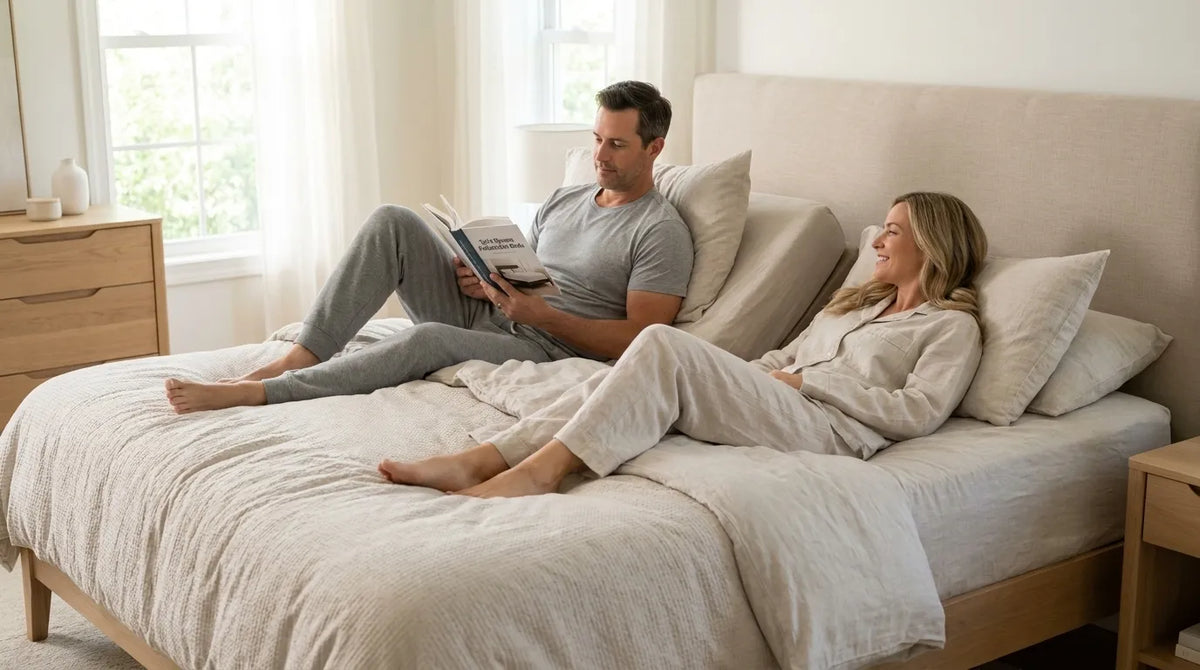
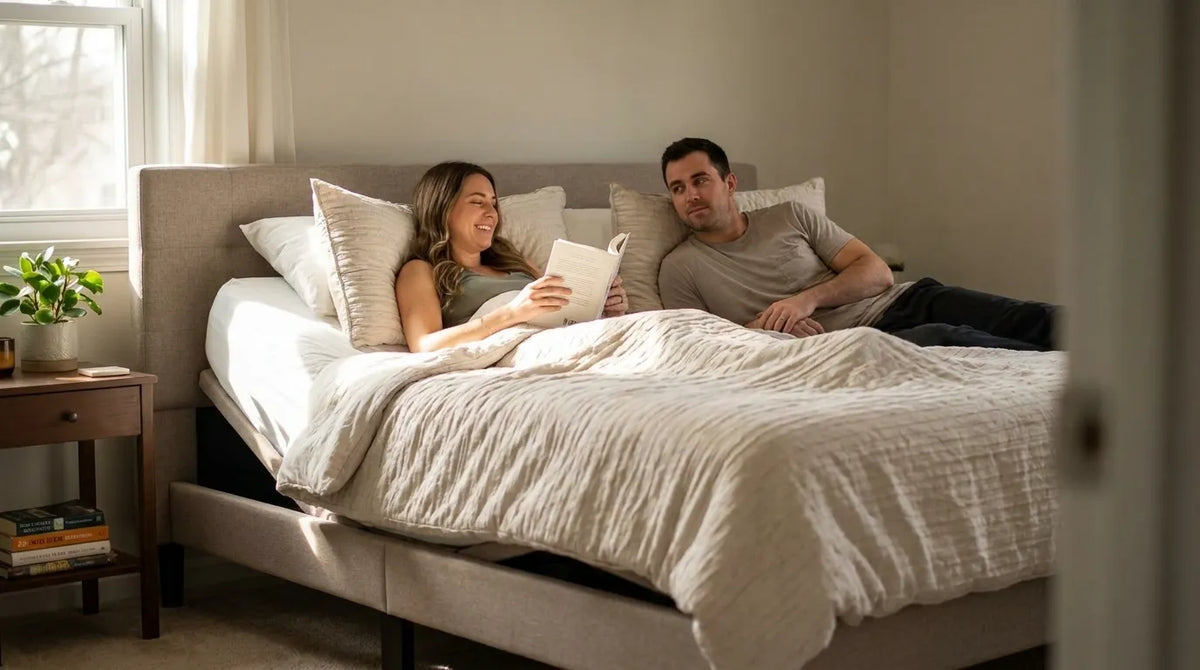
Independent split configurations allow each partner’s side to operate separately. The partner managing OSA or snoring can use head elevation and anti-snore positioning. The other partner can remain flat, choose zero-gravity positioning for pressure relief, or set a different elevation for reading or reflux management.
Leva Sleep’s adjustable bases use whisper-quiet German motors, so position changes on one side do not disturb the other. The result is a shared bed in which neither partner must accept the other’s geometry, which is the core problem a flat mattress cannot solve.
Conclusion: Solving the Geometry Problem for Couples
A flat mattress imposes one geometry on two different bodies. For the partner with OSA or positional snoring, that geometry often means supine sleep, which most promotes airway collapse. For the partner absorbing the disruption, it means a surface with no independent adjustment.
This constraint drives fragmented sleep, progressive OSA severity, and, for 31% of American couples, separate bedrooms. Adjustable sleep systems address the constraint at its source. Head elevation reduces the gravitational load on the airway. Independent per-side control removes the compromise.
Split Queen configurations deliver both benefits in a 60-inch footprint that fits rooms a King cannot. For moderate-to-severe OSA, a physician’s evaluation and CPAP or oral appliance therapy remain the appropriate clinical path. For many mild-to-moderate positional cases, and for the partner whose sleep is disrupted by the other’s condition, an adjustable base offers a practical, furniture-quality intervention that keeps couples in the same bed.
When evaluating adjustable sleep systems, consider room dimensions, each partner’s positioning needs, mattress compatibility with articulation, and whether the configuration, such as Split Queen, Split King, or split-head, fits the bedroom. For couples managing pain alongside airway concerns, the Leva Sleep pain-relief collection offers configurations that address both.
Leva Sleep has served more than 25,000 customers over nine years with complete adjustable sleep systems, including bases, mattresses built to flex, and bedding engineered for movement. These systems are backed by a 180-night comfort guarantee and in-house white-glove delivery. Transform your sleep with Leva Sleep by visiting the La Jolla showroom or shopping online today.