
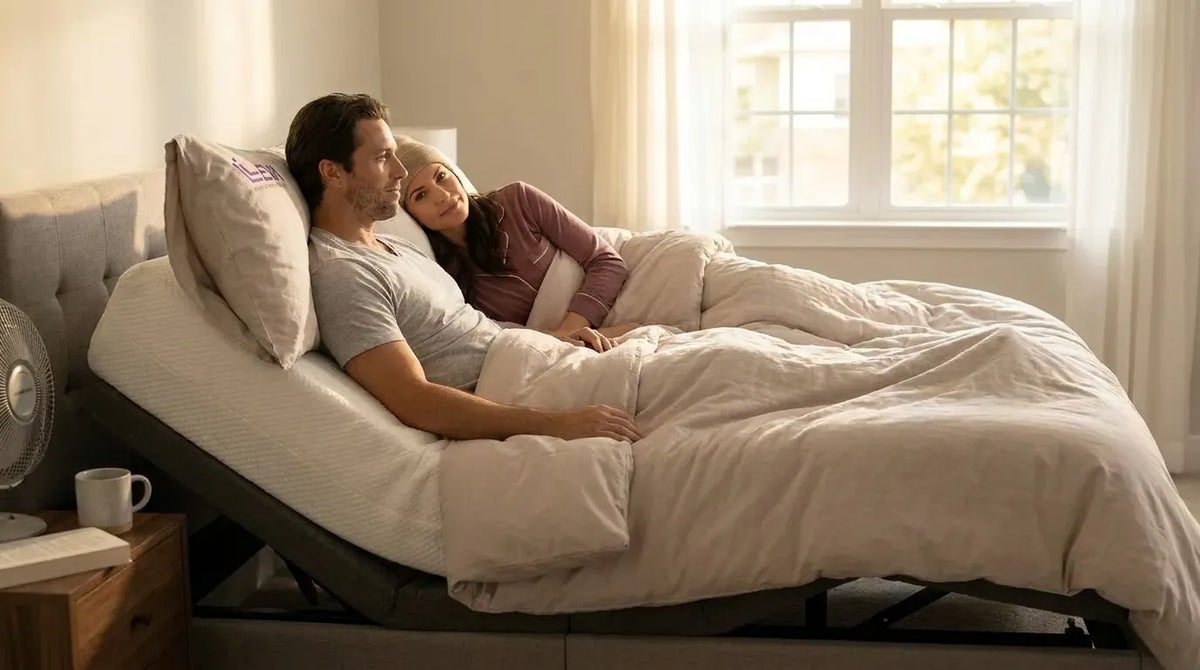
Sleep Problems From Different Temperature Preferences
Written by: Matthew Timmins, Founder and Managing Director, Leva Sleep
Updated September 26, 2026
Key Takeaways
- Many couples lose sleep because one partner runs hot while the other runs cold, turning the thermostat into a nightly negotiation.
- Physiological factors such as metabolic rate, body composition, hormones, age, and medications create genuine temperature mismatches that go beyond simple preference.
- The recommended bedroom temperature range is 60–67°F, yet a single room temperature rarely satisfies both partners when their bodies shed heat differently.
- Free or low-cost fixes like separate blankets, breathable bedding, and targeted airflow can help, but per-side temperature control built into the bed removes the compromise.
- Leva Sleep offers The Leva Sleep System with independent heating and cooling on each side of the bed so couples can share a bed without sharing a temperature.
Shop Leva Sleep Adjustable Beds Today
Why Couples Often Sleep At Different Temperatures
Temperature mismatch between partners comes from physiology rather than one person being fussy. Several biological factors shape how much heat a body generates and sheds during sleep:
- Metabolic rate: People with higher metabolic rates generate more body heat and often need a cooler environment to release it comfortably.
- Body composition: Muscle mass runs warmer than fat tissue, so a more muscular partner usually radiates more heat through the night.
- Hormonal shifts: Perimenopause, menopause, menstruation, and pregnancy can increase heat sensitivity or trigger night sweats, so temperature comfort can change over time.
- Age: Older adults may prefer slightly warmer rooms because the body becomes less efficient at regulating heat over time, which often widens the gap between partners as they age.
- Medications: Common medications can shift thermoregulation and change a person’s comfort zone without any obvious external trigger.
Both partners are dealing with a real physiological mismatch. Treating it as an engineering problem rather than a preference dispute makes it solvable.
What Temperature Supports Better Sleep?
The National Sleep Foundation recommends a bedroom temperature of 60–67°F to help promote sleep, though some guidance cites 65–68°F as optimal for most adults. The mechanism is straightforward. As bedtime approaches, core body temperature naturally drops by 1–2°F, and a cooler room supports that drop. A warm room fights that decline, which delays sleep onset and fragments the sleep that follows.
A bedroom that is too warm degrades sleep quality in four measurable ways: it makes people take longer to fall asleep, wake up more often during the night, get less REM and slow-wave sleep, and feel less rested in the morning. A room that is too cold triggers shivering and muscle tension that keep the nervous system alert, fragmenting sleep just as disruptively.
For couples, the best sleep temperature is often at the cooler end of the 60–67°F range, since two bodies generate more heat in the same bed. A single room temperature cannot serve two people whose bodies shed heat at different rates. That is the core problem a thermostat alone cannot solve. The solutions below are ranked by how completely they address that problem, from free tweaks to a system-level fix.
How To Sleep Together When One Partner Is Hot And The Other Is Cold
The right option depends on where the mismatch actually lives. If one partner simply needs less insulation, bedding changes may be enough. If the room air or sleep surface feels wrong, you will need a solution that changes those conditions for each side.
- Compromise on the thermostat and layer bedding asymmetrically. The person who runs cold sleeps with a heavy duvet or extra quilt. The partner who runs hot uses a light top sheet. This costs nothing and is worth trying first. It still requires ongoing compromise and leaves the room air unchanged.
- Use separate blankets or a dual-zone duvet. The Scandinavian sleep method, which uses individual comforters on a shared bed, eliminates blanket-stealing and allows different warmth levels without thermostat arguments.
- Choose breathable, moisture-wicking bedding and sleepwear. Breathable cellulosic fabrics such as cotton and linen are highly absorbent and allow moisture to evaporate, which helps prevent heat and humidity from trapping against the skin. Their cooling benefit depends on weave, weight, and fit, and cotton can become saturated and cling when wet.
- Add targeted airflow with a fan or personal cooling device. A personal desk fan directed at the hot sleeper’s side of the bed, or a wearable cooling device, can lower perceived temperature on one side without changing the room for both partners.
- Use per-side heating and cooling integrated into the bed. This approach creates two independent microclimates in one bed. Each person controls their side all night, so neither partner has to compromise.
The table below compares each option on cost, intrusiveness, partner compromise, and whether it solves the mismatch at the system level.
| Solution | Cost | Intrusiveness | Partner Compromise Required? | Solves At System Level? |
|---|---|---|---|---|
| Thermostat compromise + layered bedding | $0 | Low | Yes | No |
| Separate blankets / dual-zone duvet | $0–$1,100 | Low | No | No |
| Breathable bedding and sleepwear | $20–$700+ | Low | No | No |
| Targeted airflow (fan, cooling device) | $30–$180 | Medium | No | No |
| Per-side temperature control (integrated) | $1,299+ | Low | No | Yes |
Shop Adjustable Beds With Independent Climate Control
How Well Do Separate Blankets Work?
Separate blankets solve the insulation problem at no cost, which makes them a common first step. They work well when the mismatch is mostly about how much covering each partner wants. They fall short when one partner needs active cooling or when both sides of the bed still share one ambient temperature. Knowing this limitation helps you decide when to move beyond bedding fixes.
How Per-Side Temperature Control Works
Per-side temperature control lets each partner set an independent temperature on their own side of the bed. One person can sleep warm while the other sleeps cool in the same bed at the same time. Dual-zone bedding changes what you lie under, while per-side temperature control changes the temperature of the sleep surface itself for each person all night.
Leva Sleep is a specialist adjustable bed company offering The Leva Sleep System, which integrates per-side heating and cooling into a complete adjustable sleep system. Temperature control works alongside independent articulation, lumbar control, and anti-snore positioning rather than as a separate pad on top of an existing mattress. Leva Sleep has operated for nine years, served more than 25,000 customers, and backs purchases with the comfort guarantee described below. Couples can experience the full system at its luxury showroom in La Jolla, California.
For couples who need independent sides in a Queen footprint, Leva Sleep offers one of the largest selections of Split Queen adjustable beds in North America. These include five distinct packages with two fully independent bases, head and foot articulation on each side, and 30" × 80" mattresses manufactured in-house. For couples with more room, the Split King configuration provides the same independent-sides approach in a King footprint.

Compare Per-Side Temperature Control Options
How Common Are Temperature-Related Sleep Problems?
In a June 2025 survey of 2,007 US adults conducted by Atomik Research for the American Academy of Sleep Medicine, 31% of American adults said they had opted for a “sleep divorce,” meaning they regularly sleep in a separate room or bed from a partner. Among adults aged 35–44, the figure rises to 39%. A further 37% reported going to sleep at different times to accommodate a partner. Temperature preferences, along with snoring and mismatched schedules, are among the recurring reasons couples give for separate sleep arrangements.
Roughly one in three American couples has already given up on sharing a bed comfortably. The problem is common and reflects a physiological mismatch that modern sleep systems can address.
When Separate Rooms Make Sense
For some couples, separate sleeping arrangements are a legitimate and sometimes necessary choice, especially when a medical condition or work schedule makes shared sleep impractical. Dr. Seema Khosla of the AASM notes that healthy sleep is essential for healthy relationships, no matter how it is achieved. The goal is deliberate decision-making rather than defaulting to separate rooms because a solvable temperature mismatch never received a proper solution.
Frequently Asked Questions About Temperature And Sleep
Can You Get Sick From Sleeping In A Hot Room?
Discomfort and poor sleep are the realistic consequences of a warm bedroom. A warm room delays sleep onset and fragments sleep by preventing the core body temperature drop the body needs to initiate and maintain sleep. It does not cause illness directly, yet chronic sleep disruption has well-documented downstream effects on energy, mood, and cognitive performance.
What Is The Best Temperature For Sleep For Couples?
As noted above, the recommended range is 60–67°F, and couples often need the cooler end of it. Within that range, the right temperature for any individual depends on age, hormonal status, body composition, and metabolic rate, which explains why a single thermostat setting rarely satisfies both partners.
Do Cooling Mattress Pads Work For Two People?
Water-based and air-based cooling pads can provide dual-zone control, and some users report meaningful improvements in sleep comfort. They add a layer on top of the mattress rather than integrating temperature control into the sleep surface itself, and most require regular maintenance such as refilling water reservoirs, cleaning, and managing bedside hardware. When evaluating a cooling pad, consider whether the system actively heats and cools independently on each side, how much noise the unit produces, and whether the added layer changes the feel of the mattress in ways that affect comfort.
How Do You Sleep In Hot Weather Without AC?
Open windows for air circulation while keeping curtains and blinds shut to block warming sunlight. Use a lower tog duvet or cotton sheet with light cotton nightwear to wick away sweat. Cooling the feet, which helps bring down overall body temperature, is one of the more effective low-cost interventions recommended by the British Red Cross. Breathable natural-fiber bedding such as wool, cotton, and linen can reduce the heat and humidity that trap against the skin overnight by regulating the microclimate temperature and relative humidity between skin and bedding, though the degree of benefit depends on the specific fiber and ambient conditions.
Is Per-Side Temperature Control The Same As Dual-Zone Bedding?
As explained earlier, dual-zone bedding changes what you lie under, while per-side control changes the sleep surface itself. The distinction matters when the mismatch between partners involves ambient air or surface temperature rather than just the weight of the covering.
Explore Beds With Per-Side Temperature Control
Conclusion: Create Two Microclimates Instead Of Fighting One Thermostat
Different temperature preferences between partners reflect a physiological mismatch rather than a relationship problem. Sleep onset depends on a decline in core body temperature. Two people in the same bed rarely need the same conditions to achieve that decline, so a single thermostat setting often forces one partner to sacrifice their sleep.
Free fixes such as separate blankets, breathable bedding, and targeted airflow are practical starting points and may be enough when the mismatch is modest. When those options fall short, per-side temperature control integrated into the sleep system becomes the only approach that removes the compromise and gives each partner an independent microclimate in the same bed.
Leva Sleep’s The Leva Sleep System delivers per-side heating and cooling as part of a complete adjustable sleep system. Temperature control works as a matched component alongside independent articulation, lumbar support, and anti-snore positioning. Couples can explore the full system at the La Jolla showroom or compare options at levasleepusa.com, backed by the comfort guarantee described above.
Book A La Jolla Showroom Visit Or Shop Online


