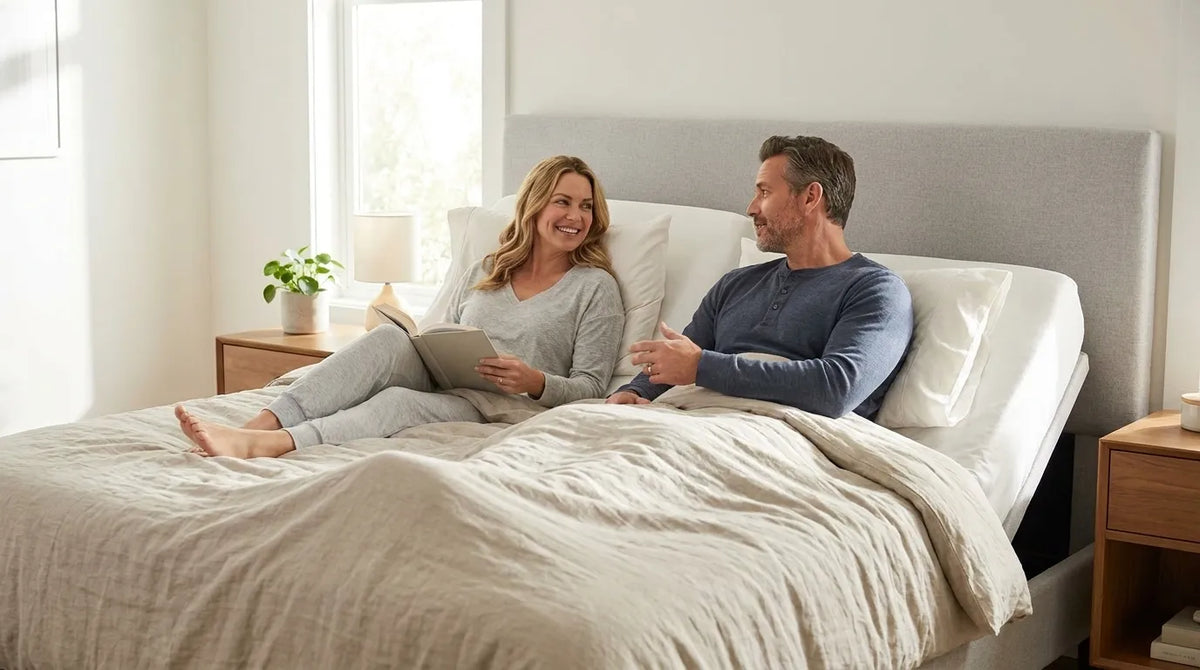
Pressure Relief Mattress for Elevated Sleeping: Buying Guide
Written by: Matthew Timmins, Founder and Managing Director, Leva Sleep
Key Takeaways
- A pressure relief mattress for elevated sleeping must flex with an adjustable base so weight redistributes at the head, hips, shoulders, and heels as the bed moves.
- Head-of-bed elevation is a proven intervention for sleep apnea, acid reflux, and snoring, with studies showing measurable improvements at angles between 7.5 and 30 degrees.
- Most standard mattresses resist bending, wear unevenly, and create new pressure points on an adjustable base, which makes construction and zoning critical.
- Deep-pocket sheets with all-around elastic and split-compatible sizing are required to stay in place when the bed articulates.
- Leva Sleep builds complete adjustable sleep systems with mattresses engineered to flex, split configurations, and bedding designed for elevation.
How Pressure Relief Mattresses Perform When You Sleep Elevated
Clinical evidence consistently supports head-of-bed elevation as a meaningful intervention for several common conditions. The mechanism is positional; the angle matters as much as the material.
- A 2017 study found that tilting the bed by 7.5 degrees reduced obstructive sleep apnea severity by about 31.8% and improved minimum oxygen levels during sleep, with researchers describing it as “a simple measure that significantly improves OSA severity without compromising sleep architecture.”
- A randomized clinical trial found that elevating the head of the bed by 20 cm (roughly 8 inches) for six weeks significantly improved acid reflux symptoms, consistent with NIDDK estimates that about 20% of people in the United States have GERD.
- A 2026 study in The Laryngoscope measured 30-degree head-of-bed elevation in apnea patients and found the apnea-hypopnea index fell from 22.6 to 16.4 events per hour, with side sleeping reducing it further to 11.7.
- Clinicians commonly recommend sleeping with the head elevated for conditions including sleep apnea, acid reflux, and post-surgical recovery. An adjustable base achieves that position at home, night after night, without stacking pillows.
- A mattress that resists bending creates new pressure points at elevation. A rigid mattress may not flex properly on an adjustable base, concentrating pressure around the hips, shoulders, or lower back. The way the mattress moves matters as much as what it is made from.
CDC NCHS Data Brief No. 559 (April 2026) found that only 54.8% of U.S. adults woke up feeling well-rested most days or every day in 2024, and a 2025 survey conducted for the American Academy of Sleep Medicine found that 31% of US adults have opted for a “sleep divorce” — regularly sleeping in a separate room from a partner. Among adults aged 35–44, the center of the elevated-sleeping buyer demographic, the figure for having opted for a “sleep divorce” rises to 39%. Position functions as a health input, not just a comfort preference, which raises the next question: can the mattress you already own deliver that position?
Find A Bed Built For Pain Relief
Can You Use A Regular Mattress On An Adjustable Base?
Sometimes you can, but most mattresses are not built to bend. A conventional mattress placed on an articulating base resists the movement, wears unevenly at the flex points, and shortens its own lifespan doing it. As the base articulates, the mattress must flex accordingly to maintain structural integrity, which a standard mattress was never designed to deliver.
The Sleep Foundation notes that adjustable bases do not work with all mattresses, so buyers may have to purchase both a base and a compatible mattress. That pairing reflects an engineering requirement. Leva Sleep builds mattresses designed to flex with the base, night after night, and sells them as a matched system. Browse the Beds For Pain Relief Collection to see how base and mattress are paired.
What Mattress Construction Works Best At Elevation?
Elevation changes the geometry of how body weight is distributed. A mattress that performs well on a flat surface can concentrate pressure at the hips and heels the moment the head section rises. Construction determines whether a mattress bends with the base or fights it. The table below compares the three construction types you will encounter against how each flexes, how each distributes pressure once the head section rises, and how each works with bedding.
| Mattress Type | Flex / Articulation | Pressure Distribution At Elevation | Bedding Compatibility |
|---|---|---|---|
| All-foam | Flexes easily; may bottom out at hips under heavier loads | Conforms to body contours but can concentrate pressure at elevation without zoned density | Standard deep-pocket sheets may pop corners when the head section rises |
| Hybrid / pocket coil | Flexes with base when coil system is designed for articulation; maintains support through the bend | Zoned coil support maintains spinal alignment when bent, with firmer lumbar and softer shoulders and hips | Requires deep pockets (16 inches or more) and all-around elastic to stay on at elevation |
| Facility pressure-redistribution foam | Rigid; designed for static repositioning in clinical settings, not home articulation | Designed for immobile patients; pressure redistribution is passive and not driven by position changes | Fluid-proof clinical covers; not compatible with home bedding systems |
Zoned support means the mattress is engineered with differentiated firmness zones. The lumbar zone feels firmer to prevent the lower back from sinking. The shoulder and hip zones feel softer to allow pressure relief where the body protrudes. When the base bends, a zoned hybrid maintains that differentiation through the articulation instead of collapsing uniformly.
To evaluate whether a mattress is built to bend, start with the manufacturer’s explicit statement of adjustable-base compatibility. If that statement is missing, assume the mattress is not rated for articulation. From there, check two construction details: edge support that flexes rather than relying on a rigid perimeter, and a coil or foam system designed to articulate without delaminating at the flex point. A quality mattress designed for adjustable-bed use should not be damaged by normal operation.
Leva Sleep manufactures two mattress constructions in 30″ × 80″ for Split Queen configurations: the Heavenly Hybrid (pocket coil) and the Heavenly Response (all-foam). Both are available in multiple firmness levels so each partner can select their own feel. A mattress that flexes is only half the system, though; the bedding has to move with it.

What Sheets Work On An Elevated Or Adjustable Bed?
Standard fitted sheets fail on an adjustable bed for a geometric reason. Every time the head rises, the sheet fabric is pulled toward the center of the bed, which pops corners off the mattress. The real issue lies in pocket depth and elastic design.
Key features to look for in bedding for an adjustable or elevated bed:
- Deep pockets of 16 inches or more. Deep-pocket sheets fit mattresses 13 to 17 inches deep; extra-deep pockets are required for mattresses 18 inches and above.
- All-around elastic instead of corner-only elastic. Elastic all around matters far more for adjustable and articulating frames.
- Split-compatible sizing. A single king fitted sheet cannot move with two mattresses adjusting independently. Split king bedding requires two Twin XL fitted sheets (each 38" × 80"), while split queen bedding uses two 30" × 80" fitted sheets.
- Duvet clips to prevent the comforter from separating when the two sides of a split bed move to different positions.
- Remote pockets sewn into the fitted sheet or base skirt so the controller stays accessible at elevation.
Leva Sleep designs all bedding accessories, including Alpine Pure Cotton and Bamboo Breeze sheet sets, Remy mattress protectors, and duvet bundles, specifically for split and adjustable beds. Extra elastic and deep pockets help them hold at full elevation. The Split Queen Collection includes a complete bedding ecosystem built to fit the 30″ × 80″ configuration.
Hospital Bed Vs. Adjustable Bed For Home Use: Key Differences
The confusion between facility pressure-redistribution mattresses and home adjustable sleep systems is a central gap in current search results. They are built for different problems, different users, and different environments. The table below breaks down the differences that matter most when you are deciding which one belongs in a bedroom.
| Feature | Facility Pressure-Redistribution Mattress | Home Adjustable Sleep System |
|---|---|---|
| Primary purpose | Prevent or heal pressure injuries by redistributing interface pressure for immobile patients | Pressure relief, spinal alignment, and personalized positioning for active home sleepers |
| Cover | Fluid-proof, tear-resistant, clinical appearance | Upholstered, furniture-quality, designed for bedrooms |
| Configuration | Single sleep surface; Group 3 air-fluidized beds require a trained adult caregiver and structural home assessment | Split Queen or Split King with fully independent sides, so each partner controls their own position |
| Bedding | Standard hospital linens; standard hospital bed frame measures 36″ × 80″ | Sheets, protectors, and duvets engineered for articulation and split sizing |
Facility-style mattresses are built for fall prevention, heel protection, and fluid-proof covers. They look clinical in a bedroom and are built for one person. A home adjustable sleep system delivers the elevation a clinician recommended in furniture-quality design, for both partners, in one bed. That solution still will not fit every situation, which makes it important to understand who benefits most.
Who A Pressure Relief Mattress For Elevated Sleeping Helps Most
An adjustable sleep system is the correct solution for a defined set of buyers. Other sleepers may need a different approach.
An adjustable sleep system is right for:
- Couples where one partner needs elevation for sleep apnea, acid reflux, or snoring. Among people aged 30 to 60, about 44% of males and 28% of females snore regularly.
- People who have been told by a clinician to sleep with the head elevated.
- Couples with different firmness preferences who want to stay in the same bed. 37% of US adults go to sleep at different times to accommodate a partner.
- People in smaller bedrooms who cannot fit a King but need split adjustability. A Split Queen occupies 60 inches of width versus 76 inches for a Split King.
An adjustable sleep system is not right for:
- People who need a clinical pressure-redistribution mattress for active pressure injury treatment. That product is a medical device governed by CMS coverage criteria.
- People who cannot accommodate an adjustable base in their bedroom.
- People looking for the lowest-cost flat mattress replacement.
How To Match Features To Your Budget
Complete Leva Sleep adjustable bed packages, with base and mattress together, run from $1,299 to $8,999+. The right tier depends on which features matter most for the specific sleep problem you want to solve.
Entry Tier ($1,299–$1,899): These packages focus on core mechanics. You get independent articulation, whisper-quiet motors, and a mattress engineered to flex. Packages include the Cala, Vela, and Heavenly Response. True Split Queen starts at $1,399.
Core Tier ($2,499–$2,999): These systems add more positional control. Features often include lumbar control, pillow tilt, anti-snore mode, and split configurations. Packages include the Passions Adore, Sereno Signature, and Midnight Bliss.
Premium Tier ($3,799–$4,499): These pair premium mattress brands with advanced base features. Examples include Tempur-Pedic ProAdapt and Stearns & Foster Estate Winslet packages.
Luxury Tier ($5,999–$8,999+): These systems focus on full-environment comfort. California-made brands, per-side heating and cooling via The Leva Sleep System, and full sleep system integration appear in Aireloom and Natural Fusion Reserve Collection packages.
Across tiers, each package pairs a base with a mattress rated for articulation so the system arrives matched rather than assembled from mismatched parts. Leva Sleep also offers the largest selection of Split Queen adjustable beds in North America, with multiple packages and in-house 30″ × 80″ mattress manufacturing to support that format.
Shop Split Queen Adjustable Beds
Frequently Asked Questions
What Is The Best Angle For Elevated Sleeping?
Most clinicians target 7.5 to 20 degrees for reflux and snoring, and 30 to 60 degrees for sleep apnea. The studies cited above found measurable improvement starting at 7.5 degrees for apnea and 20 cm for reflux. The right angle is the one that eases your symptoms without causing neck or hip discomfort. An adjustable base lets you fine-tune and save that angle, which a fixed wedge pillow or bed riser cannot match.
Can I Use My Current Mattress On An Adjustable Base?
As covered above, most conventional mattresses are not built to bend. The practical result is that the base cannot reach its full range of motion and the mattress wears out faster. Leva Sleep builds mattresses designed to flex with the base and sells them as a matched system. If a mattress is not explicitly rated for adjustable-base use by its manufacturer, it is unlikely to perform well at elevation over time.
Do I Need Special Sheets For An Adjustable Bed?
Yes. Standard fitted sheets pop off as the bed articulates because the fabric pulls toward the center when the head section rises. The effective fix is the right sheet from the start. Look for all-around elastic, deep pockets of 16 inches or more, and split-compatible sizing. For a Split Queen, that means two 30″ × 80″ fitted sheets, one per side, so each half can move independently. Leva Sleep designs all bedding accessories specifically for adjustable beds, including sheet sets, mattress protectors, and duvet bundles with clips to prevent separation when the two sides move to different positions.
What Is A Split Queen Adjustable Bed?
A Split Queen uses two 30″ × 80″ mattresses on two independent bases, forming a Queen footprint that measures 60 inches wide. Each side adjusts separately for head, foot, lumbar, and pillow tilt. Each partner controls their own position without affecting the other. The configuration is rare because the 30″ × 80″ mattress size does not exist in the standard supply chain, so a company must commit to manufacturing it. Leva Sleep’s Split Queen lineup, described above, is the largest in North America. A Split Queen occupies 60 inches of width versus 76 inches for a Split King, which makes it a strong option for couples in smaller bedrooms who still want split adjustability.
How Is A Home Adjustable Sleep System Different From A Hospital Bed?
The distinction is fundamental. A facility pressure-redistribution mattress is a medical device governed by CMS coverage criteria, designed for immobile patients at risk of pressure injuries, with fluid-proof clinical covers and a single sleep surface. A home adjustable sleep system is furniture-quality equipment designed for active home sleepers who need positional control for snoring, acid reflux, sleep apnea, or pain while sharing a bed with a partner. The two products solve different problems. A facility mattress in a bedroom looks clinical, is built for one person, and does not articulate for home use. A home adjustable sleep system delivers the elevation a clinician recommended in a design that belongs in a bedroom, with independent per-side control for both partners.
Conclusion
Buying for elevated sleeping comes down to three decisions. You need a mattress rated to flex, zoned support that still works when the bed bends, and bedding sized to stay on through every position change. Once those pieces line up, elevation can address snoring, reflux, and pain without forcing a “sleep divorce.”
Leva Sleep focuses on that complete system. Over nine years and more than 25,000 customers, Leva has built adjustable sleep setups with independent per-side control, mattresses engineered to flex, and bedding designed for movement, backed by a 180-night comfort guarantee. For couples where one partner needs elevation for snoring relief or pain relief, and for couples in smaller bedrooms who need split adjustability without a King footprint, Leva Sleep offers a matched, specialist-built system.
Build Your Matched Adjustable Sleep System