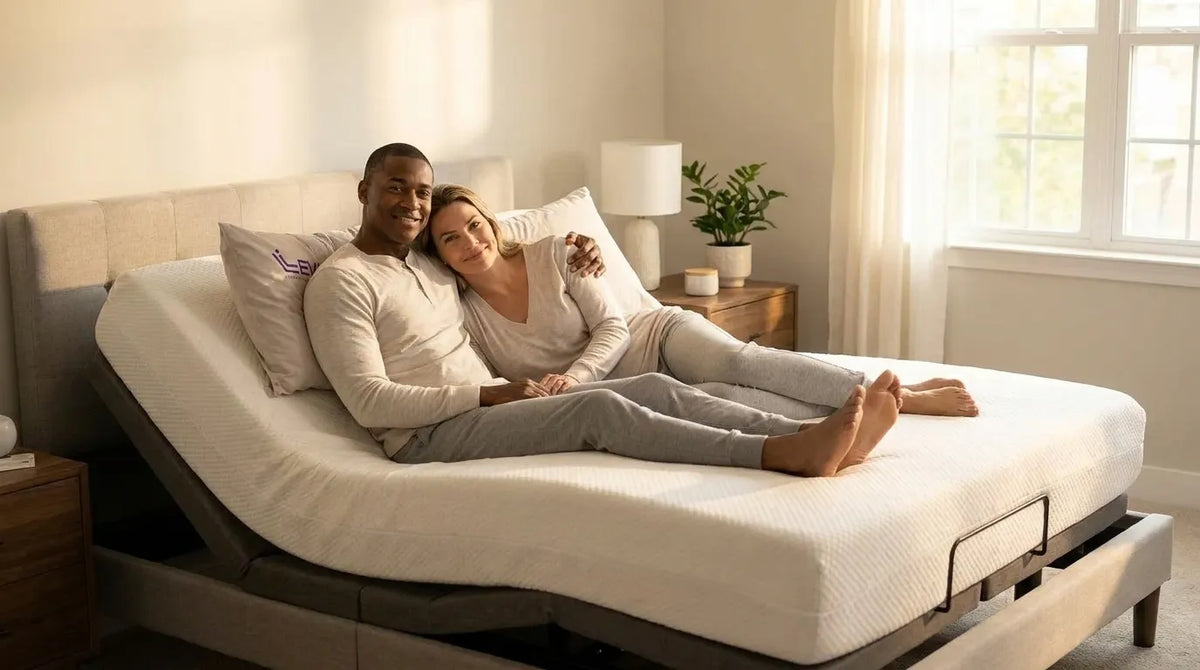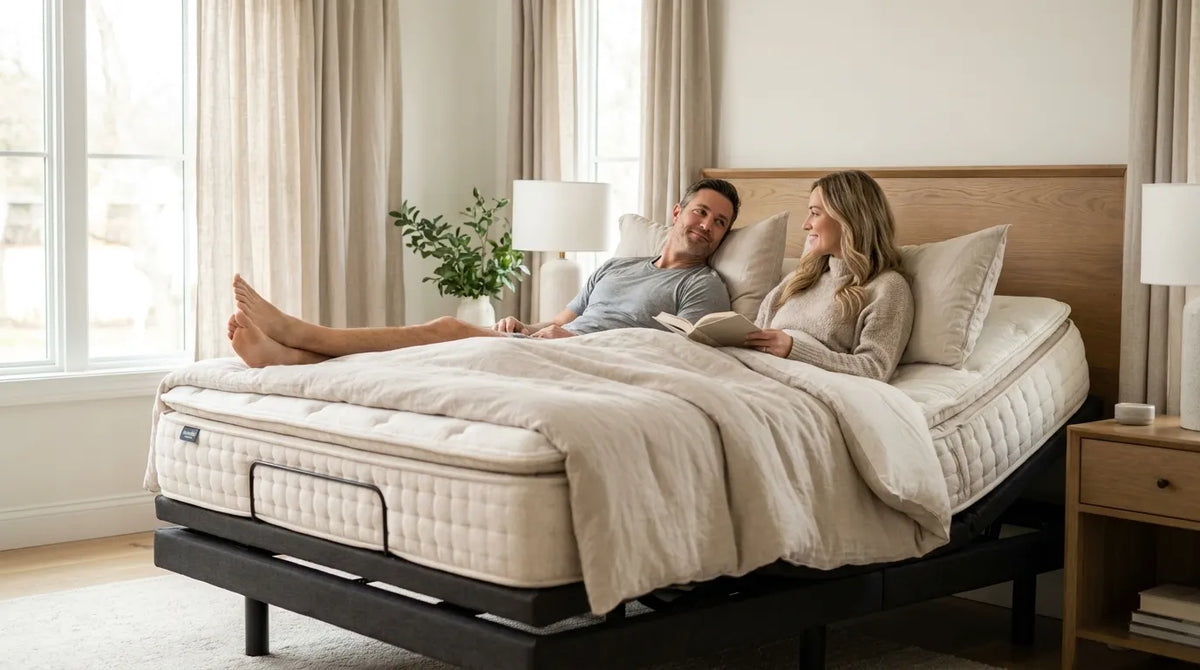
Best Pressure Relief Mattress for an Adjustable Base
Written by: Matthew Timmins, Founder and Managing Director, Leva Sleep
Key Takeaways
- A pressure relief mattress on an adjustable base improves both surface comfort and body position, distributing weight more evenly than a flat mattress.
- Most existing mattresses are incompatible with adjustable bases. A flex test, age check, construction check, and warranty review determine compatibility.
- Latex, memory foam, and pocket-coil hybrids flex well on an adjustable base. Traditional innersprings resist bending and wear out faster.
- Articulation fatigue affects incompatible mattresses. Smooth motor travel, adequate weight capacity, and approved construction help extend mattress life.
- Leva Sleep builds pressure relief mattresses and adjustable bases as matched systems and offers the largest Split Queen selection in North America.
Shop Leva Sleep Adjustable Beds
How A Pressure Relief Mattress On An Adjustable Base Changes Sleep
The term “pressure relief mattress” is a comfort-grade descriptor, not a clinical one. It refers to a mattress engineered to conform closely to the body’s contours, distributing weight across a larger contact area instead of concentrating it on the points that protrude furthest. On a flat surface, the hips, shoulders, and knees carry a disproportionate share of body weight all night.
Two variables determine how well a pressure relief mattress on an adjustable base performs. The first is the surface, which describes how deeply and evenly the mattress conforms to the body. The second is geometry, which describes the position the base places the body in before the mattress begins its work. A flat mattress, however well engineered, only addresses the surface variable and cannot change the geometry.
A flat surface imposes a single spinal geometry on a body that is not flat. The spine contains natural curves, and the shoulders, hips, and legs each place different demands on a sleep surface. On a flat mattress, these areas may carry a larger percentage of body weight because no part of the surface is positioned to support the lumbar curve, reduce load on the hips, or keep the airway open.
Zero-gravity positioning, with the head and knees slightly elevated and the back reclined at approximately 120–130 degrees relative to the thighs, addresses the geometry problem directly. Research by Nachemson and Elfström found that a reclined position can reduce lumbar disc pressure by as much as 50% compared to sitting upright. The same semi-reclined posture distributes body weight across a larger surface area instead of concentrating it on the lower back and hips. A study on adjustable base users found an average of 21 extra minutes of total sleep per night, five additional minutes in REM sleep, and fewer nighttime awakenings compared to sleeping on a flat surface.
Buying a better flat mattress upgrades the surface that already feels limiting, while the geometry problem remains. A pressure relief mattress on an adjustable base addresses both variables at once, surface conformance and positional geometry, which is why it often delivers results that mattress replacement alone does not.
Shop Pressure Relief Beds
How To Check If Your Existing Mattress Works On An Adjustable Base
Most mattresses are not built to bend. Placing an incompatible mattress on an adjustable base causes it to resist articulation, wear unevenly at the hinge points, and shorten its own life. Before pairing an existing mattress with an adjustable base, apply the following decision rule:
- Flex test. Lift the head section of the mattress manually. If it resists bending or holds a rigid shape, it will fight the base’s motor every night. A compatible mattress bends without resistance and returns to shape.
- Age and condition check. A mattress already showing body impressions or uneven wear will accelerate its own degradation under articulation. If it is more than five to seven years old, replacement usually offers better value than pairing it with a new base.
- Construction check. See the comparison table in the next section. Traditional innerspring mattresses with connected coil systems are the most likely to fail. Memory foam, latex, and pocket-coil hybrids are the most likely to succeed.
- Warranty check. Flex damage on a mattress not approved for adjustable base use is often excluded from warranty coverage, and some mattress warranties void entirely if an adjustable base is used. Confirm the mattress manufacturer’s compatibility list before proceeding.
If the mattress fails any of these checks, placing it on an adjustable base adds a second problem: the cost of the base plus the accelerated cost of replacing the mattress sooner than planned. A matched system, where the mattress and base are engineered together, removes that tradeoff.
Mattress Types Ranked For Adjustable Bed Compatibility
The table below compares the four main mattress constructions on how they flex under articulation, how they relieve pressure, and how they hold up over time on an adjustable base.
| Construction | How It Flexes Under Articulation | Pressure-Relief Behavior | Durability Under Nightly Articulation |
|---|---|---|---|
| Memory Foam | Flexes easily, conforms to base angle | High — contours closely to body | Good if density is adequate; foam mattresses under 10 inches thick may bottom out at steep articulation angles |
| Hybrid with Pocket Coils | Each coil sits in its own sleeve and flexes independently without pulling its neighbors | High — coil support plus foam contouring | Good — pocket coils bend at hinge points without damaging coil integrity |
| Latex | Bends repeatedly without cracking, returns to shape | High — resilient and contouring | Excellent — natural durability under repeated flex |
| Traditional Innerspring | Border wires and open-coil systems can kink or crack at hinge points | Low — concentrates pressure on hips and shoulders | Poor — articulation damages coil integrity over time |
Ordered by articulation compatibility, the best mattress types for an adjustable bed base are:
- Latex — the most durable under repeated bending, with excellent pressure-relief properties.
- Memory foam — the most commonly compatible type; choose adequate density, generally 4 lb/ft³ or higher for the support core, and a thickness of at least 10 inches.
- Pocket-coil hybrid — combines the independent flex of individually wrapped coils with foam comfort layers; confirm pocketed rather than Bonnell or continuous coils before purchasing.
- Traditional innerspring — generally incompatible, so avoid pairing with an adjustable base.
Firmness selection depends on sleeping position. Side sleepers need enough surface softness to allow the hip and shoulder to sink into the mattress, which reduces concentrated pressure at those points. For side sleepers, a lightly contoured position with the head raised slightly and the feet elevated a few inches can redistribute pressure away from the hips and shoulders. Back sleepers generally benefit from a medium-firm surface that supports the lumbar curve without excessive sinkage. The adjustable base manages the geometry, while the mattress firmness manages the surface conformance.
How Adjustable Bases Affect Mattress Wear
Mattress construction determines whether an adjustable base shortens or preserves its life. A mattress engineered to flex with the base maintains its lifespan, while a mattress that resists articulation develops articulation fatigue.
Every time an adjustable base raises the head or foot section, the mattress bends at the hinge point. In a foam mattress, repeated bending compresses and stretches the foam cell structure at that point. Over three to five years of nightly articulation, low-density foam cells collapse and fail to recover, producing a permanent crease or soft zone at the hinge. In a traditional innerspring mattress, the same bending force is applied to a rigid coil network. Continuous-coil and Bonnell-style systems are less compatible with adjustable bases because the coil network is interconnected and moves as one rigid sheet, so articulation forces the entire structure to bend together rather than flexing at the hinge points. Over time, this stress can kink or crack the wire.
The base itself also affects mattress longevity. Motor quality and smoothness of travel matter. A base that jerks or snaps to position applies a sudden shock load to the mattress at the hinge point, which accelerates foam cell breakdown. A base with smooth, gradual travel distributes the bending force more evenly. A slow, smooth full-range extension taking under 30 seconds is a sign of quality gearing. Weight capacity also matters, because a base operating near its maximum rated load runs its motors harder and articulates less smoothly.
To extend mattress life on an adjustable base:
- Start with manufacturer approval, because a mattress explicitly rated for adjustable base use is designed to flex at the hinge points.
- Then confirm the mattress thickness is within the base’s rated range, typically 14 inches maximum, so the head lift does not cramp the foam.
- Add a non-slip mattress pad or confirm the base includes a retainer bar at the foot. When the head section lifts, gravity pulls the mattress toward the foot of the bed, and repeated sliding accelerates wear at the hinge.
- Finally, select a base with adequate weight capacity, since most quality adjustable bases support 750 to 900 pounds of combined user and mattress weight.
What Happens To An Adjustable Bed During A Power Outage
Most adjustable bases do not have a manual override or battery backup. When power is lost, the bed stays in its last position until power returns. A few models include a battery backup box for the remote, but that backup does not automatically lower the bed and only allows the remote to function once power is restored. Battery backup units should be checked periodically, as owners note the batteries can leak if left installed for long periods unused.
When a base stops responding, start by checking the power connection and resetting the motor by unplugging the base for 30 seconds before reconnecting. Most motor faults resolve with a full power cycle. If the motor fails to respond after a reset, the warranty and motor rating become the most relevant specifications.
Most adjustable beds last about 7 to 10 years with normal use, while higher-quality motors rated for 30,000 to 50,000 cycles can last 10 to 15 years. Budget motors rated for only 5,000 to 10,000 cycles may degrade within 2 to 4 years, with no easy repair path. Motor quality, weight capacity, and smoothness of travel are the key specifications that determine longevity.
Whisper-quiet motors matter in a shared bed for comfort and for uninterrupted sleep. Adjustable base motors should have a noise rating below 50 decibels, roughly the volume of a quiet conversation, so one partner can adjust position without disturbing the other.
How Comfort-Grade Pressure Relief Differs From Clinical Surfaces
So far this guide has treated “pressure relief” as a comfort feature. That same phrase also appears in clinical contexts, and the distinction changes what you should buy.
A pressure relief mattress on an adjustable base is a comfort and positioning solution for everyday sleepers. Alternating-pressure and low-air-loss systems are clinical devices for preventing and treating pressure ulcers, typically prescribed or supplied in medical settings. These are distinct categories with different indications, and confusing them often leads to the wrong purchase.
The fourth edition of the International Pressure Injury Guideline (2026) recommends pressure-redistribution foam full-body support surfaces for individuals at risk of pressure injuries, while alternating-pressure air surfaces are usually reserved for individuals at higher risk or with deteriorating skin or clinical condition. Low-air-loss therapy primarily addresses the microclimate around the skin, the thin layer of heat and moisture next to the body, and is indicated when sweating, incontinence, wound exudate, or maceration complicate care. These features do not apply to an everyday sleeper seeking relief from hip or shoulder discomfort.
Clinicians commonly recommend sleeping with the head elevated for conditions including sleep apnea, acid reflux, and post-surgical recovery. An adjustable base provides that position at home, night after night, without stacking pillows. A systematic review in the National Library of Medicine confirmed that head-of-bed elevation reduces esophageal acid exposure, making it one of the most effective non-medication strategies for nighttime reflux. When a clinician recommends an elevated sleeping position for a non-wound-related condition, an adjustable base is the appropriate home solution. When a clinician recommends active pressure-ulcer prevention or treatment, a prescribed clinical surface is the appropriate solution.
Leva Sleep operates as a specialist adjustable bed company and focuses on comfort-grade pressure relief and positional geometry for everyday sleepers.
Who Is Not A Good Fit For An Adjustable Base
An adjustable base does not suit every situation. The following cases call for a different approach:
- Clinically indicated firm flat surface. Some spinal conditions and post-surgical protocols require a firm, flat sleeping surface as part of a treatment plan. A clinician’s recommendation for a firm flat surface takes precedence over any comfort preference. Consult a physician or physiotherapist before purchasing an adjustable base if a specific spinal condition is involved.
- Incompatible existing mattress with no budget for replacement. If the existing mattress is a traditional innerspring and the budget does not extend to a compatible replacement, the base-only purchase will accelerate mattress degradation and produce a poor result. The system works as a system, and a base paired with an incompatible mattress breaks that system.
- Single sleeper with no positional or partner-related sleep problem. An adjustable base delivers its greatest value to sleepers with pressure complaints, positional needs, or partner compatibility issues. A single sleeper on a well-matched flat mattress with no positional complaints has less to gain from the investment.
- Room that cannot accommodate the required footprint. A Split King occupies roughly 76 inches of width, while a Split Queen occupies 60 inches. Measure the room before selecting a configuration. Sixteen inches often decides whether the room works.
Why Leva Sleep Builds Matched Systems For Pressure Relief
A Leva Sleep specialist summarizes the core idea clearly: “You can’t solve a geometry problem by changing the foam. That’s the mistake almost every mattress purchase makes.”
Leva Sleep operates as a specialist adjustable bed company rather than a general mattress retailer. That focus matters because the mechanism described throughout this guide, surface conformance plus positional geometry, only works when the mattress and the base are engineered to function together. Most mattresses resist articulation and shorten their own lifespan doing it. Leva Sleep mattresses are built to flex with the base, so articulation fatigue becomes a design problem that is addressed upfront.
The Heavenly Hybrid, which uses pocket-coil construction, and the Heavenly Response, which uses all-foam construction, are both manufactured by Leva Sleep in the United States. Both are available in the 30″ × 80″ size that a true Split Queen requires, a size that does not exist in the standard mattress supply chain. This in-house capability separates Leva Sleep from retailers that simply list Split Queen as an option.
Leva Sleep offers the largest selection of Split Queen adjustable beds in North America: five distinct packages from $1,399, 30″ × 80″ mattresses manufactured in-house, and a full line of Split Queen bedding and accessories built to fit them. The typical retailer offers none. For couples whose bedroom cannot accommodate a Split King’s 76-inch footprint, the Split Queen’s 60-inch footprint often makes the difference between solving the problem and giving up on it. Split King packages are also available for rooms where the wider footprint works.

The features of a Leva Sleep system connect directly to the pressure relief mechanism:
- Independent split articulation supports two bodies with two geometries in one bed, so partners no longer need to compromise on position.
- Lumbar control and pillow tilt provide micro-geometry adjustments that support the lower back curve and angle the head independently, beyond simple head-up and foot-up positioning.
- Zero-gravity and anti-snore positioning treat position as a health input and make it easy to use head elevation for conditions such as sleep apnea, acid reflux, and post-surgical recovery.
- Whisper-quiet German motors protect sleep quality by allowing adjustments without disruptive noise.
- Bedding engineered for movement includes extra-elastic fitted sheets, duvet clips, and remote pockets that stay in place at full elevation, where generalist retailers usually stop.
Complete adjustable bed packages start around $1,299 and extend to $8,999+, with financing options that include 0% APR. Leva Sleep delivers comparable quality at 30–50% less than many high-end competitors. It designs in-house, oversees manufacturing directly, assembles regionally, and delivers with its own trained teams. Leva Sleep’s stated policy is a 180-night comfort guarantee, which provides six months to evaluate the system. The US store currently displays a 60-night guarantee, so customers should confirm the current policy. In-house white-glove delivery includes old-bed removal, full assembly, height adjustment, and a walkthrough with both partners.
Leva Sleep has served more than 25,000 customers over nine years. NCHS data show that roughly one in three US adults aged 40–59 report trouble sleeping, and a June 2025 survey of 2,007 US adults conducted by Atomik Research for the American Academy of Sleep Medicine found that 31% of American adults had opted for a “sleep divorce,” regularly sleeping in a separate room from a partner, with the figure rising to 39% among adults aged 35–44. Leva Sleep exists for couples who want a different answer.
The showroom is in La Jolla, California, serving the greater San Diego region, with national shipping across the United States.
Build Your Matched Sleep System
Frequently Asked Questions
How Long Does An Adjustable Bed Typically Last?
Most adjustable beds last about 7 to 10 years with normal use, while higher-quality motors rated for 30,000 to 50,000 cycles can last 10 to 15 years. Budget motors rated for only 5,000 to 10,000 cycles may degrade within 2 to 4 years, with no easy repair path. Motor quality, weight capacity, and smoothness of travel remain the main predictors of lifespan. A noise rating below 50 decibels and a full-range extension time under 30 seconds are practical indicators of quality gearing, and most quality adjustable bases carry a 1- to 5-year warranty on the motor and electronics.
Can Side Sleepers Use An Adjustable Bed Comfortably?
Side sleepers can benefit significantly from an adjustable base when it is paired with the right mattress. For side sleepers, a lightly contoured position with the head raised slightly and the feet elevated a few inches can redistribute pressure away from the hips and shoulders, which are the two areas that strain most on a flat surface. A pillow supports roughly 30% of the spinal column when sleeping on the side, so getting the head angle right has a large effect on how the neck and upper back feel in the morning. Many adjustable bases include a pillow tilt feature that adds a few degrees of independent head-top adjustment, allowing cervical alignment to be fine-tuned separately from the main back incline. A medium to medium-soft mattress surface usually works best for side sleepers, providing enough conformance for the hip and shoulder to sink in without bottoming out.
How Do Comfort-Grade Pressure Relief And Alternating-Pressure Mattresses Differ?
A comfort-grade pressure relief mattress on an adjustable base redistributes body weight through surface conformance and positional geometry for everyday sleepers. Alternating-pressure and low-air-loss systems are clinical devices for preventing and treating pressure ulcers. Alternating-pressure surfaces actively shift pressure between body sites at programmed intervals, while low-air-loss surfaces manage the microclimate of heat and moisture at the skin surface. These device categories serve different needs. When a clinician recommends an elevated sleeping position for a non-wound-related condition such as acid reflux or sleep apnea, an adjustable base is the appropriate home solution. When a clinician recommends a clinical pressure-ulcer prevention or treatment surface, a prescribed medical device is the appropriate solution.
Conclusion
A pressure relief mattress on an adjustable base solves two problems at once: surface conformance and positional geometry. Changing the foam alone cannot address a geometry problem. The compatibility decision rule, which includes a flex test, age check, construction check, and warranty check, determines whether an existing mattress can go on an adjustable base or whether a matched system is the better investment. Articulation fatigue is real, yet it is a design variable rather than an unavoidable outcome, because a mattress engineered to flex with the base does not wear out faster under normal use. The clinical distinction between comfort-grade pressure relief and alternating-pressure medical surfaces is clear, and the right solution depends on whether the need involves positional comfort or clinical wound management.
Leva Sleep builds the pressure relief mattress and the adjustable base as one matched system, with the largest Split Queen selection in North America, complete packages from $1,299, a 180-night stated comfort guarantee, and in-house white-glove delivery. For anyone navigating a pressure complaint, a positional need, or a partner sleep conflict, the framework in this guide provides clear criteria to evaluate the options. Where a clinician’s recommendation is involved, consult a health professional before making a decision.
Find Your Pressure Relief Setup
Explore Leva Sleep’s Split Queen Adjustable Beds