Adjustable Beds with Independent Sides for Sleep Apnea
Written by: Matthew Timmins, Founder and Managing Director, Leva Sleep
Key Takeaways
- Independent adjustable sides let each partner control head and foot elevation separately, so no one has to compromise on sleep position.
- Head elevation of 10–35° can reduce mild positional sleep apnea events by using gravity to keep the airway open. CPAP remains the primary therapy for diagnosed OSA.
- Split Queen configurations with 30" × 80" mattresses provide the same independent articulation as Split King while fitting bedrooms that cannot accommodate a 76" footprint.
- Only mattresses specifically engineered to flex, such as Leva Sleep’s Heavenly Hybrid and Heavenly Response, tolerate repeated articulation without damage.
- Leva Sleep offers a wide selection of Split Queen adjustable beds in North America, with purpose-built mattresses and bedding for split configurations. Shop Leva Sleep’s Split Queen collection to find your setup.
What Are Independent Adjustable Sides?
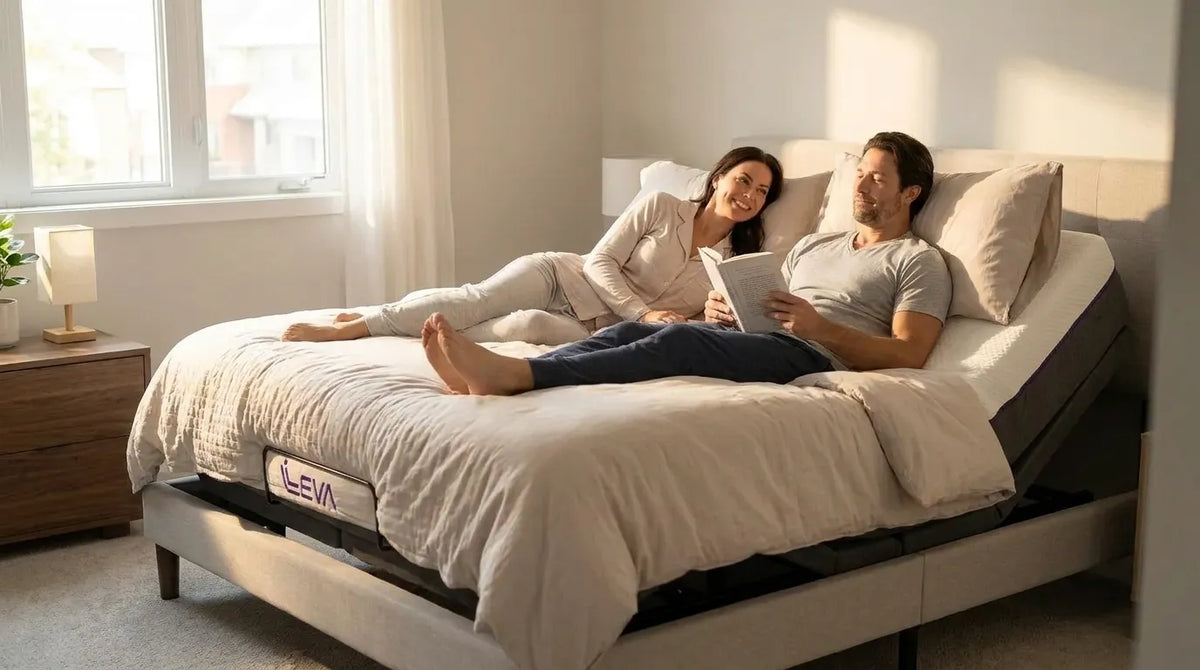
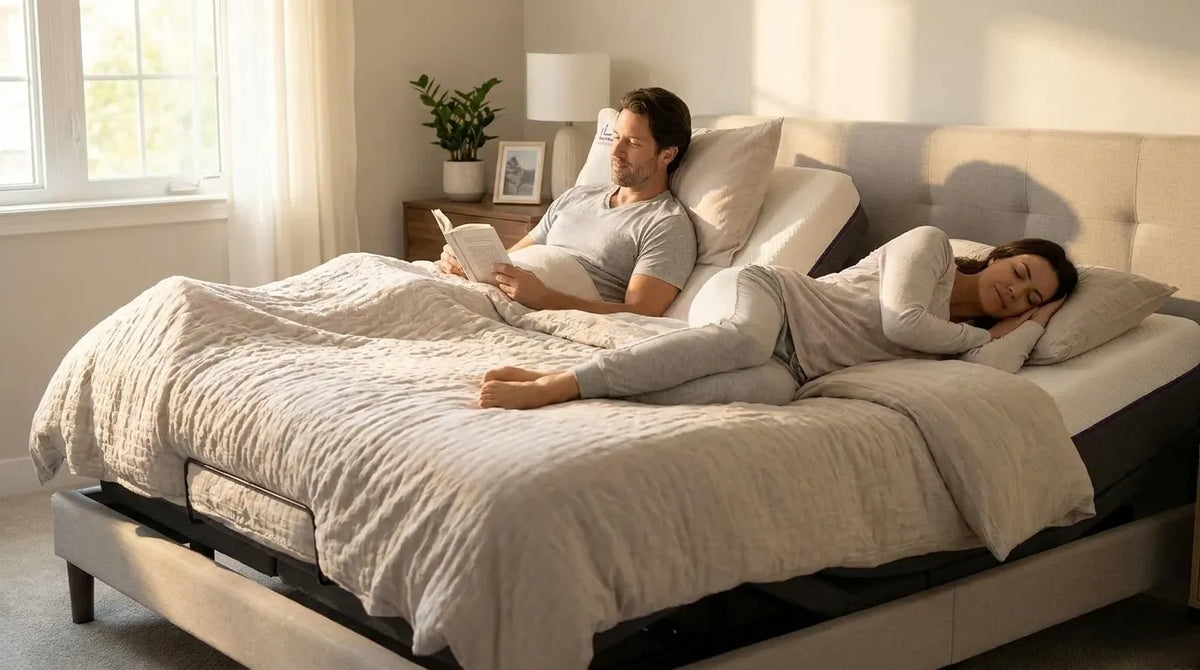
Independent adjustable sides use two bases that operate without any mechanical link to each other. Each side has its own motor, its own remote or app control, and its own range of motion. When one partner raises the head section to 30 degrees, the other side stays flat. When one side activates zero-gravity positioning, the other is unaffected.
Because preset names and features vary by retailer, the terms below are worth pinning down before you compare listings:
- Independent articulation: Each base moves through its full range of head and foot positions without affecting the other base.
- Zero gravity: A preset position with head and knees slightly elevated that distributes body weight evenly, reduces pressure on the lower back, and supports circulation.
- Anti-snore mode: A preset or automatic micro-adjustment that gently elevates the head section to help open the airway.
- Pillow tilt: An additional motor that angles the head and pillow section independently, useful for reading, watching, or airway positioning.
- Lumbar control: A dedicated motor supporting the lower back curve, distinct from raising the head or foot section.
- Split-head: A single mattress footprint where only the head sections adjust independently. This configuration differs from a true Split Queen or Split King and should not be confused with either.
Leva Sleep’s Split Queen always means two fully independent bases with head and foot articulation on each side. A split-head queen, which uses one mattress with a head-only split, is a separate configuration (for example, the Passions Adore is also available in Split-Head Queen) and is not the default Split Queen setup.
How Does Head Elevation Help Sleep Apnea?
During sleep, the muscles of the throat relax and gravity can cause soft tissues such as the tongue and soft palate to fall backward and partially or completely block the airway. Sleeping with the upper body elevated may help reduce airway blockages by using gravity to limit throat tissue collapse. A 2017 study by Souza et al. published in Sleep & Breathing found that a 7.5-degree head-of-bed elevation reduced the Apnea-Hypopnea Index in 52 adults with mild to moderate positional OSA from an average of 15.7 to 10.7 events per hour. A 2025 multicenter observational study found head-of-bed elevation significantly reduced AHI and oxygen desaturation index compared with flat supine posture, with proposed mechanisms including improved lung volume, reduced rostral fluid shift, and altered gravitational loading.
Clinicians often recommend sleeping with the head elevated for conditions including sleep apnea, acid reflux, and post-surgical recovery. The commonly cited head-of-bed elevation range for sleep apnea is 10–35°, which patients generally tolerate well. The literature describes head and trunk elevations from 5° to 60°, but angles of 30–60° are more poorly tolerated.
The CPAP caveat is essential. An adjustable base does not replace CPAP therapy. A 2025 meta-analysis of 19 randomized controlled trials found that sleep positional therapy reduced supine AHI more than placebo but showed no significant differences in overall AHI, and CPAP was superior to positional therapy in reducing overall AHI and improving oxygenation. Positional therapy works best when combined with CPAP, oral appliances, or other doctor-recommended approaches, and does not replace medically recommended treatments. Head elevation helps mild positional apnea and snoring more than moderate-to-severe OSA. Anyone with undiagnosed or severe sleep apnea should see a clinician before treating position as a primary intervention.
Explore Leva Sleep’s adjustable beds for snoring relief, or book a visit to the La Jolla showroom or shop online.
Do You Need a Split King for Independent Sides?
Many retailers default to Split King for independent sides, yet that answer does not work for every bedroom. A Split King is two Twin XL mattresses (each 38" × 80") placed side by side, producing a combined 76" × 80" footprint identical to a standard King. Because Twin XL is a standard supply-chain size, any retailer can assemble a Split King from parts that already exist.
A true Split Queen requires a different manufacturing decision. A split queen mattress uses two mattresses each measuring 30 inches wide by 80 inches long, giving the combined setup the same 60" × 80" footprint as a standard queen. That 30" × 80" size does not exist in the ordinary mattress supply chain, so a company must commit to building it.
The table below shows how Split King and Split Queen compare on footprint, per-side mattress size, and who each one suits.
| Configuration | Footprint Width | Mattress Size (Each Side) | Who It Suits |
|---|---|---|---|
| Split King | 76" | 38" × 80" (Twin XL) | Couples with a bedroom that accommodates a King footprint; standard mattresses available everywhere |
| Split Queen | 60" | 30" × 80" (purpose-built) | Couples in condos, apartments, older homes, or any bedroom where 16 fewer inches of wall width decides whether the room works |
Why True Split Queen Is Rare
The 30" × 80" mattress size does not exist as a standard supply-chain item. Split queen is classified as a specialty size rather than a standard off-the-shelf mattress dimension. Retailers cannot simply pull it from a shelf. As a result, couples in smaller bedrooms are often told their options are a standard Queen with no independent sides or a King they cannot fit.
Leva Sleep commits to this specialty size and offers five Split Queen packages from $1,399, with 30" × 80" mattresses Leva manufactures and a full Split Queen bedding line. The five packages are the Cala, Vela, Heavenly Response, Passions Adore, and Sereno Signature.
"Split king is easy, it is two standard mattresses. Split queen is a manufacturing decision. That is why almost nobody offers it, and why couples in smaller bedrooms keep getting told no." — Alex Dimitriou, Lead Sleep Specialist, Leva Sleep
Can You Use Your Current Mattress on an Adjustable Base?
Most mattresses are not built to bend repeatedly without damage. Traditional innerspring mattresses with Bonnell or offset coil systems are generally not compatible with adjustable bases. They can crack, deform, or lose support when bent repeatedly, causing broken coil connections, deformed foam rails, and permanent creasing at bend points. The core requirement for adjustable-base use is flexibility: the mattress must bend at the head and foot without damaging its internal structure.
Look for a mattress explicitly engineered to flex with the base and sold as part of a matched system. Memory foam flexes easily and is repeatedly compatible with articulation; hybrid mattresses are compatible only when they use individually wrapped coils and are explicitly labeled adjustable-base compatible.
Leva Sleep manufactures two mattresses in the 30" × 80" Split Queen size: the Heavenly Hybrid (pocket coil, available in Luxury Firm and Medium/Plush) and the Heavenly Response (all-foam). Both are built to flex with the base, night after night, as part of a matched system. Each partner can choose a different firmness level, a choice Split King buyers expect and Split Queen buyers rarely see.

Browse Leva Sleep’s adjustable beds for pain relief, or see matched mattress-and-base systems online or in the La Jolla showroom.
Mattress compatibility is only half the system; the other half is what happens to your bedding once the base starts moving.
What Happens to Your Sheets at Elevation?
Standard fitted sheets often pop off the moment the bed articulates. Many adjustable bed owners report this as their most common post-purchase complaint, and some couples abandon the configuration because of it. A standard fitted sheet is cut for a flat surface. At 20 or 30 degrees of head elevation, the geometry changes enough that the corners release.
Look for these features in bedding for an adjustable base:
- Extra elastic that holds at full elevation, not just at the corners
- Deep pockets sized for the mattress height plus the base movement
- Duvet clips that keep the duvet from sliding when the two sides are at different angles
- Remote pockets built into the sheet set
Leva Sleep designs all its bedding for split and adjustable beds. The Alpine Pure Cotton and Bamboo Breeze adjustable bed sheet sets are cut for split configurations with extra elastic that holds at full elevation. Remy and Remy Sub Zero mattress protectors, the Adjustable Bed Essentials Bundle, and the Gold Bedding Bundle are all available in Split Queen. The Leva Sleep System, which provides per-side heating and cooling, is also available in Split Queen.
Bedding is one practical consequence of independent sides; the other is the partner dynamic that motivates many couples to choose them.
What About the Partner Who Sleeps Flat?
The partner dynamic often drives the decision to buy independent sides. One side needs elevation for airway management, while the other prefers to sleep flat and feels wary of change. Independent adjustable sides remove the nightly negotiation so each partner keeps their preferred position.
The scale of the problem is significant. A 2025 survey of 2,007 US adults conducted by Atomik Research for the American Academy of Sleep Medicine found that 31% of American adults had opted for a sleep divorce, sleeping in a separate bed or space to accommodate a partner, with the figure rising to nearly 40% among adults aged 35 to 44. A further 37% of respondents said they go to sleep at different times to accommodate a partner.
Leva Sleep’s split configurations let the skeptical partner’s side stay exactly as they prefer it. The elevated side receives the airway positioning a clinician recommended, while the flat side stays undisturbed. Both partners remain in the same bed.
"A flat bed asks two different bodies to accept the same shape for eight hours. One of them always loses." — Alex Dimitriou, Lead Sleep Specialist, Leva Sleep
Who Is This Not For?
An adjustable base does not replace CPAP therapy. CPAP is the most effective treatment for OSA and the standard of care for the condition, acting as a pneumatic splint that keeps the airway open regardless of gravity or sleep position when used as prescribed. That distinction matters because head elevation helps mild positional apnea and snoring more than moderate-to-severe OSA. A study cited by ResMed found that positional sleep apnea affects nearly 50% of people with mild OSA, nearly 20% of people with moderate OSA, and nearly 7% of people with severe OSA. The benefit of positional therapy shrinks as severity increases.
Anyone with undiagnosed sleep apnea, or with moderate-to-severe OSA confirmed by a sleep study, should consult a clinician before treating position as a primary intervention. An adjustable base can complement prescribed therapy. It does not replace it.
Frequently Asked Questions
What Position Is Worst for Sleep Apnea?
Sleeping flat on the back is the position most associated with worsening sleep apnea. In the supine position, gravity causes the tongue and soft palate to fall directly backward into the airway, narrowing or blocking it. Some people experience sleep-disordered breathing only when back sleeping, a pattern clinicians call positional OSA. Side sleeping is generally recommended as an alternative, and head elevation in any position adds a gravitational assist that helps keep soft tissue from collapsing into the airway.
Will an Adjustable Bed Frame Help with Sleep Apnea?
For mild positional sleep apnea and snoring, head elevation on an adjustable base can reduce the frequency of apnea events by using gravity to limit airway collapse. Clinical studies have shown reductions in AHI with modest elevation angles. The benefit is most pronounced in people with clearly positional OSA, whose event rates are significantly higher when sleeping on their back than in other positions. For moderate-to-severe OSA, CPAP remains the standard of care and positional therapy works best as a complement rather than a replacement. An adjustable base is not a medical device and should not be described as a treatment for sleep apnea.
What Is the Best Pillow for Sleep Apnea?
Pillow choice matters because stacking standard pillows to elevate the head can bend the neck forward and push the chin toward the chest, potentially collapsing the airway further rather than opening it. The goal is to elevate the entire upper body while keeping the spine and neck aligned. Leva Sleep’s adjustable bases include a pillow tilt motor that angles the head and pillow section independently, achieving the elevation angle without the neck flexion that stacked pillows create. This approach provides a more reliable and adjustable solution than any fixed pillow configuration.
Do You Need A Split King For Independent Sides?
No. See the section “Do You Need a Split King for Independent Sides?” above for the full explanation of how Split Queen provides the same independence in a smaller footprint.
Can You Use Your Current Mattress on an Adjustable Base?
Usually not without compromise. Most mattresses, particularly traditional innerspring models, are not engineered to articulate repeatedly. They resist bending, wear unevenly at the flex points, and shorten their own lifespan doing it. Memory foam and hybrid mattresses with individually wrapped coils are more compatible, but only when explicitly designed and labeled for adjustable-base use. The safest approach is a mattress sold as part of a matched system with the base, which is how Leva Sleep’s Heavenly Hybrid and Heavenly Response are offered.
Is an Adjustable Bed a Substitute for CPAP?
No. As noted above, CPAP remains the standard of care for obstructive sleep apnea. An adjustable base changes the gravitational forces on soft tissue and can meaningfully help mild positional apnea and snoring, but it does not replace prescribed airway pressure therapy. Anyone currently using CPAP should continue doing so. Anyone who suspects they have sleep apnea should seek a clinical evaluation before changing their treatment approach.
Conclusion: Choosing Your Configuration and Compatibility
Independent adjustable sides solve a geometry problem: two different bodies, two different positional needs, one shared bed. The mechanism of head elevation is well documented for mild positional apnea and snoring, and the CPAP caveat remains central. For the couple where one partner needs elevation and the other does not, the real purchase barrier is configuration and compatibility.
That decision has three parts. First, choose the size that fits the bedroom, a Split King at 76 inches or a Split Queen at 60 inches. Second, select mattresses that survive articulation without breaking down. Third, pick bedding that stays on the bed when it moves. Few generalist retailers answer all three questions for a Split Queen configuration, because the specialty 30" × 80" size requires a manufacturing commitment.
Leva Sleep has made that commitment with five Split Queen packages from $1,399, two mattress constructions in 30" × 80", and a complete bedding line engineered for split and adjustable beds, all backed by a 180-night comfort guarantee and in-house white-glove delivery.
Explore Leva Sleep’s Split Queen lineup online or visit the La Jolla showroom.