
The Ideal Room Temperature for Sleeping: Find Your Number
Written by: Matthew Timmins, Founder and Managing Director, Leva Sleep
Key Takeaways
- Most adults sleep best between 60–67°F (15.5–19.5°C), with 65°F often working well for the body’s natural core temperature drop.
- Age, hormones, medication, and body composition shift your ideal number, so the standard range often needs personal adjustment.
- Bedding, mattress materials, humidity, and sleep position can override a well-set thermostat and deserve attention before you change the room temperature.
- Many couples want different in-bed temperatures, so independent per-side control offers a practical way to keep both partners comfortable.
- Leva Sleep’s Split Queen adjustable beds pair with The Leva Sleep System to give each partner their own temperature and position.
Shop Leva Sleep’s Split Queen Adjustable Beds
The Problem: Why The Standard Sleep Temperature Rarely Fits Everyone
The 60–67°F range comes from population-level research, so it describes an average rather than your specific body. Many people follow this advice and still wake up uncomfortable. Two patterns show up most often.
The first pattern is waking hot at 3 a.m. even though the room feels cool. The second is waking cold despite staying within the recommended range. Both patterns signal that your number needs personalizing. The 65–68°F range works for roughly 85% of adults, which leaves a meaningful minority who need to adjust up or down based on physiology, bedding, mattress material, and humidity.
Before changing the thermostat again, look at the variables between the room and your skin. Bedding fill, mattress construction, relative humidity, and sleep position all shape how warm or cool your bed actually feels. The sections below walk through each of these.
Why Your Ideal Room Temperature For Sleep Is Personal
Several physiological factors shift your thermal comfort zone away from the population average.
Age. Aging impairs thermoregulation: older adults sweat less, have reduced blood vessel dilation, and a less responsive hypothalamus. The body sheds excess heat less efficiently during sleep. This imprecision can also make a cool room feel oddly warm, because the body cannot fine-tune temperature as well as it once did.
Hormonal Changes. Falling estrogen during perimenopause and menopause narrows the thermoneutral zone, the range the body tolerates without correction. A small rise in core temperature can trigger a full heat-dissipation response. Blood vessels dilate, sweat glands activate, and the sleeper wakes overheated. Hormonal shifts related to menstruation, pregnancy, perimenopause, or menopause often push the ideal sleep temperature toward the cooler end of the 60–67°F range.
Medication. Excessive sweating affects roughly 22% of people on antidepressants and tends to worsen at higher doses. Beta blockers, thyroid medications, and other drugs that act on the autonomic nervous system can also shift your thermal baseline.
Body Composition And Metabolism. Hypermetabolism can cause more sweating and a persistent sense of warmth even in a cool room. People with lower body fat or circulation issues may feel cold at temperatures that seem comfortable to others.
Use a simple framework. If you consistently wake hot, move toward 60–63°F and adjust bedding and humidity before dropping lower. If you consistently wake cold, or are over 65, move toward 66–67°F and add a breathable layer before raising the thermostat further.
How Warm Is Too Warm: Sleeping At 72 Degrees
The earlier framework assumes you stay within the standard range. Many bedrooms sit warmer than that, especially in summer or in apartments with shared HVAC. For most adults, 72°F is too warm for ideal sleep.
72°F sits above the commonly cited 60–67°F range and can interfere with the core-temperature drop your body needs to fall asleep and stay asleep. Bedroom temperatures over 71°F (24°C) are likely to cause restlessness, especially by suppressing REM sleep.
Some people still sleep adequately at 72°F, particularly older adults, people with low body fat, or those on medications that blunt sweating. Before deciding that 72°F works for you, check whether your bedding, mattress material, and humidity are doing extra work to offset the warm room. Dense, closed-cell foams and synthetic fabrics trap body heat against the skin and create a warmer bed microclimate. With a memory foam mattress and polyester sheets, your body experiences a higher effective temperature than the thermostat reading.
How Cold Is Too Cold: Sleeping At 65 Degrees
Most healthy adults tolerate 65°F well. This temperature sits comfortably inside the evidence-backed range and often feels like a practical sweet spot. If 65°F feels too cold, the first move is adding a layer or two to your bedding rather than raising the thermostat.
Some people still run cold at 65°F. This group often includes older adults, people on beta blockers or other medications that reduce peripheral circulation, and people with low body fat. A practical adjustment is to raise the room one or two degrees and refine bedding before abandoning the range entirely. For sleepers who feel too cold, warming the room to 66–67°F, using breathable bedding, and adding a thin layer is the recommended approach.
Sleep Temperature Guidelines For Older Adults
The National Council on Aging recommends a bedroom temperature of 60–70°F for older adults, which is a wider range than the standard adult guidance. A 2026 review in the Journal of Asian Architecture and Building Engineering found that the indoor thermal comfort range for older adults sits about 2°C higher than for younger adults. The neutral temperature for older adults averaged around 22.7°C (roughly 72.9°F), which is meaningfully warmer than the 65°F sweet spot often cited for younger adults.
Controlled studies suggest seniors need operative temperatures 1–3°C higher than younger adults to feel thermally neutral. Aging physiology includes lower metabolic heat production, attenuated vasodilation, and slower re-warming.
Cold sensitivity in older adults is common and points toward a warmer personalized target. For adults over 65, a practical starting point is the upper end of the standard range, around 67–70°F, paired with layered, breathable bedding instead of a single heavy duvet.
The Couples Problem: One Thermostat, Two Bodies
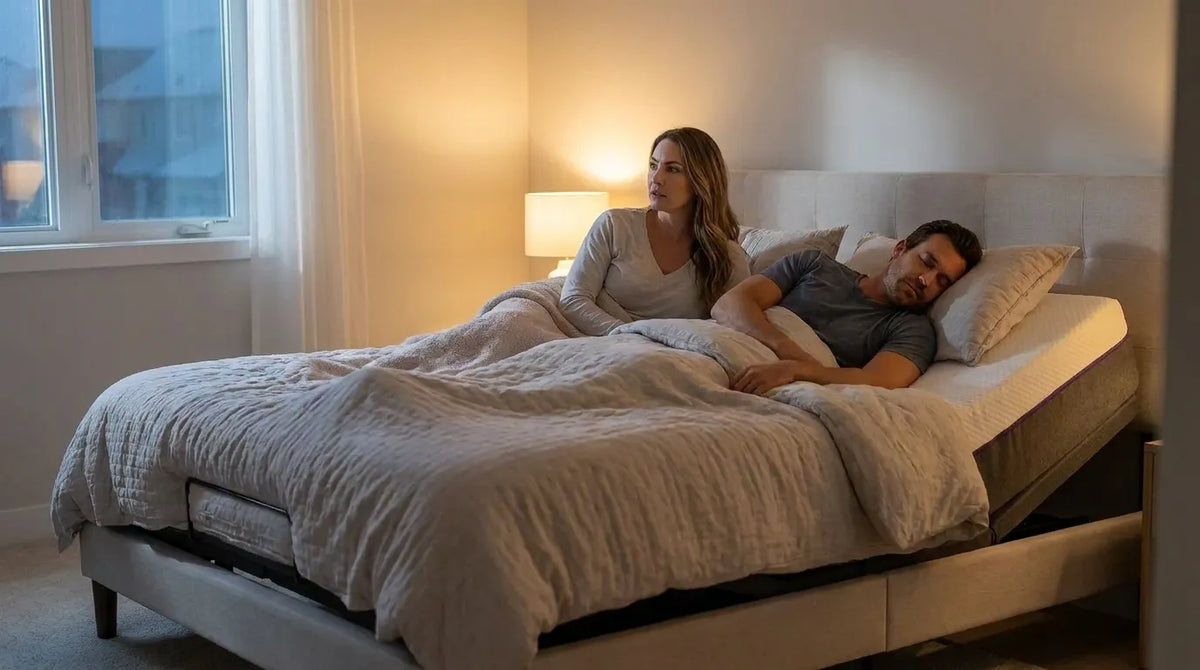
Two people in one bed almost never share the same thermal comfort point. The Sleeping Dove Couples’ Sleep Temperature Divide Survey (August 2026, n=484) found that 70.2% of bed-sharers prefer a different in-bed temperature than their partner. A single thermostat forces one partner to compromise, and that compromise often affects sleep quality. A June 2025 survey of 2,007 U.S. adults by Atomik Research for the American Academy of Sleep Medicine reported that 31% of American adults have opted for a sleep divorce, rising to 39% among adults aged 35–44.
Several low-tech adjustments can ease the conflict:
- Separate blankets or duvets so each partner controls their own insulation
- A fan directed at one side of the bed
- More breathable mattress materials on the warmer partner’s side
- Different-weight covers on each side
These steps often reduce tension but rarely solve the underlying mismatch in thermal needs. Among bed-sharers who purchased cooling bedding, 65.4% reported that it did not clearly help.
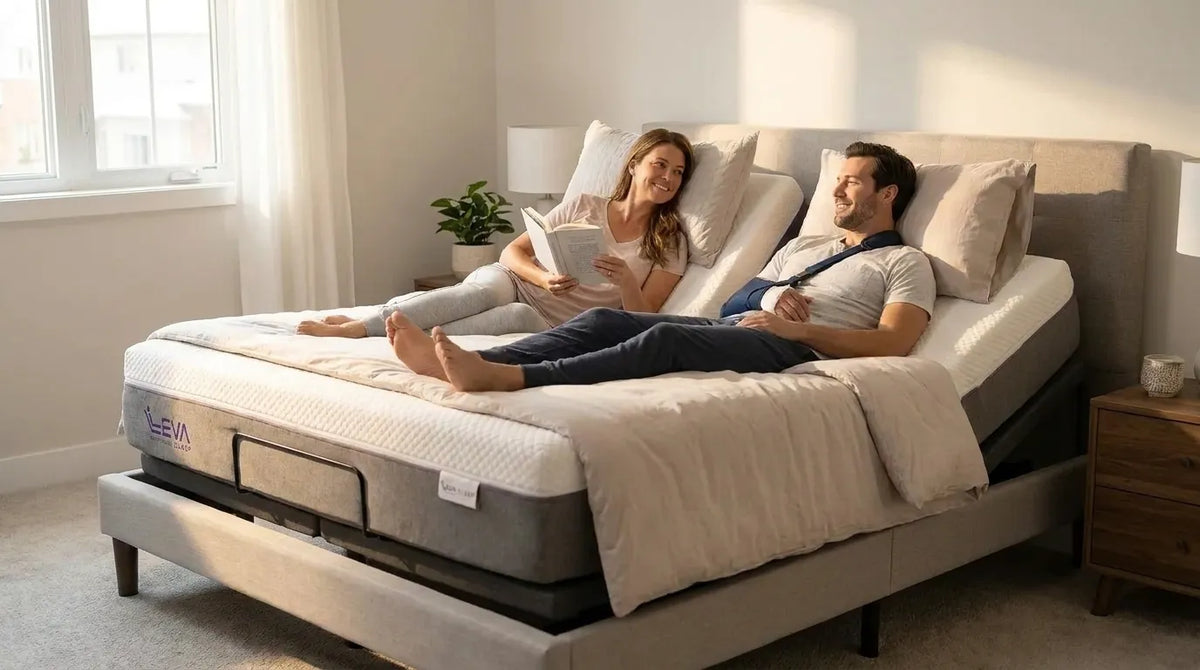
Per-side temperature control built into the sleep system addresses the source of the conflict. Leva Sleep’s Split Queen adjustable beds are two fully independent bases, each articulating at the head and foot. Paired with The Leva Sleep System, they add per-side heating and cooling so each partner sets their own temperature.

Couples who cannot fit a King footprint (76 inches wide) can still gain independent control. The Split Queen occupies 60 inches, the same width as a standard Queen, and Leva Sleep offers five Split Queen packages starting at $1,399. These include 30" × 80" mattresses manufactured in-house and a full line of Split Queen bedding. For couples with room for a King, the Split King provides the same independent per-side control.
“A flat bed asks two different bodies to accept the same shape for eight hours. One of them always loses.” — Alex Varga, Head Of Product, Leva Sleep
For more detail on resolving temperature conflict between partners, see Sleep Problems From Different Temperature Preferences and Sleep Temperature Control For Couples: Complete 2026 Guide.
Find Your Side-By-Side Sleep Temperature Solution
Beyond The Thermostat: Other Factors That Change Sleep Temperature
Room temperature is only one input. Several other variables sit between the thermostat and your body and can completely change how the same number feels.
Humidity. Bedroom relative humidity should stay between 30–50% for comfortable sleep. Above 60% RH, sweat evaporates less efficiently. Since evaporation is the body’s primary cooling mechanism, the same temperature feels warmer. Below 30% RH, nasal passages and skin dry out and trigger micro-arousals.
Sleep Position. Stomach sleepers had the highest overheating rate at 56%, followed by people who shift all night (55%), side sleepers (51%), and back sleepers (49%). Stomach sleeping presses more body surface into the mattress and limits heat dissipation, so stomach sleepers often need cooler rooms or more breathable materials to stay comfortable.
Pre-Cooling The Bedroom. Deep sleep tends to dominate the first half of the night, so cooling the bedroom before bed and letting it warm slightly toward morning can save energy while protecting the most temperature-sensitive sleep period.
The table below shows why material choice can matter as much as the thermostat. The same 65°F room feels very different under cotton percale than on a memory foam mattress with polyester sheets. For a deeper look at per-side temperature control technologies, see Per-Side Temperature Control: Water, Air, Or Integrated?
| Material | Heat Retention | Best For | Notes |
|---|---|---|---|
| Cotton Percale | Low | Hot Sleepers | Among the most reliably cool bedding options in independent testing, 180–300 thread count promotes airflow |
| Linen | Low | Hot Sleepers, Humid Climates | Naturally temperature-regulating and moisture-wicking |
| Bamboo/Rayon | Low–Moderate | Hot Sleepers Who Prefer Softness | Ultra-breathable and moisture-pulling; some sleepers find it adequately cooling |
| Polyester/Synthetic | High | Cold Sleepers Only | Traps body heat against the skin and can override a cool room |
| Memory Foam Mattress | High | Pressure Relief; Not Ideal For Hot Sleepers | Interface temperatures at the back, buttocks, and thighs run higher because those areas press deeply into the mattress |
| Pocket-Coil Hybrid Mattress | Low–Moderate | Hot Sleepers Who Want Pressure Relief | Coil layers promote airflow and keep the sleeper closer to the surface than all-foam designs |
| Latex Mattress | Low | Hot Sleepers | More responsive than memory foam, often with ventilation holes that improve airflow |
Shop Split Queen Adjustable Beds
When To Talk To A Doctor About Sleep Temperature
Night sweats, unexplained overheating, and persistent cold intolerance can signal thyroid conditions, hormonal changes, infection, or other medical issues. Physicians evaluating unexplained night sweats often start with blood work, including a complete blood count, thyroid function, blood sugar, inflammatory markers, and sometimes a chest X-ray to rule out infections. Obstructive sleep apnea is another underappreciated cause of night sweats and deserves evaluation if other symptoms appear.
This article does not replace medical care. Persistent symptoms, especially new-onset night sweats, asymmetric sweating, or overheating with other systemic symptoms, warrant a visit with a clinician.
Frequently Asked Questions
What Is The Best Temperature For Sleep?
Most healthy adults sleep well somewhere between 60 and 67°F (15.5–19.5°C). Many people land near 65°F, which supports the body’s natural nighttime drop in core temperature and helps maintain deep slow-wave and REM sleep. Your exact number shifts with age, hormones, medication, and body composition.
What Temperature Should A Bedroom Be?
A bedroom temperature of about 65–67°F before sleep works as a practical starting point for many adults. If you consistently wake hot, move toward 60–63°F and check bedding and humidity before lowering the thermostat further. If you consistently wake cold, or are over 65, aim for 67–70°F and add a breathable layer. Keeping humidity between 30–50% relative humidity helps the same temperature feel comfortable.
Why Do Some People Sleep At 62 Degrees?
62°F sits at the lower end of the evidence-backed 60–67°F range and suits people who sleep hot or have higher metabolic rates. It can also help during hormonal shifts such as perimenopause or when sharing a bed with a partner who generates more heat. Two bodies in one bed produce more combined warmth than one, so couples often prefer a cooler room. Rooms below about 54°F begin to cause discomfort and muscle tension that fragment sleep.
Does Humidity Affect Sleep Temperature?
Humidity strongly changes how a given temperature feels. Relative humidity above 60% slows sweat evaporation, the body’s main cooling method, so the same air temperature feels warmer and more stifling. Humidity below 30% dries out nasal passages and skin and can cause brief awakenings that you may not remember. A range of 30–50% relative humidity usually supports comfortable sleep. A digital hygrometer near the bed helps you see whether humidity, rather than temperature, is the main problem.
What Is The Best Temperature For Sleep With A Memory Foam Mattress?
Memory foam retains more heat than pocket-coil hybrid or latex mattresses because it hugs the body and restricts airflow. Many sleepers on memory foam need to set the room 1–2°F cooler than they would on a hybrid or latex mattress to feel equally comfortable. Interface temperatures at the back, buttocks, and thighs tend to run higher on memory foam. If lowering the thermostat is not realistic, a breathable latex or ventilated-foam topper, cotton percale or linen sheets, and a lower-fill duvet can help offset the heat retention.
What Is The Ideal Bedroom Temperature For Couples?
There is no single ideal bedroom temperature for couples because partners rarely share the same thermal comfort point. As noted earlier, roughly 70% of bed-sharers want a different in-bed temperature than their partner. A practical starting point is the cooler end of the standard range, around 65°F, because cooler rooms generally support better sleep quality. The partner who prefers warmth can add a heavier duvet. Separate blankets, a fan on one side, and breathable mattress materials often reduce conflict. For couples whose temperature difference persists, a Split Queen adjustable bed with per-side temperature control lets each partner set their own thermal environment.
Shop Split Queen Adjustable Beds
Can A Sleep System Really Fix A Temperature Disagreement Between Partners?
A per-side temperature-controlled sleep system targets the root cause of many temperature disagreements: two bodies with different thermal set points sharing one environment. Systems that integrate heating and cooling into each side of the bed let each partner choose and maintain their own temperature, independent of the room thermostat. Temperature control will not resolve issues like snoring, schedule mismatch, or untreated medical conditions, but it can remove a major source of conflict when temperature is the main problem. For couples whose primary conflict is temperature, Leva Sleep’s Split Queen adjustable beds with The Leva Sleep System offer a direct solution in a Queen footprint.
Explore Split Queen Adjustable Beds
Conclusion: Personalize Your Number And Protect Shared Sleep
Most adults sleep well around 65°F within a broader range of 60–67°F, but the real goal is finding your own number. Age, hormones, medication, and body composition all shift that target, and bedding, humidity, and mattress materials can either support or sabotage it.
For couples, a single thermostat often forces one partner to sacrifice comfort. A practical sequence is to try separate blankets and breathable bedding, then refine humidity and mattress materials. If conflict remains, a sleep system with independent per-side temperature control resolves the issue at its source. Leva Sleep provides that solution in a Queen footprint, so you can keep your room and your relationship comfortable.
Shop Split Queen Adjustable Beds Online
,%20with%2065%C2%B0F%20often%20working%20well%20for%20the%20body%E2%80%99s%20natural%20core...)