
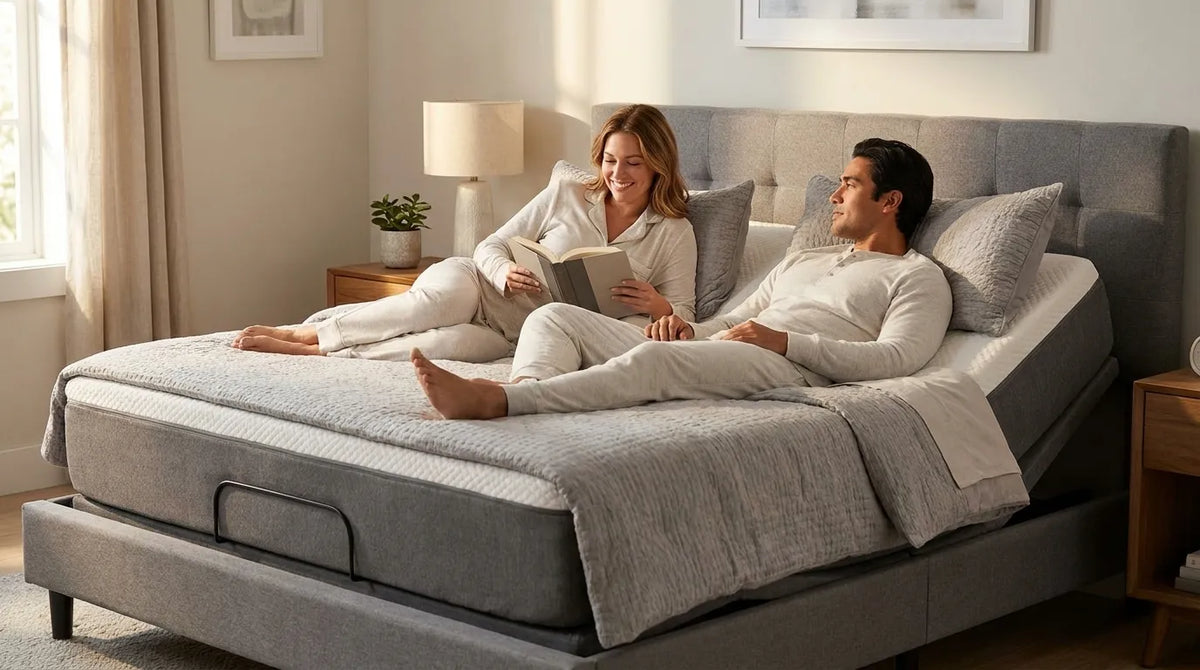
Sleep Technology For Couples: Problem-Routed Decision Guide
Written by: Matthew Timmins, Founder and Managing Director, Leva Sleep
Key Takeaways
- Sleep technology for couples lets each partner set their own temperature, position, and firmness in one shared bed.
- The right solution depends on the main incompatibility: temperature, snoring, firmness, pain, schedule, or room size.
- Water-based cooling systems give the tightest temperature control, while integrated systems like The Leva Sleep System combine temperature, position, and firmness in one package.
- A true Split Queen with 30" × 80" mattresses gives couples in smaller bedrooms independent adjustment in a Queen footprint.
- Leva Sleep offers one of the largest selections of Split Queen adjustable beds and complete sleep systems built for couples.
Shop Leva Sleep Adjustable Beds For Couples Today
Match Your Sleep Technology To Your Specific Problem
Different incompatibilities call for different types of technology. The table below routes each common couple problem to the category that addresses it and explains how it works.
| Your Couple Problem | Technology Category That Solves It | Why It Works |
|---|---|---|
| One sleeps hot, one sleeps cold | Dual-zone temperature control (air-based like BedJet, water-based like Eight Sleep Pod 5, or integrated per-side heating and cooling like The Leva Sleep System) | Each side maintains its own temperature independently, so neither partner forces their thermal preference on the other |
| One snores, one can’t sleep | Anti-snore positioning and head elevation | Elevating the head gently opens the airway, which reduces snoring for many sleepers |
| Different firmness preferences | Split mattress halves with independent firmness | Each partner chooses their own feel without compromising the other’s side |
| Different positions or back/hip pain | Independent articulation with lumbar control and pillow tilt | Each body gets its own geometry, so the compromise disappears instead of being negotiated |
| Different schedules | Independent sides plus dual-person tracking | Each partner adjusts their side without disturbing the other, and tracking identifies patterns for each sleeper separately |
| Smaller bedroom, can’t fit a King | True Split Queen | Two 30" × 80" mattresses form a 60"-wide footprint with fully independent adjustment on each side |
These categories often overlap in real life. A flat-bed geometry problem, a temperature conflict, and a snoring issue can all show up in the same bed. A complete sleep system tackles several at once, so couples avoid stacking single-purpose gadgets that never quite solve the whole problem.
Dual-Zone Sleep Technology For Couples: Why Temperature Causes Most Conflicts
Two people in one bed generate and retain heat differently. A shared flat surface forces one temperature on both partners, and blanket tug-of-war cannot change that physics. Three main technology approaches handle temperature with different mechanisms, precision levels, and prices.
Air-based systems (such as BedJet) push conditioned air through a hose into a sheet or under the covers. According to Sleep Sage’s September 2026 guide on bed cooling systems, air-based systems warm quickly, require no water maintenance, and are the least expensive route into active temperature control. They cool by evaporating sweat and moving air rather than chilling the surface directly. BedJet’s reported temperature range is approximately 66°F to 109°F, which is narrower on the cooling end than water-based alternatives.
Water-based mattress covers (such as the Eight Sleep Pod 5) circulate temperature-controlled water through channels in the cover. The Eight Sleep Pod 5 allows each side to be set independently from 55°F to 110°F. Because water carries far more heat than air, water-based systems hold a target temperature more precisely and are the most capable option for sustained cooling. Trade-offs include distilled-water maintenance, periodic cleaning to prevent biofilm, pump noise, and higher price. The Eight Sleep Pod 5 Core Bundle queen size is listed at a discounted $2,799 (from $2,999), with the bundle range starting at $2,848 for a full size, and it requires a 12-month commitment to its standard Autopilot subscription at $17 per month ($199 billed annually), with higher tiers available.
Integrated per-side heating and cooling built into the bed system, as in The Leva Sleep System at $1,299, combines temperature control with position and firmness adjustment in one system. This approach removes the need to layer a separate cooling cover over an existing mattress and base.
Add-on cooling covers solve temperature only. For couples whose incompatibility spans more than one category, a system that integrates temperature, position, and firmness is the more efficient solution. Explore temperature and sleep compatibility further in Leva Sleep’s Sleep Temperature Control For Couples: Complete 2026 Guide.
Sleep Technology That Helps When One Partner Snores
Head elevation gently opens the airway, so anti-snore positioning reduces snoring for many sleepers. Clinicians commonly recommend sleeping with the head elevated for conditions including sleep apnea, acid reflux, and post-surgical recovery. An adjustable base lets couples hold that position at home every night without stacking pillows.
The research on head-of-bed elevation points in the same direction, with moderate certainty. A 2026 study published in The Laryngoscope by Maniaci and colleagues found that 30° head-of-bed elevation reduced the apnea–hypopnea index in obstructive sleep apnea patients by 31.0% compared with 14.0% in controls, with the effect strongest in patients whose apnea was position-dependent. A 2025 multicenter observational study in Sleep and Breathing found that average AHI fell from 25.7 events per hour while flat on the back to 17.8 at 30-degree elevation. Half of participants did not meet the study’s response threshold, which shows that elevation supports treatment but does not replace it.
Two technology categories address snoring specifically:
- Contact-free anti-snore devices that detect snoring and adjust a pillow or bed position automatically
- Adjustable bases with anti-snore mode that make micro-adjustments to the head of the bed in response to detected snoring
Neither category eliminates snoring or treats sleep apnea. Anyone with a diagnosed sleep disorder should consult a clinician before relying on positional therapy alone. Browse Leva Sleep’s snoring relief collection for adjustable bases with anti-snore mode.
How Couples Track Sleep Separately
Wearables and under-mattress trackers can report each partner’s sleep data separately, including stages, heart rate variability, respiratory rate, and time awake. Higher-end adjustable bases add AI-powered tracking directly into the system.
Dr. Kelly Baron of University of Utah Health’s Sleep Wake Center states that trackers by themselves do not improve sleep in studies. Tracking highlights patterns. The improvement comes from acting on those patterns by changing position, temperature, or firmness. An integrated sleep system connects the data to real adjustments, instead of leaving it as numbers on a screen.
Split King Versus Split Queen For Couples
This distinction often decides whether a couple can solve their sleep problem without giving up their bedroom.
A Split King is two Twin XL mattresses (each 38" × 80") placed side by side on two independent bases, forming a 76"-wide footprint identical to a standard King. Each side adjusts separately. Because Twin XL is a standard supply-chain size, any retailer can assemble a Split King from parts that already exist. Browse Leva Sleep’s Split King adjustable bed.
A Split Queen is two 30" × 80" mattresses on two independent bases, forming a 60"-wide footprint. Each side adjusts fully and independently, with both head and foot articulation. The 30" × 80" mattress size is a non-standard dimension that does not exist in the normal mattress supply chain. To offer a true Split Queen, a company must commit to manufacturing the mattress itself. Many couples in smaller bedrooms are told their only options are a standard Queen with no independent adjustment or a King that does not fit.
The 16-inch difference between 76" and 60" often decides whether the room works. A King requires a minimum room size of roughly 12' × 12', though some sources recommend 13' × 13' for comfortable clearance. A Queen fits comfortably in a 10' × 10' room. For couples in condos, older homes, or downsized spaces, that gap often becomes the deciding factor. The table below summarizes how the two configurations compare on the specs that matter most.
| Split King | Split Queen | |
|---|---|---|
| Mattress dimensions (each half) | 38" × 80" (Twin XL) | 30" × 80" |
| Total footprint | 76" wide × 80" long | 60" wide × 80" long |
| Independent adjustment | Yes, head and foot on each side | Yes, head and foot on each side |
| Mattress availability | Standard supply-chain size, widely available | Purpose-built size, must be manufactured specifically |
| Who It Is For | Couples with room for a King footprint who want independent adjustability | Couples in smaller bedrooms who need independent adjustability in a Queen footprint |
Leva Sleep’s true Split Queen uses two 30" × 80" mattresses on two independent bases with each side adjusting separately, though some packages (for example, Passions Adore) are also offered in a Split-Head Queen configuration. Browse the full Split Queen adjustable bed collection.

Why Leva Sleep Stands Out For Couples
A true Split Queen requires manufacturing the mattress itself, so only a handful of companies offer one. Leva Sleep is one of those specialists. Leva Sleep focuses on adjustable beds and complete, personalized sleep systems for couples. Over nine years and more than 25,000 customers, Leva has built and delivered adjustable sleep systems long enough to see what fails and to engineer around those failure points.
The case for Leva as a strong answer for couples rests on several verifiable facts.
For Position, Pain, And Snoring
- 15–20 adjustable base models versus 3–5 at a typical mattress retailer
- Independent split articulation powered by whisper-quiet German motors
- Lumbar control and pillow tilt for micro-geometry adjustment beyond simple head-up and foot-up
- Anti-snore mode that detects snoring and makes micro-adjustments to the head of the bed
For Temperature And Comfort
- Per-side heating and cooling via The Leva Sleep System ($1,299)
- Mattresses engineered to flex with the base instead of resisting articulation
- Bedding designed for movement, including extra-elastic fitted sheets, duvet clips, and remote pockets
For Smaller Bedrooms And Budget Range
- One of the largest selections of Split Queen adjustable beds in North America, with five packages from $1,399, using 30" × 80" mattresses Leva manufactures itself
- Complete adjustable bed packages from $1,299 to $8,999+
- Financing options including 0% APR
- In-house white-glove delivery and setup with old-bed removal
- Mattresses made in the US, with 50% of the US lineup unique to the American market
Leva also carries premium brands, including Aireloom, Tempur-Pedic, Stearns & Foster, Beautyrest, Serta, Kingsdown, and Helix, then pairs them with the right base. Specialists guide that pairing so each mattress sits on a base that supports how it is built.
As one Leva Sleep specialist puts it: “Split king is easy, it’s two standard mattresses. Split queen is a manufacturing decision. That’s why almost nobody offers it, and why couples in smaller bedrooms keep getting told no.”
For couples dealing with back, hip, or joint pain alongside partner incompatibility, the pain relief collection offers adjustable bed packages matched to pressure relief and spinal alignment. For a broader overview of how adjustable systems address couple-specific sleep conflicts, see Leva Sleep’s Couples Sleep Technology: The Complete Adjustable Bed Guide.
Explore Leva Sleep’s Complete Couple-Focused Sleep Systems
Who Should Not Buy Sleep Technology For Couples?
Some couples do not need this category. Couples who feel satisfied with a single shared sleep position and temperature, who are not experiencing partner disturbance, or who are not willing to adapt to a new sleep surface over several weeks may prefer to stay with a traditional setup. Adjustable sleep systems require a short adaptation period. Most sleepers adjust to a new mattress in 2 to 4 weeks, though high-density memory foam can take the full 30 to 90 days to break in.
Anyone with a diagnosed sleep disorder, including obstructive sleep apnea, should consult a clinician before relying on positional therapy as a primary intervention. Sleep technology improves comfort and positioning and supports treatment plans. Clinical diagnosis and treatment still sit at the center of medical care.
Frequently Asked Questions About Sleep Technology For Couples
What Is The Best Sleep Technology For Couples With Different Temperature Needs?
Dual-zone temperature control is the core category for temperature conflicts. As covered above, couples can choose between air-based systems, water-based covers, or integrated systems that combine temperature with position and firmness. The tighter the temperature range and the more issues the system addresses at once, the more complete the solution feels for both partners.
Can Sleep Technology Replace Sleeping In Separate Rooms?
Sleep technology often lets couples share a bed again when it targets the specific incompatibility that pushed them apart. The AASM June 2025 survey found 31% of U.S. adults have opted for a sleep divorce, rising to 39% among adults aged 35–44. A system that solves temperature, position, and firmness at the same time gives both partners a reason to stay in the same room. Matching the category to the real problem matters more than choosing the most advertised product.
What Sleep Technology Helps If One Partner Snores?
Head elevation is the main tool. As covered above, head-of-bed elevation opens the airway and underpins anti-snore positioning. The two categories that address it are contact-free anti-snore devices and adjustable bases with anti-snore mode. Anyone with a diagnosed sleep disorder should work with a clinician before relying on positional therapy.
How Do Couples Track Sleep Separately?
Wearables, under-mattress sensors, and smart bases can track each partner individually. Tracking highlights patterns instead of fixing sleep by itself. Acting on those patterns with changes in temperature, position, or firmness creates the real improvement. Couples prone to sleep anxiety should focus on multi-night trends rather than reacting to a single bad score.
What Is The Difference Between A Split King And A Split Queen?
A Split King uses two standard Twin XL mattresses for a 76"-wide footprint, while a Split Queen uses two 30" × 80" mattresses for a 60"-wide footprint. The Split Queen relies on a purpose-built mattress size, so only manufacturers who commit to that size can offer it. That 16-inch difference in width often determines whether independent adjustment fits in a smaller bedroom.
Do Adjustable Beds Make Noise?
Noise levels vary widely. Basic adjustable bases sold as quick add-ons at mattress chains often use louder motors and jerky movement. Specialist adjustable bed companies, including Leva Sleep, use quieter motors and smoother travel so one partner can move without waking the other.
Conclusion: Match The Technology To Your Problem
Two different bodies forced into one geometry and one temperature create most couple sleep problems. The solution pathways are clear: dual-zone temperature control for thermal incompatibility, anti-snore positioning for airway obstruction, independent firmness for comfort preference differences, independent articulation for position and pain, dual-person tracking for pattern identification, and a true Split Queen for couples in smaller bedrooms who need all of the above in a 60"-wide footprint.
The most common mistake is buying the most visible technology category instead of the one that fits the actual incompatibility. A cooling pad addresses temperature. A wedge pillow addresses position. A complete sleep system, with base, mattress, bedding, and accessories matched to work together, handles multiple problems at once and reduces the need for a stack of single-purpose add-ons.
Anyone with a diagnosed sleep disorder should consult a clinician before relying on sleep technology as a primary intervention. For everyone else, the decision starts with naming the specific problem and routing to the category that solves it. For more on how to navigate that decision as a couple, see Leva Sleep’s guide on Sleep Divorce Alternatives That Keep Couples In Bed.
Find The Sleep System That Matches Your Couple Incompatibility


