Sleep Technology For Acid Reflux: How To Choose What Works
Written by: Matthew Timmins, Founder and Managing Director, Leva Sleep
Key Takeaways For Nighttime Reflux Relief
- Left-side sleeping combined with upper-body elevation is the clinically recommended approach for reducing nighttime acid reflux.
- Most sleep technologies solve only one variable: wedges and elevators handle elevation but not left-side positioning, while positional wearables do the reverse.
- Adjustable bed bases are the only category that holds a consistent elevation angle all night without compression or nightly setup.
- Right-side sleeping and lying flat on the back are the worst positions for nighttime reflux because they place the esophagus below stomach acid levels.
- Leva Sleep specializes in adjustable bed systems that deliver reliable elevation for reflux relief while allowing couples to customize positions independently.
Find Your Reflux-Friendly Adjustable Bed At Leva Sleep
Why Nighttime Heartburn Feels So Intense
Nighttime reflux behaves differently from daytime reflux. During the day, gravity keeps stomach contents down, saliva neutralizes acid that reaches the esophagus, and swallowing clears any reflux back into the stomach dozens of times per hour. At night, all three of those defenses weaken at the same time.
The lower esophageal sphincter (LES) is weak or relaxes when it should not, per the National Institute of Diabetes and Digestive and Kidney Diseases (NIDDK, 2020), and lying flat removes gravity’s assistance entirely. Swallowing decreases during sleep, which reduces acid clearance, and saliva production drops, which reduces natural neutralization. The result is that any acid that refluxes during sleep sits in contact with the esophageal lining far longer than the same amount would during the day.
Four mechanisms worsen GERD at night: gravity working against you when lying flat, LES relaxation, delayed digestion from eating close to bedtime, and increased abdominal pressure from lying on the right side or flat on the back. Sleeping flat on the back allows gastric acid to pool around the LES and increases the risk of nighttime regurgitation, while sleeping on the right side places the stomach higher than the esophagus and encourages acid to flow backward.
The Two Variables: Elevation Angle And Left-Side Position
The standard clinical advice for nighttime reflux gives two separate instructions: elevate the upper body, and sleep on the left side. These are separate mechanical problems that need separate solutions.
The 2022 American College of Gastroenterology (ACG) GERD guideline specifies that head-of-bed elevation should incline the torso, not just the neck, using a wedge or bed risers, so the esophagus stays above the stomach. The same guideline links right-side sleeping to increased nighttime and after-meal reflux compared with left-side sleeping.
Left-side sleeping keeps the junction between the stomach and esophagus above gastric acid levels because the stomach sits on the left side of the body. A 2022 study in the American Journal of Gastroenterology found that the left side had the shortest acid exposure during sleep (median 0.0% of time), while the right side (median 1.2%) and supine positions had higher exposure, and that acid clearance time was shortest on the left side (about 35 seconds) versus the right side (about 90 seconds).
A wedge pillow elevates but does not keep you on your left side. A positional wearable keeps you on your left side but does not elevate. No single technology category solves both variables simultaneously, which is why comparing them through this two-variable lens matters.
Sleep Technology For Acid Reflux: How The Options Compare
The table below maps each technology against elevation, left-side control, and all-night stability so you can see which options solve one problem and which solve both.
Wedge Pillows And Under-Mattress Elevators: Pros And Cons
Wedge pillows and under-mattress elevators share two advantages: they are inexpensive and require no installation. For someone who wants to test elevation before committing to a larger purchase, a wedge pillow offers a practical starting point.
The failure modes are specific. Memory foam wedges hold their incline through the night, while polyfoam tends to compress under body heat and weight and lose elevation, with the incline slowly flattening by around 4 a.m., exactly when reflux tends to spike. Another documented issue is sliding down the incline during sleep, especially on slippery surfaces.
Stacking multiple regular pillows under the head bends the neck forward and increases abdominal pressure, which may actually worsen reflux rather than relieve it. When using bed risers, the entire bed frame at the head must be raised, and this option requires a sturdy bed frame.
The doctor-recommended incline for nighttime acid reflux is 15 to 20 degrees, which translates roughly to 7.5 to 10 inches of wedge height for most adults. Wedge pillows and under-mattress elevators handle elevation only and do not address the left-side position variable.
Adjustable Bed Bases: Reliable Elevation For Reflux Relief
An adjustable base is the only sleep technology category that holds a consistent elevation angle without nightly setup. The motorized head section raises to the clinician-recommended range and stays there without foam compression, sliding, or nightly re-stacking.
An adjustable bed frame allows precise angle control and can help people who also have snoring or mild sleep apnea by gently elevating the head to help open the airway. The limitation is clear: an adjustable base does not enforce a left-side sleeping position, so that choice remains with the sleeper. What it does provide is reliable control of the elevation variable every night, so the sleeper only has to manage one of the two variables consciously.
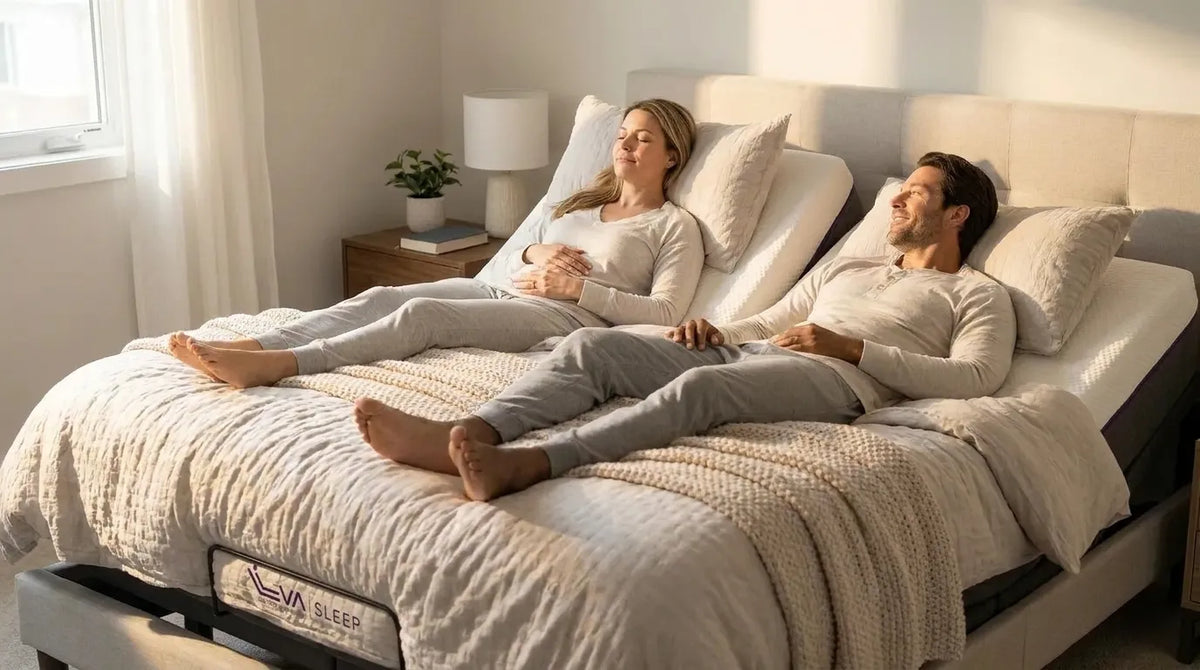
Leva Sleep focuses on adjustable bed systems. Features such as independent articulation, lumbar control, pillow tilt, and anti-snore positioning let each partner set their own elevation and position while still sharing a bed.

- Split Queen: two fully independent bases with head and foot articulation on each side, forming a 60-inch footprint with two 30" × 80" mattresses. Five packages start at $1,399.
- Split King: two Twin XL mattresses on two independent bases, forming a 76-inch footprint. Each side adjusts independently.
In a Split Queen or Split King configuration, one partner can elevate for reflux while the other stays flat, so each person keeps their preferred position. Complete adjustable bed packages from Leva Sleep run $1,299 to $8,999+. Leva Sleep’s policy states a 180-night comfort guarantee, though the US store may still display a 60-night guarantee with a comfort exchange fee pending confirmation.
Leva Sleep also offers collections specifically for pain relief and snoring relief, which often matter to people who also manage reflux.
Explore Adjustable Bases For Reflux, Pain, And Snoring At Leva Sleep
Positional Wearables And Smartwatch Apps: Training Left-Side Sleep
Adjustable bases solve the elevation variable, but they leave the left-side position variable to the sleeper. Positional wearables attack that second variable directly.
These devices vibrate when the sleeper rolls onto their right side, which trains the body to stay on the left. The clinical rationale has growing support.
A double-blind, sham-controlled trial of adults with nocturnal reflux found that an active sleep positional therapy wearable reduced right-side sleep time to 2.2% versus 23.5% in the sham group, with treatment success rates of 44% vs. 24%. A smartwatch-based positional therapy app cut right-side sleep from 31.8% to 8.1% in people with nighttime reflux, with symptom scores improving over the study period.
The limitations are straightforward. Vibration can disrupt sleep, particularly for light sleepers, and a training period is required before the body adapts. Most importantly, positional wearables do not elevate the upper body, so they address only one of the two variables. For a sleeper who is already elevated and whose primary problem is rolling onto the right side during the night, a wearable can complement their setup. It does not replace elevation.
What To Do Tonight And What To Plan Long-Term
For immediate relief, a practical starting point is left-side sleeping combined with a wedge pillow that supports the shoulders and upper back, not just the head. When choosing a wedge, look for a 6 to 8 inch incline, firm supportive foam, and a length long enough to support the shoulders and upper back. Separately, finishing eating at least 2–3 hours before bed reduces the volume of stomach contents available to reflux.
For long-term control, an adjustable base is the only category that holds a consistent elevation angle without nightly setup or frequent replacement. Wedge pillows, especially polyfoam models, tend to compress over months and lose their effective angle. An adjustable base holds the same position on night one and night five hundred.
The hardware decision has a technology answer: elevation plus left-side position, delivered reliably every night. Medication and hardware address different parts of the problem and are often used together.
Compare Leva Sleep Adjustable Bases For Long-Term Reflux Relief
When To See A Doctor: GERD, LPR, And Red Flags
Sleep positioning hardware changes the mechanical conditions that worsen nighttime reflux. It does not replace clinical evaluation when symptoms raise concern.
Red-flag symptoms that warrant seeing a gastroenterologist include chest pain or pressure at night (especially with sweating, shortness of breath, or pain radiating to the arm or jaw), difficulty or pain swallowing food, and unintentional weight loss alongside nighttime reflux. Chest pain with those accompanying features requires emergency care and not home treatment alone.
GERD and laryngopharyngeal reflux (LPR) share the same underlying problem but affect different areas. GERD affects the esophagus, while LPR affects the throat and voice box, and more than half of people with LPR never experience heartburn at all. Symptoms of LPR, such as hoarseness, chronic throat clearing, and persistent cough, often mimic allergies and post-nasal drip.
The San Diego Consensus for Laryngopharyngeal Reflux Disease (2026) recommends upfront objective testing in patients with isolated laryngopharyngeal symptoms prior to long-term acid suppressive therapy, because isolated laryngopharyngeal symptoms carry a low pretest probability of confirmed laryngopharyngeal reflux disease. Symptoms that suggest LPR warrant evaluation rather than self-treatment alone.
Frequently Asked Questions About Reflux And Sleep
What Is The Best Sleeping Position For Acid Reflux?
The best sleeping position for acid reflux is left-side sleeping with the upper body elevated 6 to 8 inches. Left-side sleeping keeps the junction between the stomach and esophagus above gastric acid levels because the stomach sits on the left side of the body. When lying on the left side, gravity works against acid flowing upward rather than assisting it. Elevation adds a second mechanical barrier by keeping the esophagus above the stomach regardless of position. Together, elevation reduces the volume of acid that can reach the esophagus, and left-side positioning reduces the anatomical opportunity for it to do so.
What Is The Worst Sleeping Position For Acid Reflux?
Right-side sleeping and lying flat on the back are the worst positions for nighttime acid reflux. As noted earlier, the 2022 ACG guideline links right-side sleeping to increased reflux. Lying flat on the back allows gastric acid to pool around the lower esophageal sphincter and increases the risk of nighttime regurgitation. Both positions remove the gravitational advantage that left-side sleeping and elevation provide.
Does Lack Of Sleep Make Acid Reflux Worse?
The relationship between sleep deprivation and acid reflux is bidirectional. Nighttime reflux disrupts sleep by waking sufferers with heartburn, coughing, or regurgitation, and disrupted sleep lowers the threshold at which esophageal discomfort feels painful. Research indicates that sleep deprivation increases esophageal sensitivity to acid in patients with GERD (erosive esophagitis), meaning the same amount of acid exposure produces more noticeable symptoms in a sleep-deprived GERD patient than in a well-rested one, whereas healthy controls show no such change. This creates a reinforcing cycle in which reflux disrupts sleep, disrupted sleep amplifies reflux perception, and amplified symptoms make it harder to sleep. Addressing the mechanical causes of nighttime reflux through elevation and left-side position helps interrupt that cycle at its source.
What Is The Connection Between Acid Reflux And Sleep Apnea?
Acid reflux and obstructive sleep apnea frequently co-occur, and proposed bidirectional mechanisms suggest each can worsen the other, though the strength and causality of this association remain debated and not all meta-analyses reach statistical significance. Both conditions worsen in the supine position: lying flat removes gravity’s help for reflux and allows soft tissue to collapse into the airway for apnea.
Research shows that CPAP therapy, the standard treatment for sleep apnea, reduces acid reflux in people who have both conditions, likely because it maintains positive airway pressure that also reduces negative intrathoracic pressure, which can otherwise draw acid upward; however, this benefit requires adequate CPAP adherence, such as at least 4 hours of use per night on 70% or more of nights. Head elevation can help with both reflux and snoring or mild apnea by keeping the esophagus above the stomach and gently opening the airway. An adjustable base that holds a consistent head elevation is relevant for people managing either or both conditions.
Is An Adjustable Bed Worth It Compared To A Wedge Pillow?
The mechanical difference is straightforward. As described earlier, polyfoam wedges compress overnight and lose their angle. An adjustable base holds a motorized position that does not compress or shift. There is no nightly setup, and the angle remains stable over months of use.
Wedge pillows are a reasonable low-cost starting point for someone testing whether elevation helps their symptoms. For someone who has already confirmed that elevation helps and wants a reliable, long-term solution, an adjustable base is the only category that delivers consistent elevation without ongoing maintenance. Leva Sleep’s adjustable bed packages start at $1,399 for a Split Queen, with the same comfort guarantee terms noted above.
Conclusion: Turning Reflux Science Into A Nightly Setup
Nighttime reflux behaves differently from daytime reflux because lying flat removes gravity’s help, saliva production drops, and swallowing nearly stops. The standard clinical advice of an elevated upper body and left-side sleeping translates into two mechanical variables that need reliable solutions. Most sleep technologies address only one.
An adjustable base is the only category that holds a consistent elevation angle all night without nightly setup. It does not enforce left-side sleeping, but it delivers the elevation variable so the sleeper can focus on position. For couples, a Split Queen or Split King configuration means each partner controls their own elevation independently while still sharing a bed.
Leva Sleep is a specialist adjustable bed company serving the United States, with a showroom in La Jolla, California. Over nine years and more than 25,000 customers, Leva has built complete adjustable sleep systems that include bases, mattresses engineered to flex, and bedding designed for movement. For more on how adjustable bases address reflux and related conditions, see Adjustable Bed For Sleep Apnea And Acid Reflux: What Works, How To Use An Adjustable Bed For Acid Reflux Relief, and The Best Adjustable Bed For Acid Reflux Relief.
Last updated: September 29, 2026
Start Building Your Reflux-Relief Sleep System With Leva Sleep