
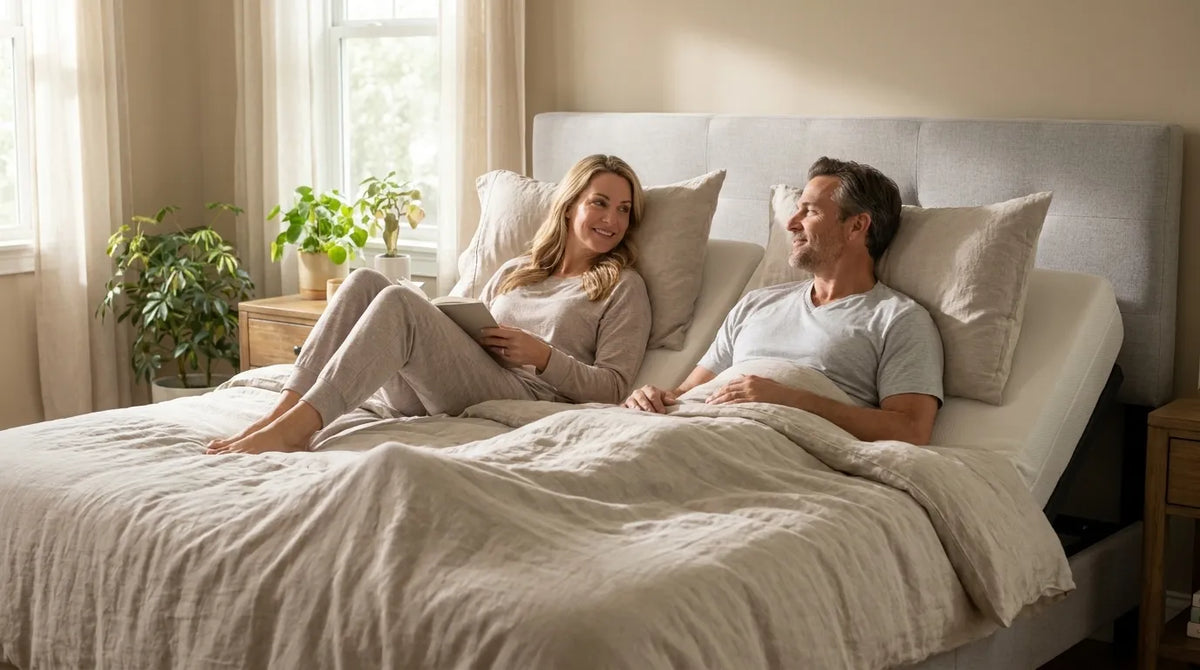
Sleep Apnea Bed for Couples: A Configuration-First Guide
Written by: Matthew Timmins, Founder and Managing Director, Leva Sleep
Updated September 2026
Key Takeaways For Couples With Sleep Apnea
- Independent articulation with separate adjustable bases is the most effective bed setup for couples managing sleep apnea.
- Head-of-bed elevation uses gravity to help keep the airway open, and even a modest 7.5-degree lift can reduce apnea events.
- Split King and Split Queen configurations give each partner independent firmness, positioning, and motion isolation, with Split Queen fitting smaller bedrooms.
- Quiet motors, CPAP hose routing, and anti-snore presets reduce nighttime disruptions for both partners.
- Leva Sleep offers the largest selection of Split Queen adjustable beds in North America, so couples can match configuration to their room and sleep needs.
Why A Flat Bed Fails A Couple With Sleep Apnea
A flat bed forces one spinal and airway geometry, for eight hours, on two people with different bodies and sleep styles. One partner may be 5′4″ and side sleeping with a hip that needs to sink. The other may be 6′2″ on his back with a lower back that needs support and an airway that closes when it lies horizontal.
A flat mattress can only respond with compromise. It ends up firm enough to fail one partner and soft enough to fail the other. That compromise lives in the surface itself. Changing the foam does not change the geometry. A better flat mattress is still a flat mattress.
The scale of the problem is measurable. 31% of US adults have opted for a “sleep divorce” — regularly sleeping in a separate room from a partner — rising to 39% among adults aged 35–44 (Atomik Research for the American Academy of Sleep Medicine, survey of 2,007 US adults, June 2025). Snoring from obstructive sleep apnea routinely reaches 50 decibels and can spike past 80 decibels, somewhere between a dishwasher and a garbage disposal, while a treated partner on CPAP runs at roughly 26 to 30 decibels, closer to a quiet whisper.
Roughly one in three American couples has already given up on sharing a bed comfortably. A configuration-first approach exists for couples who want to stay in the same room, and it starts with the position the body needs, not the mattress it rests on.
Best Sleeping Positions For Sleep Apnea Relief
Head elevation is a core positional tool for managing sleep apnea at home. Clinicians often recommend sleeping with the head elevated for sleep apnea, acid reflux, and post-surgical recovery. An adjustable base makes that position repeatable every night without a stack of pillows.
The mechanism is gravitational. When lying flat on the back, gravity pulls the base of the tongue and soft tissues of the palate downward, collapsing the upper airway and triggering apneas. Elevating the entire upper torso in a straight line uses gravity in the opposite direction and helps keep the airway more open. Clinical guidance is clear on one point. Stacking standard pillows pushes the chin toward the chest and can collapse the airway further. The torso must be elevated as a unit, which is what an adjustable base does.
Position-dependent obstructive sleep apnea, defined as OSA significantly more severe in the supine position, affects approximately 50–60% of OSA patients, according to a 2026 systematic review and network meta-analysis in BMC Pulmonary Medicine. Positional therapy can help this group, while PAP therapy remains the most effective intervention for AHI reduction overall.
Gentle head elevation often reduces snoring because it opens the airway. Leva Sleep’s anti-snore mode detects snoring and makes small head-of-bed adjustments automatically. The snoring relief collection highlights configurations that include this feature.
Best Bed Setups For Couples Managing Sleep Apnea
Four configurations come up most often for couples managing sleep apnea. The table below compares their dimensions, footprint, and the type of couple each one fits.
| Configuration | Dimensions | Footprint | Best For |
|---|---|---|---|
| Split King | Two Twin XL (38″ × 80″) | 76″ wide | Couples with room for a King who want two independent firmness choices and full per-side articulation |
| Split Queen | Two 30″ × 80″ (purpose-built) | 60″ wide | Couples in smaller bedrooms who were told split adjustability only comes in King |
| Split-Head Queen | Single mattress, head sections split | 60″ wide | One partner reads or elevates while the other does not; foot sections move together |
| Separate Beds | Two full beds | Varies | Couples who decide that separate sleep surfaces work better for their relationship |
The 76-inch versus 60-inch tradeoff shapes most real bedrooms. A standard king measures 76 inches wide, and a standard queen measures 60 inches wide. That 16-inch difference often decides whether the room layout works. A Split King needs roughly 76 inches of wall. A Split Queen needs 60. That gap often decides whether a couple solves their sleep problem or gives up on it.
Leva Sleep offers the largest selection of Split Queen adjustable beds in North America, with five distinct packages from $1,399, mattresses manufactured in-house in 30″ × 80″, and a full line of bedding and accessories built to fit them. The typical retailer offers none. The five packages are Cala, Vela, Heavenly Response, Passions Adore, and Sereno Signature. Complete adjustable bed packages across the full lineup run $1,299 to $8,999+ (Leva US catalog, August 2026).

To compare Split Queen options, explore Leva Sleep’s Split Queen adjustable beds. For Split King configurations, review the Duet Split King adjustable bed.
Managing CPAP Noise And Hoses In A Shared Bed
CPAP noise often pushes couples toward separate rooms, yet the real comparison is CPAP versus untreated apnea. Untreated apnea is far louder than any modern machine. Most modern CPAP machines produce around 26 to 30 decibels, roughly the volume of a light whisper.
Several practical setup steps reduce CPAP disruption in a shared bed:
- Nightstand clearance: Place the CPAP machine on a stable surface at or slightly below mattress height to prevent tubing strain and keep airflow smooth.
- Hose routing: Route tubing loosely so it does not drag against the bed frame or headboard. A kinked or compressed hose creates turbulence and extra noise.
- Sound-dampening: Place the machine on a soft cloth or anti-vibration pad away from hard sound-reflecting surfaces.
- Mask fit first: Mask leaks from improper fit are one of the leading sources of CPAP noise. Address the mask before changing the room.
Whisper-quiet motors matter in this context. A bed that wakes a partner every time it adjusts has not solved the problem. Leva Sleep uses whisper-quiet German motors with smooth, gradual travel, so anti-snore micro-adjustments happen without creating a second disruption.
Safety Considerations When Sleeping With A Partner Who Has Sleep Apnea
Clinicians should answer the medical question. Untreated sleep apnea is linked to cardiovascular disease, so relying on bed position instead of obtaining a proper diagnosis carries real risk. The American Academy of Sleep Medicine clinical practice guideline establishes CPAP as the standard of care for adult obstructive sleep apnea (Patil SP, Ayappa IA, Caples SM, et al., Journal of Clinical Sleep Medicine, 2019; 15(2):335-343).
Head-of-bed elevation works as an adjunct that reduces symptoms mainly for mild to moderate and positional cases. A 1999 study in Mayo Clinic Proceedings found that bed partners gained an estimated 62 minutes of sleep per night when a CPAP machine was running, compared to nights with untreated apnea.
The bed partner’s own health also matters. A 2025 American Heart Association scientific statement linked chronic poor or fragmented sleep to higher blood pressure and greater risk of heart disease and stroke, even in people without diagnosed sleep disorders. The partner without the diagnosis still carries risk when sleep is disrupted.
Many Leva Sleep customers arrive after a doctor or physiotherapist recommends an elevated sleeping position. The adjustable base becomes the practical positional complement to medical treatment, not a replacement for it.
Key Features To Look For In An Adjustable Base
Each feature in an adjustable base addresses a specific part of the geometry problem couples face:
- Anti-snore preset: Gently elevates the head to help open the airway and treat position as a health input.
- Independent controls: Give each partner their own geometry, so the compromise disappears instead of being negotiated every night.
- Quiet motors: Keep adjustments from waking the partner, even when anti-snore modes move the bed during sleep.
- Lumbar control: Adds a dedicated motor for the lower back curve, separate from head or foot elevation.
- Pillow tilt: Angles the head and pillow section independently for reading, watching, or fine-tuning airway position.
- Zero gravity preset: Slightly elevates head and knees to distribute body weight and reduce lower-back pressure.
Leva Sleep offers 15–20 adjustable base models, while a typical mattress retailer stocks 3–5 (Leva US catalog, August 2026). For couples managing pain alongside sleep apnea, the best beds for pain relief collection includes configurations with lumbar control and zero gravity positioning.
Who Should Skip An Adjustable Bed
An adjustable bed does not fit every situation. Head elevation does nothing for central sleep apnea, which is a neurological problem rather than an airway obstruction. Without a diagnosis, an adjustable base cannot replace a sleep study. When moderate to severe obstructive sleep apnea is present, CPAP remains the standard of care. If neither partner plans to use articulation, a flat bed stays simpler and less expensive.
Clear limits build trust. Leva Sleep is a specialist in adjustable sleep systems, not a medical device company, and that distinction matters.
Frequently Asked Questions
What Is The 3% Rule For Sleep Apnea?
The 3% rule refers to the AASM hypopnea scoring criterion. It defines a hypopnea as a ≥30% airflow reduction lasting at least 10 seconds, accompanied by either a ≥3% oxygen desaturation or an arousal. The oxygen desaturation index (ODI) is a separate metric that counts the number of ≥3% arterial oxygen desaturations per hour of sleep. Sleep specialists use these measures to assess apnea severity. A sleep study is required to measure them accurately, so diagnosis and treatment decisions belong with a clinician.
Is Side Sleeping Good For Sleep Apnea?
As noted earlier, roughly half of OSA patients have position-dependent apnea, so side sleeping can reduce symptoms for that group. Head-of-bed elevation remains the more consistently documented positional intervention for back sleepers because it addresses the gravitational collapse of soft tissue into the airway. For couples where one partner is a back sleeper with sleep apnea and the other prefers side sleeping, an adjustable base with independent elevation lets each partner keep their position while still supporting the airway.
How Can Couples Reduce CPAP Disruption At Night?
The most effective approach combines machine placement, hose management, mask fit, and base selection. Place the CPAP on a stable surface at or slightly below mattress height, route tubing loosely without sharp bends, and use a soft mat under the device to reduce vibration. Address mask fit before anything else because leaks are a common source of CPAP noise. Choose an adjustable base with whisper-quiet motors so positional changes stay unobtrusive. A split configuration lets the CPAP user adjust their side without moving the partner’s side.
What Is The Difference Between A Split Queen And A Split-Head Queen?
A Split Queen uses two fully independent bases, each 30″ × 80″, with complete head and foot articulation on each side. Both partners can adjust head elevation, foot elevation, lumbar support, and other base features independently. A Split-Head Queen uses a single mattress with only the head sections split, while the foot sections move together. The Split-Head layout suits couples where one partner reads or elevates while the other stays flat, yet it does not provide full independent positioning for apnea management. Leva Sleep’s Split Queen is always the fully independent two-base configuration.
Does A Split Queen Require Special Bedding?
Split adjustable beds need bedding designed for articulation. Standard fitted sheets pull loose at the corners once the base moves. A true Split Queen also uses a non-standard mattress size (30″ × 80″), so standard queen sheets do not fit correctly. Leva Sleep manufactures a complete Split Queen accessory ecosystem: Alpine Pure Cotton and Bamboo Breeze sheet sets cut for split configurations with extra elastic, Remy and Remy Sub Zero mattress protectors in Split Queen, and duvet clips that maintain separation when the two sides sit at different angles. The bedding functions as part of the sleep system.
The Configuration-First Answer For Couples
A flat bed forces one airway and spinal geometry on two different bodies. Independent articulation, gentle head elevation, quiet motors, and CPAP clearance each address a different part of that geometry problem. The configuration decision, including Split Queen versus Split King, base features, and mattress construction, is the decision that changes real-world outcomes.
Leva Sleep is a specialist adjustable bed company offering complete, personalized sleep systems for couples. Over nine years, the company has served more than 25,000 customers. Complete packages range from $1,299 to $8,999+, backed by a 180-night comfort guarantee (per company policy; confirm current terms), with in-house white-glove delivery and setup that includes old-bed removal and a walkthrough with both partners.


