
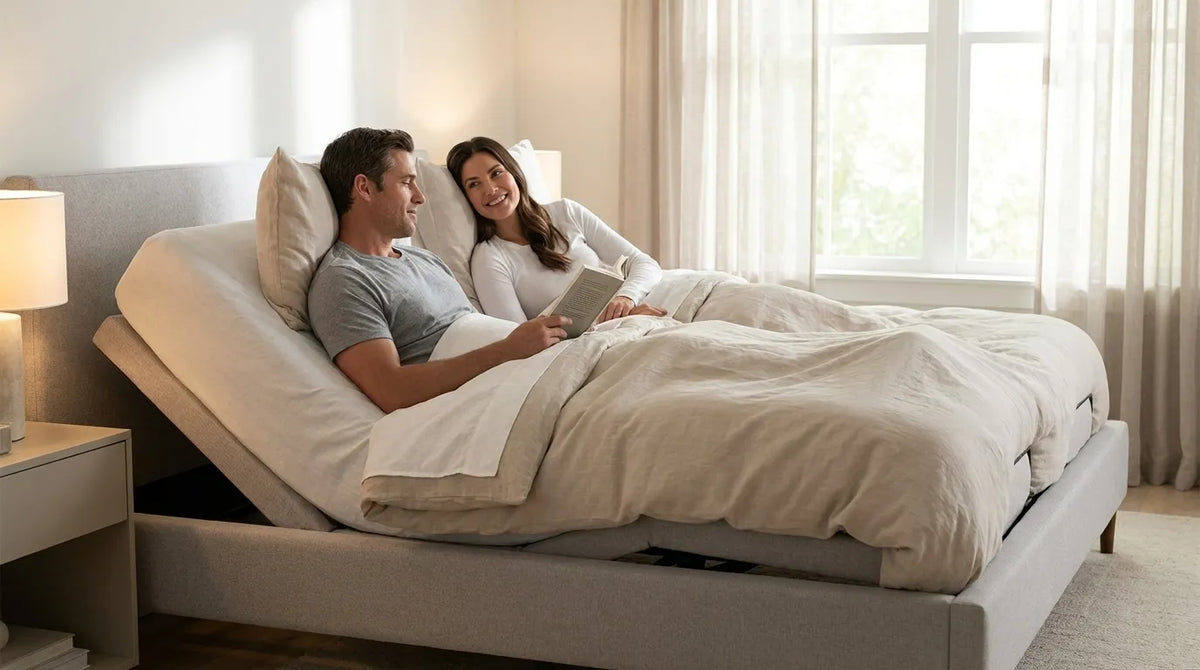
Adjustable Bed for Sleep Apnea Couples: Split King vs. Queen
Written by: Matthew Timmins, Founder and Managing Director, Leva Sleep
Updated: September 30, 2026
Key Takeaways For Sleep Apnea Couples
- Elevating the head of the bed helps keep the airway open for sleep apnea, and a split setup lets each partner adjust independently.
- Split King (76 inches wide) uses standard Twin XL mattresses and suits large bedrooms. Split Queen (60 inches wide) uses purpose-built mattresses and fits smaller spaces.
- Split-Head configurations only split the head section, so the partner without apnea has less independent control than on a full split base.
- Adjustable beds work alongside CPAP therapy. Hose slack and mask fit need attention when the head is elevated.
- Leva Sleep offers five Split Queen packages with 30" × 80" mattresses and a full accessory line built for couples who need independent adjustment.
Shop Leva Sleep Adjustable Beds
Why Sleep Apnea Becomes A Couples Problem
A 2025 survey of 2,007 US adults conducted by Atomik Research for the American Academy of Sleep Medicine found that 31% of American adults have opted for a “sleep divorce” — regularly sleeping in a separate room from a partner — rising to 39% among adults aged 35–44. A further 37% reported going to sleep at different times to accommodate a partner.
The partner without sleep apnea often carries the disruption. They lie awake, absorb the noise and movement, and eventually move to the guest room. A split adjustable bed helps the partner with apnea breathe better while keeping both people in the same bed.
A 2023 study published in Cureus found that after treatment for sleep apnea, 72.4% of couples who had been sleeping apart began sharing a bed again. Solving the positioning problem changes the relationship dynamic as well as the AHI score.
Find Split Configurations Built For Couples
Split King Vs. Split Queen Vs. Split-Head: Matching Configuration To Your Room
Room width and the need for independent adjustment decide the right configuration. Preference comes after those constraints.
A Split King needs roughly 76 inches of wall. A Split Queen needs 60 inches. That 16-inch difference often decides whether the room works, yet many couples only hear “Split King” without any width context.
The table below compares the three configurations on the details that drive the decision: footprint, mattress type, and which couples each one serves best.
| Configuration | Footprint Width | Mattress Size Required | Who It's For |
|---|---|---|---|
| Split King | 76" (two Twin XL at 38" × 80") | Two Twin XL (38" × 80") — a standard supply-chain size | Couples with a large primary bedroom who need full independent articulation on each side |
| Split Queen | 60" (two 30" × 80") | Two 30" × 80" — a purpose-built size not found in the standard supply chain | Couples in condos, apartments, guest rooms, older homes, or smaller primary bedrooms who need full independent articulation on each side |
| Split-Head | One standard Queen, King, or California King footprint | A single connected mattress (e.g., a 76" W × 80" L king mattress), rather than two separate Twin XL mattresses | Couples where one partner elevates the head and the other stays flatter, with head-only split and shared foot articulation |
Split King works well in large rooms but needs 76 inches of bed width plus side clearance. Split Queen fits smaller rooms but depends on purpose-built mattresses that most retailers do not stock. Split-Head keeps a single mattress and only splits the head section, so both feet move together and the partner without apnea has less freedom.
Compare Split King And Split Queen Options
Why Split Queen Is So Hard To Find
A true Split Queen uses two 30" × 80" mattresses, a size outside the normal mattress supply chain. Split King is simple for manufacturers because it uses two standard Twin XL mattresses (38" × 80"). Split Queen requires a brand to commit to the mattress, the base, and every accessory that must fit that footprint.
Most retailers therefore answer “no” when asked about Split Queen. Couples are pushed toward a standard Queen with no split or a King that does not fit their room.
Leva Sleep offers the largest selection of Split Queen adjustable beds in North America. The five packages start at $1,399 and use 30" × 80" mattresses Leva manufactures in-house. A full line of Split Queen bedding and accessories is built to those exact dimensions.
The five packages are the Cala ($1,399), Vela ($1,899), Heavenly Response ($1,899), Passions Adore ($2,699), and Sereno Signature ($2,799). Leva builds the 30" × 80" mattresses in two constructions, Heavenly Hybrid (pocket coil) and Heavenly Response (all-foam), and in two firmness levels so each partner can choose their own feel.

Every Leva Split Queen accessory is built to fit: Alpine Pure Cotton and Bamboo Breeze sheet sets with extra elastic that holds at full elevation, Remy and Remy Sub Zero mattress protectors, bedding bundles, and the Leva Sleep System per-side heating and cooling, all in Split Queen sizing.
Leva Sleep uses “Split Queen” to mean two fully independent bases with head and foot articulation on each side. This is a full split configuration with two mattresses, not a split-head arrangement.
Browse The Full Split Queen Collection
See Split Queen Availability And Pricing
How CPAP And Adjustable Beds Work Together
CPAP therapy works with adjustable beds when the setup accounts for hose slack and mask seal. CPAP delivers pressurized air through a mask to keep the airway open during sleep, so it remains mechanically compatible with head elevation.
CPAP tubing should have enough slack so the hose does not tug on the mask or pull it out of position when the head section rises. Routing the tubing behind the head near the top of the pillow or behind the headboard helps prevent tangling, and a tubing lift holds the hose above the head for easier movement. The machine should sit on a firm, level surface at or slightly below head level to reduce condensation draining toward the face.
Mask fit should be checked in the person's normal sleeping position, not only while sitting upright, because fit changes once lying down. Any change in position, including head elevation, can shift the seal, so checking fit after adjusting the bed angle helps keep therapy effective.
An adjustable bed serves as a positional aid used alongside clinician-directed CPAP therapy. An adjustable or smart bed does not treat or cure diagnosed obstructive sleep apnea and CPAP remains the medical gold standard.
How Much Head Elevation Helps Sleep Apnea
A 2017 study at a Brazilian sleep clinic tested 52 patients, most with mild to moderate obstructive sleep apnea, with the head of the bed raised 7.5 degrees; the apnea-hypopnea index fell from 15.7 to 10.7 events per hour, a reduction of about 31 percent. A 2026 study found that 30-degree head-of-bed elevation produced significantly better AHI than flat supine posture, with greater improvement in patients whose apnea is positional.
For people with severe OSA, positional therapy alone rarely brings AHI into a normal range, though it still reduces the total burden and may improve symptoms. Mild-to-moderate positional cases tend to benefit most. Anyone with diagnosed sleep apnea should discuss positional therapy with their clinician rather than substituting it for prescribed treatment.
The split configuration lets the partner with apnea sleep at an angle while the other partner stays flatter. Leva Sleep's snoring relief collection includes systems with anti-snore positioning that gently elevates each side of the head independently.
The Downsides Of Adjustable Beds For Sleep Apnea
Adjustable beds bring real tradeoffs, and naming them clearly helps couples plan.
Noise. Every adjustable bed frame makes sound when it moves; normal operation is a low, steady hum for five to fifteen seconds, roughly the volume of a bathroom fan two rooms away, followed by silence. Basic or older bases can be significantly louder. Leva Sleep uses whisper-quiet German motors with smooth, gradual travel designed for shared beds.
Mattress compatibility. Traditional innerspring mattresses with connected coil units and rigid border rods resist bending on an articulating base, and forcing them to bend can break the border and often void the mattress warranty. Leva builds Heavenly Hybrid pocket coil and Heavenly Response all-foam mattresses to flex with the base night after night.
Bedding retention. Standard fitted sheets often pull loose at the corners when the head of an adjustable bed rises, especially on split configurations where two mattresses move against each other. Leva sheet sets, protectors, and duvets use extra elastic, deep pockets, and duvet clips to stay put on articulated beds.
Scope of benefit. An adjustable bed works as a comfort and positional aid that complements prescribed treatment. It supports better positioning but does not cure sleep apnea.
What To Do If A Split King Does Not Fit
Bedrooms narrower than 76 inches, or rooms where 76 inches leaves little side clearance, call for a different solution. Leva Sleep manufactures that alternative in Split Queen.
- Five Split Queen packages starting at $1,399
- Two mattress constructions (Heavenly Hybrid pocket coil and Heavenly Response all-foam) in two firmness levels, manufactured in-house in 30" × 80"
- A complete Split Queen accessory line, including sheets, protectors, duvets, and per-side heating and cooling, all built to fit
- Two fully independent bases with head and foot articulation on each side, within a 60-inch footprint
Leva Sleep's stated policy is a 180-night comfort guarantee. The US store currently displays a 60-night comfort guarantee and a comfort exchange fee, and this discrepancy is being resolved. Couples can also use 0% APR financing so the purchase can be spread over time.
Explore Leva Sleep's pain relief collection for systems that address apnea, joint pain, acid reflux, and other conditions that bring couples to adjustable beds.
Browse all five Split Queen packages at Leva Sleep.
See If Split Queen Solves Your Space Constraint
Frequently Asked Questions
What Is The Best Adjustable Bed For Couples With Sleep Apnea?
The right configuration depends on bedroom width and whether both partners need independent adjustment. A Split King (76" wide) suits couples with a large primary bedroom who both need full per-side articulation. A Split Queen (60" wide) suits couples in condos, apartments, older homes, or smaller bedrooms who need the same independent control in a narrower footprint. A Split-Head configuration suits couples where only one partner needs head elevation and shared foot articulation is acceptable. The bedroom constraint comes first, then the feature set.
Split King Vs. Split Queen For Sleep Apnea Couples?
As covered above, the 16-inch difference between the two footprints often decides what fits. Split King uses two standard Twin XL mattresses, while Split Queen requires purpose-built 30" × 80" mattresses that most manufacturers do not produce. Leva Sleep manufactures those mattresses and offers five Split Queen packages from $1,399.
Does A CPAP Work On An Adjustable Bed?
CPAP therapy is mechanically compatible with head elevation on an adjustable base. The hose needs enough slack to avoid tugging the mask when the head section rises, and mask fit should be checked in the elevated sleeping position rather than sitting upright. Routing the tubing behind the headboard or using a tubing lift reduces tangling. An adjustable bed complements CPAP but does not replace it.
How Much Head Elevation Actually Helps Sleep Apnea?
Studies have tested elevations from 7.5 to 30 degrees, with meaningful AHI reductions reported across that range. Mild-to-moderate positional cases tend to benefit most, while severe OSA cases typically still require CPAP regardless of elevation. There is no single universally optimal angle, so a comfortable, stable elevation is the practical starting point, adjusted upward as needed. A clinician should be consulted about what elevation is appropriate for a specific diagnosis.
What Are The Downsides Of Using Adjustable Beds For Sleep Apnea?
The main limitations are motor noise on basic bases, mattress incompatibility with rigid innerspring designs, standard bedding that pops off at elevation, and the fact that head elevation provides supportive positioning rather than a cure. Couples using CPAP alongside an adjustable bed also need to manage hose slack and mask fit at the elevated angle. These issues are solvable with a system built for articulation instead of a standard mattress and base assembled from mismatched parts.
Explore Adjustable Systems For Sleep Apnea Couples
Conclusion: Choosing The Right Split Configuration
Choosing an adjustable bed for sleep apnea starts with the room, then the relationship, then the technology. Wall width decides whether Split King or Split Queen fits. The need for independent articulation decides whether a full split or Split-Head configuration makes sense. Apnea severity and CPAP use shape how much benefit head elevation can realistically provide.
Many couples are told Split King is the only path to true split adjustability. For couples whose bedroom suits a 60-inch footprint instead, Leva Sleep solves the manufacturing gap with five Split Queen packages, purpose-built 30" × 80" mattresses, and a complete accessory ecosystem. The system is backed by a stated 180-night comfort guarantee, while the US store currently lists a 60-night comfort guarantee and comfort exchange fee that are being aligned with that policy.
Start Building Your Split Sleep Apnea Setup


