Best Mattress for Sleep Apnea: Position Matters Most
Written by: Matthew Timmins, Founder and Managing Director, Leva Sleep
Key Takeaways
- Sleep position has the biggest impact on sleep apnea outcomes. Mattress firmness affects comfort and support but does not treat the condition.
- Supine sleeping, or lying flat on the back, is the most problematic position for sleep apnea because gravity collapses the airway. Clinicians recommend head-of-bed elevation instead.
- An adjustable base provides the elevation clinicians recommend, while a mattress engineered to flex with the base maintains that position without bunching or losing support.
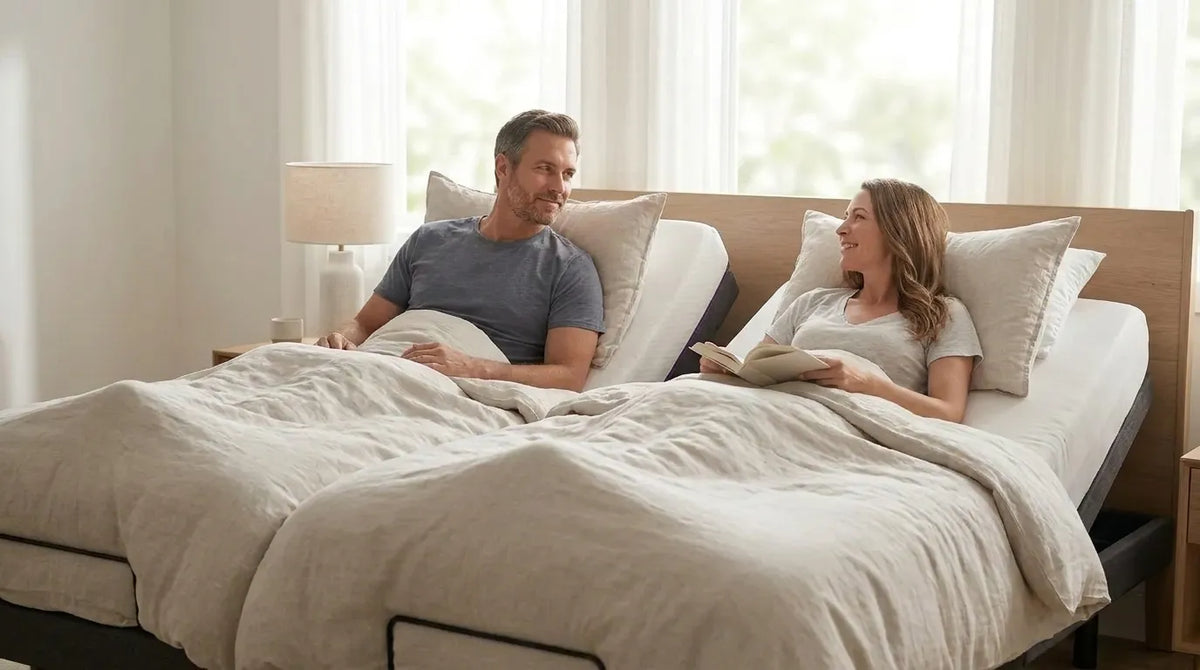
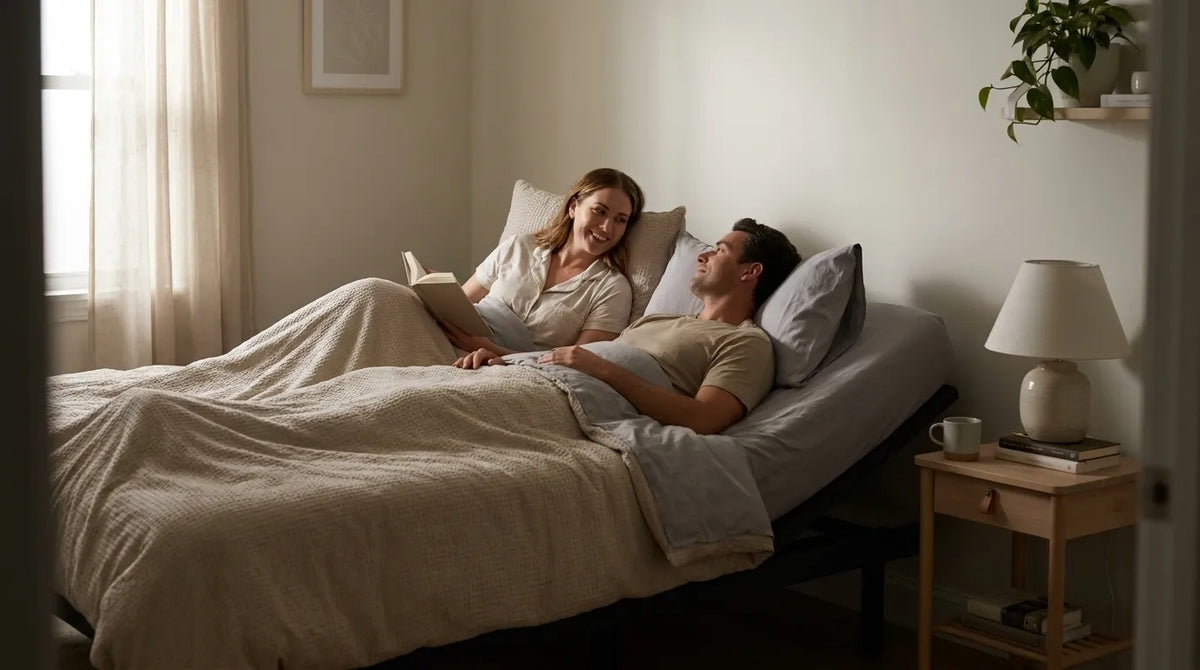
- For couples where only one partner needs elevation, a Split Queen with independent bases lets each sleeper choose their own angle without disturbing the other.
- Work with a sleep medicine clinician for diagnosis and primary treatment, then explore Leva Sleep’s adjustable bed systems to match your sleep setup to those clinical recommendations.
Choosing a Mattress When You Have Sleep Apnea
A medium-firm hybrid mattress usually works best for people with sleep apnea. It supports spinal alignment, relieves pressure at the hips and shoulders, and can pair well with an adjustable base. A mattress manages comfort and position, but it does not treat sleep apnea.
The Sleep Foundation notes that changing sleeping position is a recognized self-care step for sleep apnea, and that positional strategies support rather than replace primary treatment. A mattress influences snoring and airway alignment by keeping the spine neutral and making side sleeping comfortable, but it cannot correct the anatomical or physiological causes of sleep apnea.
When you evaluate a mattress for sleep apnea, focus on four connected criteria:
- Support: Start with support. The mattress should maintain spinal alignment in both back and side positions without letting the hips sink.
- Pressure relief: Support and pressure relief work together. The surface should relieve shoulder and hip pressure enough to sustain side sleeping through the night.
- Adjustable-base compatibility: The mattress should flex smoothly with articulation instead of resisting it.
- Breathability: The materials should manage heat well enough that temperature does not wake you up.
A mattress that is too soft allows the body to sink so the head and torso drop and the neck angle changes, which narrows the airway further. A mattress that is too firm creates hip and shoulder pressure that makes side sleeping uncomfortable and causes the sleeper to roll onto their back. That roll matters more than the mattress itself, because position, rather than firmness, determines whether the airway stays open.
What Position Is Worst for Sleep Apnea?
The worst position for sleep apnea is supine, or flat on the back. The mechanism is physical:
- When someone lies flat on their back, gravity pulls the base of the tongue and the soft tissues of the palate downward, which can collapse the upper airway and trigger apneas. This is documented in a 2024 review in the Journal of Personalized Medicine and a 2022 review in the Journal of Rhinology.
- Back sleeping is the most significant positional risk factor for snoring because gravity pulls the tongue and soft palate backward into the airway, which maximally narrows the pharyngeal space.
Elevation counteracts this mechanism. A 2017 study in Sleep & Breathing found that elevating the head of the bed to a mild 7.5-degree incline reduced the Apnea-Hypopnea Index from an average of 15.7 to 10.7 events per hour. Clinicians commonly recommend sleeping with the head elevated for conditions such as sleep apnea, acid reflux, and post-surgical recovery. An adjustable base makes that position practical at home every night without stacking pillows.
How Much a Mattress Can Help Compared With Position
Position is the primary intervention, and the mattress is the surface that helps you maintain it. A better flat mattress improves comfort on a flat surface, but it does not change the underlying geometry of the airway.
A flat surface imposes a single spinal geometry for eight hours on two people whose bodies differ. Snoring and airway restriction trace back to a horizontal head position rather than the material underneath it. Environmental changes such as bedding upgrades are unlikely to meaningfully address a clinical sleep disorder like obstructive sleep apnea and should not replace evaluation by a sleep physician when symptoms are present.
"You can't solve a geometry problem by changing the foam. That's the mistake almost every mattress purchase makes." — Alex Dimitriou, Sleep Specialist, Leva Sleep
The mattress still matters. It affects comfort, pressure relief, and whether someone can sustain a helpful position through the night. The base changes the airway geometry by elevating the head and torso.
Mattress Type Versus Position Strategy
The table below shows what each approach addresses and where its limits sit. The distinctions are qualitative and draw from both clinical evidence and product behavior.
| Approach | What It Addresses | What It Does Not Address | Best For |
|---|---|---|---|
| Medium-firm hybrid flat mattress | Spinal alignment, pressure relief, breathability | Airway collapse, head elevation, partner preference differences | Sleepers who need support and comfort on a flat surface |
| Memory foam flat mattress | Pressure relief, motion isolation | Airway collapse, head elevation; can retain heat for some sleepers | Sleepers prioritizing pressure relief over position |
| Adjustable base with a mattress engineered to flex | Head-of-bed elevation, zero gravity, anti-snore positioning | Does not treat sleep apnea; does not replace CPAP | Sleepers advised to sleep elevated |
| Split configuration with independent sides | Per-partner position and firmness, partner sleep disruption | Does not treat sleep apnea; requires purpose-built mattress sizes | Couples with different needs |
For couples, the table’s last row points to split adjustability, and sizing is where many shoppers get stuck. A Split King spans roughly 76 inches of width, using two Twin XL mattresses at 38 × 80 inches each. A Split Queen spans 60 inches, using two 30 × 80 inch mattresses.
A true Split Queen requires two 30 × 80 inch mattresses, a size that does not exist in the normal mattress supply chain, which is why most retailers cannot offer it.
Compare every Split Queen package and configuration in the collection.
The Adjustable Base Question: Mattress or Base for Sleep Apnea?
Elevation is the clinical goal, and the base provides it. Most mattresses are not built to bend. They resist articulation and wear unevenly under repeated flexion, which shortens their lifespan. A mattress engineered to flex with the base, and sold as part of a matched system, behaves differently from a standard mattress placed on an adjustable frame.
Smart and adjustable beds add convenience over static elevation by offering programmable elevation to save an angle and sensors that detect snoring and adjust position overnight. That automation creates a practical advantage for someone managing a condition that varies from night to night.
Leva Sleep’s snoring relief collection and beds for pain relief collection follow this principle. The base delivers the position, and the mattress is engineered to support that position comfortably.
Explore adjustable systems in person at the La Jolla showroom or configure one online at Leva Sleep.
The Couple Problem: When One Partner Has the Diagnosis
Sleep apnea affects the household, not only the diagnosed partner. A Sleep Foundation survey found that 75% of people with a snoring partner say their sleep has been affected. Research by Amie Gordon and Serena Chen found that after a poor night’s sleep, couples reported more conflict, showed a worse ratio of positive to negative emotion, and were measurably worse at reading their partner’s feelings, with one partner’s bad sleep degrading both people’s accuracy.
A 2023 study in Cureus followed patients starting treatment for obstructive sleep apnea and found that of the 41% who had been sleeping separately from their partner, 72% went back to sharing a bed after treatment. That return to bed-sharing only works if both partners can sleep comfortably in the same bed. When one needs elevation and the other does not, split adjustability makes shared sleep possible.
"Most people don't come to us for a bed. They come because one of them has been sleeping in the guest room and they want that to stop." — Alex Dimitriou, Sleep Specialist, Leva Sleep
Leva Sleep offers the largest selection of Split Queen adjustable beds in North America, with five distinct packages starting at $1,399. The mattresses are manufactured in-house in 30 × 80 inches for these Split Queen configurations, in two constructions and two firmness levels. A full line of bedding and accessories is built to fit them.

Each Leva Sleep Split Queen uses two fully independent bases with head and foot articulation on each side, so neither partner has to accept the other’s setting. Review the Split Queen lineup to find the right package for your household.
What a Mattress Cannot Fix
A mattress cannot treat sleep apnea, which is why it cannot replace CPAP or stand in for clinical care. The Sleep Foundation identifies positive airway pressure therapy, including CPAP, BiPAP, and APAP, as the most common and effective treatment for obstructive sleep apnea. Mayo Clinic describes obstructive sleep apnea as a chronic condition that requires treatment and monitoring throughout the lifetime.
Persistent sleep problems with consistent snoring or reported breathing pauses during sleep call for clinical assessment rather than environmental changes such as bedding upgrades. Anyone experiencing witnessed breathing pauses, gasping, morning headaches, or significant daytime exhaustion should see a sleep medicine clinician before making bedding decisions.
What to Actually Buy, and in What Order
When elevation is the goal, the base comes first and the mattress follows. The buying order looks like this:
- Base First: Select an adjustable base that provides head-of-bed elevation, zero gravity, and, for couples, independent per-side control.
- Mattress Second: Choose a mattress engineered to flex with the base in the correct size for your configuration.
- Bedding Third: Standard sheets tend to pop off an articulating base. Bedding designed for movement, such as extra-elastic fitted sheets and duvet clips, completes the system.
Once you have those three pieces, the remaining decision is where to buy them as a matched system. Leva Sleep sells complete systems rather than loose components, with packages from $1,299 to $8,999+ and financing that includes 0% APR options.
Leva Sleep is a specialist adjustable bed company serving the United States, with a luxury showroom in La Jolla, California. The company lists a 180-night comfort guarantee, with US store terms flagged for confirmation. In-house white-glove delivery and setup can include old-bed removal, full assembly, height adjustment, and a walkthrough with both partners.
Leva mattresses are made in the US, and half of the US lineup is unique to the American market, including premium California-made brands. Leva also carries Aireloom, Tempur-Pedic, Stearns & Foster, Beautyrest, Serta, Kingsdown, and Helix, pairing each mattress with an appropriate base through specialists who understand how each product should be used.
Frequently Asked Questions
Does a Mattress Help Sleep Apnea?
A mattress manages comfort and position, but it does not treat sleep apnea or replace CPAP. The right mattress supports spinal alignment and makes helpful sleep positions sustainable through the night, which offers indirect benefits. The surface itself does not change airway geometry. An adjustable base provides the head-of-bed elevation clinicians recommend.
What Firmness Is Best for Sleep Apnea?
Medium-firm hybrid construction suits most people. It supports spinal alignment in both back and side positions, provides enough pressure relief at the hips and shoulders to keep side sleeping comfortable, and usually works with an adjustable base. The same tradeoff described above applies: too soft narrows the airway, and too firm pushes sleepers onto their back.
What Is the Pillow Trick for Sleep Apnea, and Does It Work?
Stacking standard pillows to elevate the head bends the neck forward and pushes the chin toward the chest, which can further collapse the airway and worsen sleep apnea. A wedge pillow offers a lower-cost alternative that keeps the upper torso elevated in a straight line. An adjustable base provides a more reliable long-term solution because it maintains a consistent, clinician-recommended angle night after night without shifting, flattening, or bending the neck forward.
Do I Need an Adjustable Base or Just a Better Mattress?
When elevation is the clinical goal, the base provides it and the mattress does not. A better flat mattress improves comfort on a flat surface. The adjustable base changes the geometry by raising the head of the bed to an angle that reduces gravitational pull on the airway. The mattress then needs to work with that articulation, which is why mattresses engineered to flex with the base perform differently from standard mattresses on an adjustable frame.
Can I Keep My Current Mattress on an Adjustable Base?
Some existing mattresses work on adjustable bases, but many do not. Most mattresses are not built to bend, as noted earlier, and they can resist articulation and wear unevenly under repeated flexion.
The practical test is whether the mattress flexes smoothly with the base at the angles you plan to use. Check for three failure signs:
- Bunching at the fold
- Resistance to articulation
- Loss of support at the hinge
Mattresses engineered specifically for adjustable bases, and built to flex rather than resist, perform more reliably and tend to last longer in this application.
Conclusion: Position Drives Outcomes, and the Base Controls Position
The core problem in sleep apnea is geometric. A flat surface imposes one position on two different bodies for eight hours, and snoring and airway restriction trace back to a horizontal head position rather than the material underneath it. Clinicians recommend elevation, and the base delivers that elevation.
The mattress then needs to support that elevated position, flex with it, and keep it comfortable enough to maintain all night. For couples navigating one partner’s diagnosis, split adjustability lets each person choose their own settings. Work with a sleep medicine clinician for diagnosis and primary treatment, then bring your sleep system in line with both your clinical needs and your partner’s comfort.