Adjustable Beds for Couples & Sleep Apnea Relief
Written by: Matthew Timmins, Founder and Managing Director, Leva Sleep
Sharing a bed often means sharing sleep problems. One flat surface rarely suits two different bodies. This article explains three ways to use positioning for better sleep: independent mechanical positioning for couples, positional therapy for airway control, and clinical postural care for medical conditions.
Key Takeaways
- Independent mechanical positioning uses two fully separate adjustable bases so each person in a shared bed controls their own head and foot angle without disturbing their partner.
- Positional therapy devices and auto-adjusting bases detect when a sleeper rolls onto their back and gently prompt a side-sleeping or head-elevated posture to ease mild snoring or airway restriction.
- Clinical postural care systems are prescribed and monitored by clinicians for diagnosed medical conditions and are distinct from consumer adjustable beds.
- Choosing the right implementation means separating geometry-related issues such as pressure pain or partner conflict from clinical sleep disorders that need a sleep study first.
- Leva Sleep builds complete adjustable sleep systems with independent per-side control, purpose-built mattresses, and bedding designed for movement.
Shop Leva Sleep adjustable beds
Independent Mechanical Positioning for Couples Sharing a Bed
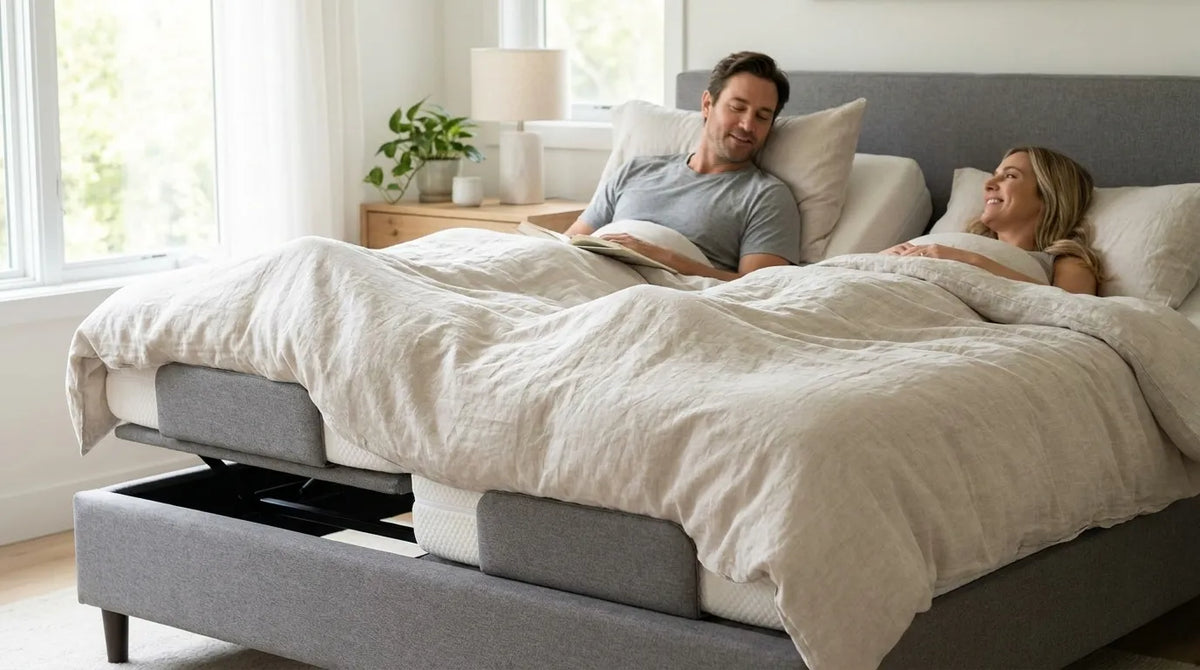
A split adjustable base places two fully independent bases side by side, each with its own head and foot articulation. Two people sharing a bed can each control their own geometry without affecting the other side. A Split King uses two Twin XL (38″ × 80″) mattresses on two independent bases, forming a 76-inch-wide King footprint. A Split Queen uses two 30″ × 80″ mattresses on two independent bases, forming a 60-inch-wide Queen footprint.

A flat surface imposes a single spinal geometry for eight hours on two people who are built differently and sleep differently. That constraint produces several downstream problems. Pressure builds in the hip, shoulder, and knee. The lower back aches on waking. Snoring and airway restriction worsen as the horizontal head position lets soft tissue collapse into the airway. Acid reflux flares at night because a horizontal torso removes the gravitational barrier that keeps stomach contents down. The 2 a.m. reposition often ends in the guest room.
As Alex Morgan, Product Specialist at Leva Sleep, puts it: “You cannot solve a geometry problem by changing the foam. That is the mistake almost every mattress purchase makes.”
Leva Sleep is a specialist adjustable bed company serving the United States, with a luxury showroom in La Jolla, California. Over nine years and more than 25,000 customers, it has focused on one thing: complete adjustable sleep systems. That means bases with independent per-side control, mattresses engineered to flex, per-side heating and cooling, and bedding designed for movement. The result is a product range that includes the largest selection of Split Queen adjustable beds in North America, with five distinct packages from $1,399, mattresses Leva manufactures in 30″ × 80″, and a full line of bedding and accessories built to fit them. The typical retailer offers none of these purpose-built Split Queen components. As noted across Leva’s range, the company stocks 15–20 adjustable base models versus the 3–5 found at a standard retailer, with complete packages from $1,299 to $8,999+, in-house white-glove delivery and setup, and a stated 180-night comfort guarantee (to be confirmed against the live US store).
The 16-inch difference between a Split King and a Split Queen footprint is a room-planning decision point that often decides whether a layout works at all. The table below compares the two configurations on mattress size, footprint width, and intended use.
| Configuration | Mattress Size | Footprint Width | Who It Is For |
|---|---|---|---|
| Split King | Two Twin XL (38″ × 80″) | 76 inches | Couples with larger primary bedrooms who want independent adjustability |
| Split Queen | Two 30″ × 80″ (purpose-built) | 60 inches | Couples in condos, apartments, older homes, or downsized bedrooms where a King footprint does not fit |
A Sleep Divorce Alternatives That Keep Couples in Bed explores why 31% of US adults have opted for a “sleep divorce”, meaning regularly sleeping in a separate room from a partner. That figure rises to 39% among adults aged 35–44, according to Atomik Research for the American Academy of Sleep Medicine, June 2025, n=2,007. A further 37% of US adults go to sleep at different times to accommodate a partner. Independent mechanical positioning is the consumer implementation designed to address this problem while keeping couples in the same room.
Leva Sleep’s pain relief collection is a practical starting point for couples where pressure pain or mobility needs drive the search for a new bed.
Zero Gravity Sleep Position: Benefits & How It Works explains how head-and-knee elevation distributes body weight evenly, reduces pressure on the lower back, and supports circulation. Independent bases offer this preset as a one-button position.
Explore Leva Sleep’s independent adjustable bases
Mechanical positioning addresses body geometry, but a second category of technology targets the airway directly. Positional therapy uses sensors and feedback to keep sleepers off their backs or with the head gently elevated.
Positional Therapy and Airway Control
Positional therapy promotes sleeping in a lateral posture instead of a supine position, or sleeping with the upper body elevated, as described in the 2026 BMJ Open Respiratory Research review by Ho et al. (Guy’s and St Thomas’ NHS Foundation Trust, n=138 patients with severe OSA, mean AHI 37.7/hour). Bio-tactile wearables, typically a small sensor worn on a chest or neck strap, detect when a sleeper rolls onto their back and emit a gentle vibration to encourage a return to a lateral position. Auto-adjusting bases use a similar detection mechanism to make a micro-elevation of the head section without fully waking the sleeper.
This approach differs from CPAP in mechanism. CPAP applies continuous positive airway pressure to pneumatically splint the airway open, as identified by the Carelon Medical Benefits Management Clinical Appropriateness Guidelines for Sleep Disorder Management (Doc ID SDM01-0926.1-v2, effective 09/19/2026) as the mainstay of treatment for obstructive sleep apnea. Positional therapy changes body geometry rather than airway pressure.
Clinicians commonly recommend sleeping with the head elevated for conditions including sleep apnea, acid reflux, and post-surgical recovery. Elevating the head gently opens the airway, which explains why anti-snore positioning reduces snoring for many sleepers. The PAVLOV trial, a multicenter study at 12 Spanish hospitals enrolling 184 patients with positional OSA, found that 64% of patients receiving CPAP and 52% of those using a positional device met the study’s definition of treatment response after 6 months. One year after discontinuing the positional device, 72% of patients remained responders, according to first author Irene Cano-Pumarega, MD, PhD, pneumologist and head of the sleep unit at Ramón y Cajal Hospital, Madrid.
The Carelon guidelines state there is currently no high-quality evidence supporting electronic positional therapy for the management of obstructive sleep apnea. Positional therapy appears alongside non-surgical weight loss measures as a treatment not fully addressed within the guideline’s primary coverage of PAP, oral appliances, hypoglossal nerve stimulation, and upper airway surgery.
For readers whose primary concern is snoring or mild positional airway restriction, Leva Sleep’s snoring relief collection and the related resource Adjustable Beds with Independent Sides for Sleep Apnea explain how anti-snore positioning works as a feature of an independent adjustable base.
Clinical Postural Care for Medical Conditions
Clinical postural care refers to body-shape management and postural support systems used under clinical oversight, typically in hospital, rehabilitation, or post-surgical settings. These systems are prescribed and monitored by clinicians and differ from consumer adjustable bases, even when the mechanical principle of elevation overlaps.
Consumer positioning technology is not medical equipment and does not substitute for diagnosis or treatment. A consumer adjustable base can achieve the elevated positions a clinician recommends for home use. It does not replace the diagnostic process, the clinical monitoring, or the prescribed therapy that a diagnosed condition requires. Sleep Technology for Medical Conditions: What Works draws this boundary in more detail.
For readers whose sleep apnea is position-dependent rather than clinical in all positions, the next question becomes which device to consider. That decision rests on a distinction only a sleep study can establish.
Best Devices for Treating Positional Sleep Apnea
The best device depends on whether the problem is position-dependent or whether airway collapse persists across all sleep positions. A sleep study must establish that distinction, and a clinician should be involved before selecting a device.
A 2026 retrospective study of 12,036 patients with OSA at Paraná’s Institute of Otorhinolaryngology (Hospital IPO) in Brazil, published in Sleep and Breathing, found that 66.3% had positional OSA (POSA) and 27.8% had supine-exclusive POSA (e-POSA). POSA patients had significantly lower AHI (24.1 vs. 44.4 events/h, p < 0.001) compared with non-POSA patients. The same study described the Amsterdam Positional OSA Classification (APOC). APOC I, defined as AHI < 5 in the best sleep position, may respond effectively to positional therapy alone. APOC II and III may require combined therapeutic approaches.
The categories available to discuss with a clinician include CPAP, positional wearables, mandibular advancement devices, auto-adjusting bases with anti-snore presets, and, for selected patients, hypoglossal nerve stimulation. Each differs in evidence base, adherence, and suitability.
Newest Alternatives to CPAP
Positional therapy and auto-adjusting bases are options some people discuss with their clinician when CPAP adherence limits treatment success. The 2026 BMJ Open Respiratory Research review by Ho et al. found that most non-CPAP therapeutic options may still be less effective than CPAP therapy, even when they reduce disease burden. Specific postural advice was recommended for 22 of 138 difficult-to-treat OSA patients (15.9%) in that multidisciplinary team review, preferentially for patients with lower baseline AHI (mean 24.5/hour).
CPAP long-term adherence is limited, with studies reporting up to 75% adherence at 3 months and less than 50% within a year, as noted by the Ho et al. review. Non-adherence is typically established within the first month of use. For patients who cannot tolerate CPAP, clinicians may consider positional therapy, mandibular advancement devices, or hypoglossal nerve stimulation depending on OSA severity and phenotype. These decisions belong with a sleep medicine specialist rather than a consumer product page.
Scientifically Informed Sleep Positions
Position needs vary by condition, and no single position works best for everyone. As Dr. Jade Wu, PhD, DBSM, sleep psychologist, states: “There is no one-size-fits-all best sleeping position.”
For acid reflux, a 2022 study published in The American Journal of Gastroenterology found that sleeping on the left side reduces nighttime acid reflux more effectively than sleeping on the back or right side. This position places the esophagus and lower esophageal sphincter higher than the stomach. Dr. Funke Afolabi-Brown, MD, FAASM, explains: “If you have GERD, lying on your left side can keep the esophageal junction intact so stomach contents do not come up.”
For snoring and sleep apnea, side sleeping is commonly recommended because gravity is less likely to pull the tongue and soft palate into the throat. Back sleeping allows the airway to narrow, which is why it is implicated in snoring and positional OSA. Individual needs differ, and a clinician’s guidance takes precedence over any general recommendation.
Pillow Tricks Versus True Incline for Sleep Apnea
Pillow positioning can change head and neck angle, and some people stack pillows to approximate an elevated sleeping position. The mechanism is real: elevating the head uses gravity to reduce the tendency of soft tissues to fall backward and narrow the airway. Stacking pillows does not match a sustained, properly angled incline.
Dr. Sam A. Kashani, board-certified sleep medicine physician, identifies the core problem. The biggest issue is doing it with pillows instead of a true incline. Elevation itself does not cause harm, but elevating the wrong way does. Dr. Likhita Shaik, sleep medicine specialist and neurologist at University of Iowa Health Care, warns that using too many pillows forces the neck into a flexed position and elevates the head too steeply. That posture can cause neck pain, shoulder pain, muscle strain, morning headaches, stiffness, numbness, tingling, disturbed sleep, and worsened breathing problems.
Dr. Phyllis Zee, Chief of Sleep Medicine at Northwestern Medicine, notes that an incline of 10 to 30 degrees is typical, with 20 to 25 degrees a reasonable starting point. Risers or blocks under the bedposts, as well as adjustable beds with a pre-set snore setting that elevate the head of the bed, are safe options. An adjustable base with an anti-snore preset achieves a consistent, repeatable incline night after night. A pillow stack cannot reliably maintain that angle through eight hours of movement.
See adjustable bases with anti-snore presets
Who Should Avoid Relying Only on Consumer Positioning Technology
Consumer positioning technology is not appropriate as a primary or sole response for people with diagnosed moderate or severe sleep apnea, people with unresolved or undiagnosed sleep problems, or anyone whose clinician has prescribed a specific therapy. The Carelon Clinical Appropriateness Guidelines identify obstructive sleep apnea as a common disorder affecting up to 2%–4% of the population, most common in patients between 40 and 70 years old, and associated with higher mortality due to cardiac arrhythmias, coronary artery disease, congestive heart failure, stroke, diabetes, and treatment-resistant hypertension.
The 2008 Wisconsin Sleep Cohort 18-year follow-up (Young T, Finn L, Peppard PE, et al., Sleep, doi:10.1093/sleep/31.8.1071) found that severe sleep-disordered breathing was associated with markedly higher all-cause and cardiovascular mortality. That association was strongest among people not treated with CPAP.
Warning signs that require a sleep study rather than a consumer device include witnessed pauses in breathing, gasping or choking during sleep regardless of position, and daytime sleepiness severe enough to affect driving or work safety. An apnea-hypopnea index that stays elevated across all positions on a sleep study also signals a clinical problem. A consumer adjustable base can deliver the elevated position a clinician recommends for home use. It cannot substitute for the diagnosis or the prescribed treatment that a clinical condition requires.
How to Evaluate Independent Positioning Options
When evaluating independent positioning systems, focus on the criteria that distinguish a complete system from a component purchase.
- Whether the base offers two fully independent sides with head and foot articulation, rather than a split-head configuration where only the head sections move independently
- Whether the mattress is engineered to bend with the base, instead of a standard mattress that resists articulation and wears unevenly under repeated flexing
- Whether bedding such as fitted sheets, mattress protectors, and duvets is designed for movement, with extra elastic and deep pockets that hold at full elevation
- Whether the footprint fits the room, with 76 inches for a Split King versus 60 inches for a Split Queen
- Whether the system includes lumbar control, pillow tilt, zero-gravity, and anti-snore positioning presets
- Whether motors are quiet enough not to wake a partner during adjustment
- Whether delivery and setup are handled by an in-house team rather than a third-party freight contractor
As noted earlier, Leva Sleep stocks 15–20 adjustable base models (versus 3–5 at a standard retailer) with complete packages from $1,299 to $8,999+. The Split Queen collection includes five packages from $1,399, with mattresses Leva manufactures in 30″ × 80″, a size that does not exist in the standard supply chain and must be purpose-built. For couples whose primary driver is pressure pain or joint discomfort, Leva Sleep’s pain relief collection is a relevant starting point.
Conclusion: Matching Positioning Approaches to Your Situation
Across the three approaches covered, independent mechanical positioning, positional therapy, and clinical postural care each serve a different problem and a different reader.
Independent mechanical positioning, meaning a split adjustable base with two fully independent sides, applies to couples with different comfort needs and anyone managing pressure pain or mobility needs in a shared bed. It also helps sleepers whose snoring, reflux, or airway restriction traces to a geometry problem rather than a diagnosed clinical condition. This is the consumer implementation Leva Sleep builds as a complete system.
Positional therapy and airway control, delivered through wearables or auto-adjusting bases that keep a sleeper lateral or elevate the head, applies to people with mild positional snoring or confirmed positional OSA. Clinicians may use it alongside or as an alternative to CPAP in selected patients. The evidence base is promising but not guideline-grade for electronic devices, and a sleep study is the appropriate first step for anyone with suspected apnea.
Clinical postural care applies to clinical settings with clinical oversight. Consumer positioning technology does not replace diagnosis or prescribed treatment.
Anyone with witnessed breathing pauses, gasping, choking, or significant daytime sleepiness should consult a clinician before selecting any device. Readers who have already ruled out a clinical condition and want the consumer implementation, with two independent sides, a matched mattress, and a complete sleep system in a footprint that fits the room, can treat Leva Sleep’s La Jolla showroom and online store as a specialist starting point.
Browse complete adjustable sleep systems from Leva Sleep
Frequently Asked Questions
This section answers common questions about split configurations, snoring relief, complete systems, positional therapy, and how to tell geometry problems from clinical issues.
What Is the Difference Between a Split Queen and a Split King Adjustable Bed?
A Split King uses two Twin XL mattresses on independent bases, creating a 76-inch footprint. A Split Queen uses two 30″ × 80″ mattresses on independent bases, creating a 60-inch footprint. As covered earlier, that 16-inch difference often decides whether a room works. Both configurations give each sleeper fully independent head and foot articulation. Split Queen is rare in the market because the 30″ × 80″ mattress size does not exist in the standard supply chain and must be purpose-built. Leva Sleep manufactures this mattress size in two constructions, the Heavenly Hybrid (pocket coil) and the Heavenly Response (all-foam), and offers five complete Split Queen packages from $1,399. A split-head queen, where only the head sections of a single mattress adjust independently, is a separate configuration and differs from a true Split Queen.
Can an Adjustable Base Help with Snoring Without a CPAP Machine?
Clinicians commonly recommend sleeping with the head elevated for conditions including sleep apnea, acid reflux, and post-surgical recovery. Elevating the head gently opens the airway, which is why anti-snore positioning reduces snoring for many sleepers. An adjustable base with an anti-snore preset achieves a consistent, repeatable incline that a pillow stack cannot reliably maintain. Snoring and obstructive sleep apnea are different conditions. Snoring is the sound produced by turbulent airflow in a narrowed airway. Sleep apnea involves actual pauses in breathing, often with oxygen desaturation. Anyone with witnessed breathing pauses, gasping, choking, or significant daytime sleepiness should have a sleep study before relying on positional adjustment alone. For people with confirmed mild positional snoring or positional OSA, an adjustable base with anti-snore positioning is a tool some clinicians recommend, but it does not replace a clinical diagnosis or a prescribed therapy where one is indicated.
What Should a Complete Sleep System Include?
A complete sleep system, as distinct from a base purchased alone, includes an adjustable base with independent per-side articulation and a mattress engineered to flex with the base rather than resist it. It also includes bedding designed for movement, such as fitted sheets with extra elastic and deep pockets, mattress protectors, and duvets that hold at elevation, and optionally per-side heating and cooling. Most mattresses are not built to articulate repeatedly and will wear unevenly or resist the base’s range of motion. Standard fitted sheets will pull off the corners when the bed elevates. A system where every component is matched and tested together, including base, mattress, and bedding, performs differently from a base purchased at a mattress chain and paired with whatever mattress and sheets the customer already owns. In-house white-glove delivery and setup, including removal of the old bed and a walkthrough with both partners, is the final component that helps ensure the system is configured correctly from the first night.
Is Positional Therapy Clinically Proven to Treat Sleep Apnea?
The evidence is promising for selected patients with positional OSA but does not yet meet the threshold for a guideline-grade recommendation for electronic positional devices. The Carelon Medical Benefits Management Clinical Appropriateness Guidelines for Sleep Disorder Management (effective 09/19/2026) state there is currently no high-quality evidence supporting electronic positional therapy for the management of obstructive sleep apnea. The PAVLOV trial results discussed earlier, with 52% positional device response versus 64% for CPAP at 6 months and 72% of positional users still responding a year later, are encouraging but not definitive. The 2026 BMJ Open Respiratory Research review by Ho et al. found that most non-CPAP options may still be less effective than CPAP, even when they reduce disease burden. Positional therapy fits best for patients with confirmed positional OSA, where events cluster heavily in the supine position and the AHI is substantially lower in other positions. It works best under clinician guidance with objective follow-up rather than assumed success based only on subjective improvement.
How Do I Know Whether My Sleep Problem Is a Geometry Problem or a Clinical Problem?
A geometry problem arises when the flat surface imposes a single spinal position on two people with different bodies, different sleep positions, and different needs. That situation produces pressure pain, morning stiffness, snoring that improves when position changes, reflux that improves with elevation, or partner conflict that traces to incompatible comfort preferences. These are the problems an independent adjustable base is designed to address. A clinical problem involves a diagnosed or suspected sleep disorder such as obstructive sleep apnea, severe GERD, post-surgical positioning requirements, or a condition a clinician has prescribed a specific therapy for. The clearest signal that a problem is clinical rather than geometric is the presence of witnessed breathing pauses, gasping or choking during sleep, significant daytime sleepiness affecting driving or work, or symptoms that persist regardless of sleep position. A sleep study is the appropriate diagnostic step for anyone in that category. Consumer positioning technology can deliver the elevated or lateral positions a clinician recommends for home use. It does not replace the diagnostic process or the prescribed treatment.