Best Adjustable Mattress for Apnea: A Sourced Buying Guide
Written by: Matthew Timmins, Founder and Managing Director, Leva Sleep
Key Takeaways
- The adjustable base, not the mattress, creates the head-of-bed elevation that helps open the airway in many apnea cases.
- Head-of-bed elevation can improve the apnea-hypopnea index (AHI) compared with flat back sleeping, especially in positional and mild-to-moderate obstructive sleep apnea.
- Only mattresses engineered to flex, such as memory foam, latex, or pocket-coil hybrids, should go on an adjustable base; traditional continuous-coil innerspring models usually fail and can void warranties.
- Insurance rarely covers consumer adjustable bases. Medicare may cover basic hospital-style beds when medically necessary, and HSA/FSA accounts may allow partial reimbursement with a Letter of Medical Necessity.
- Leva Sleep engineers complete adjustable sleep systems that pair flexible mattresses with advanced bases, including one of the largest Split Queen selections in North America. Shop Leva Sleep to compare apnea-focused configurations.
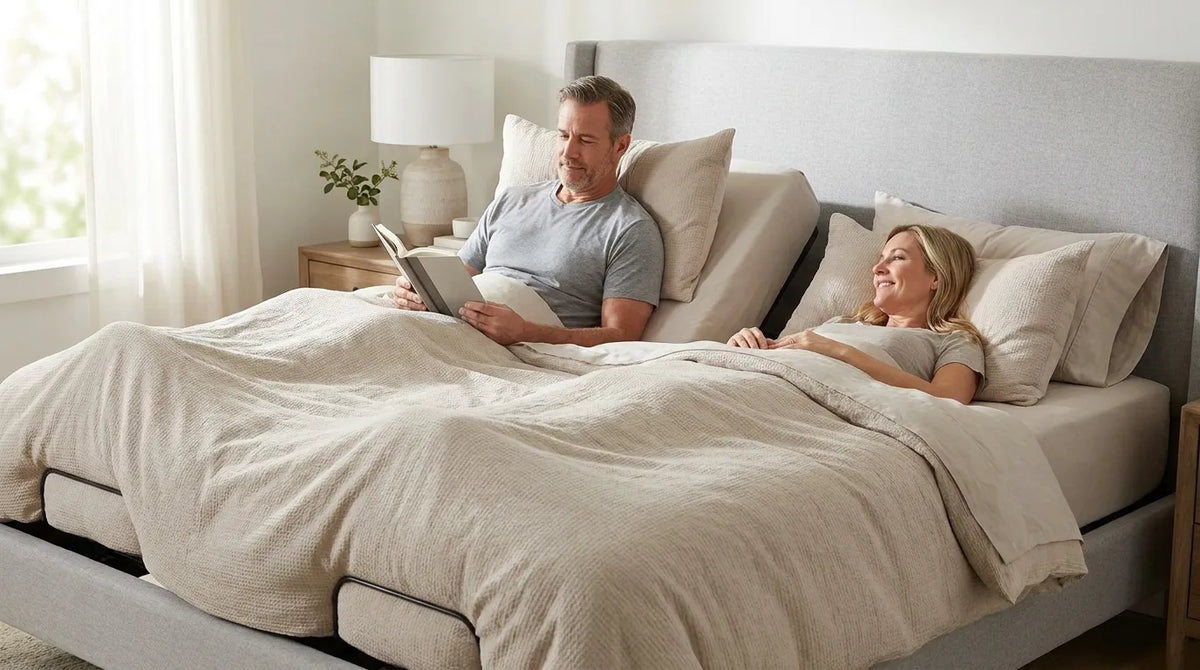
How Adjustable Beds Support Sleep Apnea Positioning
Elevating the head of the bed can gently open the airway by improving lung volume, reducing rostral fluid shift, and changing gravitational loading on the pharyngeal walls, according to a 2026 narrative review published in MedComm (Thuy et al., University of Sassari). Many sleepers snore less in this position. The benefit appears strongest in positional and mild-to-moderate obstructive sleep apnea, while prescribed therapy remains central in more severe disease.
The same review concludes that positional therapy can improve AHI compared with no treatment and is often better tolerated than CPAP, while CPAP remains superior for overall physiological control. It describes positional therapy as a phenotype-guided adjunct. Stand-alone use fits only carefully selected positional OSA phenotypes with mild-to-moderate disease and low non-supine event rates.
Clinicians commonly recommend sleeping with the head elevated for sleep apnea, acid reflux, and post-surgical recovery. An adjustable base lets you hold that position at home every night without stacking pillows. Given how common the condition is, the positioning question affects many people. A 2024 meta-analytic estimate cited in the MedComm review found that 83.7 million US adults, or 32.4%, had obstructive sleep apnea, and the review notes that many cases remain undiagnosed.
Anyone with a diagnosis should discuss positional therapy with their clinician before reducing or discontinuing prescribed treatment.
Compare Leva’s adjustable systems for apnea positioning in-store or online.
Using A CPAP Machine With An Adjustable Bed
An adjustable bed and a CPAP machine work together. The adjustable base changes sleeping position, while the CPAP machine delivers prescribed air pressure to keep the airway open. Most people with a sleep apnea diagnosis who choose an adjustable bed should continue using their CPAP exactly as prescribed.
Before pairing a CPAP with an adjustable base, check the following:
| Check | What to Verify | Why It Matters |
|---|---|---|
| Hose clearance at elevation | The CPAP hose reaches the mask at full head elevation without pulling | A short hose creates mask leak and pressure loss |
| Outlet placement | The power outlet is accessible from the elevated position | Cord tension can dislodge the machine during adjustment |
| Mattress flex | The mattress bends without buckling at the head section | A rigid mattress shifts the sleeper's head angle unpredictably |
| Head-angle range | The base reaches the elevation your clinician recommends | Insufficient elevation reduces the positional benefit |
| Mask fit as position changes | The mask seal holds at the elevated angle | Position changes can shift facial geometry and cause leak |
CPAP pressure is typically prescribed after a sleep study or titration test and usually falls within a range of about 4 to 20 cm H₂O, configured to eliminate breathing disruptions across sleeping positions. Sleeping elevated does not automatically require a pressure change, although elevation appears among the factors that can affect how prescribed pressure performs. Do not adjust CPAP pressure settings without guidance from a healthcare provider. If elevation changes how the machine feels, or if symptoms persist, contact the prescribing clinician.
Insurance And Adjustable Beds For Sleep Apnea
A consumer adjustable base from a mattress or furniture retailer is generally not covered by insurance. A hospital-style bed prescribed for a documented medical need and obtained through an approved supplier may qualify. These products fall under different rules.
Medicare Part B may cover a hospital bed as durable medical equipment when a doctor certifies it is medically necessary for home use. When covered, Medicare pays 80% of the approved amount after the deductible, which is $283 in 2026, leaving the beneficiary responsible for the remaining 20%. Coverage applies only to basic models and requires purchase or rental through a Medicare-enrolled DME supplier. Qualifying conditions usually involve specific positioning needs that pillows or wedges cannot meet.
Commercial insurance plans generally cover hospital-style adjustable beds as durable medical equipment when a physician documents that the equipment is medically necessary to treat a diagnosed condition at home. The most common reason claims are denied is incomplete paperwork. The physician's order must name the diagnosis, explain why the equipment is medically required, and document why standard alternatives will not work.
For HSA and FSA accounts, a mattress or adjustable base may qualify for reimbursement when purchased to treat or manage a documented medical condition and supported by a Letter of Medical Necessity (LMN) from a licensed healthcare provider. Diagnosed obstructive sleep apnea requiring positional therapy often supports eligibility. Under IRS Revenue Ruling 55-261, only the amount by which a special item exceeds the cost of an ordinary version may be reimbursable. The full purchase price of a consumer mattress or base almost never qualifies in full. CPAP machines and supplies are explicitly HSA/FSA eligible without an LMN under IRS Publication 502.
Contact your insurer or FSA/HSA administrator before purchasing, and ask your clinician to document medical necessity explicitly in a written order that names the diagnosis and explains why standard alternatives are insufficient.
Mattress Types That Work On Adjustable Bases
The mattress construction determines whether the sleep system performs well over time. Memory foam, latex, and most hybrid mattresses with pocketed coils are compatible with adjustable bases. Innerspring mattresses with continuous coils, heavy coil units, or rigid foam cores often crack or buckle when articulated. A mattress that resists articulation tends to wear out faster and can void its warranty.
The table below compares common constructions by how well they tolerate repeated bending.
| Construction | Adjustable Base Compatibility | Key Consideration |
|---|---|---|
| All-foam (memory foam or polyfoam) | Compatible, most flexible | Very firm high-density foam can crack under repeated bending |
| Hybrid with pocketed coils | Compatible, balance of support and flex | Coils must be individually wrapped; continuous coils are not compatible |
| Latex | Compatible, durable and naturally cool | Heavier than foam, so verify base motor weight rating |
| Traditional innerspring (Bonnell or continuous coil) | Not recommended | Coils often crack under articulation, and the warranty is typically voided |
Leva Sleep mattresses are engineered to flex with the base. Leva manufactures two constructions in 30" × 80" sizes, the Heavenly Hybrid (pocket coil) and the Heavenly Response (all-foam), each available in two firmness levels. Each partner in a split configuration can choose a preferred feel. Because Leva builds both the base and the mattress, the system is matched from the start rather than assembled from unrelated components.
Best Adjustable Bed For Sleep Apnea: Why Leva Sleep
Leva Sleep is a specialist adjustable bed company serving the United States, with a luxury showroom in La Jolla, California. Across nine years and more than 25,000 customers, Leva has built complete adjustable sleep systems for couples managing snoring, sleep apnea, pain, and differing comfort preferences. The case for Leva rests on specific, verifiable details.
- Fifteen to twenty adjustable base models, compared with three to five at a typical mattress retailer (Leva US catalog; standard retail assortment)
- Anti-snore positioning, whisper-quiet German motors, lumbar control, pillow tilt, and independent split articulation
- Per-side heating and cooling options
- Mattresses engineered to bend and bedding engineered for movement
- In-house white-glove delivery and setup, including old-bed removal and a full system walkthrough
- Comfort guarantee currently listed at 60 nights on the US store, with policy language referencing 180 nights, a discrepancy flagged for confirmation
- Complete packages from $1,299 to $8,999+, with 0% APR financing available (Leva US catalog, August 2026)
Here are four Leva configurations often considered for apnea-related needs:
- Heavenly Response Adjustable Bed Package — all-foam Leva-built mattress and base, matched as a system, from $1,899.
- Vela Adjustable Bed Package — core package with multiple comfort levels, anti-snore and zero-gravity features, from $1,899.
- Sereno Signature Adjustable Bed Package — premium tier with advanced base features, from $2,799.
- Passions Adore Adjustable Bed Package — package available in Split-Head Queen, from $2,699.
Browse the full snoring relief collection and the pain relief collection for additional matched configurations.
Split Adjustable Configurations For Couples
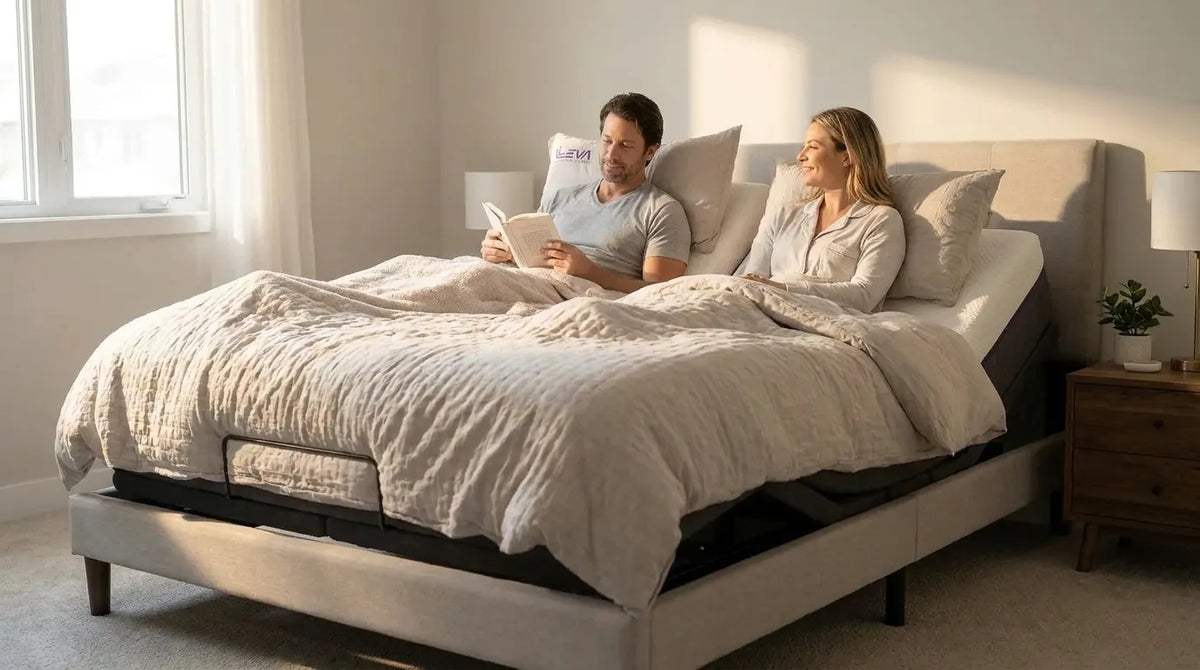
When one partner has sleep apnea and needs head elevation, that elevation should not move the other partner. A standard queen or king base articulates as a single unit, so one person’s position change disrupts the other. Independent split articulation solves this by letting each side of the bed adjust separately.
Two configurations deliver this structure:
- Split King: Two Twin XL (38" × 80") mattresses on two independent bases, forming a 76" footprint. Each side adjusts separately. Available as Leva's Duet Split King.
- Split Queen: Two 30" × 80" mattresses on two independent bases, forming a 60" footprint. Each side adjusts separately. The 16-inch width difference between Split King and Split Queen determines which configuration fits the room.
Leva Sleep offers one of the largest selections of Split Queen adjustable beds in North America, with five distinct packages from $1,399. Leva manufactures mattresses in-house in 30" × 80" sizes and supplies matching bedding and accessories. Most retailers do not stock true Split Queen systems. A true Split Queen requires purpose-built 30" × 80" mattresses, a size that does not exist in the standard mattress supply chain. Leva builds both halves, so each partner can choose a different firmness level, similar to the flexibility Split King buyers expect.

A June 2025 survey of 2,007 US adults conducted by Atomik Research for the American Academy of Sleep Medicine found that 31% of American adults had opted for a “sleep divorce,” meaning they regularly slept in a separate room from their partner. Among adults aged 35–44, the figure rises to 39%, and 37% reported going to sleep at different times to accommodate a partner. Split configuration offers a structural alternative. Each partner controls position independently, and both can stay in the same bed.
Explore the full Split Queen adjustable bed collection to compare layouts and features.
Build a split system that lets each partner choose their own position and comfort level.
Who May Not Benefit From An Adjustable Bed Alone
Head-of-bed elevation supports positional and mild-to-moderate obstructive sleep apnea, yet prescribed therapy remains central for moderate-to-severe disease. The 2026 MedComm review (Thuy et al.) states that positional therapy fits as stand-alone treatment only in carefully selected phenotypes with low non-supine event rates. Anyone with a formal diagnosis should discuss any change to their sleep setup, including adding an adjustable base, with their clinician before modifying prescribed treatment.
Response to positional therapy varies between individuals. Some people with positional OSA see meaningful AHI reduction with elevation, while others see little change. An adjustable base improves sleeping position but does not guarantee a specific clinical outcome. The AASM's practice guidelines recognize PAP therapy, oral appliance therapy, surgical referral, and medical therapy as the established treatment pathways for OSA in adults. Positional therapy sits within that framework as a phenotype-guided adjunct rather than a primary replacement.
Anti-Snore Presets On Adjustable Bases
An anti-snore preset is a programmed or automatic micro-adjustment that gently elevates the head section of the base to help open the airway. On some bases, the adjustment is triggered manually via a remote or app. On more advanced systems, a sensor detects snoring sounds and initiates the elevation automatically without waking the sleeper.
An anti-snore preset functions as a comfort and convenience feature. It does not serve as medical treatment or replace prescribed therapy. When comparing bases, focus on the degree of elevation the base can achieve, how quietly the motor moves, and whether the mattress flexes cleanly at that angle. As noted earlier, the benefit comes from the elevation itself rather than the preset label.
Mattress Types To Avoid On Adjustable Bases
Traditional innerspring mattresses with continuous coils, Bonnell coils, or heavy-gauge coil units generally do not suit adjustable bases. These constructions are designed for flat, rigid foundations. When articulated repeatedly, the coil structure resists bending, develops permanent creases or cracks, and typically voids the mattress warranty.
Very firm high-density foam, often used in some budget all-foam mattresses, can also crack or lose shape under repeated bending and rarely performs well on an adjustable base. If a mattress is not explicitly rated by its manufacturer for adjustable base use, treat it as incompatible.
Conclusion: Start With The Base, Then Match The Mattress
The base, not the mattress, creates the positioning that helps open the airway. The mattress must bend with that movement, and many standard models are not built for repeated articulation. Leva Sleep focuses on adjustable systems, with 15–20 base models, mattresses manufactured in-house to flex under articulation, independent split configurations for couples, and in-house white-glove delivery and setup. Complete packages start at $1,299 and are backed by the comfort guarantee noted above, with 0% APR financing available.