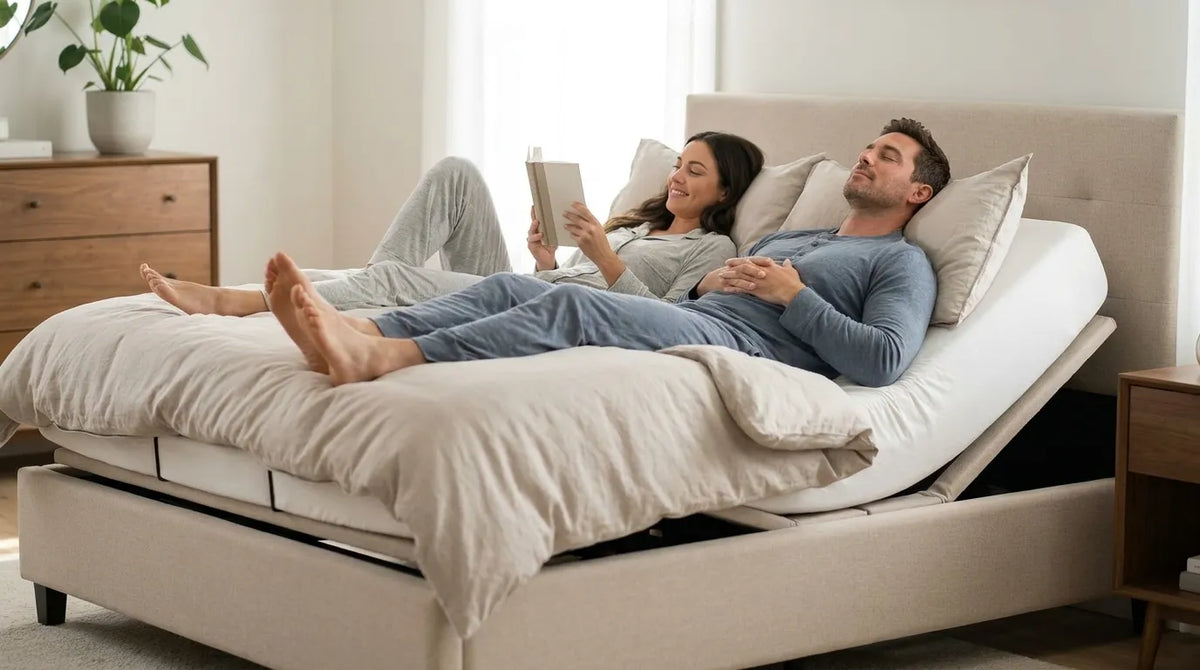
Adjustable Beds for Lower Back Pain: Do They Help?
Written by: Matthew Timmins, Founder and Managing Director, Leva Sleep
Key Takeaways
- Adjustable beds can relieve back pain by elevating the head and knees into a zero-gravity position that reduces lumbar pressure and supports the spine’s natural curve.
- Medium-firm mattresses paired with bases engineered to flex often provide better pressure distribution and pain reduction for many people with back pain.
- Zero-gravity, head-elevated, and knee-elevated positions each offer targeted relief depending on the type of lower-back discomfort.
- Real limitations include cost, motor noise on budget models, and a learning curve, so buyers should test in person and consider split configurations for couples.
Shop Leva Sleep’s pain-relief collection to see adjustable bases and matched mattresses.
How Adjustable Beds Ease Lower Back Pain
A flat surface leaves the lumbar curve unsupported and lets the pelvis rotate forward. That rotation concentrates load on the intervertebral discs and surrounding muscles, which is why many people wake stiff even after a full night’s sleep. Elevating the head and knees at the same time redistributes body weight and supports the lower back’s natural curve.
Research by Nachemson and Elfström found that lying in a reclined position can reduce lumbar disc pressure by as much as 50% compared to sitting upright, which provides the biomechanical rationale for zero-gravity-style recline to reduce spinal loading. Wilke et al., published in the Spine journal in 1999, measured intradiscal pressure directly at the L4–L5 disc and found that a supported recline at 120–130 degrees keeps lumbar intradiscal pressure lower than unsupported vertical sitting.
Lumbar control and pillow tilt extend this effect. Lumbar control uses a dedicated motor to support the lower back curve, separate from raising the head or foot section. Pillow tilt uses an additional motor to angle the head and pillow section independently. Together, these features allow small geometry adjustments that a simple head-up and foot-up base cannot achieve.
Clinicians commonly recommend sleeping with the head elevated for conditions including sleep apnea, acid reflux, and post-surgical recovery. An adjustable base makes that position repeatable at home every night without stacking pillows.
Explore adjustable beds designed for back pain relief.
Best Adjustable Bed Positions for Lower Back Pain
The four positions most relevant to lower back pain, in order of clinical support, are zero gravity, head-elevated, knee-elevated, and flat.
- Zero gravity uses slightly elevated head and knees, distributes weight evenly, and takes pressure off the lower back. Many people with back pain start here.
- Head-elevated (roughly 30–45°) opens the airway and reduces load on the lumbar spine. Clinicians often recommend elevated sleeping for reflux, apnea, and post-surgical recovery. A 2022 randomized crossover trial found that raising the head of the bed to a 30-degree angle reduced apnea-hypopnea index by 15 events per hour in postoperative patients with moderate-to-severe OSA.
- Knee-elevated tilts the pelvis and flattens the lower back against the surface, which can relieve lumbar extension pain.
- Flat provides no support for the lumbar curve and allows the pelvis to rotate. This position suits people without back pain who prefer a traditional sleep surface.
The table below summarizes how each position affects the lower back and who it tends to suit, so you can match a position to your specific pain pattern.
| Position | What It Does for the Lower Back | Who It Suits |
|---|---|---|
| Zero gravity | Distributes body weight evenly, reduces pressure on the lower back, supports circulation | Many people with back pain, including those with disc issues or pressure-point pain |
| Head-elevated (30–45°) | Opens the airway and reduces load on the lumbar spine | People with reflux, apnea, or post-surgical recovery needs |
| Knee-elevated | Tilts the pelvis and flattens the lower back against the surface | People with lumbar extension pain or those who slide down when the head is elevated |
| Flat | Provides no support for the lumbar curve and allows pelvic rotation | People without back pain who prefer a traditional sleep surface |
The 30–45° head range is a commonly cited clinical range, not a proprietary Leva measurement. The zero-gravity angle opens small gaps between the vertebrae, creating a spinal decompression effect. The resulting neutral spinal alignment reduces the muscular tension the body uses to stabilize itself during sleep, which is why many people with chronic lower back pain report waking with less stiffness.
Mattress Firmness for Lower Back Pain
Evidence points to medium-firm as the most supported starting point for lower back pain. A 2026 peer-reviewed review concluded that medium-firm mattresses were associated with better pressure distribution, improved sleep quality, reduced morning stiffness, and lower low back pain intensity for nonspecific low back pain. The authors note that heterogeneity in materials, outcome measures, and participant characteristics prevented meta-analysis, so this serves as a strong guideline rather than a universal rule.
A 2003 randomized, double-blind, multicenter trial by Kovacs et al. found that medium-firm mattresses significantly outperformed firm mattresses on both pain reduction and disability outcomes in adults with chronic nonspecific low back pain. Very soft mattresses allow excessive pelvic sink and increase disc loading. Very firm mattresses concentrate pressure at bony prominences and push the spine out of its natural curve. Medium-firm aims to avoid both problems.
The pairing rule matters as much as firmness. The mattress needs to flex with the base. Many standard mattresses resist articulation, wear unevenly under repeated bending, and shorten their own lifespan. Leva Sleep builds two mattress constructions specifically engineered to bend with the base: the Heavenly Hybrid (pocket coil hybrid) and the Heavenly Response (all-foam). Both come in configurations matched to adjustable bases.
How Clinicians View Adjustable Beds
That clinical recommendation for elevated sleeping explains why many Leva Sleep customers arrive after a doctor or physiotherapist suggests an elevated position. Adjustable bases give patients a practical way to follow that advice at home.
Karena Wu, P.T., D.P.T., an orthopedic physical therapist, states that adjustable beds can be helpful for those who have back and neck pain, chronic pains, respiratory issues like snoring or obstructive sleep apnea, digestive issues like gastric reflux, and circulatory issues. An adjustable bed does not replace diagnosis or treatment. Readers with ongoing back pain should speak to a clinician before changing their sleep setup.
The scale of the problem is significant. Thirty-one percent of US adults have opted for a “sleep divorce” per a June 2025 Atomik Research survey of 2,007 US adults for the American Academy of Sleep Medicine. Among adults aged 35–44, the figure rises to 39%. Snoring and back pain rank among the most common drivers. Gentle head elevation opens the airway, which is why anti-snore positioning reduces snoring for many sleepers.
Downsides and Limitations of Adjustable Beds
Adjustable beds offer clear benefits, and they also come with tradeoffs worth weighing before you buy.
- Cost: Complete packages run $1,299 to $8,999+ at Leva Sleep. Entry-level bases from other retailers start under $1,000, but motor quality, noise levels, and feature sets can vary significantly at that price point.
- Partner disruption on non-split bases: A single-motor base moves both sides together. One partner who wants elevation pulls the other into the same position. A split configuration prevents this but adds cost.
- Motor noise: Budget adjustable bases can exceed 55 decibels during head elevation, which is loud enough to wake a sleeping partner. Leva Sleep uses whisper-quiet German motors, and buyers evaluating other brands should test noise in person.
- Mattress compatibility: Not every mattress works on an adjustable frame. Memory foam and hybrid mattresses with individually wrapped coils flex well, while traditional innerspring mattresses with interconnected coils are generally too rigid to bend with the base.
- Learning curve: Finding the right positions takes time. Adjustment to the zero-gravity sleep position varies. Some users find it immediately comfortable while others need one to two weeks to adapt.
- Medical limits: An adjustable bed can ease pressure on a sore lower back but will not resolve a herniated disc or treat diagnosed spinal disease. It improves sleep positioning while medical care addresses underlying conditions.
Who should avoid an adjustable bed: An adjustable bed is not the right first purchase in three situations. If your pain is undiagnosed, start with a clinician rather than a bed. If your bedroom cannot accommodate the footprint, no configuration will solve that. If you are not willing to adjust positions over several weeks, the learning curve may outweigh the benefit.
Configuration and Cost for Adjustable Beds
Once you decide an adjustable bed makes sense, configuration and budget become the next questions. The configuration decision comes down to three variables: articulation (head-and-foot versus head-only), split versus single, and size.
Size is where many couples get stuck. Split adjustability normally only comes in King, which is why couples in smaller bedrooms are routinely told no. A Split King occupies roughly 76 inches of width, while a Split Queen occupies 60 inches. That 16-inch difference often determines whether the configuration fits the room.
Leva Sleep offers the largest selection of Split Queen adjustable beds in North America. The lineup includes five distinct packages from $1,399, mattresses Leva manufactures in 30 × 80 inches, and a full line of bedding and accessories built to fit them. Most retailers offer no true Split Queen. A true Split Queen requires two 30 × 80 inch mattresses, a size that does not exist in the normal mattress supply chain. Leva builds both halves, so each partner can choose a different firmness level in a footprint that fits a Queen-size room.

Leva Sleep offers roughly 15–20 adjustable base models versus the 3–5 found at a standard retailer. Features include whisper-quiet German motors, lumbar control, pillow tilt, and anti-snore positioning. The price ladder for complete adjustable bed packages (base and mattress together) looks like this:
- Entry ($1,299–$1,899): Cala, Vela, Heavenly Response packages
- Core ($2,499–$2,999): Passions Adore, Sereno Signature, Midnight Bliss packages
- Premium ($3,799–$4,499): Tempur-Pedic ProAdapt, Stearns & Foster Estate Winslet packages
- Luxury ($5,999–$8,999+): Natural Fusion Reserve Collection, Aireloom packages
Adjustable bases purchased separately run from $1,299 (Elite 250) to $2,199 (Quest Elite). Leva mattresses start at $949 for the Heavenly Response and $1,399 for the Heavenly Hybrid. Leva Sleep’s stated policy includes a 180-night comfort guarantee and financing with 0% APR options, though the US store’s displayed terms should be confirmed. Delivery uses in-house white-glove teams who handle old-bed removal, full assembly, height adjustment, and a walkthrough of the system with both partners.
Compare adjustable bed packages and find your configuration.
Frequently Asked Questions
Do Adjustable Beds Help Back Pain?
Most people with lower back pain experience relief from an adjustable bed. Elevating the head and knees into a zero-gravity position distributes body weight more evenly and reduces pressure on the lumbar spine. This change improves sleep geometry rather than treating the medical cause of pain. Anyone with a diagnosed spinal condition should consult a clinician before changing their sleep setup.
What Is the Best Sleeping Position for Lower Back Pain?
Zero gravity, with the head and knees slightly elevated and the back reclined to about 120–130 degrees relative to the thighs, has the broadest support for lower back pain. This position decompresses the spine, reduces muscular tension, and supports the lumbar curve. Knee elevation alone can also help people with lumbar extension pain. A flat sleeping surface offers no support for the lumbar curve and tends to be the least favorable position for many people with back pain.
Can I Use My Current Mattress on an Adjustable Bed?
Some existing mattresses work on adjustable bases, but many do not. Traditional innerspring mattresses with interconnected coils resist articulation, wear unevenly under repeated flexing, and can strain both the mattress and the motor. Memory foam, latex, and hybrid mattresses with individually pocketed coils usually perform better. Leva Sleep builds its Heavenly Hybrid and Heavenly Response mattresses specifically to flex with an adjustable base, which is why they are sold as a matched system.
Are Adjustable Beds Noisy?
Basic adjustable bases, especially those sold as add-ons at general mattress retailers, can be loud enough to wake a sleeping partner. Motor noise ranks as the most common complaint about many entry-level bases. Leva Sleep uses whisper-quiet German motors with smooth, gradual travel. Buyers evaluating any adjustable base should test motor noise in person, since manufacturers rarely publish a decibel figure and “quiet” often appears as a marketing claim rather than a measurement.
How Much Does an Adjustable Bed for Back Pain Cost?
As outlined above, complete adjustable bed packages at Leva Sleep range from $1,299 to $8,999+ depending on the base model, mattress, and configuration. Adjustable bases purchased separately start at $1,299 for the Elite 250. Financing, including 0% APR options, spreads the cost monthly. Every purchase includes a 180-night comfort guarantee and in-house white-glove delivery and setup.
Does Leva Sleep Offer Split Queen?
Yes. As covered earlier, Leva Sleep offers the largest selection of Split Queen adjustable beds in North America, with five packages starting from $1,399. Each Split Queen configuration uses two fully independent bases with head and foot articulation on each side, so both partners can adjust their position independently.
The Right Bed for Back Pain: A Summary
Nighttime back pain often comes down to sleep geometry. A flat surface forces one spinal shape on two different bodies for eight hours. An adjustable bed lets position adapt to the body by elevating the head and knees into zero gravity, supporting the lumbar curve with dedicated lumbar control, and allowing each partner to find a personal position on a split configuration.
Evidence supports medium-firm as the most reliable starting firmness for lower back pain, and that benefit depends on a mattress engineered to flex with the base. The real downsides include cost, potential motor noise on budget bases, a short learning curve, and the fact that an adjustable bed improves position while medical care addresses underlying conditions.
For couples in smaller bedrooms who cannot fit a King, the Split Queen configuration at Leva Sleep offers a rare alternative. Leva Sleep is a specialist adjustable bed company serving the United States, with a luxury showroom in La Jolla, California, nine years in operation, and more than 25,000 customers served. Complete packages start at $1,299, with a stated 180-night comfort guarantee that should be confirmed against the live US store.
Shop the pain-relief collection and start sleeping better.