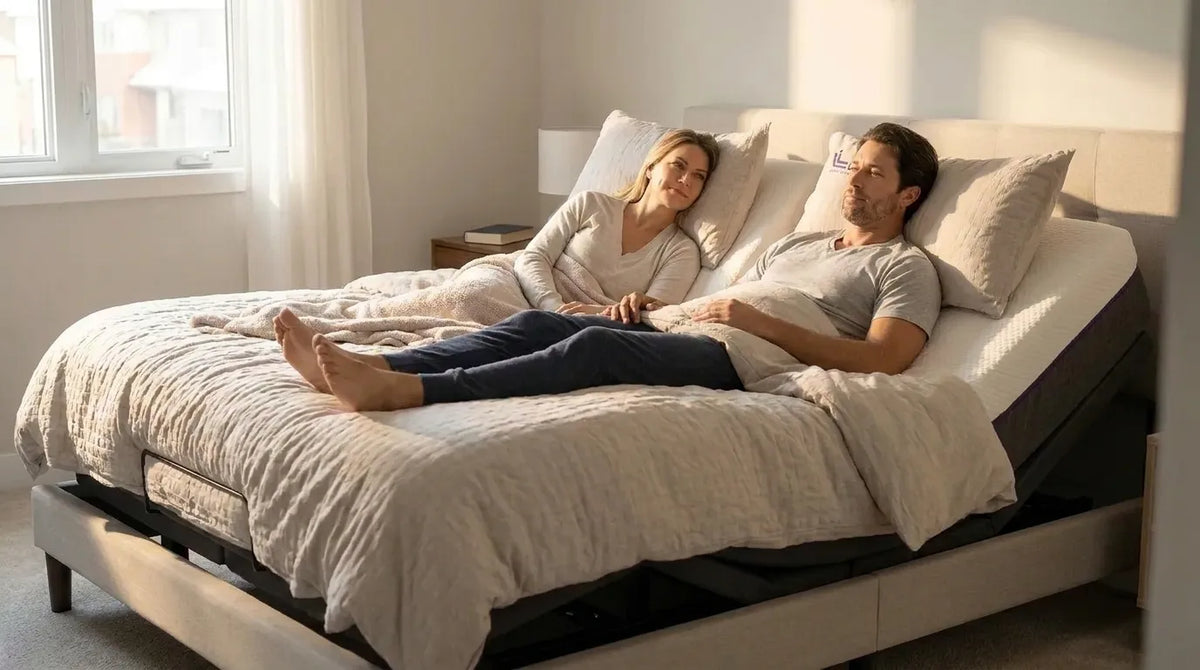
Adjustable Bed for Sleep Apnea: Couples Buying Guide
Written by: Matthew Timmins, Founder and Managing Director, Leva Sleep
Key Takeaways
- Head-of-bed elevation is a clinician-recommended positional strategy that can reduce airway collapse and improve AHI for people with positional obstructive sleep apnea.
- An adjustable bed provides repeatable, precise elevation without stacking pillows, but it is not a substitute for CPAP therapy.
- Effective elevation requires a complete system: a mattress engineered to flex, bedding that stays in place, and independent control so one partner is not forced into the same angle.
- Split adjustable beds give each partner independent positioning, which is especially valuable when only one partner has sleep apnea or when preferences differ.
- Leva Sleep offers complete adjustable bed systems with flex-engineered mattresses, movement-ready bedding, and split configurations designed for couples managing sleep apnea.
Shop Leva Sleep adjustable beds for sleep apnea
What Is Head-Of-Bed Elevation And How It Reduces Airway Collapse
Head-of-bed elevation (HOBE) means raising the head end of the sleeping surface to a defined angle above horizontal. When a person lies flat on their back, gravity pulls the base of the tongue and soft tissues of the palate toward the back of the throat. As pharyngeal muscles relax during sleep, those tissues can collapse into the airway and trigger apnea events.
Raising the head changes gravitational loading on the airway, improves lung volume, and reduces the rostral fluid shift that narrows the pharynx during supine sleep. Clinical studies have tested angles including 7.5, 30, and 60 degrees, using different populations and methods. Home-use angles commonly discussed in the literature range from about 10 to 30 degrees.
A 2025 multicenter observational study by Maniaci et al., published in Sleep and Breathing, enrolled 60 participants and found that in OSA patients the apnea-hypopnea index (AHI) fell from 25.7 events per hour supine to 17.8 events per hour at 30° head-of-bed elevation, a mean reduction of 31% (p < 0.001). Oxygen desaturation index (ODI) dropped from 20.3 to 15.2 events per hour (p < 0.001), and sleep efficiency improved from 73.0% supine to 79.0% at 30° elevation.
A 2017 study by Souza et al., published in Sleep and Breathing, found that a mild 7.5-degree head-of-bed elevation reduced AHI from an average of 15.7 to 10.7 and improved minimum oxygen saturation, with researchers describing it as a simple measure that significantly improves OSA severity without compromising sleep architecture. Steeper angles can cause sliding or lower back strain. Placing a pillow under the knees (knee-gatch position) stops sliding when the head of the bed is raised, and head-of-bed elevation should stay at 30° or lower to minimize soft tissue deformation.
Can an Adjustable Bed Replace My CPAP?
CPAP and adjustable beds work through different mechanisms, and CPAP remains the primary treatment. CPAP maintains continuous positive airway pressure regardless of sleep position, while an adjustable bed changes body geometry. The two approaches address different parts of the problem.
The American Academy of Sleep Medicine's 2019 clinical practice guideline establishes positive airway pressure as the standard of care for adult obstructive sleep apnea because it acts like a continuous splint of air that keeps the airway open regardless of gravity or sleep position. Positional therapy is a viable alternative mainly for position-dependent OSA, especially when the non-supine AHI is relatively low, and is best treated as an individualized adjunct rather than a universal replacement for PAP. Anyone with diagnosed OSA should follow their clinician's guidance on CPAP before changing treatment.
Head-of-bed elevation works best for obstructive sleep apnea because it directly addresses the mechanical, gravity-driven collapse of throat tissues. Central sleep apnea is different because it is neurological, so elevation does not correct it and specialized breathing machines are often required. That is why an adjustable bed is a positional tool, not a treatment device.
Will Insurance Pay for an Adjustable Bed for Sleep Apnea?
Commercial insurance plans generally cover hospital-style adjustable beds as Durable Medical Equipment when a physician documents that the equipment is medically necessary to treat a diagnosed condition at home. The most common reason claims get denied is incomplete paperwork. The physician's order must name the diagnosis, explain why the equipment is medically required, and document why standard alternatives will not work.
A mattress or adjustable base can qualify for HSA or FSA reimbursement when a licensed clinician ties it to a diagnosed condition in a Letter of Medical Necessity. A compliant letter should name the diagnosis, connect the mattress to treatment, and include the clinician's signature, credentials, and date. Sleep apnea appears among the conditions that can support eligibility when properly documented.
Unlike FSAs, HSA funds roll over year to year and are tied to a High Deductible Health Plan, with no use-it-or-lose-it deadline, which makes HSA the more strategic account for a larger purchase like a mattress. FSAs are typically use-it-or-lose-it by year end, with some plans allowing a limited rollover or grace period.
IRS Publication 969 states that HSA distributions are tax-free only when used for qualified medical expenses, defined as expenses for the diagnosis, cure, mitigation, treatment, or prevention of disease. Coverage varies by plan and administrator. Readers should confirm eligibility with their insurer and clinician before purchasing. Leva Sleep does not file insurance claims on behalf of customers.
Best Sleeping Positions When You Have Sleep Apnea
Three positional strategies have clinical support for obstructive sleep apnea: head-of-bed elevation, lateral (side) sleeping instead of back sleeping, and the zero-gravity position. Zero gravity means head and knees slightly elevated, which distributes body weight evenly, reduces pressure on the lower back, and supports circulation.
The 2025 Maniaci et al. study found that lateral positioning produced a larger AHI reduction than head-of-bed elevation alone, from 25.7 to 14.8 events per hour lateral versus 25.7 to 17.8 events per hour at 30° HOBE (both p < 0.001). Combining side-sleeping with head-of-bed elevation may therefore yield the greatest benefit.
In more than half of mild to moderate OSA cases, apnea events are at least twice as frequent when sleeping on the back compared to sleeping on the side. Left-side sleeping carries a small additional benefit for many people with sleep apnea because it also reduces acid reflux, which irritates the airway and fragments sleep.
An adjustable bed for sleep apnea supports all three strategies at once. It achieves head-of-bed elevation at a precise, repeatable angle. It supports the zero-gravity position with head and knee articulation. Its lumbar control and pillow tilt allow fine-tuning that a flat surface cannot provide.
Split Adjustable Beds When Only One Partner Has Apnea
When one partner needs elevation and the other does not, sharing a single adjustable base forces a compromise. A 2025 survey of 2,007 US adults conducted by Atomik Research for the American Academy of Sleep Medicine found that 31% of American adults had opted for a sleep divorce, regularly sleeping in a separate room from their partner. Among adults aged 35–44, the figure rises to 39%, and 37% reported going to sleep at different times to accommodate a partner. A split adjustable bed offers a way to stay in the same bed without that compromise.
When only one partner has sleep apnea, a non-split base forces the other partner into the same elevated angle, a position they may not need or want. A split configuration gives each side independent control.
The table below compares split and non-split bases on the factors that matter most for couples: control, disturbance, comfort, and room fit.
| Feature | Split Adjustable Bed | Non-Split Adjustable Bed | Best For |
|---|---|---|---|
| Who Controls the Position | Each partner independently, via separate remotes or app | One shared position for both partners | Split: couples with different needs; Non-split: partners who prefer the same angle |
| Partner Disturbance | Minimal, each side adjusts without moving the other | Any adjustment affects both partners | Split: light sleepers and mismatched schedules |
| Mattress and Firmness Choice | Each side can have a different firmness level | One mattress, one firmness for both | Split: couples with different comfort preferences |
| Footprint | Split Queen: 60" wide (two 30" × 80" bases); Split King: 76" wide (two Twin XL bases) | Standard Queen or King footprint | Split Queen: rooms where a King will not fit |
One naming detail matters when you shop. Leva Sleep's Split Queen always means two fully independent bases with head and foot articulation on each side. This differs from a split-head queen, which uses a single mattress with head-only articulation and is a separate minor configuration, not the default.
Leva Sleep offers five Split Queen packages from $1,399, with 30" × 80" mattresses manufactured in-house and a full line of Split Queen bedding and accessories.

What Has To Be True For Elevation To Work
Elevation only works when the mattress and bedding cooperate with the base. An adjustable base under a mattress that resists bending defeats the purpose of elevation. Most standard mattresses are not built to articulate. They resist the bend, wear unevenly under repeated flexion, and shorten their own lifespan. Standard fitted sheets compound the problem because they pop off the moment the bed reaches any meaningful angle.
Leva Sleep treats the purchase as a system decision, not a base purchase. Every component is engineered to work at full elevation:
- Mattresses engineered to flex night after night: the Heavenly Hybrid (pocket coil) and Heavenly Response (all-foam), both manufactured in 30" × 80" for Split Queen configurations. The Heavenly Hybrid is available in two firmness levels, Luxury Firm and Medium/Plush, so each partner can choose their own feel in a split configuration.
- Bedding designed for movement, including fitted sheets with extra elastic and deep pockets, duvet clips, and remote pockets that hold at full elevation where standard bedding gives up.
- Independent split articulation with whisper-quiet German motors, so one partner’s position adjustment does not wake the other.
- Lumbar control and pillow tilt for micro-geometry adjustments beyond simple head-up or foot-up positioning.
- Anti-snore positioning that gently elevates the head to help open the airway, available as a preset or automatic mode.
- Per-side heating and cooling via the Leva Sleep System, addressing temperature differences, a common source of partner conflict in bed.
- In-house white-glove delivery and setup, including old-bed removal, full assembly, height adjustment, and a system walkthrough with both partners.
Leva Sleep offers the largest selection of Split Queen adjustable beds in North America, with five distinct packages from $1,399, mattresses manufactured in-house in 30" × 80", and a full line of bedding and accessories built to fit them. Complete adjustable bed packages start at $1,299 and run past $8,999. Financing includes 0% APR options, and a comfort guarantee covers the adaptation period. Leva Sleep's policy states a 180-night comfort guarantee, though the US store currently displays a 60-night comfort guarantee, so this discrepancy is flagged for confirmation. The pricing advantage is structural because Leva designs in-house, oversees manufacturing directly, assembles regionally, and delivers with its own trained teams, which allows comparable quality at 30–50% less than many high-end competitors.
For couples managing snoring alongside apnea, Leva Sleep’s snoring relief collection pairs anti-snore positioning with the full system. For those managing joint or back pain alongside sleep apnea, the pain relief collection addresses both needs in one system.
See Leva Sleep Split Queen systems built for couples
Adjustable Bed vs. Wedge Pillow vs. Hospital Bed for Sleep Apnea
Stacking standard pillows bends the neck forward and pushes the chin toward the chest, which can collapse the airway further and worsen sleep apnea. A wedge pillow improves on stacked pillows by elevating the full upper torso, but it carries its own limitations. Wedge pillows are not a treatment for diagnosed sleep apnea, and people with loud snoring with pauses in breathing or excessive daytime sleepiness should see a healthcare provider rather than rely on a wedge pillow alone.
The table below compares adjustable beds, wedge pillows, and hospital-style beds across elevation, adjustability, partner impact, compatibility, appearance, and typical use.
| Factor | Adjustable Bed | Wedge Pillow | Hospital-Style Bed |
|---|---|---|---|
| Elevation Achieved | Continuously variable; studies have tested 7.5°, 30°, and 60° | Fixed incline; typically 6 to 12 inches in height, roughly 30 to 45 degrees | Adjustable, but designed for clinical use and single-occupant beds |
| Adjustability Through the Night | Full remote or app control; position changes without waking partner | Fixed angle; one or two positions only | Adjustable, but manual or clinical controls not suited to home use |
| Partner Impact | Split configuration gives each side independent control; non-split shares one angle | Occupies one side of the bed; partner unaffected but also unsupported | Single-occupant design; not suited to shared beds |
| Mattress and Bedding Compatibility | Requires a mattress engineered to flex and bedding designed for movement; Leva Sleep manufactures both | Works under standard bedding; can cause sliding on smooth covers | Uses clinical mattress and rail system; incompatible with standard home bedding |
| Aesthetics in the Bedroom | Furniture-quality design; upholstered frame; looks like a premium bed | Visible foam wedge on the bed surface; functional but not furniture-quality | Clinical appearance; institutional look not suited to a primary bedroom |
| Best For | Couples where one or both partners need clinician-recommended elevation, night after night, in a shared bed | Solo sleepers or occasional use; budget-conscious; mild positional needs | Post-surgical or acute medical recovery in a clinical or care setting |
An adjustable bed delivers clinician-recommended elevation for both partners in one bed. It avoids the clinical appearance of a hospital-style bed and the fixed angle and instability of a wedge pillow. Leva Sleep products are not described as hospital beds or medical beds; they are premium sleep systems designed for the bedroom.
How to Choose an Adjustable Bed for Sleep Apnea
A workable setup for sleep apnea depends on more than a base that raises and lowers. The criteria below define a system that performs at elevation.
- Does the mattress bend with the base? Start with the mattress, because a mattress that resists articulation defeats the purpose of elevation and wears unevenly under repeated flexion.
- Does the bedding hold at full elevation? Then check the bedding. Standard fitted sheets pop off at any meaningful angle, so look for extra-elastic deep-pocket sheets and duvet clips engineered for adjustable beds.
- Is the motor quiet enough for a shared bed? A base that wakes the non-adjusting partner every time it moves has solved nothing. Whisper-quiet motors with smooth, gradual travel are the standard to require.
- Does each side adjust independently? If only one partner has apnea, a split configuration keeps the other partner’s side exactly as they prefer it.
- Is there lumbar control and pillow tilt? Head-up and foot-up are the minimum. Lumbar support and independent pillow tilt handle the micro-geometry that determines whether elevation stays comfortable through the night.
- What is the trial period and return policy? Adapting to a new sleep surface and a new sleeping position takes weeks. A long comfort guarantee provides the time needed to make a genuine assessment.
- Who delivers and sets it up? In-house white-glove delivery and setup, including old-bed removal, full assembly, and a system walkthrough, ensures the system works correctly from the first night.
Frequently Asked Questions
Does an Adjustable Bed Actually Help Sleep Apnea or Is It Marketing?
Clinical evidence supports head-of-bed elevation as a positional strategy for mild to moderate positional OSA. The studies cited above found meaningful AHI reductions at both 30° and 7.5° of elevation, with improved oxygen saturation and preserved sleep architecture. Head-of-bed elevation is a clinician-recommended positional strategy that works alongside CPAP. It is most effective for positional OSA, where apnea events are significantly worse in the supine position, and less effective for non-positional or central sleep apnea. Anyone with a diagnosed sleep condition should follow their clinician's guidance on treatment.
Will My CPAP Still Work With an Adjustable Bed?
CPAP and adjustable beds can work together. CPAP maintains airway pressure through continuous positive airflow, and an adjustable bed changes body geometry. Elevation may make CPAP more comfortable for some users by reducing the pressure required to keep the airway open in a partially elevated position. Follow your clinician's guidance on CPAP settings and use, and consult your sleep team if you notice changes in mask seal or comfort at elevation.
My Partner Does Not Have Apnea, Do We Need a Split?
A split is optional, but it often improves comfort for both partners. A split configuration means the non-apnea partner is not forced into the same elevated angle. If both partners are comfortable at the same elevation, a non-split base works. If one partner prefers flat and the other needs 10–12 degrees of head elevation, a split is the only way both partners sleep in their preferred position. Leva Sleep's Split Queen means two fully independent bases with head and foot articulation on each side, not a shared mattress with a split head section. Each side adjusts independently, and each side can have a different mattress firmness.
How Much Elevation Is Enough?
Clinical studies have tested 7.5, 30, and 60 degrees, using different populations and methods. Home-use angles commonly discussed in the literature include roughly 10 to 30 degrees. The 2017 Souza et al. study found meaningful AHI reduction at just 7.5 degrees. The 2025 Maniaci et al. study used 30 degrees and found a 31% AHI reduction. Steeper angles can cause sliding or lower back strain, and placing a pillow under the knees helps prevent both. The right angle depends on individual anatomy, OSA phenotype, and comfort, which is a question best answered with a clinician using sleep study data.
Can I Use My Current Mattress?
Sometimes, but many mattresses are not built to bend. They resist articulation, wear unevenly under repeated flexion, and shorten their own lifespan. A mattress that resists the base's movement also limits the effective elevation angle the sleeper actually achieves. Leva Sleep builds mattresses designed to flex with the base, in both all-foam (Heavenly Response) and pocket coil hybrid (Heavenly Hybrid) constructions, available in 30" × 80" for Split Queen configurations.
What If It Does Not Work for Us?
Leva Sleep's policy states a 180-night comfort guarantee, though the US store currently displays a 60-night comfort guarantee, so this discrepancy is flagged for confirmation. Adjusting to a new sleep surface and a new sleeping position takes weeks, sometimes longer when the body is adapting to a clinician-recommended elevation it has never maintained consistently before. The guarantee period covers that adaptation window, and a comfort exchange is available within the stated period. See the guarantee note above and confirm the current policy at checkout.
Conclusion
Head-of-bed elevation uses gravity to reduce airway collapse and is a clinician-recommended positional strategy for obstructive sleep apnea. It works alongside CPAP and is most effective for positional OSA where supine sleep significantly worsens apnea events. The system matters more than the base. Elevation only works if the mattress bends with it, the bedding holds at full articulation, and the partner on the other side is not forced into the same angle.
Leva Sleep delivers that system in one package, with the Split Queen selection described above, flex-engineered mattresses, movement-ready bedding, and split articulation designed for couples. Complete packages start at $1,299, financing includes 0% APR options, and a comfort guarantee covers the adaptation period.
All medical decisions, including whether to modify, supplement, or continue CPAP therapy, should be confirmed with a qualified clinician using objective sleep study data.
Transform your sleep with Leva Sleep's adjustable bed systems