Adjustable Base With App Control: What It Does & How to Pick
Written by: Matthew Timmins, Founder and Managing Director, Leva Sleep | Last updated: October 15, 2026
Last updated: October 15, 2026
Key Takeaways About Adjustable Bed Apps
- App control on adjustable bases enables saved presets, scheduled adjustments, and independent per-side control on split configurations, beyond what a physical remote provides.
- Bluetooth offers reliable in-room control without internet, while Wi-Fi enables voice assistants, remote access, and firmware updates but requires network connectivity.
- Popular apps vary by platform support, subscription requirements, and features like sleep tracking or snore response, with the Leva Sleep app supporting both iOS and Android.
- App control introduces risks including pairing failures, phone dependency, and potential discontinuation of features, so the manufacturer’s software track record matters.
- Leva Sleep specializes in app-controlled adjustable bases with the largest Split Queen selection in North America and complete sleep systems for couples.
Explore Leva Sleep Adjustable Bases
What App Control Actually Does On An Adjustable Base
The app controls the same articulation the remote does: head elevation, foot elevation, and massage. It adds memory on top of that. You can save a precise reading angle, a zero-gravity position, or an anti-snore elevation as a named preset and recall it with one tap. On higher-end systems, the app can also schedule positions, such as raising the head at a set time, or respond automatically to detected snoring.
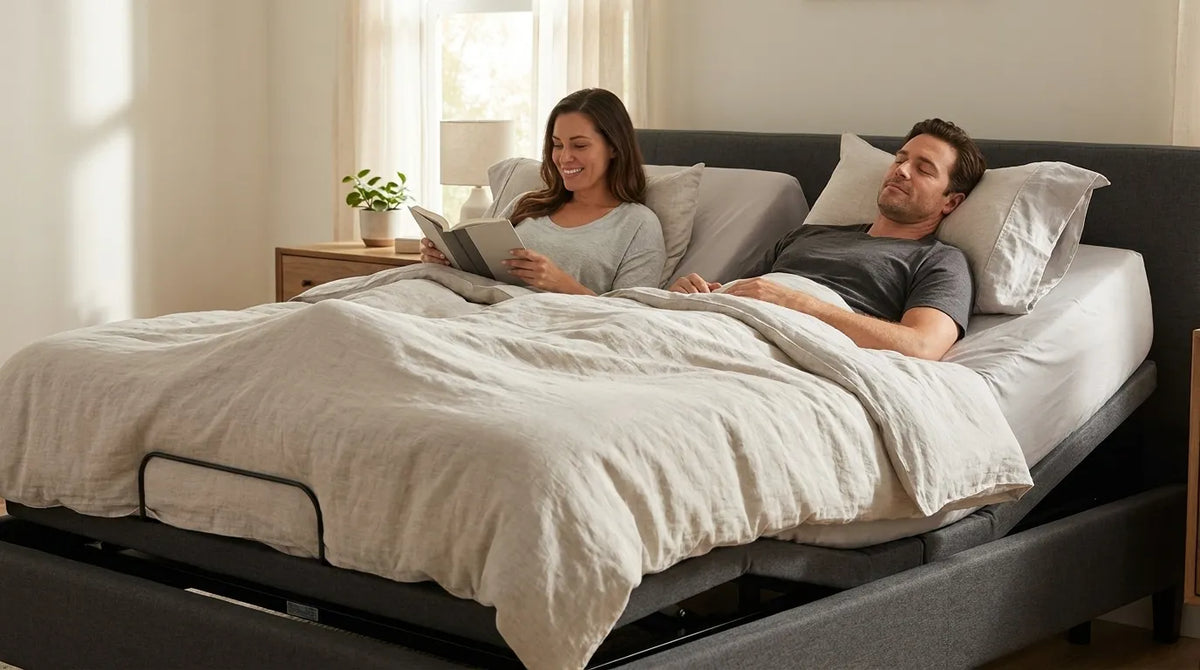
On a Split Queen or Split King adjustable base, the app becomes the primary tool for independent per-side control. Each partner saves their own positions and triggers them without disturbing the other side. A Split King occupies roughly 76" of width, while a Split Queen occupies 60", which matters in tighter rooms. A true Split Queen requires two 30" × 80" mattresses, a size the normal mattress supply chain does not produce. That gap is why almost no one offers a true Split Queen, and why Leva Sleep manufactures the mattresses itself.

Where the app can trigger a zero-gravity preset or activate massage, those features are covered in depth in Adjustable Base Zero Gravity Position: Set It And Tune It and Adjustable Base With Massage: Is It Worth It? (2026).
Leva Sleep offers five Split Queen packages from $1,399, with 30" × 80" mattresses manufactured in-house and a full line of Split Queen bedding and accessories built to fit them.
Compare App-Controlled Adjustable Bases
Bluetooth Vs. Wi-Fi Adjustable Bed Control
Before comparing apps, it helps to understand the connection underneath them. The connectivity architecture of an adjustable base determines four things: its range, its pairing behavior, its smart-home compatibility, and how it receives firmware updates. These are distinct technologies with different tradeoffs.
Bluetooth-only control keeps the phone in the room. Bluetooth control on adjustable bases remains available without Wi-Fi when the phone is within approximately 8 feet of the base, allowing local adjustments to position and massage. It can remain functional if Wi-Fi fails, and it requires no internet connection. The tradeoff is range. Move the phone to another room and control is lost.
Wi-Fi control enables routines, voice assistants, and remote access from anywhere on the home network or through the cloud. Firmware updates are handled through Wi-Fi in dual-connectivity architectures, whereas Bluetooth serves local commands rather than internet-based updates. However, Wi-Fi connectivity alone does not guarantee smart-home integration. Some Wi-Fi-connected systems still do not support Alexa, Google Home, or HomeKit, because the bridge to a cloud assistant requires a separate software layer, not just a Wi-Fi radio.
The practical decision is straightforward. Choose Bluetooth for a single sleeper who keeps a phone on the nightstand and wants simple in-room control. Choose Wi-Fi if voice control, scheduled routines, or adjusting the bed from another room matters. The table below breaks down how the two architectures differ across the factors that matter most.
| Feature | Bluetooth-Only | Wi-Fi (With Bluetooth) |
|---|---|---|
| Effective range | ~5–10 metres in-room | Whole home / remote via cloud |
| Pairing requirement | Phone must be within ~8 ft of base | Bluetooth pairing still required during initial setup |
| Smart-home integration | Generally not supported | Possible, but not guaranteed, and dependent on manufacturer software |
| Firmware updates | Not supported over Bluetooth | Delivered over Wi-Fi |
Best Adjustable Bed Apps And How Leva Compares
The Leva Sleep app provides full control of Leva adjustable bases, including custom sleep positions, vibrating alarms, and subtle adjustments to counter snoring. Higher-end Leva bases add Lumbar Control, Pillow Tilt Motor, Anti-Snore Mode, and per-side heating and cooling through The Leva Sleep System. The app supports both iOS and Android.
"A flat bed asks two different bodies to accept the same shape for eight hours. One of them always loses." — Leva Sleep Sleep Specialist
Leva is not the only app in the category. Several other manufacturers publish apps with different platform support and feature sets, and knowing how they compare helps you evaluate any base you are considering. Other named apps in the category, based on published sources:
- Purple Smart Base app (iOS and Android): Lets users dial in a fully custom recline angle beyond four built-in presets (Zero-G, lounge, anti-snore, flat), with no sensors and no subscription. The step-up Purple Premium Plus adds lumbar support, pillow tilt, and dual-zone massage.
- Tempur-Pedic Sleeptracker (iOS; Android support not confirmed in reviewed sources): Provides morning sleep reports and AI-driven monitoring of sleep stages, heart rate, and respiration; a Sleeptracker subscription is required for full features. The TEMPUR-Ergo Smart Base also supports Alexa and Google Home.
- Reverie Nightstand (iOS and Android on compatible models): Controls head and foot elevation, massage, lighting, and multiple saved positions; Bluetooth app integration appears on higher-end models such as the Dream Supreme.
- Ergomotion Sleep Assist (iOS and Android on compatible models): Subscription-free; passively monitors sleep stages, heart rate, and respiratory rate through built-in sensors, and includes Quiet-Nite Snore Intervention that gradually raises the head when snoring is detected.
- Sleep Number app (iOS and Android): Controls firmness and base position, runs massage and foot-warmer functions, and saves presets; rated 4.54/5 on iOS and 4.5/5 on Google Play. It does not support Alexa, Google Home, or HomeKit.
When evaluating any adjustable bed app, focus on a few practical criteria:
- Platform support: iOS, Android, or both.
- Control depth: full articulation or presets only.
- Subscription requirements for core features.
- Independent per-side control for couples on a split base.
- The manufacturer’s documented track record of continued app development.
Phone Platform And Smart-Home Compatibility
Platform support varies by manufacturer. Some apps are iOS-only, such as the Lucid L600 companion app, so Android users get full remote control but cannot use the app, Siri voice commands, or app presets. Android users should confirm universal app support before purchasing.
Voice control via Alexa or Google Home requires both Wi-Fi connectivity and a base whose software bridges to a cloud assistant. Bluetooth-only bases generally cannot support voice assistants because the integration requires an internet connection, not a short-range radio pairing. Sleep Number’s own support documentation states that Amazon Alexa and Google Home cannot control its smart bed, and Apple HomeKit is also unsupported, which illustrates that Wi-Fi connectivity and smart-home integration are separate questions.
Smart-home compatibility keeps gaining relevance. 63% of US households now own at least one smart home device, up from 44% in 2022, per ConsumerAffairs’ 2026 smart home market data. Buyers who already use Alexa or Google Home routines should verify native integration before purchasing and avoid assuming it exists.
Remote Vs. App: Choosing The Right Control In The Moment
The app excels at saved presets, custom positions, scheduled adjustments, and independent per-side control on a split base. It is the right tool when precision and personalization matter, such as saving a specific reading angle, scheduling a morning position, or letting each partner on a Split Queen recall their own settings without touching the other side.
The remote excels at fast, dark, one-touch adjustments. Unlocking a phone at 2 a.m. is slower than grabbing a backlit remote. The remote also functions as a fallback when the phone is charging, updating, or out of Bluetooth range.
There is one documented tradeoff worth knowing. Most Bluetooth adjustable beds only support one active connection at a time, so when a phone app is connected, the physical remote stops working until the app disconnects. This behavior is expected, but it means the two tools are not always available at the same time.
Both tools belong in the system. The remote is the better instrument for fast, dark, one-touch adjustments, and it deserves to be treated as a primary control alongside the app.
Downsides And Risks Of Adjustable Bed Apps
App control introduces failure modes that a physical remote does not. Knowing these risks before purchasing helps you make a clear technology decision.
Pairing failures. Bluetooth control can introduce pairing headaches, connection timeouts, interference from 2.4 GHz devices like Wi-Fi routers and microwaves, latency, and dependence on firmware compatibility. App controls may depend on Bluetooth, Wi-Fi, account access, or software updates, which creates failure points beyond the mechanical base itself.
Phone dependency. Full functionality of app-controlled smart beds can depend on a smartphone, app updates, and firmware updates rather than a dedicated physical controller, making the phone a single point of failure for bed operation. Some apps also require OS-level Bluetooth pairing that can break after a phone OS update.
App discontinuation. Smart beds create a long-term dependency on the manufacturer’s software and firmware support; if the manufacturer discontinues the app or stops issuing firmware updates, the smart features can stop working entirely. This risk already has a real example. Sleep Number discontinued its BreatheIQ snore-detection feature on January 30, 2026, deleting all historical snore data, which shows that app-dependent features purchased with the bed can be removed after the sale.
Subscription gating. Some manufacturers gate features behind a paid subscription tier, which means a feature you saw in a demo may not be available after the trial period ends. Before buying, confirm whether the features that matter to you are included in the base app or require ongoing payment.
These downsides highlight why the manufacturer’s software history deserves as much attention as the hardware specs.
Buyer’s Framework For Matching App Control To Budget And Sleep Setup
A simple checklist keeps the decision grounded in how you will actually use the bed:
- Confirm that the app controls full articulation, not just presets.
- Check that it is available on both iOS and Android if your household uses both.
- Review whether any core features sit behind a subscription.
- Verify independent per-side control on a split base.
- Look for a visible history of app updates and support.
- Make sure a physical remote ships with the base as a second control path.
Budget context matters as well. Complete Leva adjustable bed packages run $1,299 to $8,999+, with financing available including 0% APR and a stated 180-night comfort guarantee, though the US store’s displayed terms may currently differ and should be verified. The table below maps budget tier to app-control capability across the market and shows how more advanced app features cluster above the entry tier.
| Budget Tier | Typical Price Range (Complete Package) | App-Control Capability |
|---|---|---|
| Entry | $1,299–$1,899 (Leva US catalog, August 2026) | Basic articulation control, preset recall, Bluetooth; remote included as primary control |
| Core | $2,499–$2,999 (Leva US catalog, August 2026) | Full articulation, massage, anti-snore preset, saved positions, iOS and Android support |
| Premium | $3,799–$4,499 (Leva US catalog, August 2026) | Lumbar control, pillow tilt, per-side heating and cooling, advanced presets |
| Luxury | $5,999–$8,999+ (Leva US catalog, August 2026) | Full smart system integration, biometric-adjacent features, The Leva Sleep System per-side temperature |
Couples sharing a bed face a specific decision the solo-sleeper framework does not address. The AASM’s 2025 survey of 2,007 US adults, conducted by Atomik Research in June 2025, found 31% of US adults had opted for a sleep divorce, regularly sleeping in a separate room from a partner, with the figure rising to 39% among adults aged 35–44. A further 37% reported going to sleep at different times to accommodate a partner. For couples in this situation, the app makes independent per-side control usable without waking the other person.
Clinicians commonly recommend sleeping with the head elevated for conditions including sleep apnea, acid reflux, and post-surgical recovery. An adjustable base is how that position is achieved at home, night after night, without stacking pillows. For those researching adjustable bases for pain relief or bases for snoring relief, the app’s ability to save and recall precise head-elevation angles directly supports that use case.
Why Leva Sleep Stands Out For App-Controlled Adjustable Bases
Leva Sleep is a specialist adjustable bed company offering complete, personalized sleep systems for couples. Its adjustable bases are app-controlled via the Leva Sleep app, which provides full control including custom sleep positions, vibrating alarms, and subtle adjustments to counter snoring. Higher-end bases include the advanced features noted in the budget framework above through The Leva Sleep System.
Leva offers 15–20 adjustable base models versus the 3–5 found at a standard retailer, and the largest selection of Split Queen adjustable beds in North America, with five distinct packages from $1,399. Leva manufactures the required 30" × 80" mattresses itself and supports them with a full line of Split Queen bedding and accessories built to fit. The typical retailer offers no true Split Queen option.
Leva has operated for nine years and served more than 25,000 customers. Leva Sleep mattresses are made in the US, and 50% of the US lineup is unique to the American market, including premium California-made brands. Leva carries Aireloom, Tempur-Pedic, Stearns & Foster, Beautyrest, Serta, Kingsdown, and Helix, pairing each mattress with the right base through specialists who understand what each mattress should sit on.
The price range noted above covers complete adjustable bed packages, with financing available including 0% APR and a stated 180-night comfort guarantee, subject to the current terms displayed in the US store. In-house white-glove delivery includes removal of the old bed, full assembly, and a walkthrough of the system with both partners.
"Most people do not come to us for a bed. They come because one of them has been sleeping in the guest room and they want that to stop." — Leva Sleep Sleep Specialist
Visit The La Jolla Showroom Or Talk With A Sleep Specialist
Frequently Asked Questions
Which App Should I Choose If I Own A Non-Leva Base?
The best app depends on the base it controls and the platforms it supports. The Leva Sleep app serves Leva bases only, with full articulation control, custom sleep positions, vibrating alarms, and anti-snore adjustments on both iOS and Android. For other brands, options include the Purple Smart Base app, Tempur-Pedic Sleeptracker, Reverie Nightstand, and Ergomotion Sleep Assist, each with its own mix of subscriptions, sensors, and smart-home support. Use the criteria above, such as platform support and subscription requirements, to evaluate the app that ships with your base.
How Should Mixed iPhone And Android Households Evaluate Apps?
Some apps, including the Lucid L600 companion app, are iOS-only, which shuts Android users out of presets and voice commands entirely. Others, including the Leva Sleep app, the Purple Smart Base app, and the Ergomotion Sleep Assist app, support both platforms. For mixed-platform households, universal support is the safest choice. Voice control via Alexa or Google Home still requires Wi-Fi connectivity and a base whose software bridges to a cloud assistant, regardless of phone type.
How Serious Are The Downsides Of Adjustable Bed Apps?
The main risks involve pairing failures, phone dependency, and app discontinuation. Bluetooth pairing can break after OS updates, and many bases support only one active Bluetooth connection at a time, which can temporarily sideline the physical remote. The phone becomes a single point of failure for app-dependent features. The BreatheIQ discontinuation discussed above shows that software features can disappear, so the manufacturer’s software track record deserves careful review.
Can I Control A Split Adjustable Base From My Phone Without Waking My Partner?
Yes. On a Split Queen or Split King, each side adjusts independently. The app lets each partner save their own positions and trigger them silently, without the physical motion of reaching for a remote or the light of a screen disturbing the other side. Leva Sleep’s whisper-quiet German motors keep mechanical movement discreet. The app’s vibrating alarm feature also allows one partner to wake without sounding an audible alarm that would disturb the other.
Conclusion: Choosing App Control With Eyes Open
App control is a technology decision. The connectivity architecture, Bluetooth or Wi-Fi, determines range, smart-home compatibility, and how the base receives firmware updates. The app name and platform support determine whether the phone in your pocket can actually use the features you are paying for. The manufacturer’s track record determines whether those features will still be there in three years.
For couples, the calculus becomes more specific. A split adjustable base with genuine per-side app control solves the geometry problem that a flat mattress cannot: two bodies, two preferred positions, one bed. The app is what makes that independence usable at 2 a.m. without waking anyone. Leva Sleep focuses on those configurations, including the largest Split Queen selection in North America, with 30" × 80" mattresses manufactured in-house, app-controlled bases, and a full line of bedding built to fit them for couples in rooms where a King simply will not fit.
Shop Leva Sleep Adjustable Bases Online