Best Adjustable Bed Positions for Hip Pain Relief
Written by: Matthew Timmins, Founder and Managing Director, Leva Sleep
Key Takeaways
- An adjustable bed for hip pain changes sleep-surface angles to shift pressure off the greater trochanter and support a neutral pelvis.
- Back sleepers usually do best with 8–12 inches of knee elevation or a zero-gravity preset. Side sleepers typically need a shallow 10–15 degree head incline, minimal knee lift, and a pillow between the knees.
- Medium to medium-firm mattresses that flex with the base, such as Leva Sleep’s Heavenly Hybrid or Heavenly Response, provide reliable pressure relief and durability on an adjustable foundation.
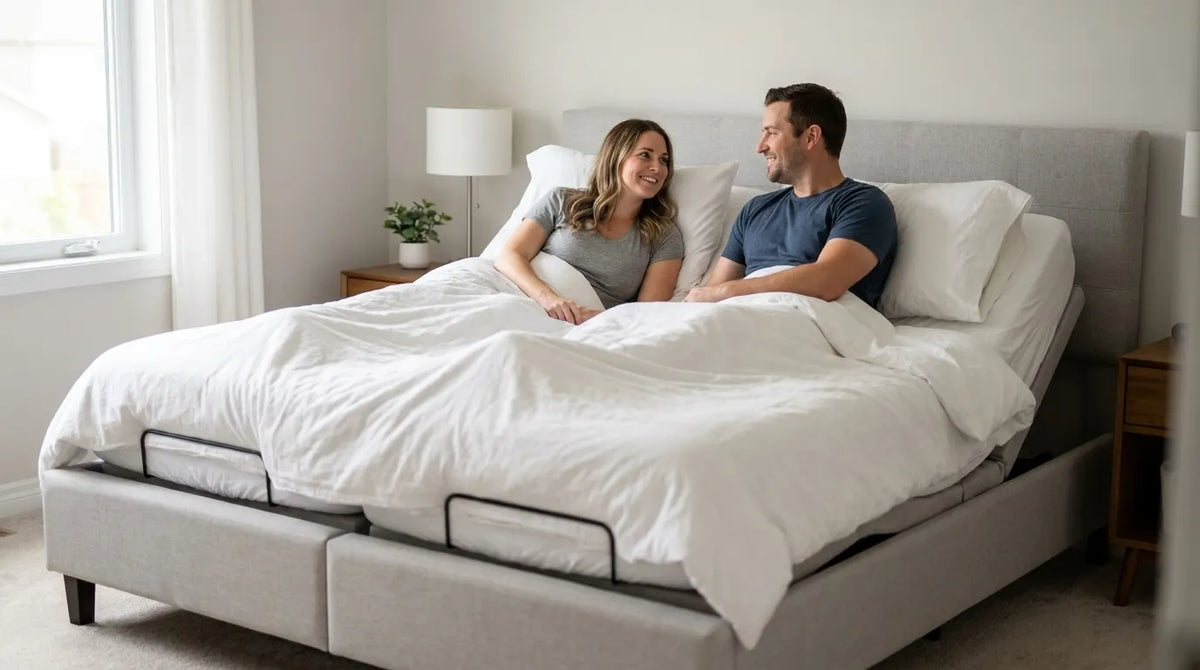
- Split configurations (Split Queen or Split King) let one partner use a therapeutic position without disturbing the other, which solves the most common couple scenario.
- Explore Leva Sleep’s purpose-built adjustable beds and mattresses to find a system designed for lasting hip-pain relief.
Will An Adjustable Bed Help With Hip Pain?
Most side sleepers experience meaningful relief from an adjustable bed when they use the right position. The mechanism is geometric: it changes the angles at which body weight loads the hip. A flat surface forces the full weight of the body through the hip’s widest contact point, the greater trochanter. Research published in Applied Ergonomics found that completely firm sleep surfaces increase peak pressure at bony contact points by 30 to 50% compared to medium-firm surfaces, fragmenting sleep and causing pain. When the leg section of an adjustable base rises, the pelvis tilts slightly, the hip flexors decompress, and pressure shifts away from the inflamed bursa or joint capsule.
Clinicians commonly recommend sleeping with the head elevated for conditions including sleep apnea, acid reflux, and post-surgical recovery. An adjustable base is how that position is achieved at home, night after night, without stacking pillows. The same principle applies to hip pain. Position is the variable, and an adjustable base is the tool that holds it reliably through the night.
An adjustable bed does not treat or cure hip pain. The reliable benefit is positional relief. The underlying condition still needs a clinician’s assessment. If pain is undiagnosed, positional changes alone are insufficient, and a clinician’s evaluation comes first.
Hip pain also has a way of spilling over into a relationship. A June 2025 survey of 2,007 US adults conducted by Atomik Research for the American Academy of Sleep Medicine found that 31% of American adults have opted for a “sleep divorce”, regularly sleeping in a separate room from their partner. Among adults aged 35–44, the figure rises to 39%. In many cases, one partner’s discomfort, including hip pain, drives that separation.
What Is The Best Adjustable Bed Position For Hip Pain?
There is no single best position. The right configuration depends on how you sleep. The four most effective configurations, grouped by sleeping style, are:
- Back Sleeper, Legs Elevated 8–12 Inches: This position flattens the lumbar lordotic curve and decompresses the posterior facet joints. Because the hips stay flexed for hours, the hip flexors can tighten over time, so alternating with a slightly flatter setting helps.
- Side Sleeper, Head Elevated 10–15 Degrees With Minimal Knee Lift: A gentler incline than full zero-gravity helps keep the neck aligned and reduces extra hip strain. A pillow between the knees supports pelvic alignment.
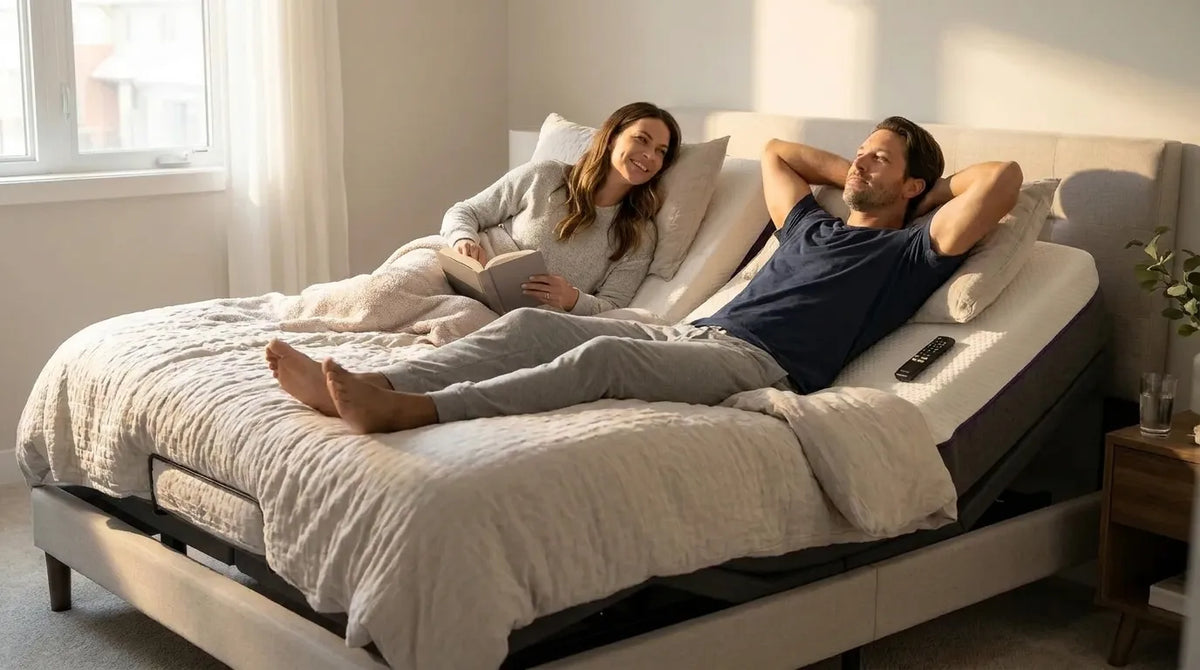
- Back Sleeper, Zero-Gravity Preset: Head 20–30 degrees and knees 25–35 degrees. This setup is best suited to back sleepers and is often recommended for chronic lower back or hip discomfort.
- Side Sleeper, Shallow Incline Only: Full zero-gravity is not recommended for side sleepers because it can twist the pelvis. The side-sleeper section below explains the mechanism.
The table below summarizes these configurations by sleeper type so you can match your own sleeping style to the right head and leg elevation at a glance.
| Sleeper Type | Head Elevation | Leg Elevation | Key Adjustment |
|---|---|---|---|
| Back Sleeper | 10–20 degrees | 8–12 inches (20–30 degrees) | Pillow under knees optional. |
| Side Sleeper | 10–15 degrees | Minimal knee lift | Pillow between knees; a shallower incline preserves hip and neck alignment for lateral sleepers. |
| Stomach Sleeper | Flat or minimal | Thin pillow under pelvis | A thin pillow under the pelvis or lower abdomen can help keep the spine and hips more supported. Stomach sleeping is generally the hardest position for hip pain. |
Best Adjustable Bed Position For Back Sleepers With Hip Pain
Back sleeping distributes body weight most evenly and takes direct pressure off both hip joints. Elevating the knees 8 to 12 inches, approximately 20 to 30 degrees of hip and knee flexion, flattens the lumbar lordotic curve and decompresses the posterior facet joints. Because the hips remain flexed, long periods in this position can tighten the hip flexors over time. On a flat surface, the legs pull the pelvis into anterior tilt and compress the posterior hip structures. Leg elevation on an adjustable base removes that pull mechanically, without pillows that shift during the night.
A slight head elevation of 10–20 degrees complements the leg position by reducing overall spinal loading. Research by Nachemson and Elfström found that a reclined position can reduce spinal disc pressure by as much as 50% compared to sitting upright. That finding is the mechanical basis for the zero-gravity preset. For back sleepers using an adjustable bed for hip and back pain, this is the position most consistently supported in the clinical literature.
Best Adjustable Bed Position For Side Sleepers With Hip Pain
Side sleeping is the position most likely to cause hip pain. An estimated 60 to 79.8% of adults sleep on their side, and lateral recumbency channels significant body weight through the greater trochanteric region, restricting blood flow and compressing the bursa against bone for hours. An adjustable bed for side sleepers with hip pain needs a different configuration than the full zero-gravity preset used by many back sleepers.
For side sleepers, a head elevation of approximately 10–15 degrees with minimal knee lift is recommended. The 10–15 degree incline from the list above is the starting point. What matters most is the knee pillow. Full zero-gravity can twist the pelvis for side sleepers. When the knees are elevated significantly in a lateral position, the top hip rotates downward relative to the bottom hip, creating lateral pelvic tilt and transmitting lateral flexion stress up the lumbar spine. In side sleeping without support, the top leg drops forward under gravity, rotating the top hip downward and creating lateral pelvic tilt toward the mattress. A high knee elevation on an adjustable base can replicate that same mechanical problem.
The correct configuration for side sleepers keeps the head elevated 10–15 degrees and the foot section raised only slightly. A firm pillow between the knees keeps the top leg level with the hip and prevents pelvic rotation. This combination redistributes pressure away from the greater trochanter without introducing new strain.
What Mattress Firmness And Type Works On An Adjustable Bed For Hip Pain?
Medium to medium-firm is the firmness range most consistently supported across the clinical literature. A 2026 systematic review published in the Journal of Orthopaedics and Traumatology (Caggiari Gianfilippo et al.) analyzed 47 studies and found that evidence most consistently favored medium-firm mattresses over very firm or very soft surfaces for adults with nonspecific low back pain or morning stiffness. A landmark Lancet trial (Kovacs et al., 2003) of 313 adults with chronic pain found that medium-firm mattress users were more than twice as likely to improve in disability scores and pain while lying in bed compared to firm mattress users.
Material matters as much as firmness when an adjustable base is involved. Memory foam and latex flex readily around the base’s hinges. Traditional innerspring mattresses with rigid, interconnected coil systems resist bending and put strain on both the mattress and the motor. Most mattresses sold at general retailers are not engineered to articulate night after night. They resist the base, wear unevenly at the flex points, and shorten their own lifespan in the process.
Leva Sleep’s Heavenly Hybrid (pocket coil) and Heavenly Response (all-foam) are manufactured specifically to flex with an adjustable base. Both are available in 30" × 80" for Split Queen configurations, a size that does not exist in the standard mattress supply chain. If you are managing hip and back pain, pair a purpose-built mattress with the right base. Otherwise the two components work against each other instead of together.
Explore Leva Sleep’s full range of sleep systems engineered for pain relief at the pain relief collection, or browse Leva Sleep’s pain-relief-focused adjustable systems online or in the La Jolla showroom.
What Are The Downsides Of An Adjustable Bed For Hip Pain?
Even with the right mattress and position, an adjustable bed is not a frictionless purchase. Four limitations come up repeatedly, and any honest guide should state them plainly.
Cost. Entry-level twin XL bases start around $400 and premium split king models can exceed $3,000 for the base alone, according to the National Council on Aging. Complete systems, base plus mattress, represent a meaningful investment. Leva Sleep’s complete packages run from $1,299 to $8,999+, with financing available.
Mattress Compatibility. Standard mattresses may not flex properly on an adjustable base, and using an incompatible mattress can void the mattress manufacturer’s warranty. A simple test helps. If a mattress cannot be folded 30 degrees without resistance, it is not suited to an adjustable base.
Motor Noise. Adjustable beds typically operate at 30–50 dB, with entry-level models producing audible motor noise. In a shared bed, a base that wakes a partner every time it moves has solved nothing. When comparing bases, ask about motor decibel ratings and travel speed. Leva Sleep’s bases use whisper-quiet German motors as one reference point.
The Side-Sleeper Zero-Gravity Caveat. As detailed above, full zero-gravity can introduce pelvic rotation for side sleepers. Use the correct position for your sleeping style, and this caveat does not apply.
If Only One Partner Has Hip Pain
This scenario is the one Leva Sleep encounters most often, and it is the one the rest of the industry handles worst. One partner needs a leg-elevated, head-raised position for hip relief. The other sleeps flat and does not want to be disturbed. A standard adjustable base moves both sides together. A split configuration gives each partner independent control. The table below compares the two split footprints so you can see which one fits your bedroom.
| Configuration | Width | Mattress Size | Best For |
|---|---|---|---|
| Split King | 76 inches (two 38" × 80" Twin XL mattresses) | Two Twin XL (38" × 80") | Couples with room for a King footprint; maximum base model selection |
| Split Queen | 60 inches (two 30" × 80" mattresses) | Two 30" × 80" (purpose-built; not a standard supply-chain size) | Couples in condos, older homes, or rooms where a King footprint does not fit |
The 16-inch difference between a Split King and a Split Queen footprint often decides whether the room works. Most couples who need split adjustability are told the only option is a King. If their bedroom cannot accommodate 76 inches of width, they are simply told no. Leva Sleep offers the largest selection of Split Queen adjustable beds in North America: five distinct packages from $1,399, with 30" × 80" mattresses manufactured in-house and a full line of Split Queen bedding and accessories. The typical retailer offers none.

Independent sides mean the partner with hip pain can use a leg-elevated, head-raised position while the other side stays flat. Because each side moves on its own, neither partner has to adjust to the other’s setting or be disturbed when it changes. Among the 37% of US adults who go to sleep at different times to accommodate a partner (Atomik Research for the American Academy of Sleep Medicine, June 2025), a split configuration removes the need for that compromise entirely.
Browse the full Split Queen range at Leva Sleep’s Split Queen collection or the Split King at the Duet Split King page.
Who Should Not Buy An Adjustable Bed For Hip Pain
Split configurations solve the couple problem, but an adjustable bed is not the right first step for everyone. Three situations call for a different approach:
- Undiagnosed Pain. Constant, positionally independent hip pain, pain not relieved by any sleeping position, is a clinical warning sign requiring urgent evaluation. An adjustable base addresses mechanical, positional pain. It does not address avascular necrosis, stress fractures, or malignancy.
- The Mattress Is The Actual Problem. A worn, sagging, or incompatible mattress on an adjustable base compounds the problem. If the mattress has visible body indentations or sagging, or is roughly seven to eight years old, address the mattress first.
- Budget Is The Binding Constraint. A well-chosen medium-firm mattress alone may deliver meaningful improvement. An adjustable base adds the most value when the mattress is already adequate and the geometry is the remaining variable.
FAQ
Do Doctors Recommend Adjustable Beds For Hip Pain?
Clinicians commonly recommend elevation for reflux, apnea, and post-surgical recovery. For hip pain specifically, orthopedic surgeons and physiotherapists frequently advise sleeping on the back with knees slightly elevated, or on the non-painful side with a pillow between the knees. An adjustable base is the most reliable way to hold those positions through the night without pillows that shift. No clinical body has issued a blanket endorsement of adjustable beds as a treatment, and no adjustable bed cures hip pain. The recommendation is positional. If a position relieves pain, a base that holds that position reliably is a practical tool.
What Is The Best Adjustable Bed For Hip Pain And Sciatica?
Position and configuration matter more than brand name. For sciatica combined with hip pain, the position most consistently supported is back sleeping with the knees elevated 8–12 inches, which slackens the piriformis and reduces lumbar nerve root stretch. The mattress should be medium to medium-firm and built to flex with the base. For couples where only one partner has symptoms, a split configuration, Split Queen for rooms that cannot accommodate a King footprint and Split King for larger rooms, allows the affected partner to use a therapeutic position without disturbing the other. Leva Sleep offers 15–20 adjustable base models compared to the 3–5 found at a typical mattress retailer, and its specialists can match the base, mattress, and configuration to the specific presentation.
Can I Use My Current Mattress On An Adjustable Base?
Sometimes this works, but most mattresses are not built to bend. Traditional innerspring mattresses with interconnected coil systems resist articulation, wear unevenly at the flex points, and can void the mattress manufacturer’s warranty when used on an adjustable base. Memory foam and latex flex readily. Modern pocket-coil hybrids with flexible coil systems can work, but compatibility varies by construction. As covered above, the 30-degree fold test is the quickest way to check. Beyond that, compatibility depends on materials and coil design. Leva Sleep’s Heavenly Hybrid and Heavenly Response mattresses are manufactured specifically to articulate with an adjustable base, night after night, without degrading at the hinge points.
How Long Does It Take To Adjust To A New Sleep Position?
Adjustment usually takes weeks, not days. Adapting to a new sleep surface and a new sleeping position takes longer than most people expect. The body’s soft tissue, hip flexors, and sleep architecture all require time to recalibrate. Most people need two to three weeks of consistent positioning before noticing a reliable difference in morning symptoms. Leva Sleep states a 180-night comfort guarantee, though the US store currently displays a 60-night comfort guarantee and a comfort exchange fee, which is an open item to reconcile. Six months is the realistic window for knowing whether a sleep system is working, not the first week.
Conclusion
Hip pain at night is a geometry problem. A flat surface concentrates pressure on the hip’s bony prominence and holds one pelvic geometry for eight hours. The right adjustable bed position, matched to sleeping style and with the side-sleeper zero-gravity caveat in mind, changes that geometry and changes the outcome. Find your split or standard adjustable system at Leva Sleep and give your hips a more forgiving night surface.