Adjustable Bed for Snoring: A Sourced Decision Guide
Written by: Matthew Timmins, Founder and Managing Director, Leva Sleep | Last updated: October 14, 2026
Last Updated: October 14, 2026
Key Takeaways
- Elevating the head of an adjustable bed at 20–30 degrees shifts soft throat tissue forward and opens the airway for many positional snorers.
- Positional snoring improves with elevation or side sleeping, while obstructive sleep apnea requires medical diagnosis and treatment from a clinician.
- One-touch anti-snore presets cover most consistent snorers, while automatic snore detection fine-tunes elevation for variable patterns without waking the sleeper.
- Adjustable beds hold a consistent angle, support independent positions for couples, and address snoring and reflux together.
- Leva Sleep builds adjustable beds with anti-snore modes, split configurations, and quiet motors specifically for snoring relief.
Shop Leva Sleep adjustable beds for snoring relief
The Problem: Why Position Affects Snoring
Lying flat lets gravity pull soft tissue in the throat backward and narrow the airway. Elevating the head shifts that tissue forward, reduces the gravitational load, and helps keep the airway open. Clinicians often recommend head-of-bed elevation for sleep apnea, acid reflux, and post-surgical recovery. An adjustable base makes that position repeatable at home without stacking pillows every night.
The most directly studied elevation angle is 30 degrees. A 2026 study by Maniaci et al. in The Laryngoscope measured 30-degree head-of-bed elevation using overnight polysomnography and found a 31% reduction in apnea-hypopnea index (AHI), from 22.6 to 16.4 events per hour (p < 0.001). At the lower end of the range, a 2017 study in Sleep and Breathing (PubMed ID 28647854) of 52 patients found that a 7.5-degree head-of-bed elevation reduced median AHI from 15.7 to 10.7 events per hour and increased minimum oxygen saturation from 83.5% to 87%. Together, these studies support a practical working range of 20–30 degrees as the bracket around the directly measured conditions. The Maniaci et al. authors describe their findings as hypothesis-generating and call for confirmation in larger prospective cohorts.
The geometry tested in these studies requires raising the entire torso. That is why propping up on pillows does not reproduce the studied condition, because it bends the neck and can worsen obstruction. An adjustable base raises the head section of the bed as a continuous incline, which matches the configuration the research measured.
How To Tell If An Adjustable Bed Will Help Your Snoring (And When To See A Doctor)
Positional snoring is the pattern an adjustable bed can address. Snoring that is loud when lying flat on the back and noticeably quieter when the sleeper rolls to one side or elevates the head fits this pattern.
Positional snoring and clinical sleep apnea are different problems that call for different responses. The NIH describes obstructive sleep apnea (OSA) as episodes of partial or complete airway obstruction during sleep, with breathing pauses lasting seconds to minutes that may occur 30 or more times per hour. The following warning signs indicate that a medical evaluation is the next step rather than a bed purchase:
- Gasping or choking during sleep
- Pauses in breathing witnessed by a partner
- Extreme daytime fatigue or falling asleep during routine activities
- Morning headaches
- Loud snoring that persists in every sleep position
The NIH notes that most individuals with OSA are unaware that their breathing repeatedly stops and restarts during sleep, so a bed partner’s observations often provide the clearest early signal. If any of the warning signs above are present, a clinician’s evaluation is the appropriate next step.
The Three Feature Tiers: Manual Incline Vs. Anti-Snore Preset Vs. Automatic Snore Detection
Many shoppers want to know whether automatic snore detection delivers a real benefit over a manual anti-snore preset and whether the extra cost makes sense. The answer depends on the snoring pattern and which partner is losing sleep. The table below breaks the three tiers down by what each one does and which sleeper it fits.
| Feature Tier | What It Does | Who Needs It |
|---|---|---|
| Manual Head Incline | The sleeper raises the head section using a remote or app before sleep and holds that angle all night | Sleepers who already know their preferred angle and set it consistently before bed |
| One-Touch Anti-Snore Preset | A saved position activated at bedtime, holding one angle through the night without further input | Sleepers whose snoring is consistent and positional, and who want a reliable nightly routine without manual adjustment |
| Automatic Snore Detection | Sensors detect snoring during the night and make micro-adjustments to the head of the bed in response, without waking the sleeper | Sleepers whose snoring varies by position through the night, or whose partner is the one losing sleep and needs the adjustment to happen without intervention |
Leva Sleep’s anti-snore mode detects snoring and makes micro-adjustments to the head of the bed to potentially reduce or eliminate snoring. A 2026 Facts for Health review notes that true automatic snore detection using microphones and sensors is rare and expensive, currently offered only by Tempur-Pedic and a few Ergomotion models. For most positional snorers, a reliable one-touch preset is sufficient. The key is using it every night, so saving the position to a memory preset matters more than the tier of automation.
That nightly-use problem often shows up as a couples problem. One partner snores, the other loses sleep and sometimes moves to another room. As one Leva Sleep specialist puts it, “Most people don’t come to us for a bed. They come because one of them has been sleeping in the guest room and they want that to stop.”
That pattern appears in national data. A 2025 survey of 2,007 US adults conducted by Atomik Research for the American Academy of Sleep Medicine found that 31% of American adults had opted for a “sleep divorce” by regularly sleeping in a separate room from their partner, with the figure rising to 39% among adults aged 35 to 44. A further 37% reported going to sleep at different times to accommodate a partner. If the goal is to keep both partners in the same bed, the next question is how much elevation helps and at what angle.
What Angle Should You Set An Adjustable Bed To For Snoring?
A practical starting protocol, based on the directly studied elevation conditions:
- Start at 20 degrees. This angle usually shifts airway geometry enough to help while limiting sliding down the mattress during the night.
- Use the 20–30 degree clinical range. The 2026 Maniaci et al. study measured 30 degrees directly, the 31% AHI reduction cited earlier. The 2017 Sleep and Breathing study measured 7.5 degrees, the lower bound cited earlier. The 20–30 degree range brackets the conditions with the strongest direct evidence.
- Go steeper only if needed. Sleep specialists cited in a 2026 Facts for Health review note that above 30 degrees, sleep becomes uncomfortable and neck strain develops. That finding sets the upper bound of the useful range. Below it the airway may stay only partially open, and above it the sleeper often slides down, which negates the benefit.
- Add a slight knee elevation (zero gravity position). Raising the knees slightly helps prevent sliding toward the foot of the bed and reduces lower back pressure, which matters for anyone spending eight hours at an incline.
Adjustable Bed Vs. Wedge Pillow Vs. Stacking Pillows
These three options differ on angle consistency, how well they work for couples, and whether they can handle reflux and snoring together.
| Option | Angle Consistency | Works For Couples | Works For Reflux-Plus-Snoring |
|---|---|---|---|
| Stacking Pillows | Poor, and stacked pillows raise the head without creating a continuous torso incline and shift during the night | No, each partner would need their own stack, so there is no shared solution | No, and the NHS warns that propping up on extra pillows can worsen reflux by bending at the waist and pressing on the stomach |
| Wedge Pillow | Moderate, and it holds angle but can slide, while cheap wedges using low-density foam flatten within weeks | No, and a single-width wedge tilts one partner and leaves a step in the middle of the bed | Partial, because it helps reflux when the torso is properly inclined, but it does not suit couples who need independent angles |
| Adjustable Bed | High, because it holds the set angle all night, and a 2026 roundup notes that saving the angle to a memory position is the key to consistent nightly use | Yes, since split configurations allow each partner to set an independent angle | Yes, because it holds the incline all night and allows knee elevation, with complete packages from $1,299 at Leva Sleep |
A wedge can work for mild positional snoring in a single sleeper and serves as a reasonable low-cost first step. Sleep and Sinus Centers of Georgia note that a wedge can be a reasonable option when snoring worsens while lying flat, but that evidence is mixed and comfort and long-term adherence determine whether any benefit persists. For reflux-plus-snoring or for couples who need different angles, an adjustable bed provides a more stable and adaptable solution.
When An Adjustable Bed Is The Wrong Purchase
An adjustable bed does not treat obstructive sleep apnea. Loud snoring with gasping, choking, or witnessed pauses in breathing calls for a doctor’s evaluation. A bed cannot replace diagnosis.
The NIH identifies positive airway pressure (PAP) therapy as a common first-line treatment for OSA, with lifestyle modifications, including positional therapy, used in conjunction with other treatments. The American Academy of Sleep Medicine’s 2006 practice parameters state that positional therapy is an effective secondary therapy or supplement to primary OSA therapies in patients who have a low AHI when non-supine, and that correction of OSA by position should be documented with an appropriate sleep test.
If the snoring is positional and mild, a wedge pillow may be sufficient. If a diagnosed sleep disorder is present, the clinician’s guidance takes precedence. Telling readers when a bed is the wrong purchase is the honest answer, even when it means a lost sale.
Configuration Note For Couples
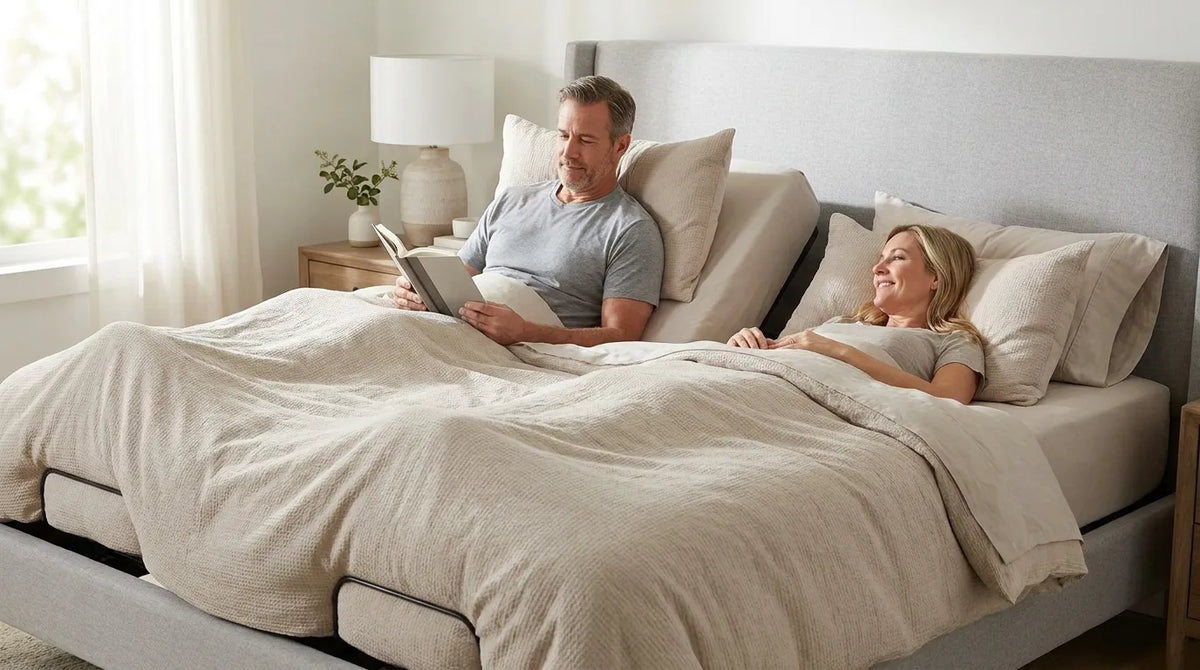
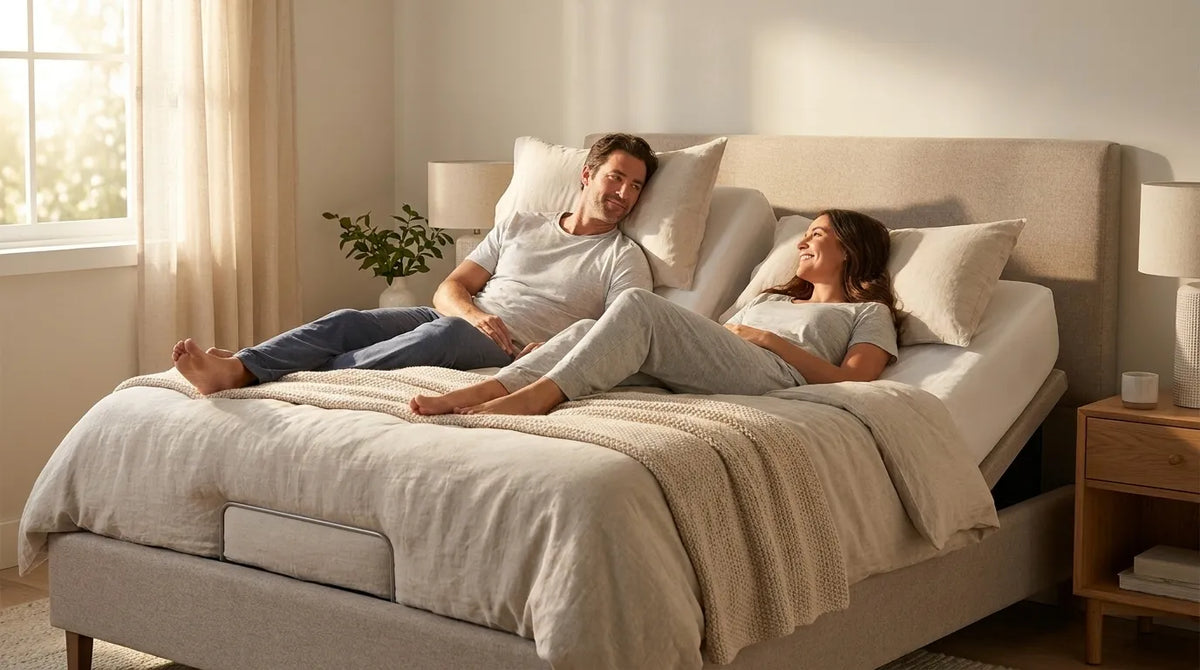
Many couples face a situation where one partner needs elevation and the other does not. That scenario calls for a split configuration. Leva Sleep offers Split Queen adjustable beds and a Split King adjustable bed with fully independent controls for each side, so one partner can elevate for snoring while the other stays flat.

Leva Sleep provides the largest selection of Split Queen adjustable beds in North America, with five packages from $1,399, 30″ × 80″ mattresses Leva manufactures, and a full line of Split Queen bedding. A Split Queen occupies a 60-inch footprint versus 76 inches for a Split King, which often marks the difference between a configuration that fits most bedrooms and one that crowds the space. For couples in condos, older homes, or rooms where a King will not fit, the Split Queen offers independent adjustability without requiring a larger room.
For a deeper look at couples-specific configurations, see Adjustable Beds For Snoring Couples: The Complete Guide and How A Split King Adjustable Bed Stops Snoring For Couples.
Why Leva Sleep For Snoring Relief
Leva Sleep builds adjustable beds specifically, rather than selling general furniture or mattresses alone. That focus matters when the purchase aims to solve a snoring problem instead of simply changing mattress feel.
As one Leva Sleep specialist explains, “You can’t solve a geometry problem by changing the foam. That’s the mistake almost every mattress purchase makes.”
Key features relevant to snoring:
- Anti-snore mode that detects snoring and makes micro-adjustments to the head of the bed to potentially reduce or eliminate snoring
- Whisper-quiet German motors so adjustments during the night rarely wake the partner who is not snoring
- Independent split articulation so each partner sets a personal position, such as one elevated and one flat
- Lumbar control and pillow tilt for fine-tuning beyond simple head-up and foot-up positioning
- Mattresses engineered to bend with the base night after night without breaking down under articulation
- Bedding designed for movement with extra-elastic fitted sheets, duvet clips, and remote pockets that stay functional at full elevation
Leva Sleep carries 15–20 adjustable base models, compared with 3–5 at a typical mattress retailer, so most bedrooms and budgets can find a workable configuration. Complete packages run $1,299 to $8,999+, with 0% APR financing available. Because adapting to a new sleep position takes weeks rather than days, the trial window matters. Leva’s stated policy is a 180-night comfort guarantee, though the US store currently displays a 60-night comfort guarantee plus a comfort exchange fee.
In-house white-glove delivery and setup include old bed removal, full assembly, and a walkthrough with both partners. The company has operated for nine years and has served more than 25,000 customers from its La Jolla, California showroom. Shoppers can browse the snoring relief collection or the pain relief collection to compare configurations and feature tiers.
Compare Leva Sleep’s anti-snore adjustable beds
Frequently Asked Questions
Does An Adjustable Bed Help With Snoring?
For positional snoring that worsens when lying flat and improves when the head is elevated, an adjustable bed can reduce snoring by shifting soft throat tissue forward and keeping the airway more open. The effect depends on posture and continues only while elevation is maintained. An adjustable bed does not treat obstructive sleep apnea, which requires medical diagnosis and treatment.
What Angle Should You Set An Adjustable Bed To For Snoring?
The most directly studied angle is 30 degrees, where a 2026 study in The Laryngoscope found a 31% reduction in apnea-hypopnea index. A 2017 study in Sleep and Breathing found meaningful benefit at 7.5 degrees. A practical starting point is 20 degrees, with gradual adjustment upward as needed. Above 30 degrees, neck strain and sliding become common problems. Combining head elevation with slight knee elevation, often called zero gravity, helps prevent sliding and reduces lower back pressure.
Do Adjustable Beds Adjust Automatically When You Snore?
Some models do. Automatic snore detection works as described above: sensors adjust the head of the bed without waking the sleeper. This feature sits at the top tier and appears in products from a small number of manufacturers. Most adjustable bases use a one-touch anti-snore preset, a saved position the sleeper activates at bedtime, which covers most positional snorers with consistent patterns.
Does Zero Gravity Help Sleep Apnea?
Zero gravity, a position with the head and knees slightly elevated, distributes body weight more evenly and reduces pressure on the lower back. The head elevation component may reduce snoring for positional snorers through the same mechanism as other head-of-bed elevation. Zero gravity does not treat obstructive sleep apnea. Anyone with suspected sleep apnea should seek a clinical diagnosis before relying on positional interventions.
What Is The Worst Sleeping Position For Snoring?
Sleeping flat on the back is the position most associated with snoring and airway collapse. In this position, gravity pulls the tongue, soft palate, and epiglottis backward into the airway. Elevating the head or sleeping on the side both reduce this gravitational load. Side sleeping generally produces a larger effect than elevation alone, and combining both, elevated and on the side, produces the greatest airway improvement in the available research.
Adjustable Bed Vs. Wedge Pillow For Snoring — Which Is Better?
A wedge pillow is a reasonable low-cost first step for a single sleeper with mild positional snoring. Its limitations include angle consistency, suitability for couples, and performance when reflux and snoring occur together. An adjustable bed holds the set angle all night, allows each partner in a split configuration to set an independent angle, and accommodates both snoring and reflux simultaneously. The right choice depends on severity, budget, and whether both partners need different positions.
Can I Get Split Adjustability Without Buying A King?
Yes. A Split Queen provides two fully independent bases, each with head and foot articulation, in a 60-inch footprint. A Split King uses a 76-inch footprint. A true Split Queen requires two 30″ × 80″ mattresses, a size that standard mattress supply chains rarely carry, so most retailers cannot offer it. Leva Sleep manufactures the 30″ × 80″ mattresses and offers the largest selection of Split Queen adjustable beds in North America, as detailed in the configuration note above.
When Should I See A Doctor Instead Of Buying An Adjustable Bed?
See a doctor if any of the following appear: gasping or choking during sleep, pauses in breathing witnessed by a partner, extreme daytime fatigue, morning headaches, or loud snoring that persists in every sleep position. These signs point toward obstructive sleep apnea, which requires clinical diagnosis and treatment, typically positive airway pressure therapy. A bed suits positional snoring but cannot replace a sleep study.
Get expert guidance on Leva Sleep adjustable beds
Conclusion And Next Steps
Elevating the head of the bed gently opens the airway, and clinical measurements at 7.5 and 30 degrees support this mechanism. The right solution depends on whether the snoring is positional or clinical and whether both partners need different positions.
For positional snoring in a single sleeper, a wedge pillow offers a reasonable low-cost trial. For couples, for reflux-plus-snoring, or for anyone whose snoring varies through the night, an adjustable bed with independent split articulation and an anti-snore mode provides more complete and consistent support.
For anyone with warning signs of obstructive sleep apnea, such as gasping, witnessed breathing pauses, extreme daytime fatigue, or morning headaches, a clinician’s evaluation is the next step. Positional therapy serves as a documented supplement to primary OSA treatment rather than a replacement for diagnosis.
When evaluating adjustable bases, compare feature tiers systematically. Manual incline works if the angle is set consistently every night. A one-touch anti-snore preset adds reliability. Automatic snore detection adds responsiveness for variable snoring patterns. Compare configurations by footprint and confirm that the mattress, bedding, and base are engineered to work together as a system.
Explore Leva Sleep configurations and pricing