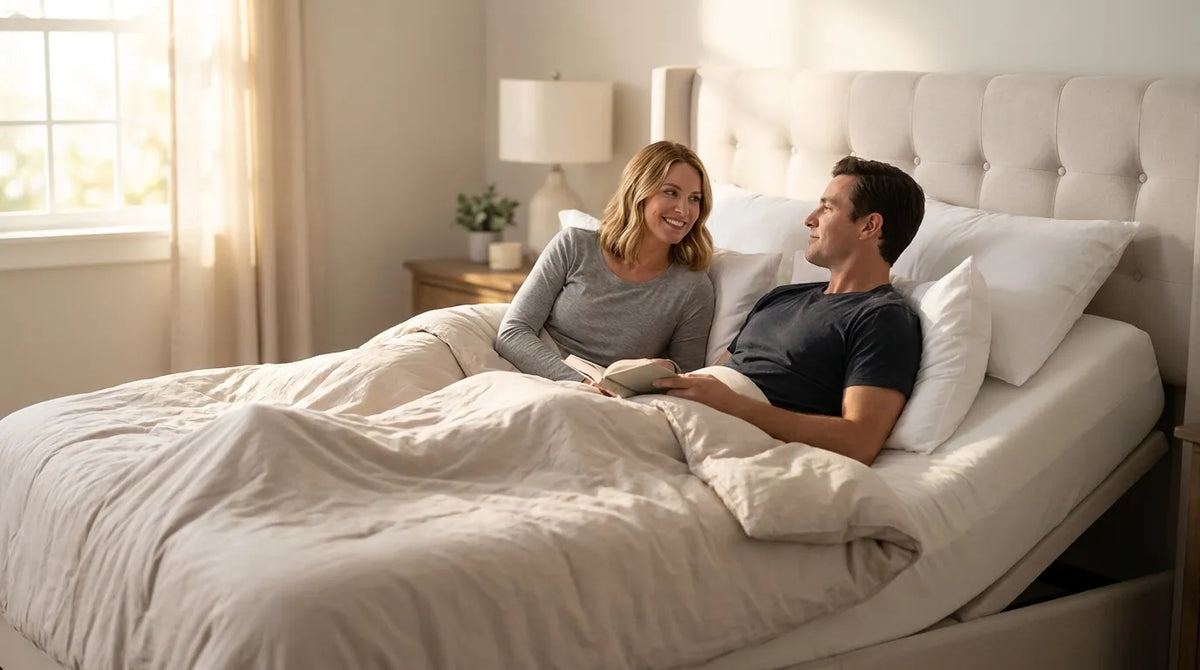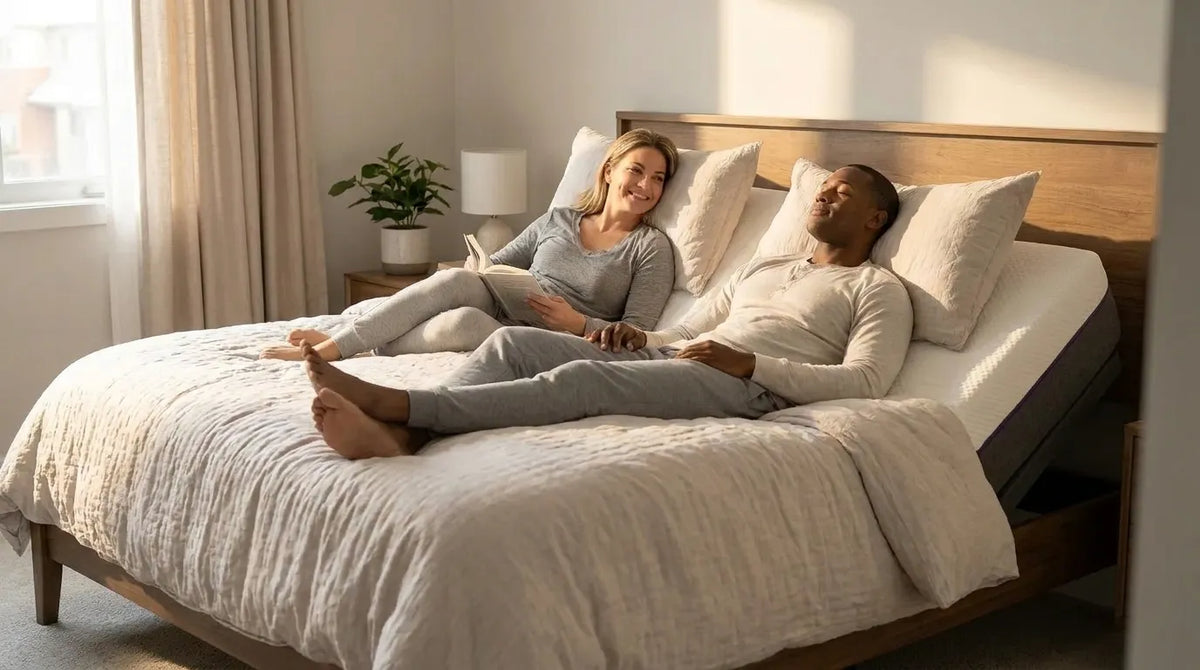
Best Sleep Positions for an Adjustable Bed Frame
Written by: Matthew Timmins, Founder and Managing Director, Leva Sleep | Last updated: October 15, 2026
Key Takeaways
- Each sleep position works best with its own head and knee angles on an adjustable base. Back sleepers often do well with 7–15° of head elevation, while side sleepers usually need only 5–15° to keep the spine aligned.
- Stomach sleepers face the most challenges on an adjustable base. Torso elevation strains the spine, so mattress support and pillow choice matter more than base angles.
- Combination sleepers benefit from programmable presets. Quick one-touch changes at night make it easier to move between flat, zero-gravity, and anti-snore positions without fully waking.
- Mattress flexibility at the base’s pivot points and bedding with deep pockets and full-perimeter elastic help prevent damage and keep sheets in place when the bed moves.
- Leva Sleep focuses on split articulation, lumbar control, and mattresses designed to bend so couples can each stay comfortable in their preferred position.
Shop Leva Sleep Adjustable Bases
Best Sleep Positions On An Adjustable Bed Frame
The best adjustable-bed position depends on your primary sleep style and any health concerns. The angle ranges below are approximate, and individual comfort varies.
- Back Sleeping With Gentle Incline: For back sleeping on a Leva Sleep adjustable base, aim for 7–15° of head elevation, with 10–12° working well for many people. The anti-snore preset keeps the foot section flat at 0°. Zero-gravity presets raise both the head and knees.
- Side Sleeping With Minimal Elevation: For side sleeping on an adjustable base, SweetNight recommends a head elevation of 5–8° and a foot elevation of 5–12°. These angles ease pressure while still keeping you on your side.
- Stomach Sleeping: Use minimal or no elevation. Keep the head flat or at a very slight incline only.
- Zero Gravity: The zero-gravity position on an adjustable base approximates NASA’s neutral body posture. It typically means about 20–30° of head elevation and 25–35° of knee elevation, though exact angles vary by source and personal comfort.
- Lounge And Reading: For reading in bed, raise the head to about 35–55° with the foot at 0–10°. For a TV or lounge recline, about 30° at the head usually feels comfortable.
- Anti-Snore Elevation: For anti-snore support, a head-of-bed incline of roughly 7–20° often helps. A 2020 pilot study found snoring stopped in 22% of people at 10° and 67% at 20°. Angles above about 30–35° usually feel too steep for long-term sleep.
- Reflux And Post-Surgery Elevation: For reflux, elevate the head of the bed by 6–8 inches (15–20 cm) at the head end of the sleeping surface. A 20 cm elevation on a standard bed corresponds to only about 4–5°, while 6–8 inches is often described as roughly 30°.
Adjustable Base Positions For Back Sleepers
Back sleepers usually do best with a 10–20° head incline and mild knee elevation. This setup helps keep the spine neutral and eases neck tension. The base bends at two hinge points, under the upper back and under the knees, so the mattress follows the body’s natural joints instead of creasing across the torso.
The Mayo Clinic recommends supporting the knees and maintaining the natural lumbar curve for back pain relief. Mild knee elevation on an adjustable base supports both goals without relying on a loose pillow that can shift overnight.
Back sleepers who snore often benefit from gentle head elevation to open the airway. A 7.5° head-of-bed elevation reduced obstructive sleep apnea severity by an average of 31.8% in one study of people with mostly mild to moderate OSA. In the 2020 anti-snoring bed pilot study (Sleep Science and Practice), snoring stopped in 67% of big-angle interventions at 20°, compared with 22% at 10°, although the overall snoring index did not change significantly.
Leva Sleep’s lumbar control and pillow tilt create fine-tuned “micro-geometry.” The system supports the lower back curve and angles the pillow independently, rather than lifting the entire head section as a single slab. That separate lumbar support reflects a specialist approach.
Back sleepers managing chronic pain can explore Leva Sleep’s pain relief collection.
Find Your Ideal Back-Sleeping Angle With Leva Sleep
Adjustable Base Positions For Side Sleepers
Side sleepers usually need a modest head elevation of about 10–15°. Those with lower back pain may prefer 15–20°. A slight foot elevation of roughly 10–15° can also help. Steeper angles tend to strain the neck and pull the spine out of alignment.
Adults spend about 54% of their time in bed sleeping on their side, according to a study of 664 sleepers. For this large group, the pivot point of the base matters more than the height of elevation.
For side sleepers on an adjustable bed, the mattress’s ability to flex at the base’s pivot points matters more than its thickness. A rigid mattress that cannot bend with the base creates hard pressure ridges at the shoulder and hip. An all-foam or flexible hybrid mattress bends cleanly at each pivot point and relieves that pressure. Because an adjustable base articulates at two hinge points, under the upper back and under the knees, the mattress must flex at those same points without resistance.
Any setup that pushes the chin toward the chest or twists the spine out of neutral uses too much head elevation for a side sleeper. A gentle whole-body tilt of roughly 5–7° that keeps the mattress flat often feels comfortable, especially with knee support. A hinge near the waist usually does not.
Leva Sleep’s independent split articulation lets each partner adjust their own side. One partner can side sleep at 5° of head elevation while the other back sleeps at 15°. A true split adjustable base makes this possible by giving each person separate head and foot controls. The full mechanics of side sleeping on an adjustable base appear in Leva Sleep’s guide: Adjustable Base For Side Sleepers: Pivot Point Matters Most.
Adjustable Base Positions For Stomach Sleepers
Stomach sleeping presents the toughest fit with an adjustable base. The position conflicts with torso-raising inclines. Clinicians note that reflux wedges do not work well for stomach sleepers because the position does not pair with a raised torso, even though the American College of Gastroenterology’s 2022 guideline still recommends head-of-bed elevation or wedge use for nocturnal GERD in general.
For stomach sleepers, an adjustable base often adds strain to the spine. Mattress support and pillow choice matter more than base angle. Gentle foot elevation can sometimes help find a balanced feel, but only very small adjustments are advisable. Elevating both head and feet while lying on the stomach tends to increase spinal stress. Sleep Junkie points out that an adjustable base cannot solve the basic geometry problem of stomach sleeping and advises against buying one specifically for this position.
Adjustable Base Positions For Combination Sleepers
Combination sleepers who move between positions during the night benefit from an adjustable base with programmable presets and a one-touch flat button. These features make it easy to return to saved positions at 2 a.m. without fully waking.
In practice, most combination sleepers do well with two or three presets:
- Back sleeping with the head at or below 30° and a comfortable knee bend
- Side sleeping with an 8–10° head tilt and about 15° of knee elevation, plus a pillow between the knees
- Zero gravity or lounge at roughly 20–30° head and 25–35° knee elevation
Leva Sleep’s app control and programmable positions make these quick changes simple. Whisper-quiet German motors keep adjustments from waking a partner. That quiet operation matters, because a bed that disturbs the other person with every movement has not solved the couple’s problem. Couples with different sleep-position needs can explore Leva Sleep’s guide: Best Adjustable Bases for Couples: Split King & More.
Zero Gravity Position On An Adjustable Bed
The zero gravity position raises both the head and knees slightly. This posture spreads body weight more evenly, reduces pressure on the lower back, and supports circulation. The name comes from NASA’s neutral body posture, the relaxed posture the body assumes in weightlessness, documented in NASA’s Man-Systems Integration Standards (MSIS, NASA-STD-3000), Section 3.3.4 and the NASA Human Integration Design Handbook.
NASA’s Neutral Body Posture research (NASA-JSC-14581) describes hip flexion of 128° ± 7° and knee flexion of 133° ± 8°. On an adjustable base, you can approximate the hip angle as 180° minus the torso tilt minus the thigh tilt. In practice, that means roughly a 20–30° torso raise combined with a 25–35° thigh raise.
NASA’s Human Integration Design Handbook and related neutral body posture research describe NBP as a reference posture with normal individual variation. There is no single universally correct zero-gravity posture, even in orbit. ClinicalTrials.gov lists trials of head-of-bed elevation and adjustable beds for sleep-disordered breathing and supine hypertension, but no registered clinical trial has tested “zero gravity beds” as a distinct treatment. Health claims for zero-gravity beds should stay modest and evidence-based.
The zero gravity sleep position suits back sleepers especially well. People with chronic lower back pain often feel immediate relief because the position aligns the spine and distributes weight without a steep incline. Some side sleepers also enjoy a gentler version of this posture. Leva Sleep’s zero-gravity preset treats position as a health input. Explore the pain relief collection for packages built around this position.
The Lounge And Reading Position
The lounge and reading position supports upright activities in bed. For laptop use, a head incline of 45–60° with the foot raised 15–25° provides ergonomic support without a stack of pillows. Reading usually feels better at 35–55° at the head with 0–10° at the foot. TV viewing often works well at about a 30° lounge.
Most people already use an adjustable base this way, but this remains a waking position rather than a sleep posture. Returning the base to flat or to a preset sleep position before drifting off protects spinal alignment. Elevated positions can help with reflux or snoring, yet staying at a steep lounge angle all night can strain the neck and lower back, especially for side or stomach sleepers.
Leva Sleep’s pillow tilt motor angles the head and pillow section independently. The neck stays supported even at a steep lounge angle instead of being pushed forward by a single raised slab.
Clinician-Recommended Elevated Positions For Reflux, Snoring, And Recovery
Clinicians often recommend sleeping with the head elevated for sleep apnea, acid reflux, and post-surgical recovery. An adjustable base makes these positions repeatable at home without a tower of pillows.
Reflux: The US National Institute of Diabetes and Digestive and Kidney Diseases (NIDDK) recommends raising the head of the bed 6–8 inches (15–20 cm) for nighttime acid reflux, with the head and upper back inclined together. The American College of Gastroenterology’s 2022 guideline conditionally suggests head-of-bed elevation for nighttime GERD symptoms and notes that several randomized trials found improvements in nighttime symptoms and acid exposure with this approach. Stacking regular pillows under the head elevates only the head and neck and tends to bend the body at the waist, which can increase stomach pressure and worsen reflux. A wedge or raised head-of-bed setup inclines the whole upper body instead.
Snoring: As noted earlier, a 7.5° head-of-bed elevation reduced OSA severity by an average of 31.8% in one study. A 2022 prospective study of 45 people with obstructive sleep apnea found that 30° head-and-trunk elevation reduced the average apnea-hypopnea index from 23.8 ± 13.3 to 17.7 ± 12.4 events/hour (p = 0.03). A separate 2025 multicenter observational study of 60 participants found AHI decreased from 25.7 to 17.8 events/hour with 30° head-of-bed elevation (p < 0.001), and 50% of OSA patients met responder criteria. An adjustable base does not replace medical treatment for sleep apnea. These findings describe positional effects rather than full clinical care.
Post-Surgery: After certain procedures, medical teams may instruct patients to sleep with the head raised to limit swelling. The correct angle and duration depend on the surgeon’s specific instructions.
Leva Sleep’s anti-snore mode gently elevates the head to help open the airway. Per-side heating and cooling address temperature differences, a common source of partner conflict. Explore the snoring relief collection for relevant packages.
Explore Leva Sleep Anti-Snore And Cooling Options
Common Mistakes To Avoid With An Adjustable Bed
An adjustable base does not suit every household. People who sleep comfortably flat, lack space or power access, or expect the base to replace medical treatment may not see enough benefit.
For those who do use one, several common mistakes shorten the life of the system or reduce its effectiveness. Each mistake stems from treating an adjustable base like a traditional bed frame:
- Using a box spring on an adjustable base. The base itself is the foundation, and a box spring adds height without function while interfering with movement.
- Using a mattress that is not rated adjustable-base compatible. Bending a rigid mattress can damage it and void the warranty.
- Sitting straight up from a fully reclined position. Lower the foot section toward flat first, then raise the head and swing the legs out.
- Stacking pillows under the head instead of inclining the whole upper body. This setup bends the body at the waist and can worsen reflux.
- Ignoring sudden, severe, or crushing chest pain. Heartburn and heart problems can feel similar, yet they require very different responses.
Why Sheets Pop Off Adjustable Beds
A base that moves without bedding that stays put solves only half the problem. When the head or foot section rises, the mattress bends and standard fitted sheets often bunch in the middle and pop off at the corners. A sheet that fits on a flat bed can peel away as soon as the base articulates.
Standard fitted sheet pockets of 12–14 inches are often too shallow for an articulating bed, especially once you add a topper or a thicker mattress profile. For adjustable-bed owners using any topper, a pocket depth of at least 15–18 inches works better. Three features keep sheets on an adjustable bed: deep-pocket fitted sheets sized to your mattress (commonly 8–18 inches, more with a topper), full-perimeter 360-degree elastic instead of corner-only elastic, and sheet straps or suspenders that clip to the sheet and run under the mattress.
As a Leva Sleep sleep specialist explains: “A split bed that your sheets won’t stay on is half a solution. The details are the product.”
Leva Sleep’s sheet sets, protectors, and duvets are built for split and adjustable beds. Extra elastic, deep pockets, duvet clips, and remote pockets address the details generalist retailers often skip.
Mattress Compatibility With Adjustable Bases
Most mattresses are not designed to bend repeatedly. Traditional innerspring models with interconnected Bonnell or offset coils usually do not pair well with adjustable bases. Repeated bending can damage these rigid coils, and some manufacturers void the warranty if the mattress is used on an adjustable base without approval.
Mattresses with a single continuous rigid element, such as interconnected coils, a rigid border wire, or a solid latex slab without flex cuts, resist bending at the base’s head and foot articulation points. This resistance places strain on coil connections and foam layers and can lead to broken coils, warping, foam cracking, and permanent creases over time.
Memory foam, latex, and hybrid mattresses with individually wrapped pocketed coils usually work well with adjustable bases. Foam edge-support layers may bow slightly when the base flexes. Many experts suggest a mattress height of roughly 10–14 inches for adjustable bases, although some sources cite 8–12 or 8–14 inches. Mattress flexibility and the manufacturer’s stated compatibility matter more than height alone.
A compatible mattress on an adjustable base typically wears at a similar rate to one on a flat foundation. Some extra wear can appear at the foot and lumbar hinge points if the bed stays in zero-gravity mode continuously. Rotating most modern mattresses head-to-foot every 3–6 months helps extend their lifespan. Some memory foam, latex, and newer innerspring models may only need rotation once or twice a year. Mattresses with zoned support should not be rotated. Returning the base to flat when not in use also helps.
Leva builds mattresses specifically designed to flex with the base, including the Heavenly Hybrid (pocket coil) and Heavenly Response (all-foam), both manufactured in 30" × 80" for Split Queen. Leva also carries Aireloom, Tempur-Pedic, Stearns & Foster, Beautyrest, Serta, Kingsdown, and Helix, pairing each brand with the right base through specialist guidance.

With those compatibility details in mind, the summary below brings together the recommended angles for each position so you can compare options at a glance.
Comparison Table: Positions Vs. Recommended Angles Vs. Best For
The table below summarizes the angle ranges discussed throughout this guide so you can match positions to your sleep style quickly.
| Position | Approximate Angle | Best For | What To Watch |
|---|---|---|---|
| Back Sleeping With Gentle Incline | Head 7–15°, mild knee elevation | Back sleepers, snoring, mild reflux | Avoid angles that push the chin toward the chest |
| Side Sleeping With Minimal Elevation | Head 10–15°, foot 10–15° | Side sleepers | Pivot point should align with the shoulder, not the waist |
| Stomach Sleeping | Minimal or no elevation | Stomach sleepers | Position conflicts with torso-raising incline |
| Zero Gravity | Head 20–30°, knees 25–35° | Back sleepers, chronic lower back pain | No clinical trial has tested zero-gravity beds specifically |
| Lounge/Reading | Reading: head 35–55°, foot 0–10°; TV: ~30° | Reading, TV, working in bed | Use only while awake, then return to flat or a sleep preset |
| Anti-Snore Elevation | Head 7–20° | Mild snoring, positional apnea | Higher angles may stop more episodes but can feel uncomfortable |
| Reflux/Post-Surgery Elevation | Head 15–20° (6–8 inches) | Nighttime GERD, post-surgical recovery | Incline head and upper back together rather than the head alone |
Why Leva Sleep Works For Every Sleep Position
A flat bed forces one geometry on two different bodies for eight hours. That mismatch contributes to the growing trend of “sleep divorce.” In a 2025 survey of 2,007 US adults conducted by Atomik Research for the American Academy of Sleep Medicine, 31% of American adults said they regularly slept in a separate room from their partner. Among adults aged 35–44, the figure rose to 39%. Leva Sleep exists for couples who want to stay in the same bed and still sleep well.
Leva Sleep is a specialist adjustable-bed company serving the United States, with a luxury showroom in La Jolla, California. Over nine years, the team has served more than 25,000 customers. The complete sleep system includes:
- Independent split articulation: Each partner gets their own geometry on one shared bed, so compromise becomes less necessary.
- Lumbar control and pillow tilt: Fine-tuned micro-geometry that goes beyond simple head-up and foot-up adjustments.
- Zero-gravity and anti-snore positioning: Presets that treat position as a health input and make helpful angles easy to reach.
- Whisper-quiet German motors: Smooth, quiet motion that protects sleep in a shared room.
- Mattresses and bedding built to move: Designs that flex with the base and stay in place through nightly articulation.
- Per-side heating and cooling: Temperature control for each partner, addressing one of the most common sources of conflict in bed.
- In-house white-glove delivery and setup: Professional installation, old-bed removal, and a walkthrough for both partners.
Leva offers the largest selection of Split Queen adjustable beds in North America, with five packages starting at $1,399. The company manufactures 30" × 80" mattresses in-house and supports them with a full line of Split Queen bedding and accessories. A Split Queen measures 60 inches wide, compared with 76 inches for a Split King. That 16-inch difference often decides whether a room works for couples in condos, older homes, or downsized spaces.
Most retailers do not stock this range of split options. Leva’s complete adjustable-bed packages run from $1,299 to $8,999+, with financing options including 0% APR and a 180-night comfort guarantee.
Explore the Split Queen collection or the Duet Split King to find the right configuration.
Visit Leva Sleep Online Or In The La Jolla Showroom
Frequently Asked Questions
Is It Okay To Sleep On Your Side On An Adjustable Bed?
Yes. Side sleeping works well on an adjustable bed when you use subtle angles. A gentle head elevation of 10–15° and a slight leg raise of 5–10° can relieve hip and lower back pressure while keeping the spine neutral. Zero-gravity presets usually suit back sleepers more than side sleepers.
As covered in the side-sleeper section above, the mattress must flex at the base’s pivot points. Memory foam, latex, or pocket-coil hybrids usually perform best. Keep head elevation modest, starting around 15–20°, and avoid steep angles that strain the neck.
Can I Put A Regular Mattress On An Adjustable Bed Frame?
Only if the manufacturer explicitly rates the mattress as adjustable-base compatible. Using an incompatible mattress can cause damage or void the warranty. Most traditional innerspring mattresses with connected coils do not pair well with adjustable bases, although a few specially designed units may.
Memory foam, latex, and pocketed-coil hybrids are generally compatible as long as no rigid border wire or stiff perimeter foam blocks the flex zones. Some brands recommend a maximum height of about 12 inches, while others focus more on flexibility than thickness. Always confirm compatibility with the mattress manufacturer before you buy.
Do Adjustable Bases Ruin Mattresses?
A compatible mattress on an adjustable base usually wears at a similar rate to one on a flat foundation. Extra wear can appear at the hinge points if the bed stays in a bent position all the time. A mattress that is not designed to bend, such as a traditional connected-coil innerspring with rigid border wires, can be damaged on an adjustable base.
Most modern mattresses benefit from rotation every 3–6 months, although some need it only once or twice a year. Mattresses with zoned support should not be rotated. Returning the base to flat when not in use also helps extend mattress life.
What Is The Best Position To Sleep In With An Adjustable Bed Frame?
The ideal position depends on your primary sleep style and health needs. Back sleepers often use a 10–20° upper-body incline with mild knee elevation to maintain spinal alignment and reduce snoring. Side sleepers usually need only modest head elevation, around 10–15°, and a mattress that flexes at the pivot points.
Stomach sleepers generally do best with a flat or nearly flat surface and a thin pillow. Combination sleepers gain the most from adjustable bases with customizable one-touch presets such as Zero G, Flat, and Anti-Snore. Zero gravity tends to benefit back sleepers and people with chronic lower back pain the most.
Why Won’t My Sheets Stay On My Adjustable Bed?
Standard fitted sheets often pop off because they lack the depth and elastic needed for a moving mattress. As covered in the sheet section above, the fix is deep-pocket sheets with full-perimeter elastic and sheet straps. On a split base, each side needs its own fitted sheet to preserve independent movement.