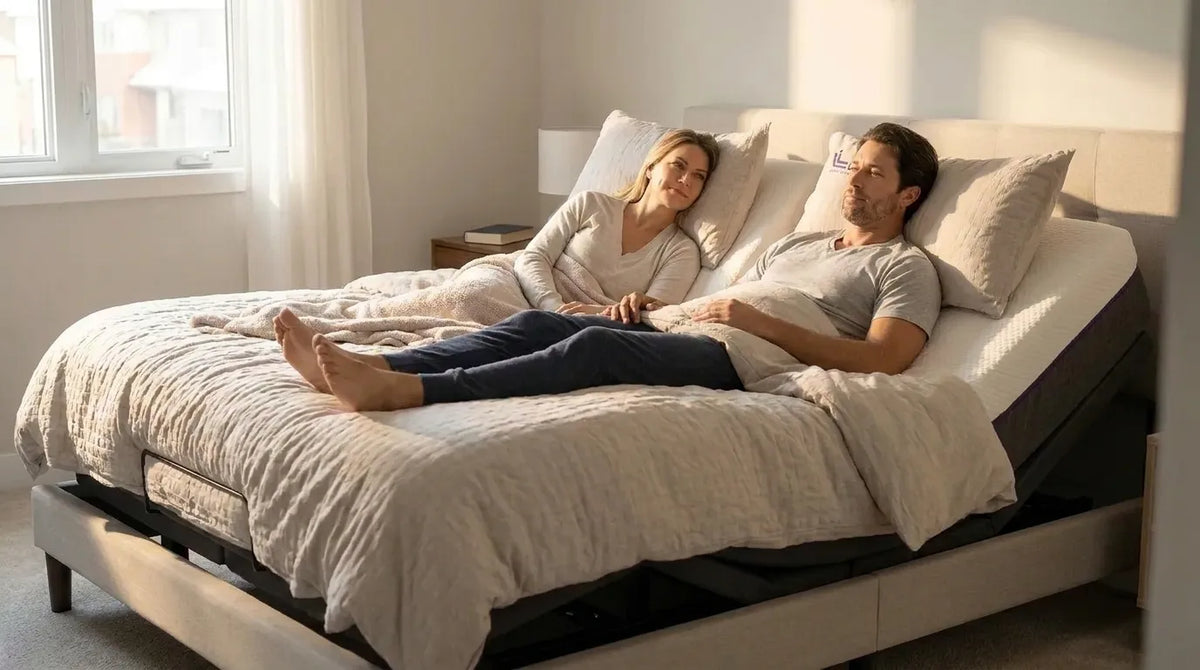
Adjustable Beds for Joint Pain: Do They Really Help?
Written by: Matthew Timmins, Founder and Managing Director, Leva Sleep
Key Takeaways
- An adjustable base relieves joint pain by changing sleep-surface geometry, redistributing weight away from hips, knees, shoulders, and lower back.
- A flat bed concentrates pressure on protruding joints for eight hours. Elevating the head, knees, or both reduces that pressure and can cut overnight swelling by up to 30%.
- Targeted positions such as zero gravity for the lower back, semi-Fowler for shoulders, and slight knee lift for hips and knees help you avoid the painful side and maintain neutral spinal alignment.
- Doctors and physical therapists commonly recommend elevated sleeping positions for arthritis, reflux, and post-surgical recovery. An adjustable base delivers those positions mechanically every night.
- Leva Sleep builds complete, matched sleep systems with adjustable bases, independent per-side control, and mattresses engineered to flex so couples can each choose their ideal joint-pain relief position.
Shop Leva Sleep Adjustable Systems For Joint Pain Relief
How A Flat Bed Makes Joint Pain Worse
A flat surface forces one spinal geometry for eight hours and puts body weight on the points that stick out furthest, including the hips, knees, shoulders, and lower back. The problem is the geometry of a flat surface, not the quality of the mattress.
When you lie flat, your body weight is distributed across a single plane. The parts of your body that protrude furthest, such as the greater trochanter of the hip, the lateral knee, the acromioclavicular joint in the shoulder, and the sacral base, bear the most pressure. During the day, movement continuously redistributes synovial fluid across joint surfaces, preventing pressure from pooling. At night, static posture concentrates pressure on those bony prominences, triggering local inflammatory cascades that peak in the early morning hours.
That pressure buildup is why you wake up stiff and why you shift positions constantly. A better mattress, even a genuinely better one, does not fix the underlying geometry. You cannot solve a geometry problem by changing the foam. A flat bed asks two different bodies to accept the same shape for eight hours, and one of them always loses.
Adjustable Base Positions For Specific Joints
Hips
Position: Slight head elevation of about 10–15 degrees with knee elevation of about 10–20 degrees. This combination reduces hip flexor tension and takes pressure off the hip joint capsule.
Mechanism: Elevating the knees slightly flexes the hips and reduces the pull on the hip joint capsule, while back sleeping with knees elevated distributes weight evenly and avoids compressing either hip. The Arthritis Foundation recommends using pillows to support joints and maintain comfortable alignment during sleep, and an adjustable base achieves this mechanically without pillows that shift. Shifting away from the painful side during sleep can reduce deep joint pressure by as much as 40%. Sleeping on the painful hip increases pressure, so a supported back-sleeping position on an adjustable base helps you stay off the affected side.
Knees
Position: Back sleeping with the knees elevated 5–10 degrees to maintain a slight bend. Avoid sleeping with legs fully extended and locked straight, which stresses the knee joint.
Mechanism: A slight knee bend reduces pressure through the joint surfaces and prevents the knee from straightening too much, which can increase pain. Elevating the leg so the knee sits slightly higher than the heart helps fluid drain away from the joint, reducing swelling and pressure. A 2020 Journal of Rheumatology study showed that people with medial knee osteoarthritis had up to 30% more overnight joint swelling after sleeping without leg support.
Lower Back
Position: Slight head elevation of about 10–15 degrees combined with knee elevation of about 10–20 degrees, often called the zero gravity position. This position supports the lumbar curve and reduces lumbar lordosis.
Mechanism: A flat bed leaves the lumbar curve unsupported and the pelvis rotated. Elevating the knees tilts the pelvis into a more natural position, allowing the lower back to relax against the mattress. The zero-gravity angle, with the head elevated 7–10 degrees and legs 15–20 degrees, offloads pressure on the L4-L5 disc space, which is the origin of most chronic lower-back pain, and may reduce lumbar disc pressure by up to 40% compared with lying flat. Lumbar control, which uses a dedicated motor supporting the lower back curve, provides additional support beyond raising the head or foot section.
Shoulders
Position: Back sleeping with the head elevated 30–45 degrees in a semi-Fowler position reduces intra-articular pressure in the shoulder. Side sleepers should lie on the unaffected side with a pillow supporting the affected arm.
Mechanism: Lying flat eliminates gravity-assisted drainage, causing fluid to pool around inflamed tissues and increasing pressure inside the joint capsule and subacromial space. Reclining at 30–45 degrees counteracts this pooling and reduces intra-articular pressure. Between 70% and 86% of people with chronic shoulder conditions report poor sleep quality because of nighttime pain, and 67% of patients with one-sided shoulder pain were found to be sleeping on that exact side. Pillow tilt, which uses an additional motor angling the head section independently, lets you adjust airway and neck position without stacking pillows that shift during the night.
The table below summarizes the recommended position and mechanism for each joint so you can match your base settings to your specific pain point.
| Joint | Recommended Position | Mechanism | Source |
|---|---|---|---|
| Hips | Head 10–15°, knees 10–20° | Reduces hip flexor tension, distributes weight evenly | Arthritis Foundation via Zero G Beds |
| Knees | Knees elevated 5–10° | Reduces joint surface pressure, prevents locking | Fondren Orthopedic Group |
| Lower Back | Zero gravity (head 10–15°, knees 10–20°) | Supports lumbar curve, reduces lordosis | NIH guidance via The Ergo Report |
| Shoulders | Head 30–45° (semi-Fowler) | Reduces intra-articular pressure, prevents fluid pooling | Superpower, reviewed by William Maish, MD |
How Clinicians Use Adjustable Positions For Joint Pain
Clinicians commonly recommend sleeping with the head elevated for conditions including sleep apnea, acid reflux, and post-surgical recovery. An adjustable base lets you hold that position at home every night without stacking pillows. Many customers come to Leva Sleep after a doctor or physiotherapist recommends an elevated sleeping position.
Michael J. Breus, Ph.D., a clinical psychologist and sleep specialist, states that anyone with gastroesophageal reflux disease, asthma, low back pain, or sleep apnea can benefit from sleeping on an adjustable bed because elevating the upper body can address many of these conditions. Karena Wu, P.T., D.P.T., an orthopedic physical therapist, notes that for lower-back pain, a 120-degree angle between the thighs and torso, the zero-gravity position, is recommended, and a resting knee position of 20 degrees can be beneficial for knee joint issues.
The Arthritis Foundation notes that sleep problems are common among people with arthritis and that addressing sleep is an important part of managing the condition. The Foundation recommends experimenting with pillow support according to the affected joint rather than forcing everyone into one sleeping position, and an adjustable base makes that experimentation mechanical rather than dependent on pillows that shift and flatten.
Important: An adjustable base changes your sleep position; it does not treat the underlying condition. A 2026 systematic review in the Journal of Orthopaedics and Traumatology concluded that smart and adaptive mattress systems are promising but require larger, methodologically rigorous clinical trials before routine recommendation. If joint pain regularly prevents sleep, is getting progressively worse, causes significant swelling, or limits normal activities, consult a clinician.
Practical Downsides To Weigh Before Buying
- Cost: Complete adjustable bed packages range from $1,299 to $8,999+. Entry-level bases start under $1,000, but mid-range options with quiet motors and reliable articulation run $1,200–$1,600 for a queen base alone.
- Mattress compatibility: Most mattresses are not built to bend. Traditional innerspring mattresses with interconnected coils can resist articulation and wear unevenly. Memory foam, latex, and pocketed-coil hybrids flex best.
- Motor noise and movement quality: Basic bases sold as add-ons often have loud motors and jerky movement. A bed that wakes your partner every time it moves does not solve the problem.
- Limited arthritis-specific evidence: As noted earlier, the 2026 systematic review found the evidence promising but not yet sufficient for routine recommendation. Adjustable bases help with positioning, and current data still evolve.
- Space requirements: Head-lift clearance requires a few extra inches of headroom. Wall-hugger designs help in tight bedrooms.
- Health contraindications: Karena Wu, P.T., D.P.T., states that individuals with spinal fusion and osteoporosis should avoid adjustable positions that may worsen their condition, and that anyone with heart or respiratory issues should consult a doctor before use.
Mattress Types That Work With Adjustable Bases
Most mattresses are not engineered to flex. A mattress built to bend with the base lasts longer and works better. The table below shows which mattress types flex reliably and which ones to avoid.
| Mattress Type | Flexes With Base? | Notes | Source |
|---|---|---|---|
| All-foam | Yes | Most flexible; maximizes head and foot elevation | Good Housekeeping |
| Latex | Yes | Less flexible than foam; may limit maximum incline | Good Housekeeping |
| Pocketed-coil hybrid | Yes | Individually wrapped coils flex; check manufacturer specs | Mattressnut |
| Traditional innerspring | No | Interconnected coils can crack or lose support under articulation | Miller Waldrop |
Mattresses in the 10–12 inch thickness range tend to flex best on an adjustable base; very thick mattresses measuring 14 inches or more can resist bending. Leva Sleep builds mattresses designed to flex with the base and sells them as a matched system rather than a base on its own. The Heavenly Hybrid, a pocket coil model, and Heavenly Response, an all-foam model, are both manufactured in 30″ × 80″ for Split Queen configurations, and each partner can choose their own firmness level.
Shop Mattresses Engineered For Adjustable Bases
Who Benefits Most From An Adjustable Base
An adjustable base suits people whose pain changes with position and whose sleep is disrupted by pressure on specific joints.
- People whose pain is positional and who wake with hip, knee, or lower back pressure after a night on a flat surface.
- Couples where one partner's position or snoring disrupts the other. A 2025 AASM survey found 31% of US adults have already opted for a sleep divorce, rising to 39% among adults aged 35–44.
- People advised by a clinician to sleep in an elevated position for sleep apnea, acid reflux, or post-surgical recovery.
Some people should delay or skip an adjustable base and seek clinical input first.
- Someone whose pain is undiagnosed or unrelated to sleep position, who should consult a clinician first.
- Someone with spinal fusion or osteoporosis, who should consult a doctor before using an adjustable bed, as certain positions may not be safe.
- Someone who currently has no problems getting consistently good sleep, since upgrading to an adjustable bed is most helpful when a health condition is preventing restful sleep.
Why Leva Sleep Is The Specialist Answer
Leva Sleep focuses on adjustable beds and offers complete, personalized sleep systems for couples across the United States, with a luxury showroom in La Jolla, California. After nine years and more than 25,000 customers, Leva designs complete sleep systems that include adjustable bases with independent per-side control, mattresses built to flex, and bedding engineered for movement.
Leva offers the largest selection of Split Queen adjustable beds in North America and manufactures the 30″ × 80″ mattresses that configuration requires. A Split Queen occupies 60 inches of width versus 76 inches for a Split King, a difference that often determines whether the configuration fits the room. Complete packages start at $1,299 and include a 180-night comfort guarantee plus in-house white-glove delivery and setup. Leva carries 15–20 adjustable base models, compared with the 3–5 at a typical mattress retailer. Premium brands include Aireloom, Tempur-Pedic, Stearns & Foster, Beautyrest, Serta, Kingsdown, and Helix, each paired with the right base by specialists who understand what goes underneath.

Explore Split Queen Adjustable Beds For Joint Pain Relief
Still weighing whether an adjustable base fits your situation? The questions below cover the most common practical details.
Frequently Asked Questions
What Is The Best Sleeping Position For Joint Pain?
No single position works for everyone, but some patterns help most people. Back sleeping with a pillow under the knees is generally the most neutral position for hip, knee, and lower back pain because it distributes body weight evenly and keeps the spine from twisting. Side sleeping on the unaffected side with a pillow between the knees works well for hip pain. An adjustable base lets you achieve these positions mechanically rather than relying on pillows that shift during the night. The goal is a position that reduces pressure on painful joints, keeps the spine reasonably aligned, and allows comfortable movement during sleep.
Does An Adjustable Bed Help With Hip Pain?
An adjustable base can help with hip pain by elevating the knees slightly to reduce hip flexor tension and by distributing body weight more evenly across the back instead of concentrating it on one hip. Sleeping on the painful hip increases discomfort, so the base helps you maintain a supported back-sleeping position without relying on pillows that flatten and shift. For side sleepers, the base can support the upper body while a pillow between the knees keeps the hips stacked. The benefit is positional because the base changes the geometry of the sleep surface so pressure does not stay concentrated on the inflamed joint for eight hours.
Do Doctors Recommend Adjustable Beds?
Clinicians often recommend sleeping with the head elevated for conditions such as sleep apnea, acid reflux, and post-surgical recovery, as described earlier. An adjustable base is the practical way to hold that position at home without unstable pillow stacks. Many customers reach Leva Sleep after a doctor or physiotherapist recommends an elevated sleeping position. Orthopedic physical therapists highlight the zero-gravity position, a 120-degree angle between the thighs and torso, for lower-back pain and note that leg elevation helps reduce pressure on the pelvis and knee joints. An adjustable base changes position but does not act as a medical device or treat the underlying condition.
What Are The Downsides Of An Adjustable Bed?
The main downsides include cost, mattress compatibility requirements, motor noise in budget models, and limited arthritis-specific clinical evidence. As noted above, packages span a wide price range from entry-level options to premium systems around $8,999+. Most mattresses are not built to bend, so a compatible mattress is essential. Budget bases often use louder motors with jerky movement, which can be disruptive in a shared bed. People with spinal fusion or osteoporosis should consult a doctor before use. Current research supports positional benefits, and larger trials will clarify long-term arthritis outcomes.
Can You Use An Adjustable Base With Any Mattress?
No, and the compatibility table above shows the key differences. All-foam, latex, and pocketed-coil hybrid mattresses flex best with an adjustable base, while traditional interconnected-coil innersprings resist articulation and can be damaged when the head or foot section bends repeatedly. Mattress thickness also matters. Models in the 10–12 inch range tend to flex best, while mattresses 14 inches or thicker can resist bending. Leva Sleep builds mattresses designed to flex with the base and sells them as a matched system, manufacturing the Heavenly Hybrid and Heavenly Response in 30″ × 80″ for Split Queen configurations. Buying base and mattress from the same specialist helps guarantee compatibility because both are engineered to articulate together.
Is A Softer Or Firmer Mattress Better For Hip Pain?
Medium-firm support is generally recommended for joint pain. A mattress that is too soft allows the body to sink, bending joints at awkward angles and failing to support the spine. A mattress that is too firm concentrates pressure at bony points, including the hips, shoulders, and knees, which increases pain. A 2026 systematic review in the Journal of Orthopaedics and Traumatology found that medium-firm mattress support was associated with better pressure distribution, improved sleep quality, reduced morning stiffness, and lower low back pain intensity. The ideal firmness also depends on body weight, sleep position, and specific pain location. Heavier sleepers generally need a firmer support core, while side sleepers with hip or shoulder sensitivity benefit from a conforming comfort layer on top of a medium-firm base.
What Is The Difference Between An Adjustable Base And An Adjustable Bed?
An adjustable base is the motorized frame that articulates and raises or lowers the head and foot sections independently. An adjustable bed usually refers to the complete system, including base and mattress. At Leva Sleep, a sleep system goes further and includes an adjustable base, a mattress built to flex, bedding engineered for movement, and per-side heating and cooling. Buying a base without a compatible mattress is a common mistake. Most mattresses are not built to bend, so a mismatched one resists articulation, wears unevenly, and shortens its own lifespan. The distinction matters because the base changes the geometry, and the mattress determines whether that geometry feels comfortable and remains sustainable night after night.
When Should I See A Doctor About Joint Pain?
Seek medical assessment for night pain that is severe and unexplained, constant and progressively worsening, or associated with fever, unexplained weight loss, significant trauma, new neurological symptoms, significant weakness, or bowel or bladder changes. If pain repeatedly wakes you, you wake with significant stiffness every morning, you cannot find a comfortable sleeping position, or you rely on medication just to sleep comfortably, a physiotherapy or medical assessment is appropriate. An adjustable base can help with positional pain, but clinical evaluation remains essential for diagnosing and treating the underlying condition.
Find Your Joint Pain Relief Sleep System At Leva Sleep
Conclusion: Change The Geometry, Change The Pressure
A flat bed forces one spinal geometry for eight hours and concentrates body weight on the joints that protrude furthest. You cannot solve a geometry problem by changing the foam. An adjustable base changes the geometry, redistributing pressure away from hips, knees, lower back, and shoulders so you are not compressed in the same position all night.
Match any solution to your personal health needs and partner dynamics. If your pain is undiagnosed or unrelated to sleep position, consult a clinician first. If you have been told to sleep elevated or you wake with hip, knee, or lower back pressure, an adjustable base provides that position at home every night without unstable pillow stacks.
Transform Your Sleep With Leva Sleep By Shopping Online Or Visiting The La Jolla Showroom