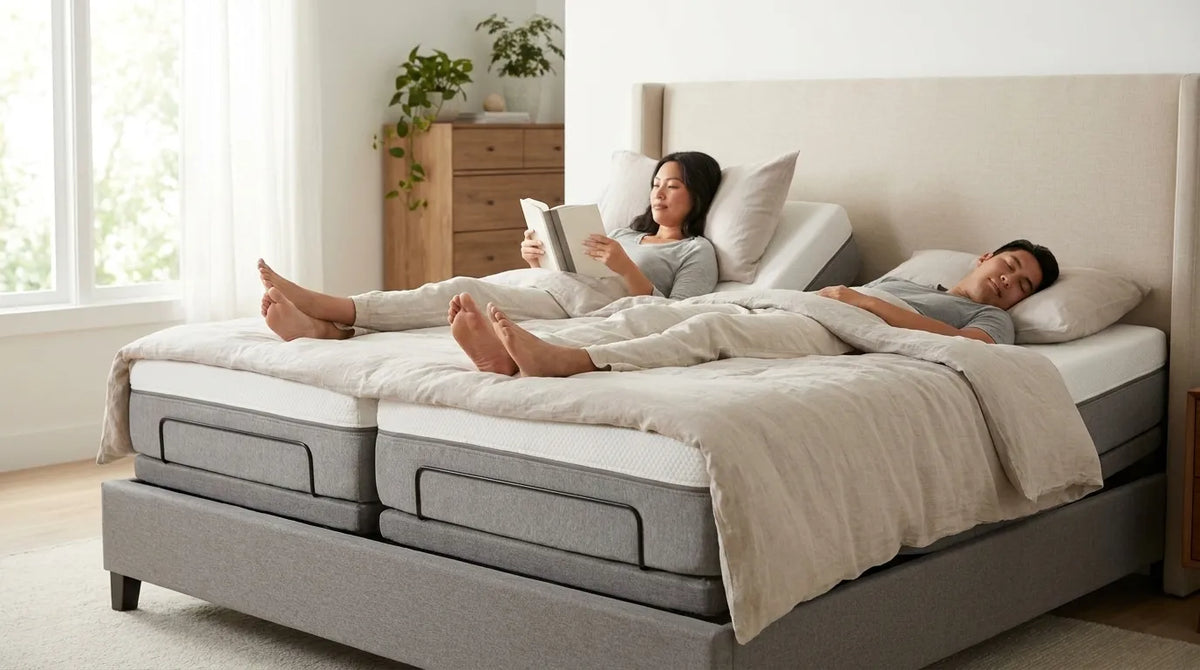
Adjustable Base for Side Sleepers: Pivot Point Matters Most
Written by: Matthew Timmins, Founder and Managing Director, Leva Sleep
Key Takeaways For Side Sleepers
- Standard folding-hinge adjustable bases create sharp waist and knee pivot points that concentrate pressure on the shoulder and hip, which often makes side-sleeper pain worse.
- Flat-tilt or full-body-incline bases keep the spine straight during elevation and prevent the torso kink that folding hinges create.
- Head elevation of 5–10 degrees paired with a 5–15 degree knee bend works best for most side sleepers, while the zero-gravity preset usually does not.
- Only all-foam or pocket-coil hybrid mattresses flex safely with an adjustable base; traditional innerspring mattresses resist articulation and can be damaged.
- Side sleepers ready to solve persistent shoulder, hip, or neck pain can see Leva Sleep’s flat-tilt and full-body-incline systems designed for side-sleeping geometry.
Key Adjustable Base Terms For Side Sleepers
Three terms appear throughout any serious discussion of adjustable bases for side sleepers. Most brands do not define them clearly, so this guide does.
- Flat tilt: A base mechanism that lifts the upper body on a flat plane rather than folding it at the waist, keeping the spine straight while elevating the head.
- Full-body incline: A base that raises the entire upper platform smoothly without creating a hinge point at the waist or knees.
- Folding hinge: A standard articulation mechanism that bends the mattress at sharp pivot points, typically the waist and knees, which can kink the spine for side sleepers.
How Side Sleepers Can Safely Use An Adjustable Base
Side sleepers can use an adjustable base effectively when the base geometry supports a straight spine. Flat-tilt and full-body-incline bases keep the torso aligned while elevating the head and legs. Standard folding hinges bend the mattress at the waist and knees, which creates angles through the torso and concentrates pressure at the shoulder and hip, the two points that already carry the most load in side sleeping. Geometry matters more than price or extra features.
Why Standard Folding Hinges Fail Side Sleepers
A standard adjustable base uses reinforced steel hinges and precision gears as articulation mechanisms that bend the mattress at jointed sections. Most models create two primary articulation points: one at the head section and one at the foot section. For back sleepers, those pivot points land roughly at the upper back and the knees, which matches the body’s natural curves.
For side sleepers, the same pivot points land differently. The waist pivot creates an angle through the middle of the torso instead of supporting the lateral curve of the spine. The knee pivot forces the hips into rotation. Side sleepers naturally place more weight on the hip and shoulder, so the usual pain source is the hip or shoulder pulling the spine out of alignment, not the lower back.
The shoulder and hip already bear up to 30% more pressure than a back sleeper experiences. With a folding hinge, they take even more load at the exact moment the base should relieve it. A recline that works for back sleepers often does little for side sleepers because it fails to address the shoulder and hip pressure that pulls the spine out of alignment. Many side sleepers try an adjustable base and still wake up sore because the base bent in the wrong place.
Flat Tilt Vs. Full-Body Incline Vs. Standard Articulation
The three base geometries differ most in where they bend. The table below shows how each one treats the side-sleeper spine and why only flat-tilt and full-body-incline designs keep the shoulder and hip from taking concentrated load.
| Base Type | How It Bends | Effect On Side-Sleeper Spine | Who It Suits |
|---|---|---|---|
| Flat Tilt | Lifts upper body on a flat plane | Keeps spine straight, no waist kink | Side sleepers with reflux or snoring |
| Full-Body Incline | Raises entire upper platform smoothly | No hinge point at waist or knees | Side sleepers wanting gentle elevation |
| Standard Articulation | Folds at waist and knee pivots | Creates angle through torso, concentrates pressure at shoulder and hip | Back sleepers; unsuitable for most side sleepers |
Best Adjustable Bed Position For Side Sleeping
Most side sleepers do best with a modest head lift, a gentle knee bend, and a clear limit on how far the base bends.
Head elevation: 5–10 degrees. A modest head lift of 5–10 degrees opens the airway and eases shoulder pressure while keeping the sleeper in side alignment. Adjust in 2-degree increments until the shoulders feel a comfortable stretch and the spine feels neutral.
Knee bend: 5–15 degrees. For side sleepers with hip pain, a slight leg elevation of 5–15 degrees improves circulation and reduces lower-back strain. A gentle knee bend also helps align the pelvis and lessen hip drop.
Avoid full zero gravity. The standard zero-gravity preset is designed for back sleepers. Elevating both the head and feet into a pronounced V creates a feeling of weightlessness but often increases hip pressure and curves the spine for side sleepers. Zero gravity tends to cause problems for side sleepers in particular. It can create hip pressure, let you slide down the mattress, and make it hard to hold a specific upper-body incline. Many side sleepers use zero gravity to wind down and then roll onto their side as they drift off, which works well. Staying in full zero gravity all night as a side sleeper rarely does.
Mattress And Base: A System That Bends Together
The right base geometry solves the pivot-point problem only when the mattress can follow the base’s movement. Traditional innerspring mattresses with interconnected Bonnell coils form a rigid structure that resists bending. Forcing these mattresses to flex can damage the coil structure and void the warranty. A stiff innerspring on a flat-tilt base defeats the purpose of the tilt because the mattress fights the geometry instead of conforming to it.
All-foam mattresses are the most naturally compatible with adjustable bases because foam layers bend and return to shape without structural resistance. Pocketed-coil hybrid mattresses are generally adjustable-base compatible because each individually wrapped coil operates independently, which lets the coil layer flex at the base’s hinge points.
Leva Sleep’s Heavenly Hybrid uses pocket coils built to articulate with the base, and the Heavenly Response is an all-foam construction engineered for the same purpose. Both are designed as components of a complete sleep system rather than standalone mattresses placed on a random base. Leva Sleep is a specialist adjustable bed company serving the United States, with a luxury showroom in La Jolla, California. Across nine years and more than 25,000 customers, Leva has built complete adjustable sleep systems and offers 15–20 adjustable base models compared to the 3–5 found at a typical mattress retailer. Complete packages run from $1,299 to $8,999+, backed by a 180-night comfort guarantee.
"A flat bed asks two different bodies to accept the same shape for eight hours. One of them always loses." — Leva Sleep
The Pillow Trick For Side Sleepers On Adjustable Bases
Elevation changes the pillow equation in a way most side sleepers do not anticipate. On a flat bed, the correct pillow height is set by shoulder width. The pillow has to bridge the gap between the ear and the mattress, which in practice equals shoulder width plus how far the shoulder sinks into the mattress. For most adults, that calls for a medium-to-high loft of 5–7 inches.
Once the head section is elevated, that gap changes. The head sits higher relative to the shoulder, so the pillow that worked perfectly on a flat bed is often too tall. A too-tall pillow tilts the head upward, strains the neck muscles, and transfers that tension into the shoulder. Many side sleepers who do everything else right still wake with neck pain after switching to an adjustable base for this reason.
A medium-high loft pillow usually fills the gap between shoulder and mattress once the head is elevated. The practical approach is simple. After setting the head elevation, lie on the side and check whether the nose lines up roughly with the sternum. If the head tilts in either direction, adjust the pillow loft before changing the base angle again.
Some premium bases include a pillow-tilt motor that angles the head section independently of the main head elevation. This feature lets you fine-tune the cervical angle without changing the overall torso incline. That level of control matters only if the base geometry is already right, which leads directly to the question of whether an adjustable base is worth the investment.
Is An Adjustable Base Worth It For Side Sleepers?
For most side sleepers whose pain persists after mattress and pillow changes, a flat-tilt or full-body-incline base paired with a compatible mattress is the logical next step. The mechanism has clinical support. A study published in the Journal of Orthopaedic & Sports Physical Therapy notes that proper head elevation reduces nocturnal shoulder impingement in side sleepers. Mayo Clinic advises raising the head of the bed by about 4 inches as a lifestyle step that may help quiet snoring, alongside side sleeping.
Some side sleepers gain little from an adjustable base. Typical low-value cases include:
- A side sleeper whose pain is fully resolved by a mattress and pillow change, where the base adds cost without adding benefit.
- A side sleeper whose current mattress is too stiff to articulate, where the base cannot overcome a rigid innerspring and the mattress would need replacement anyway.
- A healthy, flexible side sleeper under 30 with no medical complaints, who already sleeps well on a quality mattress and standard platform frame.
The scale of the underlying problem is significant. In a survey of 2,007 US adults conducted by Atomik Research for the American Academy of Sleep Medicine in June 2025, 31% of American adults said they had opted for a "sleep divorce" by regularly sleeping in a separate room from their partner. Among adults aged 35 to 44, the figure rises to 39%. For couples in that situation, a split adjustable base, where each side adjusts independently, addresses the geometry problem for both partners at once. Leva Sleep’s Split Queen adjustable beds and Split King configurations offer fully independent head and foot articulation on each side.

Downsides And Limitations Of Adjustable Bases
A clear assessment of adjustable bases for side sleepers includes several real limitations.
- Motor noise: Budget bases can measure 50–60 decibels during adjustment, comparable to a small refrigerator, while quieter models operate near 36–37 dB. Anything above 45 dB at close range will disturb a sleeping partner.
- Cost: A mid-range adjustable base lasting 10 years costs roughly $80 per year, versus $10 per year for a standard frame. That $70 annual gap is worth paying only if the base solves a problem a standard frame cannot.
- Mattress compatibility: Traditional innerspring mattresses with interconnected coils are generally incompatible with adjustable bases and can be permanently damaged by articulation. Buyers should confirm compatibility before pairing an existing mattress with a new base.
- A base will not fix a bad mattress: An adjustable base cannot correct a sagging, lumpy, or worn-out mattress. When a mattress already sags, the base’s contoured positions amplify those problems.
Frequently Asked Questions
Quick Answer: Can Side Sleepers Use An Adjustable Base?
Side sleepers can benefit from an adjustable base when the base uses flat-tilt or full-body-incline geometry. These designs keep the spine straight during elevation. Standard folding-hinge bases bend the mattress at the waist and knees, which concentrates pressure at the shoulder and hip, the two points that already carry the most load in side sleeping. Choosing the correct base type matters more than choosing the most expensive model.
Quick Answer: Best Position For Side Sleepers On An Adjustable Base
The 5–10 degree head elevation and 5–15 degree knee bend covered above form the starting point. Adjust in 2-degree increments until the spine feels neutral and the shoulder and hip pressure ease. Use zero gravity only as a short-term relaxation position rather than an all-night side-sleeping setup.
How Firm Should A Side-Sleeper Pillow Be?
Side sleepers generally need a medium-to-high loft pillow that holds its shape overnight and fills the gap between the shoulder and the ear. Once a head section is elevated on an adjustable base, the required pillow loft usually decreases because the head already sits higher relative to the shoulder. A pillow that worked on a flat bed is often too tall after elevation, which tilts the neck upward and transfers tension into the shoulder. Recheck pillow height after setting any new base elevation.
Can An Adjustable Base Help Shoulder Pain?
An adjustable base can ease shoulder pain when the geometry and mattress work together. A flat-tilt or full-body-incline base avoids the waist and knee pivot points that concentrate pressure at the shoulder. A compatible mattress, either pocket-coil hybrid or all-foam, flexes with the base instead of fighting it. A folding-hinge base paired with a stiff innerspring mattress often makes shoulder pain worse by adding a waist kink to the existing shoulder load.
Will My Current Mattress Work On An Adjustable Base?
Compatibility depends on construction. All-foam and pocket-coil hybrid mattresses are generally compatible because they flex at the base’s articulation points without damage. Traditional innerspring mattresses with interconnected Bonnell or continuous-wire coils usually resist bending, which can damage the coil structure and void the warranty. Mattresses over 14 inches thick may also resist articulation. A practical test is to place the mattress on the base, run it through the full range of positions, and check for resistance at the bend points or uncomfortable ridges. If it resists bending, a replacement mattress is needed before the base can work properly.
Is An Adjustable Base A Smart Upgrade For Side Sleepers?
For side sleepers who have already replaced the mattress and pillow and still wake with shoulder, hip, or neck pain, a flat-tilt or full-body-incline base addresses a geometry problem that foam and fill cannot solve. It adds little value for sleepers whose pain resolves with a mattress change, those whose current mattress is too stiff to articulate, or healthy sleepers under 30 with no specific medical complaints.
Conclusion: Choosing The Right Geometry For Side Sleepers
The pivot point is the core problem for side sleepers using adjustable bases. Most adjustable bases fail side sleepers because their folding-hinge geometry bends the mattress in the wrong place: at the waist and knees instead of along a flat plane. The most effective solution is a three-part system. First, use a flat-tilt or full-body-incline base that avoids those kink points. Second, pair it with a pocket-coil hybrid or all-foam mattress that flexes with the base. Third, recalibrate pillow height for the new elevation angle.
Reading about geometry helps, but real understanding comes from lying on a complete system in person. Leva Sleep’s La Jolla showroom exists for that reason, so side sleepers can feel the difference before committing. With 15–20 adjustable base models, mattresses manufactured in the US, and a 180-night comfort guarantee, evaluation continues long after the first visit.
Book a La Jolla showroom visit to test the flat-tilt geometry in person.